PUBLISHER: Mordor Intelligence | PRODUCT CODE: 2116392

PUBLISHER: Mordor Intelligence | PRODUCT CODE: 2116392
China Rice Protein - Market Share Analysis, Industry Trends & Statistics, Growth Forecasts (2026 - 2031)
According to Mordor Intelligence, the China rice protein market size is expected to grow from USD 123.10 million in 2025 to USD 129.65 million in 2026 and is forecast to reach USD 168.03 million by 2031 at 5.32% CAGR over 2026-2031.
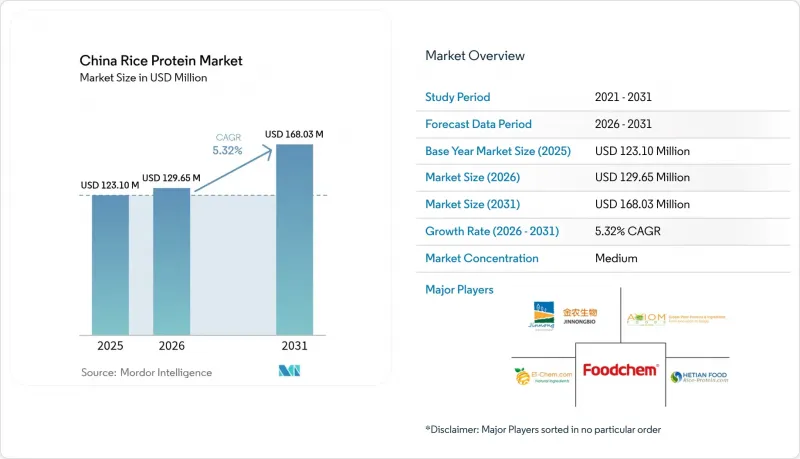
This report is Segmented by Type (Concentrates, Isolates, and Hydrolyzed/Textured), Nature (Conventional and Organic), and End-User (Food and Beverages, Supplements, and Personal Care and Cosmetics). The Market Forecasts are Provided in Terms of Value (USD).
China Rice Protein Market Trends and Insights
Rising demand for plant-based and allergen-free proteins
China's expanding middle class is becoming more health-conscious, leading to a surge in demand for plant-based proteins as substitutes for animal-derived ones. Rice protein, with its hypoallergenic properties, caters to consumers with food sensitivities and resonates with the clean-label trend. A 2024 survey conducted in five major Chinese cities, involving around 2,500 participants, highlighted that attributes like "zero cholesterol" and "high in dietary fiber" are particularly prized by consumers. This is especially true for affluent demographics who prioritize positive nutritional features. This shift in preference is bolstered by China's Gen Z, who, despite making up less than 20% of the population, represent 40% of new product consumption. Their purchasing decisions, as noted in the ProVeg 2024 report, are heavily influenced by health and safety considerations. Furthermore, the Chinese Agriculture Ministry's integration of alternative proteins into its food strategy signals the government's acknowledgment of the necessity to diversify protein sources, fostering a supportive regulatory landscape for the rice protein market's expansion.
Strong rice production base in the region
China, the world's leading rice producer, provides its domestic rice protein manufacturers with a significant competitive edge by ensuring a stable and consistent supply chain while minimizing dependence on imports. According to the United States Department of Agriculture, China's milled rice production in MY 2024/25 reached 145.3 million metric tons (MMT), a modest increase from the previous year, driven by expanded planting areas and favorable agricultural policies. This steady growth in production highlights China's capacity to meet domestic demand and support downstream industries, such as rice protein manufacturing, which rely heavily on raw material availability. The Heilongjiang Provincial Government has introduced a comprehensive three-year action plan (2023-2025) to enhance the processing of key agricultural products, including rice. The plan aims to achieve a revenue target of 450 billion yuan by 2025, reflecting a 33% increase compared to 2022. It focuses on integrating technological advancements and improving infrastructure to enhance processing efficiency, product quality, and overall competitiveness in the global market. These strategic initiatives are expected to strengthen China's rice production framework, fostering innovation and efficiency across the supply chain. As a result, the rice protein sector is well-positioned for robust growth, supported by a solid foundation of domestic production and government-backed development efforts.
Intense competition from alternative plant proteins
Other plant-based proteins, especially pea protein, are posing stiff competition to the rice protein market. Pea protein has surged in popularity, thanks to its superior protein content and functional attributes. In 2023, China imported a notable 2.6 million tons of peas, with Canada leading as the primary supplier, as reported by the U.S. Department of Agriculture. This underscores China's significant commitment to alternative protein sources. Moreover, proteins from emerging sources, like microalgae, are capturing the spotlight. For instance, Protoga Biotech has successfully wrapped up pilot production of its innovative microalgae protein and is eyeing a launch for its microalgae plant milk by the close of 2024. The competition heats up further with the introduction of novel plant proteins from diverse sources such as Pongamia, industrial hemp, barley, and chickpeas. These not only boast distinct functional properties but also come with sustainability perks. While rice protein holds certain application advantages, the robust research investments and marketing backing for these alternative proteins could curtail rice protein's market share expansion.
Other drivers and restraints analyzed in the detailed report include:
- Technological advancement in processing
- Rising demand from food and beverage industry
- High production costs for high-quality rice protein isolates
For complete list of drivers and restraints, kindly check the Table Of Contents.
Segment Analysis
In 2025, rice protein isolates held a 53.20% market share, driven by their high protein content and versatility in various applications. Their complete amino acid profile and low-fat content make them ideal for sports nutrition and functional foods. Wuxi Jinnong Biotechnology Co., Ltd., a key player in China's rice protein market, offers JNPR-Rice Protein Powder with over 80% protein content. Packaged in 20 kg bags with a 2-year shelf life, it is used in food, beverages, nutritional products, and vegan meat alternatives. However, isolates face challenges like poor water solubility, limiting their use in specific applications.
Hydrolyzed and textured rice proteins are expected to grow fastest, with a projected CAGR of 6.18% from 2026 to 2031. These variants address solubility issues and improve digestibility and bioavailability. Hydrolyzed rice protein is used as a mild surfactant in personal care and enhances amino acid absorption in nutrition. Innovations like bio-enzyme hydrolysis by Bioway Organic Inc. have improved the bioavailability and antioxidant properties of rice peptides, expanding their use in pharmaceuticals, health products, and cosmetics. Concentrates, while lower in protein than isolates, are cost-effective and nutritionally balanced, ensuring steady market demand. Advances in physical, chemical, and enzymatic modification techniques are expected to enhance the functionality of all rice protein types, potentially shifting segment dynamics.
Complete Report Scope:
- By Type
- Concentrates
- Isolates
- Hydrolyzed/Textured
- By Nature
- Conventional
- Organic
- By End-User
- Food and Beverages
- Bakery
- Beverages
- Meat/Poultry/Seafood and Meat Alternative Products
- Snacks
- Supplements
- Sport/Performance Nutrition
- Elderly and Medical Nutrition
- Personal Care and Cosmetics
- Food and Beverages
List of Companies Covered in this Report:
- BIOWAY Industrial Group LTD (Bioway (Xi'an) Organic)
- ETChem
- Foodchem International Corporation
- Kerry Group PLC
- Panjin Hetian Food Co., Ltd
- Wuxi Jinnong Biotechnology Co., Ltd
- Hainan Zhongxin Chemical Co., Ltd.
- Nutragreenlife Biotechnology Co.,Ltd
- Sudzucker AG (BENEO)
- Axiom Foods Inc.
- Conscientia Industrial Co., Ltd
- Victarbio
- Anhui Shunxin Shengyuan Biotech Co., Ltd
- Jiangxi Golden Agriculture Biotech Co., Ltd
- Shaanxi Yuantai Biological Technology Co., Ltd.
- YANGGE Biotech Co., Ltd
- Zhejiang Hecheng Biotechnology Co., Ltd.
- Xi'an Healthful Biotechnology Co.,Ltd
- Handom Chem
- Nutraonly (Xi'an) Nutritions Inc
Additional Benefits:
- The market estimate (ME) sheet in Excel format
- 3 months of analyst support
TABLE OF CONTENTS
1 INTRODUCTION
- 1.1 Study Assumptions and Market Definition
- 1.2 Scope of the Study
2 RESEARCH METHODOLOGY
3 EXECUTIVE SUMMARY
4 MARKET LANDSCAPE
- 4.1 Market Overview
- 4.2 Market Drivers
- 4.2.1 Rising demand for plant-based and allergen-free proteins
- 4.2.2 Strong rice production base in the region
- 4.2.3 Technological advancement in processing
- 4.2.4 Rising demand from food and beverage industry
- 4.2.5 Policies promoting plant-based diets are supporting the market.
- 4.2.6 Awareness of rice protein's nutritional benefits is growing.
- 4.3 Market Restraints
- 4.3.1 Intense competition from alternative plant proteins
- 4.3.2 High production costs for high-quality rice protein isolates
- 4.3.3 Concerns over the nutritional profile compared to animal proteins.
- 4.3.4 Challenges in achieving desired taste and texture in food products.
- 4.4 Supply-Chain Analysis
- 4.5 Regulatory Outlook
- 4.6 Technological Outlook
- 4.7 Porter's Five Forces
- 4.7.1 Bargaining Power of Suppliers
- 4.7.2 Bargaining Power of Buyers
- 4.7.3 Threat of New Entrants
- 4.7.4 Threat of Substitutes
- 4.7.5 Intensity of Competitive Rivalry
5 MARKET SIZE AND GROWTH FORECASTS (VALUE)
- 5.1 By Type
- 5.1.1 Concentrates
- 5.1.2 Isolates
- 5.1.3 Hydrolyzed/Textured
- 5.2 By Nature
- 5.2.1 Conventional
- 5.2.2 Organic
- 5.3 By End-User
- 5.3.1 Food and Beverages
- 5.3.1.1 Bakery
- 5.3.1.2 Beverages
- 5.3.1.3 Meat/Poultry/Seafood and Meat Alternative Products
- 5.3.1.4 Snacks
- 5.3.2 Supplements
- 5.3.2.1 Sport/Performance Nutrition
- 5.3.2.2 Elderly and Medical Nutrition
- 5.3.3 Personal Care and Cosmetics
- 5.3.1 Food and Beverages
6 COMPETITIVE LANDSCAPE
- 6.1 Market Concentration
- 6.2 Strategic Moves
- 6.3 Market Share Analysis
- 6.4 Company Profiles (includes Global level Overview, Market level overview, Core Segments, Financials as available, Strategic Information, Market Rank/Share for key companies, Products & Services, and Recent Developments)
- 6.4.1 BIOWAY Industrial Group LTD (Bioway (Xi'an) Organic)
- 6.4.2 ETChem
- 6.4.3 Foodchem International Corporation
- 6.4.4 Kerry Group PLC
- 6.4.5 Panjin Hetian Food Co., Ltd
- 6.4.6 Wuxi Jinnong Biotechnology Co., Ltd
- 6.4.7 Hainan Zhongxin Chemical Co., Ltd.
- 6.4.8 Nutragreenlife Biotechnology Co.,Ltd
- 6.4.9 Sudzucker AG (BENEO)
- 6.4.10 Axiom Foods Inc.
- 6.4.11 Conscientia Industrial Co., Ltd
- 6.4.12 Victarbio
- 6.4.13 Anhui Shunxin Shengyuan Biotech Co., Ltd
- 6.4.14 Jiangxi Golden Agriculture Biotech Co., Ltd
- 6.4.15 Shaanxi Yuantai Biological Technology Co., Ltd.
- 6.4.16 YANGGE Biotech Co., Ltd
- 6.4.17 Zhejiang Hecheng Biotechnology Co., Ltd.
- 6.4.18 Xi'an Healthful Biotechnology Co.,Ltd
- 6.4.19 Handom Chem
- 6.4.20 Nutraonly (Xi'an) Nutritions Inc
7 MARKET OPPORTUNITIES AND FUTURE OUTLOOK

