PUBLISHER: Mordor Intelligence | PRODUCT CODE: 2116400

PUBLISHER: Mordor Intelligence | PRODUCT CODE: 2116400
Microbial Protein - Market Share Analysis, Industry Trends & Statistics, Growth Forecasts (2026 - 2031)
According to Mordor Intelligence, the microbial protein market size in 2026 is estimated at USD 1.52 billion, growing from 2025 value of USD 1.33 billion with 2031 projections showing USD 2.93 billion, growing at 14.06% CAGR over 2026-2031.
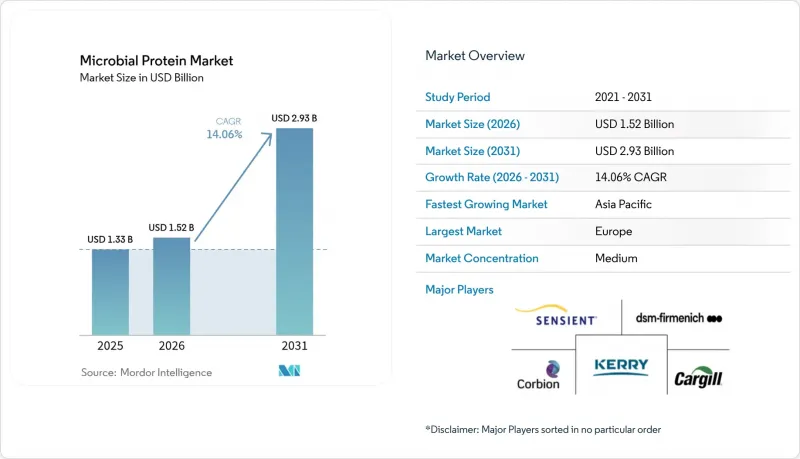
This report is Segmented by Protein Type (Algae Protein, Mycoprotein, Bacterial Protein, and Yeast Protein), Application (Food and Beverages, Supplements, Animal Feed, and Industrial and Other Applications), and Geography (North America, Europe, Asia-Pacific, South America, and Middle East and Africa). The Market Forecasts are Provided in Terms of Value (USD) and Volume (Tons).
Global Microbial Protein Market Trends and Insights
Rising Demand for Sustainable Protein Sources
Consumer awareness of environmental impacts from conventional agriculture is driving unprecedented demand for microbial proteins as climate-conscious alternatives. This shift is particularly pronounced in Europe, where regulatory frameworks increasingly favor low-carbon protein sources, and among younger demographics who prioritize sustainability credentials. The protein transition is further accelerated by corporate sustainability commitments, with major food manufacturers seeking to reduce scope 3 emissions through alternative protein sourcing. The convergence of consumer demand, regulatory pressure, and corporate sustainability targets creates a self-reinforcing cycle that sustains long-term market growth beyond typical technology adoption curves. Market research indicates that microbial proteins require significantly less land and water compared to traditional animal proteins, making them an attractive option for sustainable food production. Additionally, technological advancements in fermentation processes have improved the scalability and cost-effectiveness of microbial protein production, further supporting market expansion.
Technological Advancements in Fermentation and Bioprocessing
Innovations in fermentation technology are reducing production costs and improving protein yields, making microbial proteins more cost-competitive with conventional alternatives. Recent advances include proprietary seed train technologies that accelerate production timelines and optimize fermentation parameters for enhanced biomass generation. The integration of artificial intelligence and machine learning in bioprocess optimization enables real-time adjustments that maximize protein content while minimizing resource consumption. The development of continuous cultivation methods and novel bioreactor designs enables industrial-scale production with lower capital expenditure requirements. These technological advancements have resulted in improved product quality and consistency, meeting stringent regulatory requirements for food-grade proteins. Additionally, the scalability of these processes has attracted significant investment from major food manufacturers, further accelerating market growth.
Taste and Sensory Challenges in Food Formulations
Consumer acceptance of microbial protein products faces constraints due to sensory limitations in taste, texture, and visual appeal. Microalgae incorporation in food products encounters challenges related to color and taste, with consumer studies indicating preferences for minimal inclusion levels to reduce sensory impact. These challenges are significant in direct consumption applications, where microbial proteins must match established taste profiles and meet consumer expectations. Companies are investing in flavor masking technologies and product formulation improvements, with some achieving success through enzymatic treatments and processing innovations to enhance palatability. This constraint has led to innovation in blended products, as demonstrated by Quorn's shift toward meat-mycoprotein blends that combine familiar tastes while gradually introducing alternative proteins. While industry partnerships with flavor houses and food technologists are developing solutions, addressing these challenges requires ongoing R&D investment and consumer education efforts.
Other drivers and restraints analyzed in the detailed report include:
- Increased Adoption in Pet and Aquafeed Sectors
- Regulatory Support for Novel Food Ingredients
- High R&D and Production Setup Costs
For complete list of drivers and restraints, kindly check the Table Of Contents.
Segment Analysis
Mycoprotein holds the dominant market share at 47.62% in 2025, built on decades of commercial development by companies like Quorn Foods and established Fusarium venenatum cultivation methods. Bacterial protein is experiencing the highest growth rate with a 16.54% CAGR through 2031, supported by new production technologies that enable efficient scaling and high protein yields. Solar Foods demonstrates this potential with their Solein product, which produces protein from CO2 and hydrogen while using minimal land and water resources compared to conventional agriculture, as reported by European Biotechnology. Algae protein, including spirulina and chlorella variants, maintains steady growth through existing regulatory approvals and increased use in functional foods. Yeast protein advances through Saccharomyces cerevisiae engineering improvements that boost protein content and functionality.
The market segments show distinct development stages, with mycoprotein benefiting from existing production infrastructure while bacterial protein attracts venture capital for new production facilities. Cargill's investment in ENOUGH's mycoprotein production aims to produce over 1 million tons of ABUNDA mycoprotein by 2033 using zero-waste fermentation methods. Bacterial protein continues to grow through precision fermentation technology that produces animal-identical proteins without agricultural inputs. This segment is positioned for increased adoption as production costs decrease, and regulatory approvals expand globally.
Complete Report Scope:
- By Protein Type
- Algae Protein
- Spirulina Protein
- Chlorella Protein
- Others
- Mycoprotein
- Bacterial Protein
- Yeast Protein
- Algae Protein
- By Application
- Food and Beverages
- Meat/Poultry/Seafood and Meat Alternative Products
- Dairy and Dairy Alternatives
- Bakery
- Supplements
- Sport/Performance Nutrition
- Elderly and Medical Nutrition
- Animal Feed
- Aquafeed
- Poultry Feed
- Pet Food
- Industrial and Other Applications
- Food and Beverages
- By Geography
- North America
- United States
- Canada
- Mexico
- Rest of North America
- Europe
- Germany
- United Kingdom
- Italy
- France
- Spain
- Netherlands
- Poland
- Belgium
- Sweden
- Rest of Europe
- Asia-Pacific
- China
- India
- Japan
- Australia
- Indonesia
- South Korea
- Thailand
- Singapore
- Rest of Asia-Pacific
- South America
- Brazil
- Argentina
- Colombia
- Chile
- Peru
- Rest of South America
- Middle East and Africa
- South Africa
- Saudi Arabia
- United Arab Emirates
- Nigeria
- Egypt
- Morocco
- Turkey
- Rest of Middle East and Africa
- North America
Geography Analysis
Europe holds 33.05% market share in 2025, supported by established fermentation infrastructure, favorable regulations, and government funding for alternative protein development. The region demonstrates significant commercial progress, with Solar Foods' Factory01 in Finland producing up to 160 tons of Solein annually and Cargill's partnership with ENOUGH targeting over 1 million tons of ABUNDA mycoprotein by 2033 according to Europan biotechnology. Germany has emerged as an innovation center, with MicroHarvest achieving 10 tons daily production capacity and Nosh.bio operating at thousands of tons annual capacity in Dresden. The updated EFSA novel food guidance, effective February 2025, simplifies approval processes and reduces market entry barriers. While the region's regulatory environment and consumer preferences support market growth, high production costs and regulatory complexity remain challenges for smaller companies.
Asia-Pacific exhibits the highest growth rate at 18.21% CAGR through 2031, supported by biomanufacturing investments, increasing protein demand, and food security initiatives. Singapore maintains its position as a regulatory gateway, with Solar Foods and Ajinomoto Group planning Solein distribution across Asia following regulatory approval. Regional research advances include Nanyang Technological University's development of single-cell proteins from food processing wastewater for aquaculture applications. Growth continues through increasing consumer awareness and government support for biotechnology innovation in food security.
North America maintains market growth through efficient GRAS regulatory pathways and venture capital support, despite smaller market share compared to Europe and Asia-Pacific. Recent FDA approvals include Superbrewed Food's postbiotic cultured protein and various microbial protein GRAS notifications. Industry developments include Fonterra's partnership with Superbrewed Food for postbiotic protein ingredients using lactose permeate, NovoNutrients' USD 18 million funding for CO2-to-aquafeed protein, and Liberation Labs' precision fermentation facility funding. South America and Middle East & Africa show growth potential, demonstrated by NEOM Investment Fund's support for Saudi Arabia's precision fermentation facility and Enifer's collaboration with Brazilian company FS for mycoprotein production using corn ethanol byproducts.
- Cyanotech Corporation
- Corbion N.V.
- ENOUGH (3F Bio Ltd.)
- Naplasol BV (Mycorena AB)
- Roquette Freres S.A.
- KnipBio Inc.
- Algenol Biotech LLC
- Alver World SA
- Enifer
- Zilor (Biorigin)
- Cargill, Incorporated
- DSM-Firmenich
- Allmicroalgae- Natural Products, S.A
- Sophie's Bionutrients Pte. Ltd.
- NovoNutrients
- Sensient Technologies Corporation
- ABF Ingredients (Ohly)
- Kerry Group plc
- AngelYeast Co., Ltd.
- Lallemand Inc.
Additional Benefits:
- The market estimate (ME) sheet in Excel format
- 3 months of analyst support
TABLE OF CONTENTS
1 Introduction
- 1.1 Study Assumptions and Market Definition
- 1.2 Scope of the Study
2 Research Methodology
3 Executive Summary
4 Market Landscape
- 4.1 Market Overview
- 4.2 Market Drivers
- 4.2.1 Rising Demand for Sustainable Protein Sources
- 4.2.2 Technological Advancements in Fermentation and Bioprocessing
- 4.2.3 Increased Adoption in Pet and Aquafeed Sectors
- 4.2.4 Regulatory support for novel food ingredients
- 4.2.5 Expanding applications in functional food and beverages
- 4.2.6 High protein content and rapid biomass generation
- 4.3 Market Restraints
- 4.3.1 Taste and sensory challenges in food formulations
- 4.3.2 Competition from Other Alternative Proteins
- 4.3.3 High Research and Development and production setup costs
- 4.3.4 Limited consumer awareness and acceptance
- 4.4 Supply-Chain Analysis
- 4.5 Regulatory and Technological Outlook
- 4.6 Porter's Five Forces
- 4.6.1 Threat of New Entrants
- 4.6.2 Bargaining Power of Buyers
- 4.6.3 Bargaining Power of Suppliers
- 4.6.4 Threat of Substitutes
- 4.6.5 Intensity of Competitive Rivalry
5 Market Size and Growth Forecasts (Value)
- 5.1 By Protein Type
- 5.1.1 Algae Protein
- 5.1.1.1 Spirulina Protein
- 5.1.1.2 Chlorella Protein
- 5.1.1.3 Others
- 5.1.2 Mycoprotein
- 5.1.3 Bacterial Protein
- 5.1.4 Yeast Protein
- 5.1.1 Algae Protein
- 5.2 By Application
- 5.2.1 Food and Beverages
- 5.2.1.1 Meat/Poultry/Seafood and Meat Alternative Products
- 5.2.1.2 Dairy and Dairy Alternatives
- 5.2.1.3 Bakery
- 5.2.2 Supplements
- 5.2.2.1 Sport/Performance Nutrition
- 5.2.2.2 Elderly and Medical Nutrition
- 5.2.3 Animal Feed
- 5.2.3.1 Aquafeed
- 5.2.3.2 Poultry Feed
- 5.2.3.3 Pet Food
- 5.2.4 Industrial and Other Applications
- 5.2.1 Food and Beverages
- 5.3 By Geography
- 5.3.1 North America
- 5.3.1.1 United States
- 5.3.1.2 Canada
- 5.3.1.3 Mexico
- 5.3.1.4 Rest of North America
- 5.3.2 Europe
- 5.3.2.1 Germany
- 5.3.2.2 United Kingdom
- 5.3.2.3 Italy
- 5.3.2.4 France
- 5.3.2.5 Spain
- 5.3.2.6 Netherlands
- 5.3.2.7 Poland
- 5.3.2.8 Belgium
- 5.3.2.9 Sweden
- 5.3.2.10 Rest of Europe
- 5.3.3 Asia-Pacific
- 5.3.3.1 China
- 5.3.3.2 India
- 5.3.3.3 Japan
- 5.3.3.4 Australia
- 5.3.3.5 Indonesia
- 5.3.3.6 South Korea
- 5.3.3.7 Thailand
- 5.3.3.8 Singapore
- 5.3.3.9 Rest of Asia-Pacific
- 5.3.4 South America
- 5.3.4.1 Brazil
- 5.3.4.2 Argentina
- 5.3.4.3 Colombia
- 5.3.4.4 Chile
- 5.3.4.5 Peru
- 5.3.4.6 Rest of South America
- 5.3.5 Middle East and Africa
- 5.3.5.1 South Africa
- 5.3.5.2 Saudi Arabia
- 5.3.5.3 United Arab Emirates
- 5.3.5.4 Nigeria
- 5.3.5.5 Egypt
- 5.3.5.6 Morocco
- 5.3.5.7 Turkey
- 5.3.5.8 Rest of Middle East and Africa
- 5.3.1 North America
6 Competitive Landscape
- 6.1 Market Concentration
- 6.2 Strategic Moves
- 6.3 Market Share Analysis
- 6.4 Company Profiles (includes Global-level Overview, Market-level Overview, Core Segments, Financials as available, Strategic Information, Market Rank/Share, Products & Services, Recent Developments)
- 6.4.1 Cyanotech Corporation
- 6.4.2 Corbion N.V.
- 6.4.3 ENOUGH (3F Bio Ltd.)
- 6.4.4 Naplasol BV (Mycorena AB)
- 6.4.5 Roquette Freres S.A.
- 6.4.6 KnipBio Inc.
- 6.4.7 Algenol Biotech LLC
- 6.4.8 Alver World SA
- 6.4.9 Enifer
- 6.4.10 Zilor (Biorigin)
- 6.4.11 Cargill, Incorporated
- 6.4.12 DSM-Firmenich
- 6.4.13 Allmicroalgae- Natural Products, S.A
- 6.4.14 Sophie's Bionutrients Pte. Ltd.
- 6.4.15 NovoNutrients
- 6.4.16 Sensient Technologies Corporation
- 6.4.17 ABF Ingredients (Ohly)
- 6.4.18 Kerry Group plc
- 6.4.19 AngelYeast Co., Ltd.
- 6.4.20 Lallemand Inc.
7 Market Opportunities and Future Outlook

