PUBLISHER: Mordor Intelligence | PRODUCT CODE: 2116452

PUBLISHER: Mordor Intelligence | PRODUCT CODE: 2116452
Blood Processing Devices And Consumables - Market Share Analysis, Industry Trends & Statistics, Growth Forecasts (2026 - 2031)
According to Mordor Intelligence, the blood processing devices and consumables market size is expected to grow from USD 51.60 billion in 2025 to USD 55.53 billion in 2026 and is forecast to reach USD 80.06 billion by 2031 at 7.61% CAGR over 2026-2031.
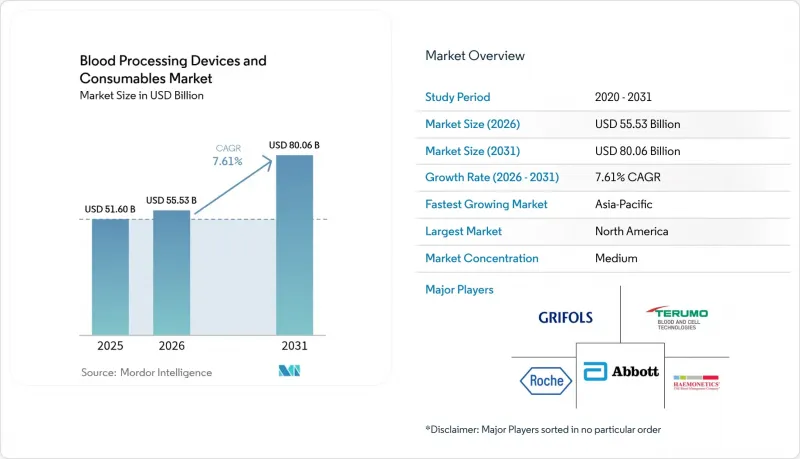
This report is Segmented by Product (Blood Processing Devices and Blood Processing Consumables), Technology (Centrifugation, Membrane Filtration, and More), End User (Hospitals and Clinics, Diagnostic Laboratories, and More), Geography (North America, Europe, Asia-Pacific, The Middle East and Africa, and South America). The Market Forecasts are Provided in Terms of Value (USD).
Global Blood Processing Devices And Consumables Market Trends and Insights
Rising Global Blood Transfusion Demand
Worldwide transfusion requirements continue to outstrip donations, with the American Red Cross citing a 25% decline in supply even as surgical and trauma cases rise. The World Health Organization confirms that voluntary unpaid donations still contribute less than half of needed units in many low-income regions, underscoring chronic shortfalls. High-yield component separators and automated cold-chain logistics are therefore essential. Taiwan's teaching hospitals demonstrate best-in-class inventory control, trimming wastage to 0.08% through real-time monitoring. University Hospitals processed 7% more samples in 2024 after automating triage workflows, activating 323 Massive Transfusion Protocols in the same year. These examples illustrate how capacity gains hinge on sophisticated devices and consumables that maximize usable components from every donation.
Growing Geriatric Population Base
United Nations projections show rapidly aging populations across developing economies, converting erstwhile donors into recipients. U.S. healthcare spending rose 7.5% to USD 4.9 trillion in 2023, mainly through Medicare outlays linked to older patients. Blood centers are piloting donor-management systems that safely extend eligibility for seniors to mitigate shrinking youth donor pools. The WHO's patient blood-management guidelines urge adoption of resource-efficient component processing for anemia in the elderly, spurring uptake of compact cell processors that can run small volumes with minimal wastage. As geriatrics grow, facilities must scale processing while navigating stricter hemovigilance standards.
Stringent Regulatory and Quality-Compliance Requirements
The FDA's updated donor-eligibility draft guidance expands documentation demands, extending validation cycles and internal audit workloads. WHO technical directives stipulate that every blood establishment must embed quality systems covering donor recruitment through transfusion, forcing smaller centers to invest in bar-coded bags, audit software, and staff certification. While necessary for safety, these rules elevate operating costs and create steep learning curves, discouraging new entrants.
Other drivers and restraints analyzed in the detailed report include:
- Expansion of Regenerative Medicine and Cell Therapies
- Government Programs to Enhance Blood Safety
- High Capital and Maintenance Costs of Equipment
For complete list of drivers and restraints, kindly check the Table Of Contents.
Segment Analysis
Devices contributed 54.62% of blood processing devices and consumables market revenue in 2025, reflecting their indispensability in every transfusion service. FDA clearances for multi-bag automated separators and smart freezers confirm fast innovation. Hospitals prefer modular systems that integrate chilling, mixing, and barcode tracking to slash manual steps. Vendors are embedding predictive-maintenance algorithms that reduce downtime and extend asset life. Operating-lease models are emerging, shifting capex to opex and broadening access in mid-tier facilities.
Consumables, although smaller today, are the chief growth engine at 9.31% CAGR to 2031, making them critical to the long-term trajectory of the blood processing devices and consumables market. Single-use apheresis kits, pathogen-inactivation sleeves, and leukofilters are ordered with every procedure, producing recurring revenue streams. In Asia-Pacific, hospital upgrades and rural outreach programs are boosting baseline demand, while mature markets pivot to premium consumables with RFID and antimicrobial coatings. As a result, disposables producers with localized manufacturing footprints can shorten lead times and cushion currency risks.
Complete Report Scope:
- By Product
- Blood Processing Devices
- Blood Bank Freezers
- Blood Grouping Analyzers
- Blood Warmers
- Blood Cell Processors
- Other Blood Processing Devices
- Blood Processing Consumables
- Blood Bags
- Disposable Apheresis Kits
- Blood Lancets
- Vials & Collection Tubes
- Blood Administration Sets
- Other Consumables
- Blood Processing Devices
- By Technology
- Centrifugation
- Membrane Filtration
- Automated Robotic Processing
- AI-Enabled Cross-Matching Platforms
- By End User
- Hospitals and Clinics
- Diagnostic Laboratories
- Blood Banks & Transfusion Centers
- Other End Users
- Geography
- North America
- United States
- Canada
- Mexico
- Europe
- Germany
- United Kingdom
- France
- Italy
- Spain
- Rest of Europe
- Asia-Pacific
- China
- Japan
- India
- Australia
- South Korea
- Rest of Asia-Pacific
- Middle East & Africa
- GCC
- South Africa
- Rest of Middle East & Africa
- South America
- Brazil
- Argentina
- Rest of South America
- North America
Geography Analysis
North America commanded 38.10% of 2025 revenue, leveraging mature infrastructure, stringent but transparent regulation, and USD 4.9 trillion in healthcare spending. Large integrated delivery networks continuously refresh centrifuges, warmers, and compatibility analyzers to meet evolving AABB standards. Abbott's USD 500 million manufacturing expansion in Illinois and Texas, scheduled to go live by end-2025, will amplify domestic supply of transfusion-diagnostic kits. FDA guidance pipelines foster predictable approval cycles that encourage vendors to pilot next-gen AI algorithms in regional reference labs.
Asia-Pacific is the fastest-growing territory at an 8.41% CAGR through 2031, fueled by hospital build-outs, medical tourism, and middle-class insurance uptake. China's national quality re-certification program for 600 blood centers is accelerating centrifuge and apheresis upgrades. Terumo's USD 15 million production plant in Hangzhou will assemble local versions of its Reveos system, aligning with provincial procurement preferences. In India and Thailand, public-private partnerships are co-financing regional plasma-fractionation hubs, mandating high-throughput separators and sterile-tube welders.
Europe shows steady replacement demand as hospitals tighten cost controls yet pursue pathogen-reduced components to meet new EN standards. Bulk-buying alliances in Germany and France favor suppliers offering multi-year service bundles with uptime guarantees. Eastern European modernization funds tied to EU cohesion budgets are financing first-time adoption of automated component extractors in mid-size cities, broadening the installed base.
Middle East & Africa and South America provide incremental upside though infrastructure gaps persist. Gulf states invest in cutting-edge robotics to support tertiary-care hubs, while Sub-Saharan Africa leans on donor-funded mega-centers outfitted with rugged centrifuges and solar-powered storage. Latin America's private hospital chains are upgrading compatibility analyzers to win medical-tourism contracts. Across these regions, vendors that offer flexible financing and on-site training gain competitive traction.
- Abbott Laboratories
- Roche
- Terumo Corporation (Terumo BCT)
- Grifols
- Haemonetics
- Danaher
- Beckton Dickinson
- Fresenius
- Asahi Kasei
- Baxter
- Bio-Rad Laboratories
- bioMerieux
- Immucor
- MacoPharma
- Siemens Healthineers
- Thermo Fisher Scientific
- B. Braun
- 3M
- Cardinal Health
- Barkey
- Avantor Inc.
Additional Benefits:
- The market estimate (ME) sheet in Excel format
- 3 months of analyst support
TABLE OF CONTENTS
1 Introduction
- 1.1 Study Assumptions & Market Definition
- 1.2 Scope of the Study
2 Research Methodology
3 Executive Summary
4 Market Landscape
- 4.1 Market Overview
- 4.2 Market Drivers
- 4.2.1 Rising Global Blood Transfusion Demand
- 4.2.2 Growing Geriatric Population Base
- 4.2.3 Expansion of Regenerative Medicine And Cell Therapies
- 4.2.4 Government Programs to Enhance Blood Safety Infrastructure
- 4.2.5 Technological Advancements in Apheresis And Automation
- 4.2.6 Increasing Point-of-Care and Mobile Blood Processing Adoption
- 4.3 Market Restraints
- 4.3.1 Stringent Regulatory and Quality Compliance Requirements
- 4.3.2 High Capital And Maintenance Costs of Equipment
- 4.3.3 Limited Reimbursement for Advanced Procedures
- 4.3.4 Shortage of Skilled Technicians in Low-Resource Settings
- 4.4 Value / Supply-Chain Analysis
- 4.5 Regulatory Landscape
- 4.6 Porter's Five Forces Analysis
- 4.6.1 Threat Of New Entrants
- 4.6.2 Bargaining Power Of Buyers
- 4.6.3 Bargaining Power Of Suppliers
- 4.6.4 Threat Of Substitutes
- 4.6.5 Competitive Rivalry
5 Market Size & Growth Forecasts (Value, USD)
- 5.1 By Product
- 5.1.1 Blood Processing Devices
- 5.1.1.1 Blood Bank Freezers
- 5.1.1.2 Blood Grouping Analyzers
- 5.1.1.3 Blood Warmers
- 5.1.1.4 Blood Cell Processors
- 5.1.1.5 Other Blood Processing Devices
- 5.1.2 Blood Processing Consumables
- 5.1.2.1 Blood Bags
- 5.1.2.2 Disposable Apheresis Kits
- 5.1.2.3 Blood Lancets
- 5.1.2.4 Vials & Collection Tubes
- 5.1.2.5 Blood Administration Sets
- 5.1.2.6 Other Consumables
- 5.1.1 Blood Processing Devices
- 5.2 By Technology
- 5.2.1 Centrifugation
- 5.2.2 Membrane Filtration
- 5.2.3 Automated Robotic Processing
- 5.2.4 AI-Enabled Cross-Matching Platforms
- 5.3 By End User
- 5.3.1 Hospitals and Clinics
- 5.3.2 Diagnostic Laboratories
- 5.3.3 Blood Banks & Transfusion Centers
- 5.3.4 Other End Users
- 5.4 Geography
- 5.4.1 North America
- 5.4.1.1 United States
- 5.4.1.2 Canada
- 5.4.1.3 Mexico
- 5.4.2 Europe
- 5.4.2.1 Germany
- 5.4.2.2 United Kingdom
- 5.4.2.3 France
- 5.4.2.4 Italy
- 5.4.2.5 Spain
- 5.4.2.6 Rest of Europe
- 5.4.3 Asia-Pacific
- 5.4.3.1 China
- 5.4.3.2 Japan
- 5.4.3.3 India
- 5.4.3.4 Australia
- 5.4.3.5 South Korea
- 5.4.3.6 Rest of Asia-Pacific
- 5.4.4 Middle East & Africa
- 5.4.4.1 GCC
- 5.4.4.2 South Africa
- 5.4.4.3 Rest of Middle East & Africa
- 5.4.5 South America
- 5.4.5.1 Brazil
- 5.4.5.2 Argentina
- 5.4.5.3 Rest of South America
- 5.4.1 North America
6 Competitive Landscape
- 6.1 Market Concentration
- 6.2 Market Share Analysis
- 6.3 Company Profiles (includes Global level Overview, Market level overview, Core Business Segments, Financials, Headcount, Key Information, Market Rank, Market Share, Products and Services, and analysis of Recent Developments)
- 6.3.1 Abbott Laboratories
- 6.3.2 F. Hoffmann-La Roche AG
- 6.3.3 Terumo Corporation (Terumo BCT)
- 6.3.4 Grifols S.A.
- 6.3.5 Haemonetics Corporation
- 6.3.6 Danaher Corporation (Beckman Coulter)
- 6.3.7 Becton, Dickinson And Company
- 6.3.8 Fresenius Kabi AG
- 6.3.9 Asahi Kasei Corporation
- 6.3.10 Baxter International Inc.
- 6.3.11 Bio-Rad Laboratories Inc.
- 6.3.12 bioMrieux SA
- 6.3.13 Immucor Inc.
- 6.3.14 Macopharma SA
- 6.3.15 Siemens Healthineers AG
- 6.3.16 Thermo Fisher Scientific Inc.
- 6.3.17 B. Braun Melsungen AG
- 6.3.18 3M Company
- 6.3.19 Cardinal Health Inc.
- 6.3.20 Barkey GmbH & Co. KG
- 6.3.21 Avantor Inc.
7 Market Opportunities & Future Outlook
- 7.1 White-Space & Unmet-Need Assessment

