PUBLISHER: Mordor Intelligence | PRODUCT CODE: 2116454

PUBLISHER: Mordor Intelligence | PRODUCT CODE: 2116454
Endoscopic Retrograde Cholangiopancreatography (ERCP) - Market Share Analysis, Industry Trends & Statistics, Growth Forecasts (2026 - 2031)
According to Mordor Intelligence, the endoscopic retrograde cholangiopancreatography market size was valued at USD 2.01 billion in 2025 and estimated to grow from USD 2.17 billion in 2026 to reach USD 3.19 billion by 2031, at a CAGR of 8.01% during the forecast period (2026-2031).
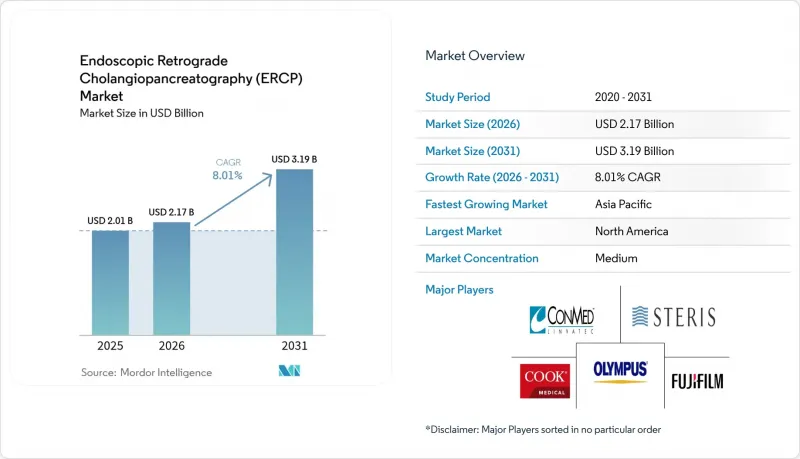
This report is Segmented by Product (Duodenoscopes, Endotherapy Devices [Sphincterotomes and More], and More), Procedure (Biliary Sphincterotomy and More), End User (Hospitals, and More), Technology (Reusable, Hybrid, and More), Application (Biliary Disorders, Pancreatic Disorders), and Geography. The Market Forecasts are Provided in Terms of Value (USD).
Global Endoscopic Retrograde Cholangiopancreatography (ERCP) Market Trends and Insights
Rising incidence of pancreatic & biliary cancers
Gallbladder cancer prevalence has climbed to 20.3% among at-risk groups, notably individuals with gallstones, creating a large pool of patients who require endoscopic intervention. Early-onset pancreatic cancer cases add clinical complexity, demanding specialised diagnostic and therapeutic protocols tailored to younger populations. These epidemiological shifts lift procedure volumes beyond normal demographic growth, especially in high-income nations with established reimbursement systems. Post-ERCP pancreatitis affects up to 15% of patients and adds more than USD 200 million in annual U.S. costs, intensifying the search for safer technologies.Ageing societies and lifestyle risk factors combine to keep long-term demand for ERCP solutions strong.
Growing preference for single-use duodenoscopes to curb cross-infection
Hospitals increasingly choose single-use duodenoscopes, driven by safety, operational efficiency, and new reimbursement pathways. Boston Scientific's EXALT Model D shows performance parity with reusable devices across seven peer-reviewed studies while removing cross-infection risks. The U.S. Centers for Medicare & Medicaid Services has granted an add-on payment for Ambu's aScope Duodeno, alleviating cost concerns for administrators. These policy incentives, coupled with lower legal liability, accelerate broader adoption beyond high-risk cases.
High capital & per-procedure cost of disposable scopes
Although infection risk falls to near zero, single-use devices still cost more per case than reusables, straining budgets in systems with tight reimbursement. Hospitals saved USD 451 million through device reprocessing programs in 2024, illustrating pressure to contain spending. As economies of scale improve and payment models evolve, the cost differential is expected to narrow.
Other drivers and restraints analyzed in the detailed report include:
- AI-enabled imaging & navigation boosts cannulation success
- Reimbursement expansion for outpatient ERCP in OECD markets
- Shortage of ERCP-skilled endoscopists in emerging markets
For complete list of drivers and restraints, kindly check the Table Of Contents.
Segment Analysis
Duodenoscopes held 46.98% of Endoscopic Retrograde Cholangiopancreatography market share in 2025 and remain on track to grow at an 11.62% CAGR through 2031. Hospital infection-control policies and supportive reimbursement drive brisk conversion to single-use models, while hybrid scopes with disposable tips help institutions with tight budgets transition gradually. Olympus, Boston Scientific, and Ambu compete closely, each offering ergonomics, imaging clarity, and sterile packaging that answer clinician demands. As institutions retire ageing reusable fleets, procurement cycles increasingly favour newer single-use or hybrid options that lower reprocessing load and litigation exposure.
Endotherapy devices form the second-largest revenue block and cover sphincterotomes, guidewires, lithotripters, and stents. Growing case complexity, particularly in pancreatic interventions, sustains multi-device demand per procedure. Radiofrequency ablation catheters such as Habib EndoHPB broaden therapeutic scope and extend stent patency. Accessories and consumables enjoy steady volume growth, reflecting the overall expansion of procedures rather than large price swings.
Biliary sphincterotomy accounted for 26.35% of Endoscopic Retrograde Cholangiopancreatography market size in 2025, confirming its role as the traditional workhorse procedure. Pancreatic duct stenting, however, posts the quickest rise at a 12.25% CAGR as clinicians manage pancreatitis complications and malignant strictures with endoscopic techniques that once required surgery. Advances in imaging and wire technology improve cannulation precision, allowing safe navigation of complex duct anatomy. As procedural confidence grows, hospitals adopt expanded indications, driving a mix shift toward higher-value pancreatic work.
Pancreatic duct dilatation and combined EUS-ERCP techniques continue to gain ground. Technical success rates up to 92% in EUS-guided drainage highlight the expanding therapeutic envelope. Device firms market mini-sphincterotomes for difficult cannulations, reinforcing procedure adoption in less experienced hands. This broadening toolkit accelerates the transition from purely diagnostic ERCP toward comprehensive endoscopic therapy.
Complete Report Scope:
- By Product
- Duodenoscopes
- Endotherapy Devices
- Sphincterotomes
- Guidewires & Cannulation Devices
- Lithotripters
- Stents
- Other Endotherapy
- Visualization & Imaging Systems
- Energy Devices
- Accessories & Consumables
- By Procedure
- Biliary Sphincterotomy
- Biliary Stenting
- Biliary Dilatation
- Pancreatic Sphincterotomy
- Pancreatic Duct Stenting
- Pancreatic Duct Dilatation
- By End User
- Hospitals
- Ambulatory Surgery Centers
- Specialty & GI Clinics
- By Technology
- Reusable
- Hybrid (Reusable with Disposable Distal Cap)
- Fully Single-Use
- By Application
- Biliary Disorders
- Pancreatic Disorders
- By Geography
- North America
- United States
- Canada
- Mexico
- Europe
- Germany
- United Kingdom
- France
- Italy
- Spain
- Rest of Europe
- Asia-Pacific
- China
- Japan
- India
- Australia
- South Korea
- Rest of Asia-Pacific
- Middle East and Africa
- GCC
- South Africa
- Rest of Middle East and Africa
- South America
- Brazil
- Argentina
- Rest of South America
- North America
Geography Analysis
North America maintained 39.12% of Endoscopic Retrograde Cholangiopancreatography market share in 2025 due to robust reimbursement, mature training networks, and early roll-out of single-use scopes. U.S. ambulatory centre growth signals confidence in outpatient ERCP safety profiles, while Canadian provinces adopt similar policies to relieve inpatient pressures. Market players use the region to launch premium technologies, assuming rapid payer uptake and clinician buy-in.
Europe ranks second, driven by stringent infection-control mandates and environmental goals that elevate demand for hybrid and single-use options. The new EU Medical Device Regulation imposes uniform safety standards, smoothing cross-border distribution and encouraging pan-European procurement contracts. Hospitals in Germany and France lead adoption of AI-supported imaging, citing evidence of improved cannulation and reduced fluoroscopy exposure.
Asia-Pacific posts the fastest expansion at 9.92% CAGR. Investments in endoscopy training centres, as seen in the Philippines, bring advanced ERCP to previously under-served populations. China and India stand out with rising pancreatic cancer incidence, translating to higher procedure volumes. Government health-insurance schemes widen access, yet specialist shortages still cap throughput in rural areas. Regional private providers respond by offering executive health packages that include ERCP screening for high-risk demographics.
The Middle East & Africa and South America show smaller absolute numbers but strong relative growth. Sustained oil revenues support capital spending in Gulf Cooperation Council countries, while Brazilian teaching hospitals establish ERCP fellowships to retain talent. These regions rely on simplified scope platforms and tele-mentoring programs to overcome limited local expertise.
- Olympus
- Boston Scientific
- FUJIFILM
- Johnson & Johnson
- Medtronic
- Cook Group
- Conmed
- STERIS
- Karl Storz SE
- HOYA
- Ambu
- Micro-tech
- Taewoong Medical
- ERBE Elektromedizin
- Endo-Flex
- TeleMed Systems Inc.
- SonoScape Medical Corp.
- DCC Healthcare (Medi-Globe)
- Huger Medical Instrument Co.
Additional Benefits:
- The market estimate (ME) sheet in Excel format
- 3 months of analyst support
TABLE OF CONTENTS
1 Introduction
- 1.1 Study Assumptions and Market Definition
- 1.2 Scope of the Study
2 Research Methodology
3 Executive Summary
4 Market Landscape
- 4.1 Market Overview
- 4.2 Market Drivers
- 4.2.1 Rising Incidence Of Pancreatic & Biliary Cancers
- 4.2.2 Growing Preference For Single-Use Duodenoscopes To Curb Cross-Infection
- 4.2.3 AI-Enabled Imaging & Navigation Boosts Cannulation Success
- 4.2.4 Reimbursement Expansion For Outpatient ERCP In OECD Markets
- 4.2.5 Endotherapy Device Miniaturisation Enabling Pediatric ERCP
- 4.2.6 ESG-Based Hospital Decarbonisation Favouring Low-Water-Use Scopes
- 4.3 Market Restraints
- 4.3.1 High Capital & Per-Procedure Cost Of Disposable Scopes
- 4.3.2 Shortage Of ERCP-Skilled Endoscopists In Emerging Markets
- 4.3.3 Risk Of Post-ERCP Pancreatitis & Related Litigation
- 4.3.4 Slow Regulatory Clearance For AI-Guided Cannulation Software
- 4.4 Value / Supply-Chain Analysis
- 4.5 Regulatory Landscape
- 4.6 Technology Outlook
- 4.7 Porter's Five Forces Analysis
- 4.7.1 Bargaining Power of Suppliers
- 4.7.2 Bargaining Power of Buyers
- 4.7.3 Threat of New Entrants
- 4.7.4 Threat of Substitutes
- 4.7.5 Intensity of Competitive Rivalry
5 Market Size and Growth Forecasts (Value-USD)
- 5.1 By Product
- 5.1.1 Duodenoscopes
- 5.1.2 Endotherapy Devices
- 5.1.2.1 Sphincterotomes
- 5.1.2.2 Guidewires & Cannulation Devices
- 5.1.2.3 Lithotripters
- 5.1.2.4 Stents
- 5.1.2.5 Other Endotherapy
- 5.1.3 Visualization & Imaging Systems
- 5.1.4 Energy Devices
- 5.1.5 Accessories & Consumables
- 5.2 By Procedure
- 5.2.1 Biliary Sphincterotomy
- 5.2.2 Biliary Stenting
- 5.2.3 Biliary Dilatation
- 5.2.4 Pancreatic Sphincterotomy
- 5.2.5 Pancreatic Duct Stenting
- 5.2.6 Pancreatic Duct Dilatation
- 5.3 By End User
- 5.3.1 Hospitals
- 5.3.2 Ambulatory Surgery Centers
- 5.3.3 Specialty & GI Clinics
- 5.4 By Technology
- 5.4.1 Reusable
- 5.4.2 Hybrid (Reusable with Disposable Distal Cap)
- 5.4.3 Fully Single-Use
- 5.5 By Application
- 5.5.1 Biliary Disorders
- 5.5.2 Pancreatic Disorders
- 5.6 By Geography
- 5.6.1 North America
- 5.6.1.1 United States
- 5.6.1.2 Canada
- 5.6.1.3 Mexico
- 5.6.2 Europe
- 5.6.2.1 Germany
- 5.6.2.2 United Kingdom
- 5.6.2.3 France
- 5.6.2.4 Italy
- 5.6.2.5 Spain
- 5.6.2.6 Rest of Europe
- 5.6.3 Asia-Pacific
- 5.6.3.1 China
- 5.6.3.2 Japan
- 5.6.3.3 India
- 5.6.3.4 Australia
- 5.6.3.5 South Korea
- 5.6.3.6 Rest of Asia-Pacific
- 5.6.4 Middle East and Africa
- 5.6.4.1 GCC
- 5.6.4.2 South Africa
- 5.6.4.3 Rest of Middle East and Africa
- 5.6.5 South America
- 5.6.5.1 Brazil
- 5.6.5.2 Argentina
- 5.6.5.3 Rest of South America
- 5.6.1 North America
6 Competitive Landscape
- 6.1 Market Concentration
- 6.2 Market Share Analysis
- 6.3 Company profiles (includes Global level Overview, Market level overview, Core Segments, Financials as available, Strategic Information, Market Rank/Share for key companies, Products and Services, and Recent Developments)
- 6.3.1 Olympus Corporation
- 6.3.2 Boston Scientific Corporation
- 6.3.3 Fujifilm Holdings Corporation
- 6.3.4 Johnson & Johnson
- 6.3.5 Medtronic plc
- 6.3.6 Cook Medical
- 6.3.7 CONMED Corporation
- 6.3.8 STERIS plc
- 6.3.9 Karl Storz SE
- 6.3.10 HOYA Corporation
- 6.3.11 Ambu A/S
- 6.3.12 Micro-Tech Endoscopy
- 6.3.13 Taewoong Medical
- 6.3.14 ERBE Elektromedizin
- 6.3.15 Endo-Flex GmbH
- 6.3.16 TeleMed Systems Inc.
- 6.3.17 SonoScape Medical Corp.
- 6.3.18 DCC Healthcare (Medi-Globe)
- 6.3.19 Huger Medical Instrument Co.
7 Market Opportunities & Future Outlook
- 7.1 White-space & Unmet-need Assessment

