PUBLISHER: Mordor Intelligence | PRODUCT CODE: 2116456

PUBLISHER: Mordor Intelligence | PRODUCT CODE: 2116456
Outpatient Rehabilitation Centers - Market Share Analysis, Industry Trends & Statistics, Growth Forecasts (2026 - 2031)
According to Mordor Intelligence, the outpatient rehabilitation centers market size is expected to grow from USD 103.14 billion in 2025 to USD 110.59 billion in 2026 and is forecast to reach USD 156.74 billion by 2031 at 7.23% CAGR over 2026-2031.
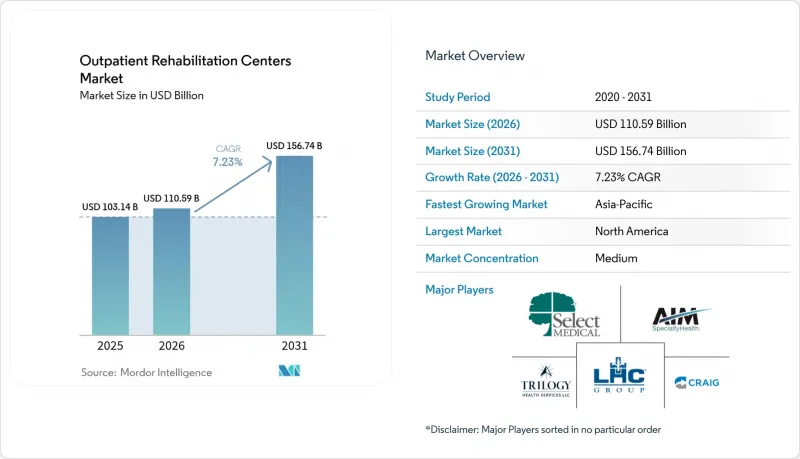
This report is Segmented by Program (Standard Outpatient Programs, Intensive Outpatient Programs, and More), Therapy (Physical Therapy, Occupational Therapy, and More), Condition Treated (Musculoskeletal Rehabilitation, Neurological Rehabilitation, and More), End User (Paediatric Population, Adult Population, and More), and Geography. The Market Forecasts are Provided in Terms of Value (USD).
Global Outpatient Rehabilitation Centers Market Trends and Insights
Rapidly ageing population & chronic disease burden
Adults aged 65+ will exceed 20% of the U.S. population by 2030, intensifying demand for rehabilitation of arthritis, cardiovascular sequelae, and diabetes-related mobility issues. With 39% of adults already living with at least one chronic disease, payers and providers view outpatient programs as the most cost-effective long-term management setting. Clinics that bundle physical, occupational, and behavioral therapies are especially positioned to capture sustained, non-cyclical volumes.
Cost-shift from inpatient to lower-cost outpatient settings
Outpatient visits are projected to hit 5.82 billion annually by 2030, propelled by Medicare's value-based purchasing and payer pushback against high hospital facility fees. States trimming Certificate-of-Need requirements have fueled a jump in ambulatory facility openings, widening choice for both surgeons and rehabilitation patients. Because outpatient rehabilitation costs 30-50% less than comparable inpatient episodes, commercial payers increasingly steer beneficiaries toward community clinics for post-acute recovery.
Shortage of licensed therapists & clinicians
A projected shortfall of 12,070 full-time physical therapists by 2037 threatens capacity, with current outpatient vacancy reaching 9.5% and rural supply at just 19% of need. Salary inflation and retention bonuses squeeze margins for smaller independents and may slow new-site rollouts.
Other drivers and restraints analyzed in the detailed report include:
- Inclusion of Intensive Outpatient Program codes in Medicare (2024)
- Tele-rehab parity laws boosting rural access
- Downward reimbursement pressure from private payors
For complete list of drivers and restraints, kindly check the Table Of Contents.
Segment Analysis
Standard outpatient programs generated the largest share of 39.12% in 2025, underpinning the outpatient rehabilitation centers market through routine post-surgical and chronic-care visits. These clinics benefit from predictable volume streams and embedded referral pathways. Hybrid tele-outpatient programs, although nascent, are scaling at a 10.32% CAGR as patients welcome the convenience of alternating in-clinic assessments and at-home VR-guided sessions. Payers back these models when real-time data feed proves adherence and functional gains, curbing unnecessary in-person encounters and travel costs.
Hybrid formats combine traditional therapist oversight with AI-driven progress dashboards. Because reimbursement parity exists in many jurisdictions, providers can monetize digital-first follow-ups without revenue dilution. Intensive outpatient programs, newly reimbursable under Medicare, add a behavioral-health revenue layer, while partial-hospitalization and day-rehab schemes address complex neurologic and orthopedic cases needing multidisciplinary input. The upshot is a diversified service mix that cushions operators against payer or regulatory shocks.
Physical therapy accounted for 42.31% of 2025 revenue, making it the anchor modality on which most clinics build broader service bundles. Its dominance stems from pervasive MSK and post-operative needs. VR-assisted therapy, expanding at an 11.05% CAGR, introduces immersive tasks that sharpen balance and neuro-motor control, shortening average recovery timelines. Occupational and speech therapy maintain steady demand for stroke and pediatric populations, whereas cognitive behavioral therapy and motivational interviewing open new revenue lanes in integrated substance-use and chronic-pain programs.
Therapists increasingly deploy exoskeletons and gamified VR labs to manage higher caseloads without sacrificing quality. AI-backed platforms personalize session intensity and adapt exercise scripts mid-stream, boosting adherence and outcomes. As outcome-based reimbursement tightens, clinics leveraging objective digital metrics gain favor with value-based payors.
Complete Report Scope:
- By Program
- Standard Outpatient Programs
- Intensive Outpatient Programs (IOP)
- Partial Hospitalisation Programs (PHP)
- Hybrid Tele-Outpatient Programs
- Specialised Day Rehabilitation (Neuro, Cardiac, Ortho)
- By Therapy
- Physical Therapy
- Occupational Therapy
- Speech & Language Therapy
- Cognitive Behavioural Therapy (CBT)
- Contingency Management (CM)
- Motivational Interviewing (MI)
- Virtual-Reality-Assisted Therapy
- Aquatic / Ocean Therapy
- By Condition Treated
- Musculoskeletal Rehabilitation
- Neurological Rehabilitation
- Cardiac Rehabilitation
- Pulmonary Rehabilitation
- Substance-Use-Disorder Rehabilitation
- Others (Burn, Oncology, etc.)
- By End User
- Paediatric Population
- Adult Population
- Geriatric Population
- Sports-Injury Patients
- Workers' Compensation Cases
- By Geography
- North America
- United States
- Canada
- Mexico
- Europe
- Germany
- United Kingdom
- France
- Italy
- Spain
- Rest of Europe
- Asia-Pacific
- China
- Japan
- India
- Australia
- South Korea
- Rest of Asia-Pacific
- Middle East and Africa
- GCC
- South Africa
- Rest of Middle East and Africa
- South America
- Brazil
- Argentina
- Rest of South America
- North America
Geography Analysis
North America led the outpatient rehabilitation centers market with 44.05% revenue share in 2025, powered by broad insurance coverage, wage-adjusted reimbursement, and dense clinic networks. The United States embodies most spending, as Medicare and large commercial insurers reimburse diverse program types, including the new IOP behavioral codes. Canada supplements demand through universal coverage and rising chronic-disease prevalence, while Mexico's growing medical tourism and employer MSK initiatives add cross-border volume.
Europe maintains mid-single-digit growth thanks to public-sector investment in community-based rehab and updated EU directives favoring home-based tele-rehab. Countries such as Germany are rolling out digital-health prescriptions reimbursed under statutory insurance, widening VR therapy acceptance. The United Kingdom's NHS long-term plan invests in MSK hubs that coordinate surgeon, physio, and occupational therapy under value-based budgets, increasing outpatient throughput.
Asia-Pacific is the fastest-expanding region with a 9.62% CAGR, propelled by rapid population aging in China, South Korea, and Singapore, plus public-private partnerships that finance greenfield clinic builds. Governments champion AI adoption to offset therapist shortages, sparking demand for smart rehabilitation devices. Emerging markets such as India and Indonesia witness surging lifestyle disease incidence, spurring domestic chains to replicate Western outpatient models. Tele-rehab overcomes rural provider gaps and reduces capital required per patient served, accelerating geographic coverage.
South America and the Middle East & Africa present nascent yet promising landscapes. Brazil is streamlining private-insurance approvals for outpatient rehab as hospital occupancy rates climb, whereas Saudi Arabia's Vision 2030 health agenda designates rehabilitation as a priority service. Infrastructure constraints and clinician scarcity continue to limit immediate scale, but bilateral training initiatives with U.S. and European partners are beginning to bolster capacity.
- Select Medical
- Kindred Healthcare
- Encompass Health
- ATI Physical Therapy
- LHC Group
- Shirley Ryan AbilityLab
- Mayo Clinic
- Kessler Institute for Rehabilitation
- Brooks Rehabilitation
- U.S. Physical Therapy Inc.
- Athletico Physical Therapy
- Pivot Physical Therapy
- AIM Health Group
- Craig Hospital
- Moss Rehabilitation
- Rusk Rehabilitation
- Shephard Center
- Trilogy Health Services
- TIRR Memorial Hermann
- The Dunes East Hampton
Additional Benefits:
- The market estimate (ME) sheet in Excel format
- 3 months of analyst support
TABLE OF CONTENTS
1 Introduction
- 1.1 Study Assumptions and Market Definition
- 1.2 Scope of the Study
2 Research Methodology
3 Executive Summary
4 Market Landscape
- 4.1 Market Overview
- 4.2 Market Drivers
- 4.2.1 Rapidly Ageing Population & Chronic Disease Burden
- 4.2.2 Cost-Shift From Inpatient To Lower-Cost Outpatient Settings
- 4.2.3 Inclusion Of Intensive Outpatient Program (IOP) Codes In Medicare (2024)
- 4.2.4 Tele-Rehab Parity Laws Boosting Rural Access
- 4.2.5 Employer-Sponsored MSK Programmes Driving Clinic Foot-Fall
- 4.2.6 ACO / MSO Consolidation Accelerating Referral Volumes
- 4.3 Market Restraints
- 4.3.1 Shortage Of Licensed Therapists & Clinicians
- 4.3.2 Downward Reimbursement Pressure From Private Payors
- 4.3.3 Rising Cyber-Security & HIPAA Compliance Costs For Tele-Rehab
- 4.3.4 Community Zoning Restrictions On New Outpatient Sites
- 4.4 Value / Supply-Chain Analysis
- 4.5 Regulatory Landscape
- 4.6 Technology Outlook
- 4.7 Porter's Five Forces Analysis
- 4.7.1 Bargaining Power of Suppliers
- 4.7.2 Bargaining Power of Buyers
- 4.7.3 Threat of New Entrants
- 4.7.4 Threat of Substitutes
- 4.7.5 Intensity of Competitive Rivalry
5 Market Size and Growth Forecasts (Value-USD)
- 5.1 By Program
- 5.1.1 Standard Outpatient Programs
- 5.1.2 Intensive Outpatient Programs (IOP)
- 5.1.3 Partial Hospitalisation Programs (PHP)
- 5.1.4 Hybrid Tele-Outpatient Programs
- 5.1.5 Specialised Day Rehabilitation (Neuro, Cardiac, Ortho)
- 5.2 By Therapy
- 5.2.1 Physical Therapy
- 5.2.2 Occupational Therapy
- 5.2.3 Speech & Language Therapy
- 5.2.4 Cognitive Behavioural Therapy (CBT)
- 5.2.5 Contingency Management (CM)
- 5.2.6 Motivational Interviewing (MI)
- 5.2.7 Virtual-Reality-Assisted Therapy
- 5.2.8 Aquatic / Ocean Therapy
- 5.3 By Condition Treated
- 5.3.1 Musculoskeletal Rehabilitation
- 5.3.2 Neurological Rehabilitation
- 5.3.3 Cardiac Rehabilitation
- 5.3.4 Pulmonary Rehabilitation
- 5.3.5 Substance-Use-Disorder Rehabilitation
- 5.3.6 Others (Burn, Oncology, etc.)
- 5.4 By End User
- 5.4.1 Paediatric Population
- 5.4.2 Adult Population
- 5.4.3 Geriatric Population
- 5.4.4 Sports-Injury Patients
- 5.4.5 Workers' Compensation Cases
- 5.5 By Geography
- 5.5.1 North America
- 5.5.1.1 United States
- 5.5.1.2 Canada
- 5.5.1.3 Mexico
- 5.5.2 Europe
- 5.5.2.1 Germany
- 5.5.2.2 United Kingdom
- 5.5.2.3 France
- 5.5.2.4 Italy
- 5.5.2.5 Spain
- 5.5.2.6 Rest of Europe
- 5.5.3 Asia-Pacific
- 5.5.3.1 China
- 5.5.3.2 Japan
- 5.5.3.3 India
- 5.5.3.4 Australia
- 5.5.3.5 South Korea
- 5.5.3.6 Rest of Asia-Pacific
- 5.5.4 Middle East and Africa
- 5.5.4.1 GCC
- 5.5.4.2 South Africa
- 5.5.4.3 Rest of Middle East and Africa
- 5.5.5 South America
- 5.5.5.1 Brazil
- 5.5.5.2 Argentina
- 5.5.5.3 Rest of South America
- 5.5.1 North America
6 Competitive Landscape
- 6.1 Market Concentration
- 6.2 Market Share Analysis
- 6.3 Company profiles (includes Global level Overview, Market level overview, Core Segments, Financials as available, Strategic Information, Market Rank/Share for key companies, Products and Services, and Recent Developments)
- 6.3.1 Select Medical Holdings
- 6.3.2 Kindred Healthcare
- 6.3.3 Encompass Health
- 6.3.4 ATI Physical Therapy
- 6.3.5 LHC Group
- 6.3.6 Shirley Ryan AbilityLab
- 6.3.7 Mayo Clinic
- 6.3.8 Kessler Institute for Rehabilitation
- 6.3.9 Brooks Rehabilitation
- 6.3.10 U.S. Physical Therapy Inc.
- 6.3.11 Athletico Physical Therapy
- 6.3.12 Pivot Physical Therapy
- 6.3.13 AIM Health Group
- 6.3.14 Craig Hospital
- 6.3.15 Moss Rehabilitation
- 6.3.16 Rusk Rehabilitation
- 6.3.17 Shephard Center
- 6.3.18 Trilogy Health Services
- 6.3.19 TIRR Memorial Hermann
- 6.3.20 The Dunes East Hampton
7 Market Opportunities and Future Outlook
- 7.1 White-Space and Unmet-Need Assessment

