PUBLISHER: Mordor Intelligence | PRODUCT CODE: 2116457

PUBLISHER: Mordor Intelligence | PRODUCT CODE: 2116457
United States Outpatient Rehabilitation Centers - Market Share Analysis, Industry Trends & Statistics, Growth Forecasts (2026 - 2031)
According to Mordor Intelligence, the United States outpatient rehabilitation centers market size is estimated at USD 40.02 billion in 2026, and is expected to reach USD 55.11 billion by 2031, at a CAGR of 6.61% during the forecast period (2026-2031).
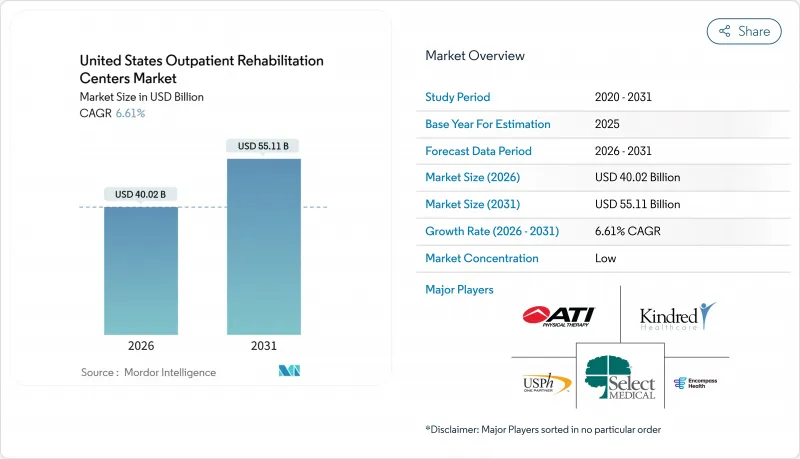
This report is Segmented by Service Type (Physical Therapy, Occupational Therapy, Speech & Language Therapy, Respiratory Therapy), Rehabilitation Condition (Musculoskeletal Disorders, Neurological Disorders, and More), Age Group (Pediatric, Adult, Geriatric), and Payer Type (Private Insurance, and More). The Market Forecasts are Provided in Terms of Value (USD).
United States Outpatient Rehabilitation Centers Market Trends and Insights
Aging Population & Chronic Musculoskeletal Burden
The 65-plus cohort climbed 3.1% to 61.2 million in 2024 and is projected to reach 78 million by 2040, a shift that dovetails with higher arthritis, chronic back pain, and fall-related injuries. Arthritis affects 53.2 million adults, chronic back pain is reported by 39% of adults, and falls result in 3 million emergency visits annually, prompting Medicare to reimburse evidence-based fall-prevention therapy that saves USD 3 in acute-care costs for every rehabilitation dollar spent. Sun Belt states show the steepest senior growth yet remain below median clinic density, stretching wait times beyond three weeks in suburban Phoenix and Tampa. As the geriatric population accumulates multiple chronic conditions, the United States outpatient rehabilitation centers market increasingly relies on multi-modal programs that target strength, balance, and pain management within one care plan.
Shift to Value-Based Outpatient Care Models
Medicare Advantage enrollment hit 33.8 million in 2024, or 54% of eligible beneficiaries, and many plans now pay for additional physical therapy visits beyond fee-for-service limits. Bundled payment models covering joint replacement and cardiac episodes delivered 18% more outpatient therapy visits in the first 90 days post-discharge than fee-for-service cohorts, rewarding clinics that can share real-time outcomes data with accountable care organizations. Providers adept at risk-sharing are securing preferred-network status, especially in California, New York, and Pennsylvania, where value-based contracts tie up to 15% of revenue to quality metrics such as functional-outcome scores and 90-day readmission rates. The United States outpatient rehabilitation centers market thus favors operators with interoperable EHRs and analytics that quantify therapy's economic returns.
CMS Fee-Schedule Reimbursement Cuts
The Medicare physician fee schedule reduced payment for core evaluation and therapeutic exercise codes by 3.37% in 2024 and a further 2.83% in 2025, slicing already thin 8-12% EBITDA margins for independent clinics. Rural operators, unable to leverage large commercial payer contracts, face disproportionate pressure and are either consolidating or exiting the United States outpatient rehabilitation centers market. National chains are downsizing footprints, shortening visit lengths, and shifting to group sessions to offset lost revenue while lobbying continues for multi-year phase-ins.
Other drivers and restraints analyzed in the detailed report include:
- AI-Driven Motion Tracking Boosts Adherence
- Hospital-at-Home Codes Enabling Hybrid Rehab
- Licensed Therapist Workforce Shortage
For complete list of drivers and restraints, kindly check the Table Of Contents.
Segment Analysis
Physical therapy held 69.62% of 2025 revenue in the United States outpatient rehabilitation centers market, while tele-rehab PT is growing at 10.52% annually through 2031. Occupational therapy leverages Medicare's expanded fall-prevention benefits, speech therapy meets rising post-stroke aphasia needs, and respiratory therapy gains traction from long-COVID cases. Hybrid care models typically start and finish in clinic but shift six to eight mid-episode visits online, cutting facility costs by 35%. Reimbursement parity is improving; Medicare pays 95% of in-person rates, but commercial discounts of up to 30% still challenge aggressive virtualization.
Continued tele-rehab adoption is supported by 2024 competency standards that make virtual-care skills mandatory for new graduates. Yet interoperability gaps and payer variability keep in-person visits dominant for occupational therapy that requires environmental assessments and for speech therapy nuances best captured face-to-face. Providers balance modality mix to sustain margins across the United States outpatient rehabilitation centers market size.
Musculoskeletal disorders accounted for 58.56% of 2025 cases, reflecting 53.2 million arthritis sufferers, chronic back pain prevalence, and 120,000 ACL repairs. Neurological rehabilitation is set to grow 9.24% through 2031 as 7.6 million stroke survivors and 1 million Parkinson's patients demand extended therapy. Cardiopulmonary programs benefit from CMS expansion to 36 covered sessions, and post-operative pathways thrive under bundled payments that reward early mobilization.
Constraint-induced movement therapy and LSVT BIG protocols require 20-40 visits, boosting revenue per episode versus routine orthopedic cases. Medicare Advantage plans accept the cost because robust neurological programs cut nursing-home placements, lowering long-term spend. Operators diversify into these higher-acuity lines to cushion CMS fee-schedule cuts, sustaining the United States outpatient rehabilitation centers market share.
Complete Report Scope:
- By Service Type
- Physical Therapy
- Occupational Therapy
- Speech & Language Therapy
- Respiratory Therapy
- By Rehabilitation Condition
- Musculoskeletal Disorders
- Neurological Disorders
- Cardiopulmonary Conditions
- Post-Operative Recovery
- Sports & Orthopedic Injuries
- By Age Group
- Pediatric (0-17 yrs)
- Adult (18-64 yrs)
- Geriatric (65+ yrs)
- By Payer Type
- Private Insurance
- Medicare
- Medicaid
- Workers' Compensation
- Self-Pay / Out-of-Pocket
List of Companies Covered in this Report:
- AdventHealth Outpatient Rehab
- Athletico Physical Therapy
- ATI Physical Therapy
- Baylor Scott & White Rehab
- BenchMark PT (Upstream)
- Concentra
- CORA Health Services
- Encompass Health
- HCA Healthcare Outpatient Services
- Kindred Rehabilitation
- Mayo Clinic Outpatient Rehab
- Mercy Health Outpatient Rehab
- NovaCare Rehabilitation
- OrthoCarolina Rehab
- Pivot Physical Therapy
- PT Solutions
- Sanford Health Rehab
- Select Medical
- Shirley Ryan AbilityLab
- U.S. Physical Therapy Inc.
Additional Benefits:
- The market estimate (ME) sheet in Excel format
- 3 months of analyst support
TABLE OF CONTENTS
1 Introduction
- 1.1 Study Assumptions & Market Definition
- 1.2 Scope of the Study
2 Research Methodology
3 Executive Summary
4 Market Landscape
- 4.1 Market Overview
- 4.2 Market Drivers
- 4.2.1 Aging Population & Chronic Musculoskeletal Burden
- 4.2.2 Shift To Value-Based Outpatient Care Models
- 4.2.3 Rising Sports Injuries & Active-Lifestyle Demand
- 4.2.4 Hospital-At-Home Codes Enabling Hybrid Rehab
- 4.2.5 Employer-Sponsored Onsite Rehab Clinics
- 4.2.6 AI-Driven Motion Tracking Boosts Adherence
- 4.3 Market Restraints
- 4.3.1 CMS Fee-Schedule Reimbursement Cuts
- 4.3.2 Licensed Therapist Workforce Shortage
- 4.3.3 Rising Urban Clinic Real-Estate Costs
- 4.3.4 Data-Privacy Friction For Sensor Monitoring
- 4.4 Value / Supply-Chain Analysis
- 4.5 Regulatory Landscape
- 4.6 Technological Outlook
- 4.7 Porter's Five Forces Analysis
- 4.7.1 Threat of New Entrants
- 4.7.2 Bargaining Power of Suppliers
- 4.7.3 Bargaining Power of Buyers
- 4.7.4 Threat of Substitutes
- 4.7.5 Intensity of Competitive Rivalry
5 Market Size & Growth Forecasts (Value in USD)
- 5.1 By Service Type
- 5.1.1 Physical Therapy
- 5.1.2 Occupational Therapy
- 5.1.3 Speech & Language Therapy
- 5.1.4 Respiratory Therapy
- 5.2 By Rehabilitation Condition
- 5.2.1 Musculoskeletal Disorders
- 5.2.2 Neurological Disorders
- 5.2.3 Cardiopulmonary Conditions
- 5.2.4 Post-Operative Recovery
- 5.2.5 Sports & Orthopedic Injuries
- 5.3 By Age Group
- 5.3.1 Pediatric (0-17 yrs)
- 5.3.2 Adult (18-64 yrs)
- 5.3.3 Geriatric (65+ yrs)
- 5.4 By Payer Type
- 5.4.1 Private Insurance
- 5.4.2 Medicare
- 5.4.3 Medicaid
- 5.4.4 Workers' Compensation
- 5.4.5 Self-Pay / Out-of-Pocket
6 Competitive Landscape
- 6.1 Market Concentration
- 6.2 Market Share Analysis
- 6.3 Company Profiles (includes Global level Overview, Market level overview, Core Segments, Financials as available, Strategic Information, Market Rank/Share for key companies, Products and Services, and Recent Developments)
- 6.3.1 AdventHealth Outpatient Rehab
- 6.3.2 Athletico Physical Therapy
- 6.3.3 ATI Physical Therapy
- 6.3.4 Baylor Scott & White Rehab
- 6.3.5 BenchMark PT (Upstream)
- 6.3.6 Concentra
- 6.3.7 CORA Health Services
- 6.3.8 Encompass Health Corporation
- 6.3.9 HCA Healthcare Outpatient Services
- 6.3.10 Kindred Rehabilitation
- 6.3.11 Mayo Clinic Outpatient Rehab
- 6.3.12 Mercy Health Outpatient Rehab
- 6.3.13 NovaCare Rehabilitation
- 6.3.14 OrthoCarolina Rehab
- 6.3.15 Pivot Physical Therapy
- 6.3.16 PT Solutions
- 6.3.17 Sanford Health Rehab
- 6.3.18 Select Medical Corporation
- 6.3.19 Shirley Ryan AbilityLab
- 6.3.20 U.S. Physical Therapy Inc.
7 Market Opportunities & Future Outlook
- 7.1 White-space & Unmet-need Assessment

