PUBLISHER: Mordor Intelligence | PRODUCT CODE: 2116482

PUBLISHER: Mordor Intelligence | PRODUCT CODE: 2116482
Healthcare Content Management System - Market Share Analysis, Industry Trends & Statistics, Growth Forecasts (2026 - 2031)
According to Mordor Intelligence, the healthcare content management system market size was valued at USD 37.07 billion in 2025 and estimated to grow from USD 40.31 billion in 2026 to reach USD 61.28 billion by 2031, at a CAGR of 8.74% during the forecast period (2026-2031).
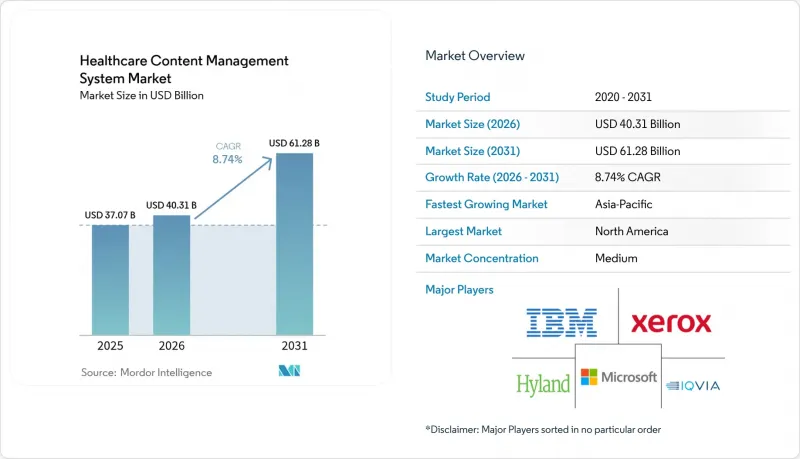
This report is Segmented by Component (Software and Services), by Deployment Mode (On-Premise and Cloud), by Application(Clinical Content Management, Administrative/Non-clinical and More), by End-User (Hospitals & Health Systems, Ambulatory Surgical Centers and More), and Geography (North America, Europe, Asia-Pacific and More). The Report Offers the Value (in USD) for the Above Segments.
Global Healthcare Content Management System Market Trends and Insights
Surge in EHR Adoption Mandates Integrated Document & Imaging Workflows
The 21st Century Cures Act's interoperability deadlines now link Medicare reimbursements to seamless data exchange, driving providers to embed imaging and document management directly inside core EHR workflows. Hospitals running Epic or Oracle Health increasingly demand vendor-neutral archives and FHIR-based repositories, forcing content management vendors to swap proprietary interfaces for open APIs that satisfy Merit-based Incentive Payment System metrics. This realignment elevates the healthcare content management system market from compliance utility to clinical workflow enabler, reshaping competitive priorities around latency, embedded analytics, and clinician user experience.
Regulatory Push for Data Retention & HIPAA/GDPR Compliance
HIPAA's six-year minimum retention rule, coupled with state mandates that stretch to ten years, obligates U.S. providers to maintain scalable archives with automated deletion policies, encryption, and audit trails. Across the EU, GDPR adds "right-to-erasure" and data residency provisions that require granular lifecycle controls, steering multinational health systems toward cloud vendors offering region-specific storage nodes and policy engines hl7.org. As compliance complexity rises, buyers reward vendors that embed rules libraries and evidence logging, lifting average selling prices and locking in multiyear subscription contracts within the healthcare content management system market.
High Upfront Migration & Integration Costs with Legacy Systems
Full-scale data conversion, interface development, and user re-training push typical six-month deployments beyond USD 10 million for large health systems, delaying ROI and depressing near-term healthcare content management system market spending. Although cloud pay-as-you-go pricing offsets hardware purchases, parallel-run periods inflate labor costs until legacy systems fully sunset.
Other drivers and restraints analyzed in the detailed report include:
- Shift from On-Premise to Cloud Content Services Lowering TCO
- Rising Telehealth & Remote Workforce Needs Real-Time Content Access
- Data Security & Privacy Concerns Slowing Cloud Deployments
For complete list of drivers and restraints, kindly check the Table Of Contents.
Segment Analysis
In 2025, software contributed USD 22.84 billion, equal to 61.62% of the healthcare content management system market, while the services slice reached USD 14.23 billion. Professional, managed, and support engagements are expected to add USD 8.42 billion new revenue by 2031 as buyers seek integration, optimization, and compliance outsourcing. The healthcare content management system market size for services is projected to climb at a 9.78% CAGR, reflecting growing reliance on third-party expertise to navigate HIPAA audits and AI model validation.
Healthcare systems adopting image-enabled EHRs typically allocate 45% of project budgets to consulting and training, underscoring why service partners hold center stage in complex deployments. Managed services appeal to mid-tier hospitals lacking 24X7 security operations centers, driving multi-year contracts that stabilize vendor revenue and reinforce platform lock-in within the healthcare content management system market.
Cloud installations retained 53.89% of 2025 revenue, and are tracking a 10.21% CAGR to 2031-outpacing overall market growth as providers retire aging data centers. Hybrid models-on-premise edge nodes combined with regional cloud zones-account for most new contracts, especially in Europe where GDPR data-sovereignty clauses restrict full public-cloud adoption.
The healthcare content management system market size for cloud deployments capturing two-thirds of total spend, aided by automatic uptime SLAs and built-in AI accelerators unavailable in legacy servers. However, prolonged vendor-risk assessments and cyber-insurance underwriting slow(continued) contract finalization cycles, suggesting security certifications-FedRAMP, HITRUST, ISO 27001-will remain decisive differentiators for cloud vendors.
Complete Report Scope:
- By Component
- Software
- Services
- By Deployment Mode
- On-premise
- Cloud
- Hybrid
- By Application
- Clinical Content Management
- Administrative / Non-clinical
- Imaging & Diagnostics
- Patient Portals & Engagement
- By End User
- Hospitals & Health Systems
- Ambulatory Surgical Centers
- Diagnostic & Imaging Centers
- Payers / Insurance Providers
- Long-Term Care Facilities
- By Geography
- North America
- United States
- Canada
- Mexico
- Europe
- United Kingdom
- Germany
- France
- Italy
- Spain
- Rest of Europe
- Asia-Pacific
- China
- India
- Japan
- South Korea
- Australia
- Rest of Asia-Pacific
- South America
- Brazil
- Argentina
- Rest of South America
- Middle East and Africa
- GCC
- South Africa
- Rest of Middle East and Africa
- North America
Geography Analysis
North America contributed 38.41% of 2025 revenue, supported by mature EHR penetration, HIPAA audit activity, and a consolidated hospital landscape that prioritizes integrated clinical-imaging workflows. Multi-factor authentication and encryption mandates, coupled with ransomware fears, sustain demand for zero-trust repositories-a trend expected to keep regional CAGR at 7.74% through 2031.
Asia-Pacific is the fastest-growing territory at 11.32% CAGR, buoyed by national EHR rollouts in India, Thailand, and Australia, plus strong government funding for AI in diagnostics whitecase.com. Public-private telehealth programs in rural provinces add incremental volume, especially for cloud-native vendors licensed to host medical records under evolving local data-sovereignty laws.
Europe delivers mid-single-digit expansion as GDPR compliance and cross-border data-exchange initiatives stabilize buyer demand. Hybrid-cloud architectures dominate new engagements, with sovereign-cloud nodes mitigating residency constraints in Germany, France, and the Nordics hl7.org. Meanwhile, Middle-East markets begin adopting AI-driven repositories tied to medical tourism and national insurance digitization, adding a modest but strategic growth corridor for global vendors.
- Hyland Software (OnBase, Perceptive)
- OpenText (Documentum, Content Suite)
- IBM (FileNet, Cloud Pak for Content)
- Microsoft (SharePoint, Viva, Azure Content Services)
- Adobe (Experience Manager, Document Cloud)
- Alfresco (now Hyland)
- Oracle (WebCenter Content)
- Epic Systems
- Oracle Health (Cerner)
- Veradigm (Allscripts)
- Athenahealth
- Quest Diagnostics (Quanum ECS)
- GE Healthcare
- ImageSoft
- CrownPeak
- Laserfiche
- DocuWare
- Nuxeo (now Hyland)
- Xerox (DocuShare)
- M-Files
- Newgen Software
Additional Benefits:
- The market estimate (ME) sheet in Excel format
- 3 months of analyst support
TABLE OF CONTENTS
1 Introduction
- 1.1 Study Assumptions & Market Definition
- 1.2 Scope of the Study
2 Research Methodology
3 Executive Summary
4 Market Landscape
- 4.1 Market Overview
- 4.2 Market Drivers
- 4.2.1 Surge in EHR adoption mandates integrated document & imaging workflows
- 4.2.2 Regulatory push for data retention & HIPAA/GDPR compliance
- 4.2.3 Shift from on-premise to cloud content services lowering TCO
- 4.2.4 Rising telehealth & remote workforce needs real-time content access
- 4.2.5 AI-powered Intelligent Document Processing unlocks unstructured clinical data
- 4.2.6 Value-based care contracts require longitudinal patient content repositories
- 4.3 Market Restraints
- 4.3.1 High upfront migration & integration costs with legacy systems
- 4.3.2 Data security & privacy concerns slowing cloud deployments
- 4.3.3 Vendor lock-in risk limits interoperability across imaging platforms
- 4.3.4 Shortage of health-IT staff skilled in metadata governance
- 4.4 Value / Supply-Chain Analysis
- 4.5 Regulatory Landscape
- 4.6 Technological Outlook
- 4.7 Porter's Five Forces Analysis
- 4.7.1 Threat of New Entrants
- 4.7.2 Bargaining Power of Buyers
- 4.7.3 Bargaining Power of Suppliers
- 4.7.4 Threat of Substitutes
- 4.7.5 Intensity of Rivalry
5 Market Size & Growth Forecasts (Value)
- 5.1 By Component
- 5.1.1 Software
- 5.1.2 Services
- 5.2 By Deployment Mode
- 5.2.1 On-premise
- 5.2.2 Cloud
- 5.2.3 Hybrid
- 5.3 By Application
- 5.3.1 Clinical Content Management
- 5.3.2 Administrative / Non-clinical
- 5.3.3 Imaging & Diagnostics
- 5.3.4 Patient Portals & Engagement
- 5.4 By End User
- 5.4.1 Hospitals & Health Systems
- 5.4.2 Ambulatory Surgical Centers
- 5.4.3 Diagnostic & Imaging Centers
- 5.4.4 Payers / Insurance Providers
- 5.4.5 Long-Term Care Facilities
- 5.5 By Geography
- 5.5.1 North America
- 5.5.1.1 United States
- 5.5.1.2 Canada
- 5.5.1.3 Mexico
- 5.5.2 Europe
- 5.5.2.1 United Kingdom
- 5.5.2.2 Germany
- 5.5.2.3 France
- 5.5.2.4 Italy
- 5.5.2.5 Spain
- 5.5.2.6 Rest of Europe
- 5.5.3 Asia-Pacific
- 5.5.3.1 China
- 5.5.3.2 India
- 5.5.3.3 Japan
- 5.5.3.4 South Korea
- 5.5.3.5 Australia
- 5.5.3.6 Rest of Asia-Pacific
- 5.5.4 South America
- 5.5.4.1 Brazil
- 5.5.4.2 Argentina
- 5.5.4.3 Rest of South America
- 5.5.5 Middle East and Africa
- 5.5.5.1 GCC
- 5.5.5.2 South Africa
- 5.5.5.3 Rest of Middle East and Africa
- 5.5.1 North America
6 Competitive Landscape
- 6.1 Market Concentration
- 6.2 Market Share Analysis
- 6.3 Company Profiles (includes Global level Overview, Market level overview, Core Segments, Financials as available, Strategic Information, Market Rank/Share for key companies, Products & Services, and Recent Developments)
- 6.3.1 Hyland Software (OnBase, Perceptive)
- 6.3.2 OpenText (Documentum, Content Suite)
- 6.3.3 IBM (FileNet, Cloud Pak for Content)
- 6.3.4 Microsoft (SharePoint, Viva, Azure Content Services)
- 6.3.5 Adobe (Experience Manager, Document Cloud)
- 6.3.6 Alfresco (now Hyland)
- 6.3.7 Oracle (WebCenter Content)
- 6.3.8 Epic Systems
- 6.3.9 Oracle Health (Cerner)
- 6.3.10 Veradigm (Allscripts)
- 6.3.11 Athenahealth
- 6.3.12 Quest Diagnostics (Quanum ECS)
- 6.3.13 GE Healthcare
- 6.3.14 ImageSoft
- 6.3.15 CrownPeak
- 6.3.16 Laserfiche
- 6.3.17 DocuWare
- 6.3.18 Nuxeo (now Hyland)
- 6.3.19 Xerox (DocuShare)
- 6.3.20 M-Files
- 6.3.21 Newgen Software
7 Market Opportunities & Future Outlook
- 7.1 White-space & Unmet-need Assessment

