PUBLISHER: Mordor Intelligence | PRODUCT CODE: 2117977

PUBLISHER: Mordor Intelligence | PRODUCT CODE: 2117977
OTT CMS - Market Share Analysis, Industry Trends & Statistics, Growth Forecasts (2026 - 2031)
According to Mordor Intelligence, the OTT CMS market size is expected to increase from USD 0.62 billion in 2025 to reach USD 1.23 billion by 2031, growing at a CAGR of 12.40% over 2026-2031, as operators invest in systems that can manage content, data, permissions, and publishing activity in one connected environment.
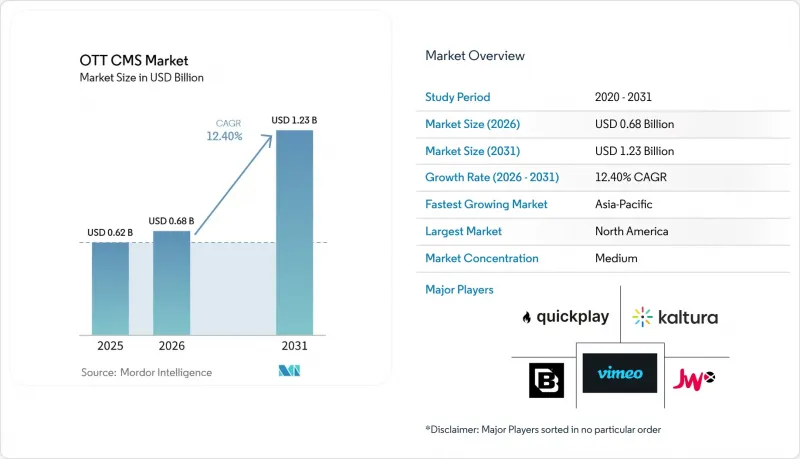
This report is Segmented by Deployment (Cloud, On-Premises, and More), Revenue Model (Subscription Video On Demand (SVOD), AVOD, Transactional and Pay-Per-View (TVOD), Hybrid Monetization, and Freemium), Functionality (Content and Asset Management, Workflow and Publishing Management, Monetization and Business Intelligence, and Rights, and More), and Geography. The Market Forecasts are Provided in Terms of Value (USD).
Global OTT CMS Market Trends and Insights
Rising Demand for Cloud-Native OTT Workflows
Cloud infrastructure has become a core requirement for competitive OTT CMS operations because streaming demand can change sharply by title, territory, and event. Cloud-based platforms allow operators to scale encoding, packaging, storage, and delivery according to actual viewing demand rather than maintaining fixed capacity for occasional peaks. They also support shorter publishing cycles during live events and large releases, when editorial teams must prepare assets and distribution settings within a narrow window. Containerized services allow teams to update transcoding, DRM, advertising, or metadata modules without replacing the entire system or interrupting the core asset library. This approach reduces the effect of older, tightly integrated technology stacks on the OTT content management system market and lets operators modernize selected functions in stages. It also gives specialized vendors a clearer route to offer individual capabilities alongside broader platform suites, while buyers retain control over their existing workflow design.
Growth in Multi-Language and Regional Content Delivery
Multi-language delivery is increasing the amount of information that OTT CMS platforms must manage for every title, including the relationship between language versions, territory rules, and release windows. A single asset may require different audio tracks, subtitles, localized metadata, program descriptions, artwork, and rights settings across many territories, even when the underlying program is identical. In April 2026, Amagi introduced AI reasoning agents within Amagi NOW that automate metadata enrichment in more than 25 languages and localization in more than 100 languages. The release shows why the OTT content management system (CMS) market needs publishing workflows that can handle localization, quality checks, and repeated asset updates without matching increases in staffing or slower release schedules. Disney+ expanded its audio support from 41 to 58 languages in 2026, including Arabic, Hindi, Tamil, Telugu, and Indonesian. Regional platforms that release several language tracks for one title will continue to need efficient metadata and asset-versioning processes that preserve a consistent title record across each local release.
High Re-Platforming and Migration Complexity
Replacing an OTT CMS is a multi-month operational project for organizations with several regions, subscriber records, rights data, connected applications, and established publishing routines. Operators may need to keep the existing platform active while testing the replacement environment, reconciling asset records, and confirming that entitlements remain accurate. This can add cost, require additional staff attention, and limit the speed of a changeover even when the proposed platform offers better features. The risk of disrupted subscriptions, incomplete rights data, or inconsistent viewing experiences also encourages cautious decisions by operators that rely on uninterrupted service. As a result, some operators keep older platforms longer than their feature gaps would otherwise justify and choose narrower upgrades instead of a full replacement. This slower replacement cycle can protect established suppliers and reduce near-term demand in the OTT content management system market, particularly where a platform is connected to many internal and external systems.
Other drivers and restraints analyzed in the detailed report include:
- Expansion of Live Sports and Event Streaming
- Increasing Need for Rights-Aware Content Operations
- Persistent Content Piracy and Rights Leakage Risk
For complete list of drivers and restraints, kindly check the Table Of Contents.
Segment Analysis
Cloud deployment held 60.46% of the OTT CMS market in 2025, confirming that cloud use has moved beyond limited trials for many streaming operators. This position reflects the scale of cloud migration already completed by operators that need flexible infrastructure for content libraries, release activity, and high-demand viewing periods. Cloud platforms can shorten ingest-to-publish work and expand capacity during live events, when a fixed local system may be less able to adjust quickly. They also support incremental upgrades to AI metadata, DRM, advertising functions, and other modules that can be introduced as needs change. This flexibility is difficult to replicate in a fixed local environment, particularly when the operator must support several services, territories, or content formats from the same platform.
Brightcove's 2026 roadmap included 8 new AI Suite capabilities and a redesigned Prism interface delivered as updates to its cloud platform. On-premises systems still serve broadcasters with sensitive content or unfavorable connectivity economics. Hybrid models combine local processing with cloud storage, metadata, and rights controls. This approach is useful for broadcasters with legacy systems and regulatory requirements. Wowza Streaming Engine 4.11 supports bare metal, virtual machines, Docker, Kubernetes, local environments, hybrid environments, and public clouds from one management interface. The OTT Content Management System (CMS) market is therefore serving operators at different stages of the transition rather than treating cloud use as a single decision.
Complete Report Scope:
- By Deployment
- Cloud
- On-Premises
- Hybrid
- By Revenue Model
- Subscription Video on Demand (SVOD)
- Advertising Supported Streaming (AVOD)
- Transactional and Pay-Per-View (TVOD)
- Hybrid Monetization
- Freemium
- By Functionality
- Content and Asset Management
- Workflow and Publishing Management
- Monetization and Business Intelligence
- Rights, Security and Compliance Management
- By Geography
- North America
- United States
- Canada
- Mexico
- Rest of North America
- Europe
- Germany
- United Kingdom
- France
- Russia
- Rest of Europe
- Asia-Pacific
- China
- Japan
- India
- South Korea
- Australia
- Rest of Asia-Pacific
- Middle East
- Saudi Arabia
- United Arab Emirates
- Turkey
- Rest of Middle East
- Africa
- South Africa
- Egypt
- Nigeria
- Rest of Africa
- South America
- Brazil
- Argentina
- Rest of South America
- North America
Geography Analysis
North America accounted for 38.73% of the OTT CMS market in 2025, making it the leading regional base for providers serving large and complex video operations. The region has major subscription platforms, enterprise video publishers, and sports rights holders that require robust content operations across many titles, devices, and viewer access models. Its operators need enterprise-level rights control, multi-tier monetization, and infrastructure for large live audiences that may place sharp demands on capacity and operational response. The United States sets much of the region's technology demand through large streaming services and rights-led content investments. Canada and Mexico also contribute through broadcaster cloud investment, expanding streaming activity, and the need to manage content across national and regional audiences.
Asia-Pacific is projected to grow at a 13.22% CAGR through 2031, supported by a broad mix of high-volume markets and mature premium-content markets. India requires multilingual content operations because platforms often publish several regional language tracks for each title and must maintain reliable data for every version. This creates demand for AI-assisted metadata processes and structured asset libraries that reduce manual work without weakening control over language and territory details. China has high-volume OTT environments through services including iQIYI and Youku, where domestic platforms use local formats and tailored infrastructure that differ from many Western systems. In March 2026, Tving and Wave announced mutual sharing of original content, which highlights the need for cross-platform metadata and rights synchronization. Japan and Australia remain mature, high-ARPU markets where premium content packaging and sports rights shape CMS spending, with platform decisions focused on service quality and content differentiation rather than subscriber scale alone.
Middle East, Africa, and South America represent emerging parts of the OTT content management system market, but the operating needs of their countries are not identical. Saudi Arabia and the United Arab Emirates need Arabic-language metadata, right-to-left interfaces, and Halal content classification as domestic content investment grows and local catalogs develop. South Africa, Egypt, and Nigeria are important African adoption markets, where mobile viewing increases the need for bandwidth-adaptive streaming settings and practical distribution controls. Brazil and Argentina support South American demand, with Brazil placing particular attention on AVOD-capable configurations that can support a growing advertising opportunity. Smaller operators across these regions are cost-sensitive and often favor cloud-native, subscription-priced alternatives to large local installations, creating an opening for vendors that can offer required functions without complex implementation.
- Brightcove Inc.
- Kaltura, Inc.
- Vimeo, Inc.
- JW Player, Inc.
- Wowza Media Systems, LLC
- Muvi LLC
- Dacast, Inc.
- Zype, Inc.
- Uscreen, Inc.
- Quickplay Media, Inc.
- Contus Tech
- Bitmovin Inc.
- Akamai Technologies, Inc.
- Cloudflare, Inc.
- Vbrick Systems, Inc.
- Panopto, Inc.
- Wistia, Inc.
- Haivision Systems Inc.
- Axinom GmbH
- BuyDRM, Inc.
- EZDRM LLC
Additional Benefits:
- The market estimate (ME) sheet in Excel format
- 3 months of analyst support
TABLE OF CONTENTS
1 INTRODUCTION
- 1.1 Study Assumptions and Market Definition
- 1.2 Scope of the Study
2 RESEARCH METHODOLOGY
3 EXECUTIVE SUMMARY
4 MARKET LANDSCAPE
- 4.1 Market Overview
- 4.2 Industry Impact of Macroeconomic Factors
- 4.3 Market Drivers
- 4.3.1 Rising Demand for Cloud-Native OTT Workflows
- 4.3.2 Growth in Multi-Language and Regional Content Delivery
- 4.3.3 Expansion of Live Sports and Event Streaming
- 4.3.4 Increasing Need for Rights-Aware Content Operations
- 4.3.5 Rising Adoption of AI-Assisted Metadata and Search
- 4.3.6 Demand for Monetization Flexibility Across SVOD, AVOD, and TVOD
- 4.4 Market Restraints
- 4.4.1 High Re-Platforming and Migration Complexity
- 4.4.2 Persistent Content Piracy and Rights Leakage Risk
- 4.4.3 Fragmented Legacy Media Supply Chains
- 4.4.4 Compliance Burden Across Privacy, Accessibility, and Territorial Rights
- 4.5 Industry Value Chain Analysis
- 4.6 Regulatory Landscape
- 4.7 Technological Outlook
- 4.8 Porter's Five Forces Analysis
- 4.8.1 Threat of New Entrants
- 4.8.2 Bargaining Power of Suppliers
- 4.8.3 Bargaining Power of Buyers
- 4.8.4 Threat of Substitutes
- 4.8.5 Competitive Rivalry
5 MARKET SIZE AND GROWTH FORECASTS (VALUE)
- 5.1 By Deployment
- 5.1.1 Cloud
- 5.1.2 On-Premises
- 5.1.3 Hybrid
- 5.2 By Revenue Model
- 5.2.1 Subscription Video on Demand (SVOD)
- 5.2.2 Advertising Supported Streaming (AVOD)
- 5.2.3 Transactional and Pay-Per-View (TVOD)
- 5.2.4 Hybrid Monetization
- 5.2.5 Freemium
- 5.3 By Functionality
- 5.3.1 Content and Asset Management
- 5.3.2 Workflow and Publishing Management
- 5.3.3 Monetization and Business Intelligence
- 5.3.4 Rights, Security and Compliance Management
- 5.4 By Geography
- 5.4.1 North America
- 5.4.1.1 United States
- 5.4.1.2 Canada
- 5.4.1.3 Mexico
- 5.4.1.4 Rest of North America
- 5.4.2 Europe
- 5.4.2.1 Germany
- 5.4.2.2 United Kingdom
- 5.4.2.3 France
- 5.4.2.4 Russia
- 5.4.2.5 Rest of Europe
- 5.4.3 Asia-Pacific
- 5.4.3.1 China
- 5.4.3.2 Japan
- 5.4.3.3 India
- 5.4.3.4 South Korea
- 5.4.3.5 Australia
- 5.4.3.6 Rest of Asia-Pacific
- 5.4.4 Middle East
- 5.4.4.1 Saudi Arabia
- 5.4.4.2 United Arab Emirates
- 5.4.4.3 Turkey
- 5.4.4.4 Rest of Middle East
- 5.4.5 Africa
- 5.4.5.1 South Africa
- 5.4.5.2 Egypt
- 5.4.5.3 Nigeria
- 5.4.5.4 Rest of Africa
- 5.4.6 South America
- 5.4.6.1 Brazil
- 5.4.6.2 Argentina
- 5.4.6.3 Rest of South America
- 5.4.1 North America
6 COMPETITIVE LANDSCAPE
- 6.1 Market Concentration
- 6.2 Strategic Moves
- 6.3 Market Share Analysis
- 6.4 Company Profiles (includes Global Level Overview, Market Level Overview, Core Segments, Financials as available, Strategic Information, Market Rank/Share, Products and Services, Recent Developments)
- 6.4.1 Brightcove Inc.
- 6.4.2 Kaltura, Inc.
- 6.4.3 Vimeo, Inc.
- 6.4.4 JW Player, Inc.
- 6.4.5 Wowza Media Systems, LLC
- 6.4.6 Muvi LLC
- 6.4.7 Dacast, Inc.
- 6.4.8 Zype, Inc.
- 6.4.9 Uscreen, Inc.
- 6.4.10 Quickplay Media, Inc.
- 6.4.11 Contus Tech
- 6.4.12 Bitmovin Inc.
- 6.4.13 Akamai Technologies, Inc.
- 6.4.14 Cloudflare, Inc.
- 6.4.15 Vbrick Systems, Inc.
- 6.4.16 Panopto, Inc.
- 6.4.17 Wistia, Inc.
- 6.4.18 Haivision Systems Inc.
- 6.4.19 Axinom GmbH
- 6.4.20 BuyDRM, Inc.
- 6.4.21 EZDRM LLC
7 MARKET OPPORTUNITIES AND FUTURE OUTLOOK
- 7.1 White-Space and Unmet-Need Assessment

