PUBLISHER: Mordor Intelligence | PRODUCT CODE: 2116485

PUBLISHER: Mordor Intelligence | PRODUCT CODE: 2116485
Animal Intestinal Health - Market Share Analysis, Industry Trends & Statistics, Growth Forecasts (2026 - 2031)
According to Mordor Intelligence, the animal intestinal health market size is estimated at USD 5.68 billion in 2026, and is expected to reach USD 8.38 billion by 2031, at a CAGR of 8.11% during the forecast period (2026-2031).
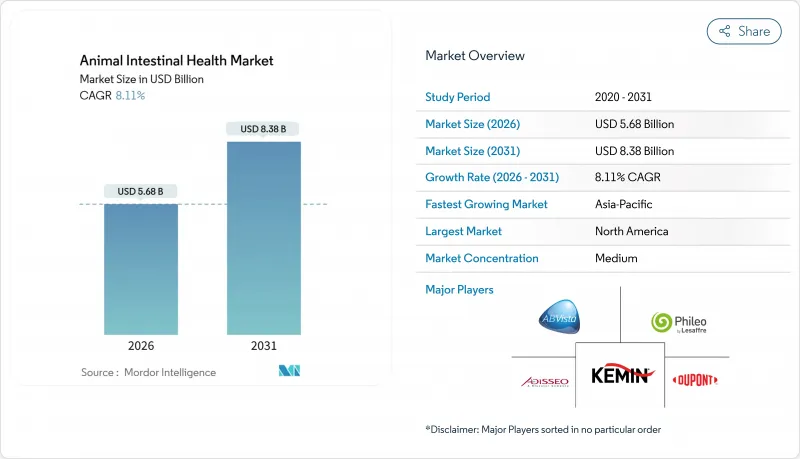
This report is Segmented by Livestock (Aquaculture, Poultry, Ruminant, Swine, and Others), Additive (Probiotics, Prebiotics, Immunostimulants, and Phytogenics), Form (Dry and Liquid), Source (Microbial and Plant-Based), and Geography (North America, Europe, Asia-Pacific, Middle East & Africa, and South America). The Market Forecasts are Provided in Terms of Value (USD).
Global Animal Intestinal Health Market Trends and Insights
Rising Intestinal Disorders Among Livestock Drive Market Expansion
Higher stocking densities, faster growth cycles, and fluctuating temperatures have increased the prevalence of gut disorders in most commercial species. Post-weaning diarrhea now affects up to one-fifth of modern swine cohorts and has become costlier than respiratory disease in some units. Poultry producers navigating AGP withdrawals face similar pressure from necrotic enteritis outbreaks that trim weight gain and raise mortality. Producers calculate that each percentage point loss in feed conversion adds thousands of dollars to feed bills every cycle, prompting rapid investment in protective additives. Integrating probiotics and prebiotics into starter diets has cut diarrhea incidence by 30% in large trials. Demand therefore scales directly with the push to preserve margins without antibiotics, reinforcing the upward trajectory of the animal intestinal health market.
Functional Animal-Feed Production Growth Accelerates Additive Integration
Feed mills increasingly design complete rations that embed gut health ingredients instead of selling them as stand-alone supplements. The practice simplifies logistics for livestock enterprises and guarantees uniform additive delivery from the first to the last bite. Major European integrators have expanded functional-feed lines by nearly one-third since 2024. In parallel, extruders and pelleting lines have been upgraded with temperature-controlled zones that protect probiotic viability, allowing higher inclusion levels without sacrificing live-cell counts. Savings accrue because one production pass now accomplishes what used to require multiple on-farm steps, and additive makers benefit from more predictable off-take agreements with feed formulators. These trends anchor a structural rise in bulk orders and underpin sustained revenue growth for the animal intestinal health market.
Stringent Regulatory Approval Timelines Constrain Innovation Deployment
Bringing a novel probiotic or phytogenic to market can require two to three years of dossier preparation and review in major jurisdictions. EFSA's Qualified Presumption of Safety process demands extensive genomic and toxicology data, while the U.S. FDA's GRAS route insists on multi-species feeding trials that together can cost USD 2-5 million per application. Such hurdles lengthen the payback period and deter small biotechnology firms from entering the space, narrowing the pipeline of disruptive solutions. Even large multinationals must stagger launches geographically to recoup cost, which slows the global diffusion of breakthroughs and tempers near-term expansion in the animal intestinal health market.
Other drivers and restraints analyzed in the detailed report include:
- AGP Bans Accelerate Transition to Gut Health Alternatives
- AI-Driven Microbiome Profiling Enables Precision Nutrition Strategies
- High Costs of Specialty Ingredients Limit Market Penetration
For complete list of drivers and restraints, kindly check the Table Of Contents.
Segment Analysis
Swine contributed 29.45% to the animal intestinal health market size in 2025 as production systems tightened biosecurity and replaced AGPs with multi-strain probiotic and prebiotic packages. Post-weaning programs now emphasize early gut colonization to limit pathogenic E. coli proliferation that erodes growth. Meanwhile, aquaculture posts a 10.34% CAGR, the highest among all species, supported by rising seafood demand and chronic bacterial challenges in intensive ponds. Freshwater tilapia and brackish shrimp farms adopt coated probiotics that survive water dispersion and improve feed conversion. Poultry retains steady demand, mainly from broiler complexes combating necrotic enteritis after AGP removal. Ruminant adoption centers on calf and lamb starter feeds, with specialty blends easing the transition from milk to solid feed. Insect farming, led by black soldier fly larvae, appears small today but opens an innovative niche for targeted prebiotics that raise protein-conversion efficiency.
The animal intestinal health market share edge held by swine is expected to compress as aquaculture's absolute spending climbs. Shrimp growers in Vietnam and India already dedicate up to 4% of feed budgets to gut additives, mirroring levels typical in swine systems. Competitive intensity therefore shifts toward water-stable formulations, with suppliers leveraging patents on micro-encapsulation and spore-forming strains. Cross-species platforms also gain traction, letting companies repurpose IP developed for terrestrial livestock in aquatic settings. This convergence lifts volumes and strengthens economies of scale across the value chain.
Prebiotics accounted for 27.54% of the animal intestinal health market share in 2025, anchored by fructo-oligosaccharides and mannan-rich fractions that enhance beneficial bacteria growth. Their compatibility with most regulatory frameworks and ability to tolerate high pelleting temperatures secure widespread usage. Phytogenics grow fastest at 9.89% CAGR, buoyed by plant-derived compounds such as essential oils that exhibit antimicrobial and anti-inflammatory properties without the residue concerns linked to synthetic additives. Probiotics comprise a mature but innovation-active cluster, with researchers tailoring strains for heat resistance and spore formation to widen use in pelleted feeds. Immunostimulants, while niche, attract attention for reducing vaccine-stress impacts in young animals.
Producers gravitate toward multi-component solutions that blend prebiotics with phytogenics, achieving synergistic action on microbial balance and intestinal integrity. This holistic tilt differentiates premium offerings and raises switching costs for end users. Suppliers that validate such combinations through peer-reviewed trials enjoy faster listing by international feed formulators. Regulatory bodies in the European Union and Brazil have begun approving specific phytogenic molecules, a milestone that encourages broader uptake and dilutes historical skepticism around botanical variability.
Complete Report Scope:
- By Livestock
- Aquaculture
- Poultry
- Ruminant
- Swine
- Others
- By Additive
- Probiotics
- Prebiotics
- Immunostimulants
- Phytogenics
- By Form
- Dry
- Liquid
- By Source
- Microbial
- Plant-Based
- Geography
- North America
- United States
- Canada
- Mexico
- Europe
- Germany
- United Kingdom
- France
- Italy
- Spain
- Rest of Europe
- Asia-Pacific
- China
- Japan
- India
- Australia
- South Korea
- Rest of Asia-Pacific
- Middle East & Africa
- GCC
- South Africa
- Rest of Middle East & Africa
- South America
- Brazil
- Argentina
- Rest of South America
- North America
Geography Analysis
North America held 41.33% of the animal intestinal health market in 2025, led by the United States, where mandatory veterinary feed directives and early AGP withdrawals fostered rapid alternative adoption. Large integrators deploy real-time monitoring devices that link pen-side sensors with cloud-based nutrition platforms, allowing quick dosing adjustments when gut dysbiosis signals emerge. Canada's thriving black soldier fly sector also boosts prebiotic sales, as larvae growers refine microbiome management to improve protein yield, while Mexico's feed industry scales probiotic use to satisfy export-market residue limits.
Asia-Pacific demonstrates the swiftest climb with a projected 9.54% CAGR, underpinned by surging fish and shrimp output and continued rise in regional protein demand. China's post-ASF swine rebuilding accelerates spending on gut health to safeguard newly installed high-biosecurity units. India's dairy cooperatives invest in calf nutrition programs to curb early-life scours and raise lifetime milk output. Japan and South Korea, characterized by high technology adoption, pilot AI-guided microbiome tools that refine additive selection, providing templates other nations aim to replicate.
Europe records solid, regulation-driven expansion as producers must comply with the world's toughest antimicrobial curbs. Feed formulators there lead in functional-feed innovations, integrating multiple gut support agents into single pellets accepted by organic certification bodies. Scandinavian poultry complexes showcase low antibiotic-usage benchmarks through probiotics plus oat-based beta-glucans. In contrast, South America and the Middle East & Africa register lower current penetration but deliver new volume growth as local authorities tighten drug-residue controls and export-oriented farms seek certification.
- AB Vista
- ADM/Anco Animal Nutrition
- Alltech
- ARM & Hammer Animal Nutrition
- Beneo
- Biorigin
- Bluestar Adisseo
- Calpis
- Cargill
- Chr. Hansen
- Delacon
- Dr Eckel
- DuPont (IFF)
- Evonik Industries
- Kemin Industries
- DSM
- Lallemand
- Lesaffre
- Nutreco
- Ohly
- Pancosma
- Phytobiotics
- Unique Biotech
Additional Benefits:
- The market estimate (ME) sheet in Excel format
- 3 months of analyst support
TABLE OF CONTENTS
1 Introduction
- 1.1 Study Assumptions & Market Definition
- 1.2 Scope of the Study
2 Research Methodology
3 Executive Summary
4 Market Landscape
- 4.1 Market Overview
- 4.2 Market Drivers
- 4.2.1 Rising Intestinal Disorders Among Livestock
- 4.2.2 Growth in Functional Animal-feed Production
- 4.2.3 AGP Bans Shifting demand to Gut-health Additives
- 4.2.4 Insect-protein Farming Spurring Prebiotic Demand
- 4.2.5 AI-driven Microbiome Profiling Enabling Precision Nutrition
- 4.3 Market Restraints
- 4.3.1 Stringent Regulatory Approval Timelines
- 4.3.2 High Cost of Specialty Gut-health Ingredients
- 4.3.3 Microbiome Variability Across Breeds Limits Standardisation
- 4.4 Value / Supply-Chain Analysis
- 4.5 Regulatory Landscape
- 4.6 Technological Outlook
- 4.7 Porter's Five Forces
- 4.7.1 Threat of New Entrants
- 4.7.2 Bargaining Power of Buyers
- 4.7.3 Bargaining Power of Suppliers
- 4.7.4 Threat of Substitutes
- 4.7.5 Intensity of Rivalry
5 Market Size & Growth Forecasts (Value, USD)
- 5.1 By Livestock
- 5.1.1 Aquaculture
- 5.1.2 Poultry
- 5.1.3 Ruminant
- 5.1.4 Swine
- 5.1.5 Others
- 5.2 By Additive
- 5.2.1 Probiotics
- 5.2.2 Prebiotics
- 5.2.3 Immunostimulants
- 5.2.4 Phytogenics
- 5.3 By Form
- 5.3.1 Dry
- 5.3.2 Liquid
- 5.4 By Source
- 5.4.1 Microbial
- 5.4.2 Plant-Based
- 5.5 Geography
- 5.5.1 North America
- 5.5.1.1 United States
- 5.5.1.2 Canada
- 5.5.1.3 Mexico
- 5.5.2 Europe
- 5.5.2.1 Germany
- 5.5.2.2 United Kingdom
- 5.5.2.3 France
- 5.5.2.4 Italy
- 5.5.2.5 Spain
- 5.5.2.6 Rest of Europe
- 5.5.3 Asia-Pacific
- 5.5.3.1 China
- 5.5.3.2 Japan
- 5.5.3.3 India
- 5.5.3.4 Australia
- 5.5.3.5 South Korea
- 5.5.3.6 Rest of Asia-Pacific
- 5.5.4 Middle East & Africa
- 5.5.4.1 GCC
- 5.5.4.2 South Africa
- 5.5.4.3 Rest of Middle East & Africa
- 5.5.5 South America
- 5.5.5.1 Brazil
- 5.5.5.2 Argentina
- 5.5.5.3 Rest of South America
- 5.5.1 North America
6 Competitive Landscape
- 6.1 Market Concentration
- 6.2 Market Share Analysis
- 6.3 Company Profiles (includes Global level Overview, Market level overview, Core Segments, Financials as available, Strategic Information, Market Rank/Share for key companies, Products & Services, Recent Developments)
- 6.3.1 AB Vista
- 6.3.2 ADM/Anco Animal Nutrition
- 6.3.3 Alltech
- 6.3.4 ARM & Hammer Animal Nutrition
- 6.3.5 Beneo
- 6.3.6 Biorigin
- 6.3.7 Bluestar Adisseo
- 6.3.8 Calpis
- 6.3.9 Cargill
- 6.3.10 Chr. Hansen
- 6.3.11 Delacon
- 6.3.12 Dr Eckel
- 6.3.13 DuPont (IFF)
- 6.3.14 Evonik Industries
- 6.3.15 Kemin Industries
- 6.3.16 DSM
- 6.3.17 Lallemand
- 6.3.18 Lesaffre
- 6.3.19 Nutreco
- 6.3.20 Ohly
- 6.3.21 Pancosma
- 6.3.22 Phytobiotics
- 6.3.23 Unique Biotech
7 Market Opportunities & Future Outlook
- 7.1 White-space & Unmet-Need Assessment

