PUBLISHER: Mordor Intelligence | PRODUCT CODE: 2116487

PUBLISHER: Mordor Intelligence | PRODUCT CODE: 2116487
Mental Health Apps - Market Share Analysis, Industry Trends & Statistics, Growth Forecasts (2026 - 2031)
According to Mordor Intelligence, the mental health apps market size was valued at USD 8.40 billion in 2025 and is estimated to grow from USD 9.45 billion in 2026 to reach USD 18.81 billion by 2031, at a CAGR of 14.76% during the forecast period (2026-2031).
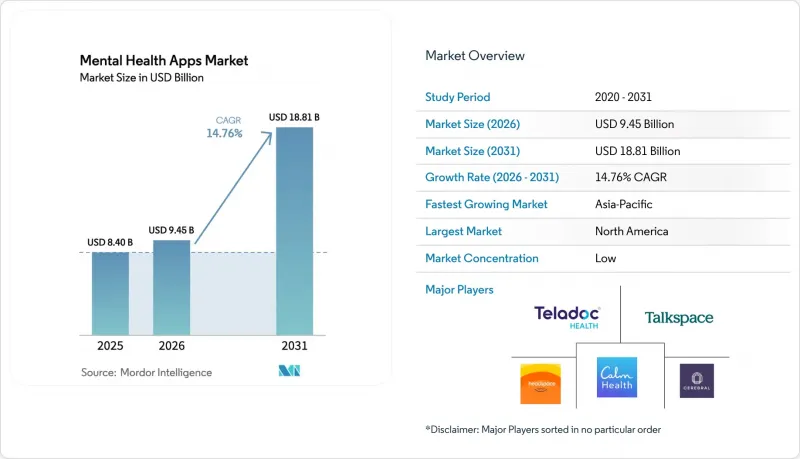
This report is Segmented by Platform (iOS, Android, Cross-platform/Hybrid, Wearables-First), Application (Depression & Anxiety Management, and More), End User (Homecare/Individuals, and More), Age Group (Children & Adolescents <=17, and More), Subscription Model (Freemium, and More), and Geography (North America, and More). The Market Forecasts are Provided in Terms of Value (USD).
Global Mental Health Apps Market Trends and Insights
Rising Burden Of Anxiety And Depression Globally
More than 1 billion people live with a mental disorder, and treatment gaps stay wide. U.S. surveys in 2024 showed 19% of adults reported depression and anxiety, while 42% of high-school students felt persistently sad. Eight thousand U.S. regions lacked enough professionals, leaving 167 million residents underserved. Evidence now places app-based CBT on par with face-to-face therapy for mild cases. Validated results move apps onto payer formularies, converting unmet need into the expanding mental health apps market.
Smartphone Penetration And App-Store Distribution Scale
Smartphone ownership reached 52% in India and 68% in Indonesia by 2024. App stores let developers reach new users at minimal marginal cost and update weekly, speeding feature iteration. Wysa gained 5 million users and embedded its chatbot in leading Indian hospital systems. Japanese public campaigns raised demand for Awarefy and Emol. Fast feedback loops cut the attrition that plagues stand-alone digital content and enlarge the global mental health apps market.
Regulatory Classification Ambiguity And Evidence Thresholds
The FDA cleared only two prescription digital therapeutics for mental health, and both left the market after Pear Therapeutics' bankruptcy. Germany's DiGA directory contained 53 reimbursable apps by late 2024, each needing randomized trial proof within a year. Fragmented rules force multi-country filings that can cost up to USD 1 million. Small developers struggle with these demands, slowing new evidence-grade launches and tempering growth in the mental health apps market.
Other drivers and restraints analyzed in the detailed report include:
- Employer And Payer Adoption Of Digital Mental Health Benefits
- AI Chatbots And CBT Personalization Improving Access And Outcomes
- Data Privacy And Cybersecurity Risks Erode Trust
For complete list of drivers and restraints, kindly check the Table Of Contents.
Segment Analysis
iOS held 52.63% of mental health apps market share in 2025 due to higher average revenue per user and strong privacy controls. Android is set to grow at a 17.45% CAGR because India, Indonesia, and China now supply most new smartphone users. Cross-platform frameworks cut build costs yet miss native features that deepen engagement. Wearables-first designs stay niche but validate passive tracking. Together these trends diversify the mental health apps market.
Apple's on-device AI encrypts data and satisfies employer risk teams, boosting adoption in corporate programs. Google's Health Connect mirrors this privacy stance for Android. Paid conversion remains stronger on iOS, yet enterprise sponsorship is bridging the gap on Android. Platform strategies will determine monetization pathways across the mental health apps market.
Depression and anxiety tools captured 30.13% of the mental health apps market share in 2025 on the back of FDA 510(k) clearances for Sleepio and Daylight. Stress management apps are projected to rise at a 16.34% CAGR as employers bundle mindfulness to curb absenteeism. Meditation apps face free-content competition, while sleep solutions benefit from wearable data. Substance use and PTSD apps remain underserved, leaving white space within the mental health apps market.
Employer demand for preventive tools helps stress apps outpace legacy meditation catalogs. Integration with Apple Watch and Fitbit sleep scores anchors engagement. The limited pipeline for substance use care after Pear's exit signals an acquisition opportunity for validated newcomers. Niches such as eating disorder support need careful design to avoid triggering behaviors, yet they remain part of the broader mental health apps industry.
Complete Report Scope:
- By Platform Type
- iOS
- Android
- Web/Progressive Web Apps
- Others (Wearable-first, Voice-only)
- By Application
- Depression and Anxiety Management
- Stress Management
- Meditation and Mindfulness
- Sleep and Wellness Improvement
- Substance-Use Disorder Support
- Other Applications
- By End User
- Home-care Settings
- Employers and Corporate Wellness Programs
- Mental Hospitals and Clinics
- Schools and Universities
- Other End Users
- By Age Group
- Children and Adolescents (<=17 yrs)
- Adults (18-64 yrs)
- Geriatric (65+ yrs)
- By Geography
- North America
- United States
- Canada
- Mexico
- Europe
- Germany
- United Kingdom
- France
- Italy
- Spain
- Rest of Europe
- Asia-Pacific
- China
- Japan
- India
- Australia
- South Korea
- Rest of Asia-Pacific
- Middle East and Africa
- GCC
- South Africa
- Rest of Middle East and Africa
- South America
- Brazil
- Argentina
- Rest of South America
- North America
Geography Analysis
North America produced 37.56% of global revenue in 2025, fueled by wide employer adoption and the 2025 CMS codes that reimburse digital therapy sessions. The United States alone delivered 85% of the region's value as self-insured firms adopted Spring Health and Lyra Health to curb claims. Canada and Mexico trail because fragmented payor systems complicate reimbursement, though Dialogue Health Technologies expanded mental health offerings for Canadian employers in 2024. CAC inflation from Apple privacy policies squeezed direct-to-consumer margins, yet enterprise channels kept the mental health apps market growing.
Asia-Pacific is projected to post the fastest regional expansion at a 17.55% CAGR through 2031. Smartphone ownership and destigmatization campaigns push adoption in India, Indonesia, and China. Wysa's partnerships with Apollo and Manipal hospitals integrate chatbots into clinical care, while Japanese government initiatives boosted use of Awarefy and Emol. South Korea piloted reimbursement through the National Health Insurance Service. Anonymity addresses cultural stigma, lifting participation and enlarging the mental health apps market.
Europe is led by Germany's DiGA pathway with 53 reimbursable apps. France's Forfait Innovation approves tools but lacks fixed pricing, slowing roll-out. The U.K. NHS Apps Library sets safety and privacy standards, yet post-Brexit divergence adds duplication. Northern Europe's high digital literacy speeds adoption, while the Mediterranean and Eastern regions advance slowly. Outside Europe, emerging programs in Brazil and select Middle East markets signal early interest, but infrastructure gaps limit near-term contribution to the mental health apps market.
- Calm.com Inc.
- Headspace Health
- BetterHelp (Teladoc Health)
- Talkspace Inc.
- Sanvello Health Inc.
- Wysa Ltd.
- Happify Health
- MoodMission
- Youper
- K Health
- CVS Health (Aetna Inc.)
- Lyra Health
- Spring Health
- Big Health (Sleepio)
- Unmind Ltd.
- Inner Explorer Inc.
- Insight Timer
- MoodTools
- TimelyCare
- MindDoc Health GmbH
- Kintsugi
Additional Benefits:
- The market estimate (ME) sheet in Excel format
- 3 months of analyst support
TABLE OF CONTENTS
1 Introduction
- 1.1 Study Assumptions & Market Definition
- 1.2 Scope of the Study
2 Research Methodology
3 Executive Summary
4 Market Landscape
- 4.1 Market Overview
- 4.2 Market Drivers
- 4.2.1 Rising global prevalence of anxiety, depression & stress disorders
- 4.2.2 Surge in smartphone penetration & 5G connectivity enabling on-demand care
- 4.2.3 Growing clinical & payer acceptance of tele-mental-health solutions
- 4.2.4 Growing Awareness Pertaining to the Importance of Mental Health
- 4.2.5 Expanding corporate wellness and insurance reimbursement programs
- 4.2.6 Technological advancements and AI Integration
- 4.3 Market Restraints
- 4.3.1 Ambiguous regulatory classification & evidence requirements across regions
- 4.3.2 Data-privacy and cybersecurity concerns undermining user trust
- 4.3.3 Market saturation with low-quality apps diluting clinical credibility
- 4.3.4 Low engagement and high dropout rates
- 4.4 Technological Outlook
- 4.5 Porter's Five Forces Analysis
- 4.5.1 Threat of New Entrants
- 4.5.2 Bargaining Power of Buyers/Consumers
- 4.5.3 Bargaining Power of Suppliers
- 4.5.4 Threat of Substitute Products
- 4.5.5 Intensity of Competitive Rivalry
5 Market Size & Growth Forecasts (Value)
- 5.1 By Platform Type
- 5.1.1 iOS
- 5.1.2 Android
- 5.1.3 Web/Progressive Web Apps
- 5.1.4 Others (Wearable-first, Voice-only)
- 5.2 By Application
- 5.2.1 Depression and Anxiety Management
- 5.2.2 Stress Management
- 5.2.3 Meditation and Mindfulness
- 5.2.4 Sleep and Wellness Improvement
- 5.2.5 Substance-Use Disorder Support
- 5.2.6 Other Applications
- 5.3 By End User
- 5.3.1 Home-care Settings
- 5.3.2 Employers and Corporate Wellness Programs
- 5.3.3 Mental Hospitals and Clinics
- 5.3.4 Schools and Universities
- 5.3.5 Other End Users
- 5.4 By Age Group
- 5.4.1 Children and Adolescents (<=17 yrs)
- 5.4.2 Adults (18-64 yrs)
- 5.4.3 Geriatric (65+ yrs)
- 5.5 By Geography
- 5.5.1 North America
- 5.5.1.1 United States
- 5.5.1.2 Canada
- 5.5.1.3 Mexico
- 5.5.2 Europe
- 5.5.2.1 Germany
- 5.5.2.2 United Kingdom
- 5.5.2.3 France
- 5.5.2.4 Italy
- 5.5.2.5 Spain
- 5.5.2.6 Rest of Europe
- 5.5.3 Asia-Pacific
- 5.5.3.1 China
- 5.5.3.2 Japan
- 5.5.3.3 India
- 5.5.3.4 Australia
- 5.5.3.5 South Korea
- 5.5.3.6 Rest of Asia-Pacific
- 5.5.4 Middle East and Africa
- 5.5.4.1 GCC
- 5.5.4.2 South Africa
- 5.5.4.3 Rest of Middle East and Africa
- 5.5.5 South America
- 5.5.5.1 Brazil
- 5.5.5.2 Argentina
- 5.5.5.3 Rest of South America
- 5.5.1 North America
6 Competitive Landscape
- 6.1 Market Concentration
- 6.2 Market Share Analysis
- 6.3 Company profiles (includes Global level Overview, Market level overview, Core Segments, Financials as available, Strategic Information, Market Rank/Share for key companies, Products & Services, and Recent Developments)
- 6.3.1 Calm.com Inc.
- 6.3.2 Headspace Health
- 6.3.3 BetterHelp (Teladoc Health)
- 6.3.4 Talkspace Inc.
- 6.3.5 Sanvello Health Inc.
- 6.3.6 Wysa Ltd.
- 6.3.7 Happify Health
- 6.3.8 MoodMission
- 6.3.9 Youper Inc.
- 6.3.10 K Health Inc.
- 6.3.11 CVS Health (Aetna Inc.)
- 6.3.12 Lyra Health Inc.
- 6.3.13 Spring Health
- 6.3.14 Big Health (Sleepio)
- 6.3.15 Unmind Ltd.
- 6.3.16 Inner Explorer Inc.
- 6.3.17 Insight Timer
- 6.3.18 MoodTools
- 6.3.19 TimelyCare
- 6.3.20 MindDoc Health GmbH
- 6.3.21 Kintsugi
7 Market Opportunities & Future Outlook
- 7.1 White-space & Unmet-Need Assessment

