PUBLISHER: Mordor Intelligence | PRODUCT CODE: 2116509

PUBLISHER: Mordor Intelligence | PRODUCT CODE: 2116509
Healthcare CRM - Market Share Analysis, Industry Trends & Statistics, Growth Forecasts (2026 - 2031)
According to Mordor Intelligence, the healthcare CRM market size is expected to grow from USD 20.61 billion in 2025 to USD 23.15 billion in 2026 and is forecast to reach USD 41.45 billion by 2031 at 12.34% CAGR over 2026-2031.
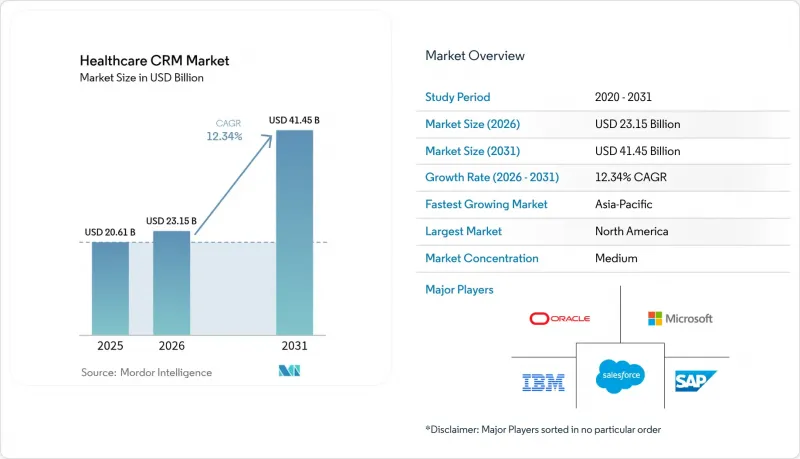
This report is Segmented by Component (Software and Services), Deployment Model (On-Premise, Web/Cloud-Based), Organization Size (Large Enterprises and SMEs), Application (Customer Service & Support and More), End-User (Hospitals and More), and Geography (North America, Europe, Asia-Pacific, Middle East and Africa, and South America). The Market Forecasts are Provided in Terms of Value (USD).
Global Healthcare CRM Market Trends and Insights
Shift to Value-Based Care Requiring Patient Engagement Platforms
Health systems moving toward value-based reimbursement models need robust tools that monitor outcomes and enable proactive outreach. Organizations involved in value-based contracts are 36% more likely to invest in advanced patient-engagement software that ties clinical, financial, and behavioral data into a single record. The Centers for Medicare & Medicaid Services increased home-health payment rates by 2.7% for 2025, though adjustments lowered the net rise to 0.5%. Providers are therefore intensifying efforts to track quality metrics and minimize penalties. Integrated healthcare CRM market platforms automate outreach, support care-gap closure, and simplify population-health analytics across multiple care settings, making them critical enablers of value-based success.
Rapid Adoption of Omnichannel Patient Communication Across Healthcare
The omnichannel trend is driving record levels of platform investment. Surveys show 92% of patients prefer digital intake forms and 91% expect rapid responses through portals, text, or email. Providers using coordinated SMS, portal, and voice workflows report appointment-adherence jumps of up to 35% and satisfaction increases of 28%. These gains translate directly into revenue retention by reducing no-shows and driving loyalty. As consumer expectations continue to align with retail-style experiences, the healthcare CRM market is moving quickly toward AI-driven chatbots and sentiment analysis that refine engagement strategies in real time.
Persistent Data Silos from Fragmented Legacy IT
Many health systems continue to maintain dozens of specialized applications that cannot easily exchange information, blocking efforts to create unified patient records. Dirty data costs the sector an estimated USD 300 billion each year and complicates analytics roll-outs. Implementations routinely require labor-intensive data mapping and transformation projects that inflate budgets and extend timelines. Vendors with in-house accelerators or partnerships for enterprise integration are gaining traction, yet the risk of budget overruns remains a deterrent for smaller organizations evaluating healthcare CRM market projects.
Other drivers and restraints analyzed in the detailed report include:
- Government Interoperability Mandates Elevating Data Integration Demand
- Telehealth Expansion Driving CRM-Virtual Care Integration
- Stringent Data-Protection Regulations Prolonging Procurement Cycles
For complete list of drivers and restraints, kindly check the Table Of Contents.
Segment Analysis
The component landscape shows software accounting for 65.12% of revenue in 2025, yet services are expanding faster at a 13.25% CAGR. Cloud migrations, EHR integrations, and change-management programs demand specialist expertise that internal IT teams often lack. Health systems commonly bundle consulting, implementation, and managed-support contracts into multiyear deals to guarantee performance and user adoption. As artificial-intelligence modules become commonplace, advanced configuration and ongoing algorithm tuning further elevate services spend. The healthcare CRM market benefits when implementation partners accelerate time-to-value by harmonizing workflows across clinical, financial, and consumer-experience departments.
In parallel, platform vendors are unveiling low-code toolkits, but most providers still prefer external assistance for data-quality remediation and regulatory mapping. Early evidence indicates that service-supported roll-outs achieve 20-30% higher user-satisfaction scores compared with do-it-yourself deployments. These positive outcomes reinforce the services' growth story and encourage first-time buyers to select bundled engagements. As more mid-tier hospitals and ambulatory networks join the buyer pool, the healthcare CRM industry services ecosystem is poised to widen, creating new niches for niche system integrators.
Web/cloud segment held a 77.65% share in 2025 and continue to grow at a 12.46% CAGR. Subscription pricing lowers upfront capital expenditure, while remote access supports hybrid workforce models. Providers gravitate toward single-tenant or regionally segregated arrangements that comply with data sovereignty rules. Legacy on-premise deployments linger within academic medical centers that co-locate research data and require ultra-low latency. Yet, the cost of hardware refresh cycles drives many toward managed hosting.
Elastic storage and integrated disaster-recovery features have reduced security concerns. Most vendors now achieve HITRUST, ISO 27001, and SOC2 certifications, removing significant procurement barriers. The shift also aligns with sustainability goals, as consolidated hosting often improves energy efficiency. Given these factors, the healthcare CRM market is expected to maintain a decisive cloud tilt throughout the decade.
Complete Report Scope:
- By Component
- Software
- Services
- By Deployment Model
- On-Premise
- Web/Cloud
- By Organization Size
- Large Enterprises
- SMEs
- By Application
- Customer Service & Support
- Marketing
- Sales
- Patient Information Management
- Other Applications
- By End-User
- Hospitals
- Ambulatory Surgery Centers & Clinics
- Diagnostic Centers
- Other End-Users
- By Geography (Value)
- North America
- United States
- Canada
- Mexico
- Europe
- Germany
- United Kingdom
- France
- Italy
- Spain
- Rest of Europe
- Asia-Pacific
- China
- India
- Japan
- Australia
- South Korea
- Rest of Asia-Pacific
- Middle East & Africa
- GCC
- South Africa
- Rest of Middle East & Africa
- South America
- Brazil
- Argentina
- Rest of South America
- North America
Geography Analysis
North America held 51.78% of global revenue in 2025, anchored by mature electronic-health-record penetration, advanced reimbursement models, and a dense vendor ecosystem. The region's 11.98% CAGR to 2031 is solid though modest compared with emerging markets. Health systems concentrate on optimization projects that improve patient-experience metrics and unlock incremental value from prior IT spend. Federal incentives for interoperability, plus ongoing telehealth reimbursement parity within Medicare, keep demand high across integrated delivery networks and payer-provider hybrids.
Asia Pacific is the fastest-growing territory with 13.62% CAGR, propelled by large population bases, rapid digitization, and progressive national e-health programs. China and India are funneling budget toward regional cloud hubs, rural telemedicine, and mobile-first engagement. India's Union Budget 2025 underlined plans to extend digital-health coverage and to incentivize broadband expansion into remote districts. These policies shorten deployment timelines for cloud-native solutions, directly boosting the healthcare CRM market.
Europe contributes a sizeable share and grows at 12.33% CAGR. The European Health Data Space, combined with GDPR privacy safeguards, drives organizations toward platforms with fault-tolerant encryption and audit trails. United Kingdom trusts and German university clinics are piloting AI-powered segmentation that tailors outreach to linguistic and socioeconomic profiles. Southern and Eastern European systems follow the path, often supported by EU structural funds that co-finance digital infrastructure. Middle East & Africa and South America expand at 13.41% and 12.88%, underpinned by private-sector investment, growing medical-tourism inflows, and demand for consumer-grade digital experiences.
- Accenture
- Creatio
- Cured Health
- Epic Systems
- hc1.com
- IBM Corp
- Infor Inc
- Innovaccer
- Microsoft Corp
- Oracle
- Pegasystems
- Personify Health, Inc.
- Phreesia, Inc
- Sage Group plc
- Salesforce Inc
- SAP
- SugarCRM
- Veeva Systems
- WebMD Ignite, Inc
- Zoho Corporation
Additional Benefits:
- The market estimate (ME) sheet in Excel format
- 3 months of analyst support
TABLE OF CONTENTS
1 Introduction
- 1.1 Study Assumptions & Market Definition
- 1.2 Scope of the Study
2 Research Methodology
3 Executive Summary
4 Market Landscape
- 4.1 Market Overview
- 4.2 Market Drivers
- 4.2.1 Shift to Value-Based Care Requiring Patient Engagement Platforms
- 4.2.2 Rapid Adoption of Omnichannel Patient Communication Across Healthcare
- 4.2.3 Government Interoperability Mandates Elevating Data Integration Demand
- 4.2.4 Telehealth Expansion Driving CRM-Virtual Care Integration
- 4.2.5 Rise of Healthcare Consumerism & Personalized Patient Journeys
- 4.2.6 Hospital Consolidation Catalyzing Enterprise-Wide CRM Roll-outs
- 4.3 Market Restraints
- 4.3.1 Persistent Data Silos from Fragmented Legacy IT
- 4.3.2 Stringent Data-Protection Regulations Prolonging Procurement Cycles
- 4.3.3 Global Healthcare IT Talent Shortage Limiting Deployment Capacity
- 4.3.4 Clinician Resistance to Workflow Changes and Technology Uptake
- 4.4 Technological Outlook
- 4.5 Regulatory Outlook
- 4.6 Porter's Five Forces Analysis
- 4.6.1 Threat of New Entrants
- 4.6.2 Bargaining Power of Buyers
- 4.6.3 Bargaining Power of Suppliers
- 4.6.4 Threat of Substitutes
- 4.6.5 Intensity of Rivalry
5 Market Size & Growth Forecasts (Value)
- 5.1 By Component
- 5.1.1 Software
- 5.1.2 Services
- 5.2 By Deployment Model
- 5.2.1 On-Premise
- 5.2.2 Web/Cloud
- 5.3 By Organization Size
- 5.3.1 Large Enterprises
- 5.3.2 SMEs
- 5.4 By Application
- 5.4.1 Customer Service & Support
- 5.4.2 Marketing
- 5.4.3 Sales
- 5.4.4 Patient Information Management
- 5.4.5 Other Applications
- 5.5 By End-User
- 5.5.1 Hospitals
- 5.5.2 Ambulatory Surgery Centers & Clinics
- 5.5.3 Diagnostic Centers
- 5.5.4 Other End-Users
- 5.6 By Geography (Value)
- 5.6.1 North America
- 5.6.1.1 United States
- 5.6.1.2 Canada
- 5.6.1.3 Mexico
- 5.6.2 Europe
- 5.6.2.1 Germany
- 5.6.2.2 United Kingdom
- 5.6.2.3 France
- 5.6.2.4 Italy
- 5.6.2.5 Spain
- 5.6.2.6 Rest of Europe
- 5.6.3 Asia-Pacific
- 5.6.3.1 China
- 5.6.3.2 India
- 5.6.3.3 Japan
- 5.6.3.4 Australia
- 5.6.3.5 South Korea
- 5.6.3.6 Rest of Asia-Pacific
- 5.6.4 Middle East & Africa
- 5.6.4.1 GCC
- 5.6.4.2 South Africa
- 5.6.4.3 Rest of Middle East & Africa
- 5.6.5 South America
- 5.6.5.1 Brazil
- 5.6.5.2 Argentina
- 5.6.5.3 Rest of South America
- 5.6.1 North America
6 Competitive Landscape
- 6.1 Market Concentration
- 6.2 Competitive Benchmarking
- 6.3 Market Share Analysis
- 6.4 Company Profiles (includes Global level Overview, Market level overview, Core Segments, Financials as available, Strategic Information, Market Rank/Share for key companies, Products & Services, and Recent Developments)
- 6.4.1 Accenture plc
- 6.4.2 Creatio
- 6.4.3 Cured Health
- 6.4.4 Epic Systems Corporation
- 6.4.5 hc1.com
- 6.4.6 IBM Corp
- 6.4.7 Infor Inc
- 6.4.8 Innovaccer Inc.
- 6.4.9 Microsoft Corp
- 6.4.10 Oracle Corporation
- 6.4.11 Pegasystems Inc
- 6.4.12 Personify Health, Inc.
- 6.4.13 Phreesia, Inc
- 6.4.14 Sage Group plc
- 6.4.15 Salesforce Inc
- 6.4.16 SAP SE
- 6.4.17 SugarCRM Inc
- 6.4.18 Veeva Systems
- 6.4.19 WebMD Ignite, Inc
- 6.4.20 Zoho Corporation
7 Market Opportunities & Future Outlook
- 7.1 White-Space & Unmet-Need Assessment

