PUBLISHER: Mordor Intelligence | PRODUCT CODE: 2116560

PUBLISHER: Mordor Intelligence | PRODUCT CODE: 2116560
Gastrointestinal Devices - Market Share Analysis, Industry Trends & Statistics, Growth Forecasts (2026 - 2031)
According to Mordor Intelligence, the gastrointestinal devices market size is expected to grow from USD 8.70 billion in 2025 to USD 9.15 billion in 2026 and is forecast to reach USD 11.81 billion by 2031 at 5.22% CAGR over 2026-2031.
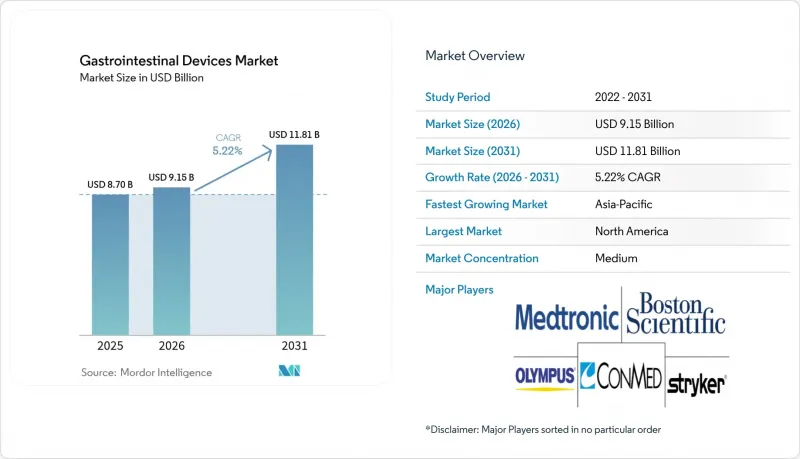
This report is Segmented by Product Type (Endoscopy Devices, GI Surgical Devices, Bariatric Surgery Devices, GI Hemostasis Devices, GI Stent Devices, Others), End User (Hospitals, Ambulatory Surgical Centers, and More), Disease/Disorder (Colorectal Cancer, Inflammatory Bowel Disease, and More), and Geography (North America, Europe, and More). The Market Forecasts are Provided in Terms of Value (USD).
Global Gastrointestinal Devices Market Trends and Insights
Rising Prevalence of GI Disorders
Colorectal cancer shows the highest age-standardized incidence in Asia at 23.88 per 100,000 and stomach cancer continues as the top GI cancer killer, pushing demand for earlier detection tools. Non-oncologic burdens, notably inflammatory bowel disease, escalate procedure volumes that rely on advanced imaging, biopsy, and hemostasis devices. Dietary westernization, urban pollution, and sedentary lifestyles magnify disease risk across emerging economies, while the global shift toward older populations further elevates screening frequency. Collectively, these trends create durable pull for both diagnostic and therapeutic solutions within the gastrointestinal devices market.
Growing Adoption of Minimally-Invasive Endoscopy
Endoscopic balloon dilation now defers surgery in inflammatory bowel disease strictures, improving quality of life and trimming inpatient costs. Robotic endoluminal systems enter routine use to navigate tortuous anatomy with millimeter precision, which lowers complication rates and shortens recovery times. Imaging advances such as narrow-band and confocal modalities allow histology-level visualization during a single session, enabling immediate therapy. These combined benefits underpin the expanding share of minimally-invasive interventions inside the gastrointestinal devices market.
High Procedure & Device Costs
Premium systems such as robotic platforms and AI processors command high capital outlays and recurring disposables, creating affordability hurdles for lower-income providers. FDA import holds on Olympus inventories illustrate how supply disruptions can tighten availability and sustain pricing power in the United States. Hospitals respond by demanding value-based evidence that links technology cost to quantifiable outcome improvement, lengthening procurement cycles.
Other drivers and restraints analyzed in the detailed report include:
- Ageing Population & Higher Screening Compliance
- Expansion of Reimbursement for Outpatient GI Procedures
- Stringent FDA & CE Regulatory Clearance Timelines
For complete list of drivers and restraints, kindly check the Table Of Contents.
Segment Analysis
Endoscopy devices contribute 43.18% of 2025 revenue, making them the anchor of the gastrointestinal devices market. The gastrointestinal devices market size for endoscopy is USD 3.76 billion in 2025 and is projected to grow at a 4.85% CAGR through 2031. Continuous breakthroughs such as Olympus EZ1500 extended-depth-of-field scopes improve visualization and raise adenoma detection. AI overlays like Fujifilm CAD EYE deliver a 17% boost in adenoma detection without prolonging procedure time. The segment also benefits from disposable endoscopes that curb infection risk, aligning with stricter reprocessing regulations.
Parallel growth emerges in bariatric surgery devices, the fastest-expanding category at a 6.03% CAGR. MIT's controllable gastric balloon hints at next-generation implants that can be adjusted post-placement, reducing revision rates. The incisionless ForePass device combines sleeve and balloon principles to cut weight gain by 79% while enhancing insulin sensitivity. Vendors now bundle endoscopic suturing, stapling, and hemostasis consumables to present holistic obesity interventions, expanding the addressable base beyond surgical suites into advanced endoscopy centers.
Complete Report Scope:
- By Product Type
- Endoscopy Devices
- Endoscopes
- Visualization & Insufflation Systems
- GI Surgical Devices
- Bariatric Surgery Devices
- GI Hemostasis Devices
- GI Stent Devices
- Others
- Endoscopy Devices
- By End User
- Hospitals
- Ambulatory Surgical Centers
- Specialty Clinics & GI Labs
- Home-Care Settings
- By Disease/ Disorder
- Colorectal Cancer
- Inflammatory Bowel Disease (IBD)
- Obesity
- Gastro-Esophageal Reflux Disease (GERD)
- Others
- By Geography
- North America
- United States
- Canada
- Mexico
- Europe
- Germany
- United Kingdom
- France
- Italy
- Spain
- Rest of Europe
- Asia-Pacific
- China
- India
- Japan
- South Korea
- Australia
- Rest of Asia-Pacific
- South America
- Brazil
- Argentina
- Rest of South America
- Middle East and Africa
- GCC
- South Africa
- Rest of Middle East and Africa
- North America
Geography Analysis
North America holds 39.62% revenue in 2025 owing to robust reimbursement and swift technology adoption. Early commercial deployment of AI cloud platforms and the FDA clearance of robotic systems such as Johnson & Johnson's OTTAVA underscore the region's innovation leadership. Supply-chain setbacks, including import holds on key endoscope models, can create intermittent device shortages yet also trigger rapid supplier diversification.
Asia-Pacific posts a 7.78% CAGR, the fastest worldwide, thanks to higher cancer incidence, economic growth, and government spending on advanced imaging suites. The launch of India's Gastro AI Academy illustrates dedicated efforts to upskill clinicians in AI-augmented workflows. China and South Korea channel state funding into domestic manufacturing of endoscopes and capsules to reduce import reliance, while Australia pilots nationwide tele-endoscopy programs in rural communities.
Europe shows steady mid-single-digit growth tempered by Medical Device Regulation complexity. Extended recertification deadlines strain SME suppliers but enhance patient safety confidence in the long term. Major economies prioritize colorectal cancer screening adherence, underpinning sustained system purchases of advanced colonoscopy stacks.
Latin America and the Middle East & Africa together contribute a smaller but rising share. Brazil's regulator ANVISA modernizes review pathways, attracting multinational suppliers, whereas Chile's clinical-trial uptick signals growing regional R&D importance. Gulf Cooperation Council members invest in AI and robotics ranging from tele-endoscopy to print-on-demand stents, positioning the region for above-average future expansion.
- Olympus
- Boston Scientific
- Medtronic
- Stryker
- Johnson & Johnson (Ethicon Endo-Surgery)
- FUJIFILM
- HOYA Corporation (PENTAX Medical)
- Conmed
- Cook Group
- Ambu
- Steris plc
- Karl Storz
- Coloplast
- B. Braun
- Smiths Group
- Intuitive Surgical
- Laborie Medical Technologies
- QIAGEN
Additional Benefits:
- The market estimate (ME) sheet in Excel format
- 3 months of analyst support
TABLE OF CONTENTS
1 Introduction
- 1.1 Study Assumptions & Market Definition
- 1.2 Scope of the Study
2 Research Methodology
3 Executive Summary
4 Market Landscape
- 4.1 Market Overview
- 4.2 Market Drivers
- 4.2.1 Rising prevalence of GI disorders
- 4.2.2 Growing adoption of minimally-invasive endoscopy
- 4.2.3 Ageing population & higher screening compliance
- 4.2.4 Expansion of reimbursement for outpatient GI procedures
- 4.2.5 AI-assisted endoscopy improving detection (under-reported)
- 4.2.6 Smart ingestible sensing capsules enabling remote care (under-reported)
- 4.3 Market Restraints
- 4.3.1 High procedure & device costs
- 4.3.2 Stringent FDA & CE regulatory clearance timelines
- 4.3.3 Shortage of skilled gastroenterologists
- 4.3.4 Device-related adverse-event publicity (under-reported)
- 4.4 Value / Supply-Chain Analysis
- 4.5 Regulatory Landscape
- 4.6 Technological Outlook
- 4.7 Porter's Five Forces
- 4.7.1 Threat of New Entrants
- 4.7.2 Bargaining Power of Buyers
- 4.7.3 Bargaining Power of Suppliers
- 4.7.4 Threat of Substitutes
- 4.7.5 Competitive Rivalry
5 Market Size & Growth Forecasts (Value, USD)
- 5.1 By Product Type
- 5.1.1 Endoscopy Devices
- 5.1.1.1 Endoscopes
- 5.1.1.2 Visualization & Insufflation Systems
- 5.1.2 GI Surgical Devices
- 5.1.3 Bariatric Surgery Devices
- 5.1.4 GI Hemostasis Devices
- 5.1.5 GI Stent Devices
- 5.1.6 Others
- 5.1.1 Endoscopy Devices
- 5.2 By End User
- 5.2.1 Hospitals
- 5.2.2 Ambulatory Surgical Centers
- 5.2.3 Specialty Clinics & GI Labs
- 5.2.4 Home-Care Settings
- 5.3 By Disease/ Disorder
- 5.3.1 Colorectal Cancer
- 5.3.2 Inflammatory Bowel Disease (IBD)
- 5.3.3 Obesity
- 5.3.4 Gastro-Esophageal Reflux Disease (GERD)
- 5.3.5 Others
- 5.4 By Geography
- 5.4.1 North America
- 5.4.1.1 United States
- 5.4.1.2 Canada
- 5.4.1.3 Mexico
- 5.4.2 Europe
- 5.4.2.1 Germany
- 5.4.2.2 United Kingdom
- 5.4.2.3 France
- 5.4.2.4 Italy
- 5.4.2.5 Spain
- 5.4.2.6 Rest of Europe
- 5.4.3 Asia-Pacific
- 5.4.3.1 China
- 5.4.3.2 India
- 5.4.3.3 Japan
- 5.4.3.4 South Korea
- 5.4.3.5 Australia
- 5.4.3.6 Rest of Asia-Pacific
- 5.4.4 South America
- 5.4.4.1 Brazil
- 5.4.4.2 Argentina
- 5.4.4.3 Rest of South America
- 5.4.5 Middle East and Africa
- 5.4.5.1 GCC
- 5.4.5.2 South Africa
- 5.4.5.3 Rest of Middle East and Africa
- 5.4.1 North America
6 Competitive Landscape
- 6.1 Market Concentration
- 6.2 Market Share Analysis
- 6.3 Company Profiles (includes Global level Overview, Market level overview, Core Segments, Financials as available, Strategic Information, Market Rank/Share for key companies, Products & Services, and Recent Developments)
- 6.3.1 Olympus Corporation
- 6.3.2 Boston Scientific Corporation
- 6.3.3 Medtronic plc
- 6.3.4 Stryker Corporation
- 6.3.5 Johnson & Johnson (Ethicon Endo-Surgery)
- 6.3.6 Fujifilm Holdings Corporation
- 6.3.7 HOYA Corporation (PENTAX Medical)
- 6.3.8 Conmed Corporation
- 6.3.9 Cook Group Incorporated
- 6.3.10 Ambu A/S
- 6.3.11 Steris plc
- 6.3.12 Karl Storz SE & Co. KG
- 6.3.13 Coloplast A/S
- 6.3.14 B. Braun Melsungen AG
- 6.3.15 Smith & Nephew plc
- 6.3.16 Intuitive Surgical Inc.
- 6.3.17 Laborie Medical Technologies
- 6.3.18 Qiagen N.V.
7 Market Opportunities & Future Outlook
- 7.1 White-space & Unmet-Need Assessment

