PUBLISHER: Mordor Intelligence | PRODUCT CODE: 2116589

PUBLISHER: Mordor Intelligence | PRODUCT CODE: 2116589
European Built-in Refrigerator - Market Share Analysis, Industry Trends & Statistics, Growth Forecasts (2026 - 2031)
According to Mordor Intelligence, the european built-in refrigerator market size is expected to grow from USD 7.36 billion in 2025 to USD 7.66 billion in 2026 and is forecast to reach USD 9.39 billion by 2031 at 4.14% CAGR over 2026-2031.
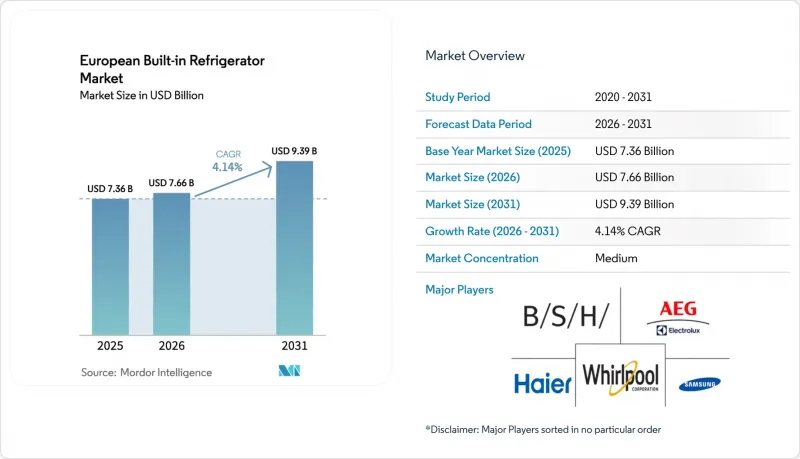
This report is Segmented by Product (Single-Door Refrigerator, Double-Door Refrigerator, and More), by Capacity (Less Than 15 Cu. Feet, More Than 15 Cu. Feet), by End User (Residential and Commercial), by Distribution Channel (B2C / Retail and B2B / Directly From the Manufacturers), by Geography (United Kingdom, and More). The Market Forecasts are Provided in Terms of Value (USD) and Volume (Units).
European Built-in Refrigerator Market Trends and Insights
Urbanization-Driven Demand For Space-Saving Kitchens
Apartment sizes continue to shrink in major European cities, and 48% of residents already live in flats, pushing architects and homeowners toward integrated appliances that conserve floor area. Overcrowding affects 16.8% of households, making full-height built-in models attractive because they nest seamlessly within cabinetry. Building permits for new dwellings fell 19.8% in 2023, yet renovation activity remains robust, directing spending toward kitchen upgrades that favor built-in formats. Rising monthly housing costs, averaging EUR 765 in early 2024, intensify the need to optimize usable space, and developers increasingly specify integrated refrigeration to justify premium rents .
Premiumization And Rising Disposable Income
Stabilizing consumer confidence supports willingness to pay extra for design, connectivity, and food-preservation features. Grocery sales grew faster than inflation in 2024, signalling discretionary spending capacity for large appliances. Brands such as Miele target affluent buyers with MasterCool units that include internal cameras and advanced freshness systems, while surveys show Northern Europeans rate energy efficiency and product longevity as core purchase criteria. The smart-appliance subsegment is expanding, and regional research confirms that consumers in the BENELUX and Nordic states willingly trade up to connected models that integrate with wider smart-home ecosystems.
High Price Premium Versus Freestanding Models
Built-in refrigerators can cost 30-70% more than comparable freestanding units, deterring price-sensitive buyers in Eastern and Southern Europe. A 35,000-member UK poll reported that one-quarter of shoppers place the lowest price above all, while housing cost ratios exceed 40% for renters, squeezing budgets for premium appliances. Installation charges and cabinetry modifications add further expense, reinforcing the gap and slowing penetration outside affluent regions .
Other drivers and restraints analyzed in the detailed report include:
- Stringent EU Energy-Efficiency Regulations Accelerating Replacements
- Rapid Growth of E-Commerce For Large Appliances
- Volatile Raw Materials and Logistics Costs
For complete list of drivers and restraints, kindly check the Table Of Contents.
Segment Analysis
Double-door models commanded 45.12% of 2025 revenue because they balance storage capacity with familiar ergonomics. The segment benefits from widespread cabinet designs that accommodate standard heights and hinge positions. In contrast, side-by-side units, though holding a smaller base, are forecast to grow 5.34% CAGR through 2031 as consumers with larger floorplans seek quick access to fridge and freezer compartments. The Europe built-in refrigerator market size for side-by-side models is on track to widen materially, given rising adoption in Germany and the Nordics.
Premium brands differentiate through Wi-Fi connectivity, AI-driven energy modes, and internal cameras. Samsung's 2024 EuroCucina lineup includes the BRB6500D with SmartThings optimization, while Miele's MasterCool range enables remote monitoring via the Miele@Home app. These innovations reinforce premium positioning and justify higher price points, sustaining momentum within the Europe built-in refrigerator market.
Refrigerators above 15 cubic feet represented 67.10% of sales in 2025 and will deliver the fastest 4.66% CAGR because households buy in bulk and cook at home more often. Higher capacity aligns with renovation projects that expand kitchens, and SlimTech insulation from Whirlpool boosts usable volume within existing footprints, appealing to space-constrained urban dwellers. The Europe built-in refrigerator market size for large-format units will therefore outpace smaller categories despite shrinking apartment dimensions.
Smaller than 15 cubic feet models retain a niche in studio flats and secondary pantries but face headwinds as consumers demand multifunctional storage. Urban developers look to integrate full-height columns that maximize cubic capacity while preserving aisle clearance. Manufacturers respond by slim-lining down wall thickness and adopting variable cooling zones to attract both groups, strengthening the versatility of offerings within the Europe built-in refrigerator market.
Complete Report Scope:
- By Product
- Single-Door Refrigerator
- Double-Door Refrigerator
- Top Freezer
- Bottom Freezer
- Side-By-Side Door Refrigerator
- French-Door Refrigerator
- Other Refrigerators
- By Capacity
- Less Than 15 cu. Feet
- More Than 15 cu. Feet
- By End User
- Residential
- Commercial
- By Distribution Channel
- B2C / Retail
- Multi-Brand Stores
- Exclusive Brand Outlets
- Online
- Other Distribution Channels
- B2B / Directly From The Manufacturers
- B2C / Retail
- By Geography
- United Kingdom
- Germany
- France
- Spain
- Italy
- BENELUX (Belgium, Netherlands, Luxembourg)
- NORDICS (Denmark, Finland, Iceland, Norway, Sweden)
- Rest Of Europe
List of Companies Covered in this Report:
- BSH Hausgerate (Bosch / Siemens / Gaggenau / Neff)
- Whirlpool Corp.
- Electrolux AB (AEG, Zanussi)
- Haier Europe (Candy, Hoover)
- Samsung Electronics
- LG Electronics
- Liebherr-Hausgerate
- Miele & Cie. KG
- Beko (Arcelik)
- Sub-Zero Group
- Smeg S.p.A.
- Indesit
- Hisense Europe (Gorenje)
- Sharp Corporation
- Vestel Beyaz Esya
- Fisher & Paykel
- CDA Group
- Fulgor Milano
- Amica SA
- Hitachi Global Life Solutions
Additional Benefits:
- The market estimate (ME) sheet in Excel format
- 3 months of analyst support
TABLE OF CONTENTS
1 Introduction
- 1.1 Study Assumptions & Market Definition
- 1.2 Scope of the Study
2 Research Methodology
3 Executive Summary
4 Market Landscape
- 4.1 Market Overview
- 4.2 Market Drivers
- 4.2.1 Urbanization-Driven Demand For Space-Saving Kitchens
- 4.2.2 Premiumization And Rising Disposable Income
- 4.2.3 Stringent EU Energy-Efficiency Regulations Accelerating Replacements
- 4.2.4 Rapid Growth Of E-Commerce For Large Appliances
- 4.2.5 Post-Pandemic Surge In Modular Kitchen Renovations
- 4.2.6 Luxury Real-Estate Developers Bundling Smart Built-Ins
- 4.3 Market Restraints
- 4.3.1 High Price Premium Versus Freestanding Models
- 4.3.2 Volatile Raw-Material And Logistics Costs
- 4.3.3 Shortage Of Certified Installers And Service Technicians
- 4.3.4 Cabinet-Depth Constraints In Micro-Apartments
- 4.4 Industry Value Chain Analysis
- 4.5 Porter's Five Forces Analysis
- 4.5.1 Threat Of New Entrants
- 4.5.2 Bargaining Power Of Suppliers
- 4.5.3 Bargaining Power Of Buyers
- 4.5.4 Threat Of Substitutes
- 4.5.5 Competitive Rivalry
- 4.6 Insights Into The Latest Trends And Innovations In The Market
- 4.7 Insights On Recent Developments (New Product Launches, Strategic Initiatives, Investments, Partnerships, JVs, Expansion, M&As, Etc.) In The Market
5 Market Size & Growth Forecasts (Value)
- 5.1 By Product
- 5.1.1 Single-Door Refrigerator
- 5.1.2 Double-Door Refrigerator
- 5.1.2.1 Top Freezer
- 5.1.2.2 Bottom Freezer
- 5.1.3 Side-By-Side Door Refrigerator
- 5.1.4 French-Door Refrigerator
- 5.1.5 Other Refrigerators
- 5.2 By Capacity
- 5.2.1 Less Than 15 cu. Feet
- 5.2.2 More Than 15 cu. Feet
- 5.3 By End User
- 5.3.1 Residential
- 5.3.2 Commercial
- 5.4 By Distribution Channel
- 5.4.1 B2C / Retail
- 5.4.1.1 Multi-Brand Stores
- 5.4.1.2 Exclusive Brand Outlets
- 5.4.1.3 Online
- 5.4.1.4 Other Distribution Channels
- 5.4.2 B2B / Directly From The Manufacturers
- 5.4.1 B2C / Retail
- 5.5 By Geography
- 5.5.1 United Kingdom
- 5.5.2 Germany
- 5.5.3 France
- 5.5.4 Spain
- 5.5.5 Italy
- 5.5.6 BENELUX (Belgium, Netherlands, Luxembourg)
- 5.5.7 NORDICS (Denmark, Finland, Iceland, Norway, Sweden)
- 5.5.8 Rest Of Europe
6 Competitive Landscape
- 6.1 Market Concentration
- 6.2 Strategic Moves
- 6.3 Market Share Analysis
- 6.4 Company Profiles (includes Global Level Overview, Market Level Overview, Core Segments, Financials As Available, Strategic Information, Market Rank/Share For Key Companies, Products & Services, And Recent Developments)
- 6.4.1 BSH Hausgerate (Bosch / Siemens / Gaggenau / Neff)
- 6.4.2 Whirlpool Corp.
- 6.4.3 Electrolux AB (AEG, Zanussi)
- 6.4.4 Haier Europe (Candy, Hoover)
- 6.4.5 Samsung Electronics
- 6.4.6 LG Electronics
- 6.4.7 Liebherr-Hausgerate
- 6.4.8 Miele & Cie. KG
- 6.4.9 Beko (Arcelik)
- 6.4.10 Sub-Zero Group
- 6.4.11 Smeg S.p.A.
- 6.4.12 Indesit
- 6.4.13 Hisense Europe (Gorenje)
- 6.4.14 Sharp Corporation
- 6.4.15 Vestel Beyaz Esya
- 6.4.16 Fisher & Paykel
- 6.4.17 CDA Group
- 6.4.18 Fulgor Milano
- 6.4.19 Amica SA
- 6.4.20 Hitachi Global Life Solutions
7 Market Opportunities & Future Outlook
- 7.1 Integration with Smart Kitchen Ecosystems

