PUBLISHER: Mordor Intelligence | PRODUCT CODE: 2116605

PUBLISHER: Mordor Intelligence | PRODUCT CODE: 2116605
Carboxymethyl Cellulose (CMC) - Market Share Analysis, Industry Trends & Statistics, Growth Forecasts (2026 - 2031)
According to Mordor Intelligence, the carboxymethyl cellulose market size is expected to grow from USD 1.57 billion in 2025 to USD 1.64 billion in 2026 and is forecast to reach USD 2.06 billion by 2031 at 4.58% CAGR over 2026-2031.
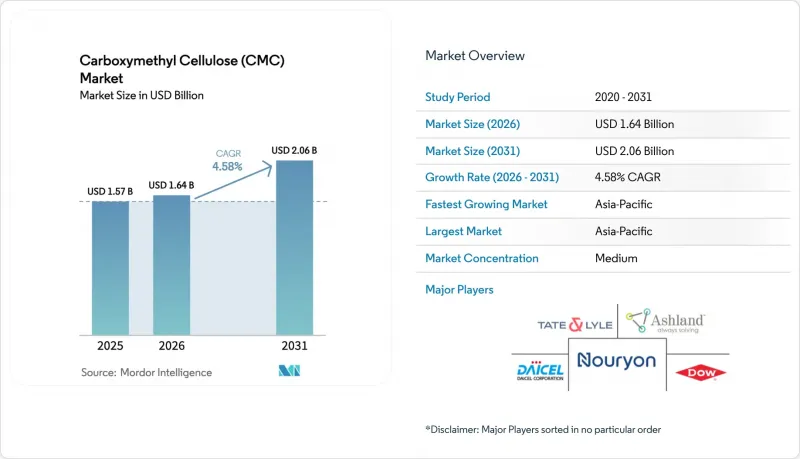
This report is Segmented by Purity/Grade (Highly Purified, Technical, and Industrial), Application (Food and Beverages, Oil and Gas, Cosmetics and Personal Care, Pharmaceuticals, Detergents, Paper Processing, and Other Applications), and Geography (Asia-Pacific, North America, Europe, South America, and Middle-East and Africa). The Market Forecasts are Provided in Terms of Value (USD).
Global Carboxymethyl Cellulose (CMC) Market Trends and Insights
Surge in Demand for Clean-Label, Low-Fat Texturising Solutions
Food manufacturers reformulate products to shorten ingredient labels and reduce saturated fat while preserving mouthfeel. Highly purified grades of the polymer replace fat yet maintain viscosity, which supports low-calorie dressings, dairy alternatives, and plant-based meat. Research also shows CMC enabling smart antimicrobial food packaging films that signal spoilage, broadening functionality beyond simple thickening. Brands pay premium prices for grades produced with minimal chemical residues and full international approvals, strengthening revenue per kilogram. North American and European retailers reinforce momentum by tightening label audit requirements and promoting clean-label front-of-pack claims.
Expansion of High-Salinity Oil and Gas Drilling in the Middle East Deserts
Operators in Saudi Arabia, the United Arab Emirates, and Kuwait explore deep reservoirs with extreme salinity and temperature. CMC maintains fluid viscosity and filtration control where guar or native starches fail, safeguarding wellbore stability. Laboratory work at the University of Glasgow demonstrates the polymer's capacity to disperse nanoparticulates that enhance thermal conductivity and lubricity. Service companies qualify battery-grade CMC grades for drilling fluids to lower overall chemical loading, which cuts disposal costs. Rising rig counts in unconventional plays create immediate volume pull, while secondary demand flows to shale basins in Texas and New Mexico, facing similar salinity challenges.
Rapid Price Swings in Monochloroacetic Acid Feedstock
Monochloroacetic acid is classified as a high toxicological concern under REACH, which limits production flexibility and heightens compliance expenses. Spot prices have moved more than 30% within six months due to caustic soda shortages and port congestion in Europe, forcing CMC makers to accept volatile profit margins. Vertically integrated producers hedge by operating captive chloroacetic plants, whereas stand-alone Chinese facilities suspend production during price spikes, tightening global supply. Hedging strategies are limited because exchange-traded derivatives for the acid remain illiquid.
Other drivers and restraints analyzed in the detailed report include:
- Pharma Shift Toward Abuse-Deterrent Oral Dosage Coatings
- Electric-Vehicle Li-ion Anode Binders Adopting Carboxymethyl Cellulose
- Rise of Enzymatically-Modified Guar and Xanthan Gum Blends
For complete list of drivers and restraints, kindly check the Table Of Contents.
Segment Analysis
Highly Purified grades held 42.76% carboxymethyl cellulose market share in 2025 and posted a 5.36% CAGR outlook. Regulatory bodies, including the US Food and Drug Administration, EU Pharmacopoeia, and China National Medical Products Administration, enforce tight purity specifications that smaller manufacturers struggle to match. As a result, top producers allocate capital to upgrade filtration, bleaching, and ion exchange systems. Pharmaceutical and specialty food contracts lock in multi-year volumes and support predictable capacity utilization. Wastewater treatment costs rise with each purity step, but the price premium offsets operating expenses and maintains segment margin leadership.
Complete Report Scope:
- By Purity/Grade
- Highly Purified (Greater than 99.5%)
- Technical (90-99.5%)
- Industrial (50-90%)
- By Application
- Food and Beverages
- Oil and Gas
- Cosmetics and Personal Care
- Pharmaceuticals
- Detergents
- Paper Processing
- Other Applications (Mining, Construction and Ceramics, etc.)
- By Geography
- Asia-Pacific
- China
- India
- Japan
- South Korea
- Rest of Asia-Pacific
- North America
- United States
- Canada
- Mexico
- Europe
- Germany
- United Kingdom
- France
- Italy
- Rest of Europe
- South America
- Brazil
- Argentina
- Rest of South America
- Middle-East and Africa
- Saudi Arabia
- South Africa
- Rest of Middle-East and Africa
- Asia-Pacific
Geography Analysis
Asia-Pacific accounted for 41.78% of global revenue in 2025 and is projected to advance at a 4.96% CAGR. China leads in capacity, but India's processed food sector adds robust incremental consumption. Japan and South Korea invest in pharmaceutical and battery research and development, which elevates local demand for Highly Purified and battery-grade variants. Southeast Asian nations such as Vietnam and Indonesia import CMC for instant noodle, dairy, and textile applications, supported by favorable tariff regimes.
North America maintains a sizable carboxymethyl cellulose market driven by pharmaceutical excipients and shale oil drilling. Large integrated producers operate plants near caustic soda and monochloroacetic acid sources, which mitigates raw-material volatility. Europe emphasizes food safety and green chemistry, which sustains demand for sustainable grades. Regulation EC 1333/2008 prescribes additive purity and labeling, favoring incumbents with established dossiers.
South America, and Middle East and Africa offer untapped potential. Brazilian agribusiness requires CMC as a thickener in fruit-based beverages, but import tariffs and currency swings complicate procurement.
List of Companies Covered in this Report:
- Amtex Chemicals, LLC
- Ashland
- Chongqing Xishan Science & Technology Co., Ltd.,
- Daicel Corporation
- DKS Co. Ltd.
- Dow
- IFF
- Jining Fortune Biotech Co.,Ltd.
- Lamberti S.p.A.
- MIKEM
- Mikro Technik GmbH.
- NIPPON PAPER INDUSTRIES CO., LTD.
- Nouryon
- Qingdao Fangjinlong Technology Development Co., Ltd.
- SINOCMC CHEMICAL CO., LTD.
- Tate & Lyle
- Tianjin Eray Industrial Co.
- Zibo Hailan Chemical Co., Ltd.
Additional Benefits:
- The market estimate (ME) sheet in Excel format
- 3 months of analyst support
TABLE OF CONTENTS
1 Introduction
- 1.1 Study Assumptions and Market Definition
- 1.2 Scope of the Study
2 Research Methodology
3 Executive Summary
4 Market Landscape
- 4.1 Market Overview
- 4.2 Market Drivers
- 4.2.1 Surge in Demand for Clean-Label, Low-Fat Texturising Solutions
- 4.2.2 Expansion of High-Salinity Oil and Gas Drilling in Middle East Deserts
- 4.2.3 Pharma Shift Toward Abuse-Deterrent Oral Dosage Coatings
- 4.2.4 Electric-Vehicle Li-ion Anode Binders Adopting Carboxymethyl Cellulose
- 4.2.5 High Demand from Processed and Convenient Food
- 4.3 Market Restraints
- 4.3.1 Rapid Price Swings in Monochloroacetic Acid Feedstock
- 4.3.2 Rise of Enzymatically-Modified Guar and Xanthan Gum Blends
- 4.3.3 Availability of Substitutes in the Market
- 4.4 Value Chain Analysis
- 4.5 Porter's Five Forces
- 4.5.1 Bargaining Power of Suppliers
- 4.5.2 Bargaining Power of Buyers
- 4.5.3 Threat of New Entrants
- 4.5.4 Threat of Substitute Products and Services
- 4.5.5 Degree of Competition
5 Market Size and Growth Forecasts (Value)
- 5.1 By Purity/Grade
- 5.1.1 Highly Purified (Greater than 99.5%)
- 5.1.2 Technical (90-99.5%)
- 5.1.3 Industrial (50-90%)
- 5.2 By Application
- 5.2.1 Food and Beverages
- 5.2.2 Oil and Gas
- 5.2.3 Cosmetics and Personal Care
- 5.2.4 Pharmaceuticals
- 5.2.5 Detergents
- 5.2.6 Paper Processing
- 5.2.7 Other Applications (Mining, Construction and Ceramics, etc.)
- 5.3 By Geography
- 5.3.1 Asia-Pacific
- 5.3.1.1 China
- 5.3.1.2 India
- 5.3.1.3 Japan
- 5.3.1.4 South Korea
- 5.3.1.5 Rest of Asia-Pacific
- 5.3.2 North America
- 5.3.2.1 United States
- 5.3.2.2 Canada
- 5.3.2.3 Mexico
- 5.3.3 Europe
- 5.3.3.1 Germany
- 5.3.3.2 United Kingdom
- 5.3.3.3 France
- 5.3.3.4 Italy
- 5.3.3.5 Rest of Europe
- 5.3.4 South America
- 5.3.4.1 Brazil
- 5.3.4.2 Argentina
- 5.3.4.3 Rest of South America
- 5.3.5 Middle-East and Africa
- 5.3.5.1 Saudi Arabia
- 5.3.5.2 South Africa
- 5.3.5.3 Rest of Middle-East and Africa
- 5.3.1 Asia-Pacific
6 Competitive Landscape
- 6.1 Market Concentration
- 6.2 Strategic Moves
- 6.3 Market Share(%)/Ranking Analysis
- 6.4 Company Profiles (includes Global level Overview, Market level overview, Core Segments, Financials as available, Strategic Information, Market Rank/Share, Products and Services, Recent Developments)
- 6.4.1 Amtex Chemicals, LLC
- 6.4.2 Ashland
- 6.4.3 Chongqing Xishan Science & Technology Co., Ltd.,
- 6.4.4 Daicel Corporation
- 6.4.5 DKS Co. Ltd.
- 6.4.6 Dow
- 6.4.7 IFF
- 6.4.8 Jining Fortune Biotech Co.,Ltd.
- 6.4.9 Lamberti S.p.A.
- 6.4.10 MIKEM
- 6.4.11 Mikro Technik GmbH.
- 6.4.12 NIPPON PAPER INDUSTRIES CO., LTD.
- 6.4.13 Nouryon
- 6.4.14 Qingdao Fangjinlong Technology Development Co., Ltd.
- 6.4.15 SINOCMC CHEMICAL CO., LTD.
- 6.4.16 Tate & Lyle
- 6.4.17 Tianjin Eray Industrial Co.
- 6.4.18 Zibo Hailan Chemical Co., Ltd.
7 Market Opportunities and Future Outlook
- 7.1 White-space and Unmet-Need Assessment

