PUBLISHER: Mordor Intelligence | PRODUCT CODE: 2116606

PUBLISHER: Mordor Intelligence | PRODUCT CODE: 2116606
Builders Joinery And Carpentry Of Wood - Market Share Analysis, Industry Trends & Statistics, Growth Forecasts (2026 - 2031)
According to Mordor Intelligence, builders joinery and carpentry of wood market size in 2026 is estimated at USD 83.72 billion, growing from 2025 value of USD 80.36 billion with 2031 projections showing USD 102.74 billion, growing at 4.18% CAGR over 2026-2031.
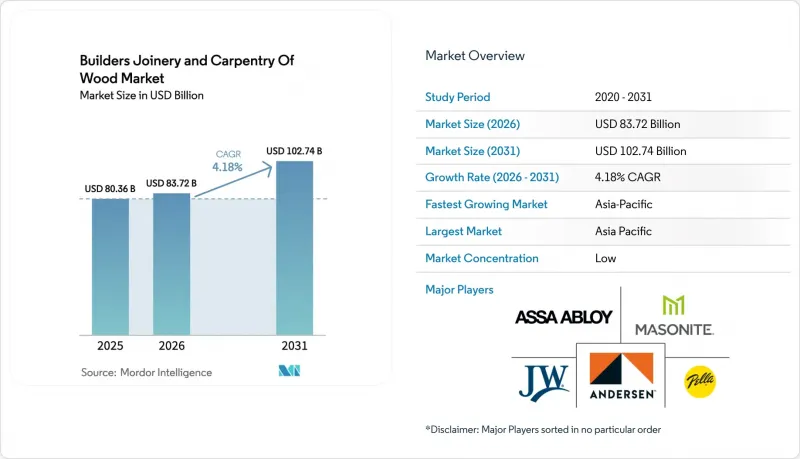
This report is Segmented by Product Type (Cellular Wood Panels, Door/Window Frames & Thresholds, and More), by Material & Construction (Solid Wood, Engineered Wood), by Application (Residential, Non-Residential), and by Geography (North America, South America, and More). The Market Forecasts are Provided in Terms of Value (USD).
Global Builders Joinery And Carpentry Of Wood Market Trends and Insights
Sustainable Construction & Green-Building Mandates
Regulations such as France's RE2025 and California's CALGreen elevate embodied-carbon limits, nudging architects toward certified wood over steel or concrete. The 2021 International Building Code allows 19-story mass-timber structures, transforming lofty prototypes into mainstream procurement options. Developers now monetize stored biogenic carbon via platforms like Riverse, layering an incremental revenue stream on top of rent yields and green-bond eligibility. Municipal sourcing criteria award scoring premiums to bio-based envelopes, helping wood outcompete higher-carbon assemblies in public tenders. ESG-driven investors track embodied-carbon disclosures, institutionalizing demand for low-emission products. Insurers, once wary, revise underwriting after large-scale fire tests prove performance parity, broadening access to project finance. Certification programs such as FSC and PEFC verify responsible forestry, closing transparency gaps and qualifying projects for sustainable-finance tax breaks. Together, these policies, financial, and risk-management levers translate into a 1.2-percentage-point lift in forecast CAGR across the builders' joinery and carpentry of wood market.
Rapid Urbanisation Fuelling New Residential Starts
Asia-Pacific adds nearly 70 million urban residents annually, straining housing stock and compelling authorities to approve high-density multifamily projects that favor fast-install engineered panels. BIM-enabled layouts cut site labor by roughly one-third, a critical offset as wage inflation outpaces GDP in megacities. India's Smart Cities Mission bundles infrastructure and housing approvals, compressing timelines and channeling demand toward prefabricated wall and floor systems. Brazil's 20% export surge in October 2024 signals Latin American mills scaling output to feed global urban-housing booms, while U.S. multifamily starts remain resilient despite interest-rate volatility. Tokyo developers pioneer hybrid timber-steel frames that meet seismic codes while retaining wood's low-carbon profile. Demographic momentum, cost pressure, and schedule risk together sustain high panel volumes well into the 2030s. Completion rates still hinge on easing skilled-labor gaps, yet modular assembly helps bridge supply-chain bottlenecks. Overall, intensified urbanization adds an estimated 0.8 percentage points to global CAGR within the builders' joinery and carpentry of wood market.
Skilled-Carpenter Shortage & Wage Inflation
The U.S. construction sector requires an extra 501,000 workers in 2024 and 454,000 in 2025 above normal hiring levels, with carpentry posting the steepest deficits. Europe shows one in three construction vacancies unfilled after 90 days, and 14 countries classify carpenters as high-severity shortages. Japan's construction workforce shrank 20% in a decade, and nearly 40% of those remaining are over 55, foreshadowing a retirement wave by 2030. Rising wage bids swell framing budgets by USD 8 to10 per square foot on complex builds, forcing developers to reassess feasibility. Smaller contractors struggle to compete for talent, risking project cancellations that reverberate through supply chains. Apprenticeship incentives expand, yet long training cycles mean relief lags demand peaks. Automation offsets certain gaps, but robotic cells require capital that some firms cannot access under current lending conditions. Tight labor markets also increase safety incidents as overstretched crews work extended hours. Collectively, these factors subtract 0.9 percentage points from the projected CAGR in the builders' joinery and carpentry of wood market.
Other drivers and restraints analyzed in the detailed report include:
- Digital Design-for-Manufacture Adoption by Off-Site Builders
- High-Rise Timber Engineering (Mass-Timber) Proof-of-Concept Projects
- Volatile Soft-Wood Prices Driven by Climate-Linked Supply Shocks
For complete list of drivers and restraints, kindly check the Table Of Contents.
Segment Analysis
Door and window frames generated 38.45% of 2025 revenue within the builders joinery and carpentry of wood market, supported by steady remodeling cycles and new-build demand across geographies. Despite dominance, their growth lags the overall curve as energy-efficient replacements and smart-sensing upgrades saturate mature markets. Cellular panels, conversely, chart a 6.52% CAGR through 2031 on the back of weight savings, rapid installation, and compatibility with robotic fabrication lines. The builders' joinery and carpentry of wood market size for cellular panels is forecast to climb from USD 19.74 billion in 2025 to nearly USD 28.82 billion by 2031, fueled by InventWood's SuperWood, which offers 10X strength-to-weight gains and Class A fire ratings. Expanding panel widths let contractors span greater floor areas with fewer seams, reducing weather-seal leakage and inspection costs. Apex adopters in prefab housing stack pre-cut window openings that slash finish-carpentry labor by 40%, countering trade shortages. Meanwhile, Harvey Windows' sensor-enabled entry door launch exemplifies innovation in the leading product class by merging IoT modules with lower U-values. Flooring, pergolas, shutters, and specialty facades deepen product diversity, allowing suppliers to cross-sell packages that lift average order values and dampen commodity rivalry.
Demand for assembled parquet panels grows alongside interior-design trends favoring warm, biophilic aesthetics in commercial lobbies and hospitality spaces. Producers targeting upscale residential clients offer FSC-certified tropical veneers laminated onto domestically sourced cores to navigate deforestation scrutiny. Digital CAD-CAM systems accelerate bespoke stair-stringer fabrication, allowing boutique builders to deliver complex geometries cost-effectively. In emerging markets, project-home builders still favor solid-wood doors for perceived durability, yet rising labor costs trigger a gradual shift toward pre-hung engineered alternatives. Regulatory tightening around energy codes drives uptake of triple-glazed timber windows in colder climates, pushing suppliers to expand insulated-glass capacity. Looking ahead, composite panel formats embedding phase-change materials promise improved thermal management, positioning panel suppliers for future building-performance mandates within the builders' joinery and carpentry of the wood market.
Complete Report Scope:
- By Product Type
- Cellular Wood Panels
- Door/Window Frames & Thresholds
- Assembled Parquet Panels / Wood Flooring
- Doors (interior & exterior) & Sets
- Others (Staircases & Stair Parts, Shutters, Blinds, Louvres, cladding/sidings, pergolas, fence panels, etc)
- By Material & Construction
- Solid wood
- Engineered wood
- By Application
- Residential
- Non-Residential (Commercial, Institutional, Hospitality, and Industrial)
- By Geography
- North America
- United States
- Canada
- Mexico
- South America
- Brazil
- Argentina
- Rest of South America
- Europe
- United Kingdom
- Germany
- France
- Italy
- Spain
- BENELUX (Belgium, Netherlands, and Luxembourg)
- NORDICS (Denmark, Finland, Iceland, Norway, and Sweden)
- Rest of Europe
- Asia-Pacific
- China
- India
- Japan
- Australia
- South Korea
- ASEAN (Indonesia, Thailand, Philippines, Malaysia, Vietnam)
- Rest of Asia-Pacific
- Middle East and Africa
- Saudi Arabia
- United Arab Emirates
- Qatar
- Kuwait
- Turkey
- Egypt
- South Africa
- Nigeria
- Rest of Middle East and Africa
- North America
Geography Analysis
Asia-Pacific dominated 2025 revenue with a 47.10% stake in the builders joinery and carpentry of wood market, driven by rapid urban migration, infrastructure stimulus, and expanding manufacturing clusters in China, India, and ASEAN. Beijing's 14th Five-Year Plan emphasizes prefabricated construction to cut urban pollution, prompting municipal builders to specify engineered panels that arrive sealed against moisture. India's Production-Linked Incentive scheme subsidizes laminated veneer lumber plants, reducing import reliance and fostering regional panel hubs in Andhra Pradesh and Gujarat. Japan's Expo 2025 showcases a 675-meter timber ring, demonstrating large-span wood engineering despite workforce constraints. Indonesia promotes certified tropical hardwood exports, supplying raw veneer to panel mills across the region, while Singapore's Gaia building illustrates tall-timber feasibility in humid tropics. Localized supply chains shorten lead times and stabilize currency exposure, yet climate-driven log shortages in Western Australia underscore resource risk. Digital-fabrication start-ups in Vietnam leverage cloud-BIM to service regional residential developers, signaling rising tech adoption.
North America captures considerable value through established forest assets, deep prefab expertise, and regulatory tailwinds from the 2021 IBC that legitimize 19-story mass-timber towers. State-level code uptake spreads eastward, with Michigan's April 2025 enactment delivering critical certainty for Great Lakes developers. Canada's boreal forest fuels integrated CLT plants, though wildfire-related shutdowns curb output and reveal supply fragility. U.S. lumber futures fluctuations push builders toward long-term offtake contracts, locking in panel volumes for multi-family pipelines. Venture-backed robotic framing start-ups cluster around Seattle and Toronto, feeding innovation spillovers into regional subcontractor networks. Federal tax credits under the Inflation Reduction Act reward low-carbon materials, further privileging wood over steel, especially in public works. Rising cyber-risk prompts mills to adopt zero-trust networks, enhancing resilience but adding overhead. Educational outreach by trade associations targets code officials, smoothing approval for upcoming tall-wood bids.
Europe combines a stringent decarbonization policy with a rich craft heritage, but labor scarcity hampers output even as demand climbs. The EURES dashboard lists carpentry among the top three high-severity shortages in 14 member states. Germany's timber-frame volumes expand under subsidies for energy-positive schools, while Scandinavian sawmills pioneer bio-epoxy bonded panels compatible with circular-economy design. The Nordic Wood Declaration commits governments to public-sector timber quotas, anchoring predictable demand. In Central and Eastern Europe, wage-inflation pressures accelerate investment in robotic joinery lines to sustain export competitiveness. France's RE2025 reinforces life-cycle carbon accounting, tightening specs that favor manufacturers offering Environmental Product Declarations. The United Kingdom, post-Brexit, aligns building regulations with Eurocode updates yet lags in mass-timber adoption due to fire-safety debates. Overall, Europe's policy clarity offsets workforce constraints, keeping CAGR on par with global averages and cementing the continent's role as a technology incubator for the builders' joinery and carpentry of the wood market.
Middle East & Africa and Latin America, while smaller contributors, post above-average growth. Saudi Arabia's megaprojects Neom and the Red Sea developments specify biophilic resorts using engineered-wood facades to moderate desert climates. South Africa's public-housing backlog channels funding into modular timber-frame units that assemble rapidly and meet energy-efficiency codes. Brazil leverages abundant plantation pine and eucalyptus to supply both domestic builds and exports; its October 2024 20% export jump signals strengthening global linkage. Chile's seismic-resilient glulam plants target U.S. West Coast builders seeking alternative suppliers to mitigate wildfire disruptions. African coastal nations, rich in tropical hardwoods, trial certified small-diameter timber in coastal resorts, provided procurement aligns with anti-deforestation pledges. These regions collectively add diversity and resource depth that hedge geopolitical concentration risk in the builders' joinery and carpentry of the wood market.
- Masonite International Corporation
- JELD-WEN Holding Inc.
- Pella Corporation
- Andersen Corporation
- ASSA ABLOY AB
- VELUX Group
- VKR Holding (VELFAC)
- YKK AP Inc.
- Shenzhen Runcheng Chuangzhan Woodworking
- Hormann KG
- LIXIL Corporation
- Deceuninck NV
- Sierra Pacific Industries
- Medici Joinery
- Stora Enso Building Solutions
- Sunwin House Co., Ltd.
- Centor Architectural
- JOSKO Fenster & Turen GmbH
- JAS Timber
- Koch Industries (Guardian Doors)
Additional Benefits:
- The market estimate (ME) sheet in Excel format
- 3 months of analyst support
TABLE OF CONTENTS
1 Introduction
- 1.1 Study Assumptions & Market Definition
- 1.2 Scope of the Study
2 Research Methodology
3 Executive Summary
4 Market Landscape
- 4.1 Market Overview
- 4.2 Market Drivers
- 4.2.1 Sustainable construction & green-building mandates
- 4.2.2 Rapid urbanisation fuelling new residential starts
- 4.2.3 Circular-economy demand for reclaimed timber systems
- 4.2.4 Digital design-for-manufacture (DfMA) adoption by off-site builders
- 4.2.5 High-rise timber engineering (mass-timber) proof-of-concept projects
- 4.2.6 Carbon-credit monetisation for bio-based materials
- 4.3 Market Restraints
- 4.3.1 Skilled-carpenter shortage & wage inflation
- 4.3.2 Volatile soft-wood prices driven by climate-linked supply shocks
- 4.3.3 Fire-safety code uncertainty for tall-timber structures
- 4.3.4 Digital IP & cyber-security risks in CAD-CAM joinery files
- 4.4 Value / Supply-Chain Analysis
- 4.5 Regulatory Landscape
- 4.6 Technological Outlook
- 4.7 Industry Attractiveness - Porter's Five Forces Analysis
- 4.7.1 Threat of New Entrants
- 4.7.2 Bargaining Power of Suppliers
- 4.7.3 Bargaining Power of Buyers
- 4.7.4 Threat of Substitutes
- 4.7.5 Competitive Rivalry
- 4.8 Project-Pipeline Analysis
5 Market Size & Growth Forecasts (Value, In USD Billion)
- 5.1 By Product Type
- 5.1.1 Cellular Wood Panels
- 5.1.2 Door/Window Frames & Thresholds
- 5.1.3 Assembled Parquet Panels / Wood Flooring
- 5.1.4 Doors (interior & exterior) & Sets
- 5.1.5 Others (Staircases & Stair Parts, Shutters, Blinds, Louvres, cladding/sidings, pergolas, fence panels, etc)
- 5.2 By Material & Construction
- 5.2.1 Solid wood
- 5.2.2 Engineered wood
- 5.3 By Application
- 5.3.1 Residential
- 5.3.2 Non-Residential (Commercial, Institutional, Hospitality, and Industrial)
- 5.4 By Geography
- 5.4.1 North America
- 5.4.1.1 United States
- 5.4.1.2 Canada
- 5.4.1.3 Mexico
- 5.4.2 South America
- 5.4.2.1 Brazil
- 5.4.2.2 Argentina
- 5.4.2.3 Rest of South America
- 5.4.3 Europe
- 5.4.3.1 United Kingdom
- 5.4.3.2 Germany
- 5.4.3.3 France
- 5.4.3.4 Italy
- 5.4.3.5 Spain
- 5.4.3.6 BENELUX (Belgium, Netherlands, and Luxembourg)
- 5.4.3.7 NORDICS (Denmark, Finland, Iceland, Norway, and Sweden)
- 5.4.3.8 Rest of Europe
- 5.4.4 Asia-Pacific
- 5.4.4.1 China
- 5.4.4.2 India
- 5.4.4.3 Japan
- 5.4.4.4 Australia
- 5.4.4.5 South Korea
- 5.4.4.6 ASEAN (Indonesia, Thailand, Philippines, Malaysia, Vietnam)
- 5.4.4.7 Rest of Asia-Pacific
- 5.4.5 Middle East and Africa
- 5.4.5.1 Saudi Arabia
- 5.4.5.2 United Arab Emirates
- 5.4.5.3 Qatar
- 5.4.5.4 Kuwait
- 5.4.5.5 Turkey
- 5.4.5.6 Egypt
- 5.4.5.7 South Africa
- 5.4.5.8 Nigeria
- 5.4.5.9 Rest of Middle East and Africa
- 5.4.1 North America
6 Competitive Landscape
- 6.1 Market Concentration
- 6.2 Strategic Moves
- 6.3 Market Share Analysis
- 6.4 Company Profiles (includes Global level Overview, Market level overview, Core Segments, Financials as available, Strategic Information, Products & Services, and Recent Developments)
- 6.4.1 Masonite International Corporation
- 6.4.2 JELD-WEN Holding Inc.
- 6.4.3 Pella Corporation
- 6.4.4 Andersen Corporation
- 6.4.5 ASSA ABLOY AB
- 6.4.6 VELUX Group
- 6.4.7 VKR Holding (VELFAC)
- 6.4.8 YKK AP Inc.
- 6.4.9 Shenzhen Runcheng Chuangzhan Woodworking
- 6.4.10 Hormann KG
- 6.4.11 LIXIL Corporation
- 6.4.12 Deceuninck NV
- 6.4.13 Sierra Pacific Industries
- 6.4.14 Medici Joinery
- 6.4.15 Stora Enso Building Solutions
- 6.4.16 Sunwin House Co., Ltd.
- 6.4.17 Centor Architectural
- 6.4.18 JOSKO Fenster & Turen GmbH
- 6.4.19 JAS Timber
- 6.4.20 Koch Industries (Guardian Doors)
7 Market Opportunities & Future Outlook
- 7.1 White-space & Unmet-need Assessment

