PUBLISHER: Mordor Intelligence | PRODUCT CODE: 2116615

PUBLISHER: Mordor Intelligence | PRODUCT CODE: 2116615
Europe Sustainable Furniture - Market Share Analysis, Industry Trends & Statistics, Growth Forecasts (2026 - 2031)
According to Mordor Intelligence, the Europe sustainable furniture market size is expected to grow from USD 13.37 billion in 2025 to USD 14.05 billion in 2026 and is forecast to reach USD 18.01 billion by 2031 at 5.12% CAGR over 2026-2031.
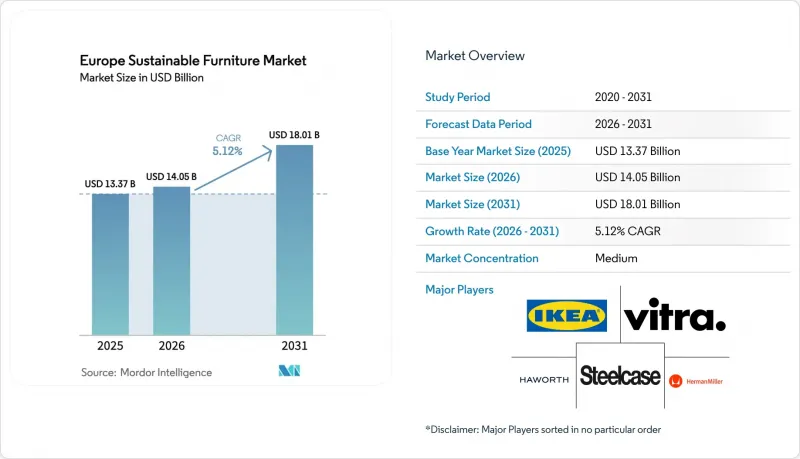
This report is Segmented by Product (Chairs, Tables, Sofas, Beds, and More), Material (Reclaimed/FSC-Certified Wood, Bamboo & Rapidly Renewable Grass, Recycled Metals, and More), End-User (Residential, Commercial), Distribution Channel (B2C/Retail, B2B/Project), and Geography (United Kingdom, Germany, France, Spain, Italy, and More). The Market Forecasts are Provided in Terms of Value (USD).
Europe Sustainable Furniture Market Trends and Insights
EU Ecodesign & Circular-Economy Legislation Implementation (2025-2030)
The ESPR officially prioritized furniture on July 18, 2024, mandating material circularity, reparability, and recyclability. Draft delegated acts due 2025-2027 will make digital product passports obligatory, compelling transparent disclosure of material origin, carbon footprint, and end-of-life pathways. Vertically integrated groups able to track inputs from forest to factory gain a compliance edge, while legacy manufacturers reliant on opaque imports face 3-5% cost inflation for data gathering and design redesigns. Modular construction tailored for component replacement dovetails with FaaS contracts in which producers keep ownership and handle maintenance. Early adopters that internalize regulatory costs now are positioned to build durable competitive moats.
Rising Consumer Demand for Certified Sustainable Wood & Low-VOC Materials
European households are willing to pay a premium for eco-certified furniture and consider sustainable living essential. FSC labels have therefore shifted from marketing claim to purchase prerequisite in Germany, Denmark, and France. Manufacturers are now compelled to invest in supply chain verification systems as material transparency shifts from being a mere marketing differentiator to a key purchasing criterion. Vendors have responded by digitizing chain-of-custody records and expanding low-formaldehyde product lines, especially in the bedroom, where sleep wellness is paramount. Premiums remain 15-30% above conventional offers, yet improved durability and lower off-gassing reinforce value perceptions over lifetime ownership.
Higher Up-front Costs vs. Conventional Furniture
Despite consumers expressing a preference for sustainability, sustainable furniture often comes with a 15-30% price premium compared to conventional options, creating a barrier to adoption. This price hike is largely due to the costs associated with certified materials, third-party verifications, and the complexities of circular design. Such pricing challenges are especially pronounced in price-sensitive segments, notably in residential markets where decisions are predominantly driven by cost, even amidst a growing awareness of sustainability. Yet, models like furniture-as-a-service are addressing these upfront cost concerns. By allowing expenses to be spread over subscription periods, companies like NORNORM have seen corporate clients embrace their premium offerings.
Other drivers and restraints analyzed in the detailed report include:
- Rapid Expansion of Green Building Projects & LEED/BREEAM Certifications
- Growth of Furniture-as-a-Service Subscription Models Supporting Re-use
- Supply-Chain Complexity in Sourcing Certified Materials
For complete list of drivers and restraints, kindly check the Table Of Contents.
Segment Analysis
Chairs generated 35.72% of Europe sustainable furniture market share in 2025, reflecting ergonomic upgrades in hybrid workplaces and institution tenders specifying FSC timber frames. Average selling prices climbed 4.2% as buyers prioritized height-adjustable and repairable designs. Over the forecast, beds record the quickest 6.74% CAGR, helped by sleep-wellness spending and stricter formaldehyde limits in bedroom air standards. Europe sustainable furniture market size for beds is projected to climb from USD 2.17 billion in 2026 to USD 2.99 billion by 2031, backed by organic mattress cores and certified wood slats. Tables and storage units log steady mid-single-digit growth on the back of home-organization trends, while outdoor lines are experimenting with recycled aluminum frames to lower embodied carbon.
Product innovators stress modularity: snap-fit components simplify repair and enable FaaS operators to refresh worn parts rather than replace units. Chair makers incorporate ocean-bound plastics in seat shells, and bed firms introduce bolt-less joinery for tool-free assembly. Mass-market retailers bundle repair kits and extend warranties to signal durability. As ESPR right-to-repair provisions crystallize, SKUs with component access points should outperform, reinforcing the leadership of brands already running circular design audits.
Reclaimed and FSC wood kept a 31.35% revenue lead in 2025, yet recycled and bio-based plastics will deliver a 6.39% CAGR through 2031 as polymer-recycling plants mature. Europe sustainable furniture market size tied to recycled plastics is forecast to move from USD 1.99 billion in 2026 to USD 2.71 billion in 2031, supported by design freedom and color stability. Ocean-bound resin programs feed office-chair shells, while bio-PU foams derived from castor oil enter soft seating. Supply risk is lower because recycling infrastructure for PET and PP has been scaled under EU packaging rules.
Wood remains indispensable for aesthetic appeal and carbon-sequestration narratives, yet manufacturers diversify into bamboo and agrifiber panels to hedge cost swings. Recycled steel and aluminum see demand from architects targeting net-zero buildings, leveraging infinite recyclability. Adhesive innovations allow clean debonding of multi-material assemblies, raising recovery rates. Material choices increasingly factor into EPD scores as developers target embodied-carbon caps set by national building codes.
Complete Report Scope:
- By Product
- Chairs
- Tables
- Sofas
- Beds
- Storage Cabinets
- Other Products
- By Material
- Reclaimed / FSC-Certified Wood
- Bamboo & Rapidly Renewable Grass
- Recycled Metals (Steel & Aluminum)
- Recycled & Bio-Based Plastics
- Organic / Natural Fibers (Rattan, Jute, Hemp)
- Other Materials (parawood, rubberwood, natural fabrics, etc.)
- By End-User
- Residential
- Commercial
- Offices
- Hospitality
- Healthcare Facilities
- Educational Institutes
- Other Commercial Users (public places, retail malls, government offices, etc.)
- By Distribution Channel
- B2C/Retail
- Home Centers
- Specialty Furniture Stores
- Online
- Other Distribution Channels
- B2B /Project
- B2C/Retail
- By Geography
- United Kingdom
- Germany
- France
- Spain
- Italy
- BENELUX (Belgium, Netherlands, Luxembourg)
- NORDICS (Denmark, Finland, Iceland, Norway, Sweden)
- Rest of Europe
List of Companies Covered in this Report:
- IKEA Group
- Vitra International AG
- Steelcase Inc.
- Herman Miller Inc.
- Haworth Inc.
- Royal Auping BV
- Muuto A/S
- Vestre AS
- Hay A/S
- Fritz Hansen A/S
- Arper SpA
- Bene GmbH
- Sancal Diseno S.A.
- Lammhults Design Group AB
- Nikari Oy
- V-Zone (Kinnarps Group)
- Actiu Berbegal y Formas SA
- Vangstad Design (Mater)
- VG & Rothlisberger Kollektion
- Teknion Europe Ltd.
Additional Benefits:
- The market estimate (ME) sheet in Excel format
- 3 months of analyst support
TABLE OF CONTENTS
1 Introduction
- 1.1 Study Assumptions & Market Definition
- 1.2 Scope of the Study
2 Research Methodology
3 Executive Summary
4 Market Landscape
- 4.1 Market Overview
- 4.2 Market Drivers
- 4.2.1 EU Ecodesign & Circular-Economy Legislation Implementation (2025-2030)
- 4.2.2 Rising Consumer Demand for Certified Sustainable Wood & Low-VOC Materials
- 4.2.3 Rapid Expansion of Green Building Projects & LEED/BREEAM Certifications
- 4.2.4 Growth of Furniture-as-a-Service Subscription Models Supporting Re-use
- 4.2.5 Advancements in Bio-based Adhesives & Finishes Improving Recyclability
- 4.2.6 Digital Product Passports Enhancing Transparency & Secondary-Market Value
- 4.3 Market Restraints
- 4.3.1 Higher Up-front Costs vs. Conventional Furniture
- 4.3.2 Supply-Chain Complexity in Sourcing Certified Materials
- 4.3.3 Fragmented Sustainability Certification Standards Across EU States
- 4.3.4 Insufficient End-of-Life Reverse-Logistics Infrastructure
- 4.4 Industry Value Chain Analysis
- 4.5 Porter's Five Forces Analysis
- 4.5.1 Threat of New Entrants
- 4.5.2 Bargaining Power of Suppliers
- 4.5.3 Bargaining Power of Buyers
- 4.5.4 Threat of Substitutes
- 4.5.5 Intensity of Rivalry
- 4.6 Insights into the Latest Trends and Innovations in the Market
- 4.7 Insights on Recent Developments (New Product Launches, Strategic Initiatives, Investments, Partnerships, JVs, Expansion, M&As, etc.) in the Market
- 4.8 Insights on Regulatory Framework and Industry Certifications for the Sustainable Furniture Industry
5 Market Size & Growth Forecasts
- 5.1 By Product
- 5.1.1 Chairs
- 5.1.2 Tables
- 5.1.3 Sofas
- 5.1.4 Beds
- 5.1.5 Storage Cabinets
- 5.1.6 Other Products
- 5.2 By Material
- 5.2.1 Reclaimed / FSC-Certified Wood
- 5.2.2 Bamboo & Rapidly Renewable Grass
- 5.2.3 Recycled Metals (Steel & Aluminum)
- 5.2.4 Recycled & Bio-Based Plastics
- 5.2.5 Organic / Natural Fibers (Rattan, Jute, Hemp)
- 5.2.6 Other Materials (parawood, rubberwood, natural fabrics, etc.)
- 5.3 By End-User
- 5.3.1 Residential
- 5.3.2 Commercial
- 5.3.2.1 Offices
- 5.3.2.2 Hospitality
- 5.3.2.3 Healthcare Facilities
- 5.3.2.4 Educational Institutes
- 5.3.2.5 Other Commercial Users (public places, retail malls, government offices, etc.)
- 5.4 By Distribution Channel
- 5.4.1 B2C/Retail
- 5.4.1.1 Home Centers
- 5.4.1.2 Specialty Furniture Stores
- 5.4.1.3 Online
- 5.4.1.4 Other Distribution Channels
- 5.4.2 B2B /Project
- 5.4.1 B2C/Retail
- 5.5 By Geography
- 5.5.1 United Kingdom
- 5.5.2 Germany
- 5.5.3 France
- 5.5.4 Spain
- 5.5.5 Italy
- 5.5.6 BENELUX (Belgium, Netherlands, Luxembourg)
- 5.5.7 NORDICS (Denmark, Finland, Iceland, Norway, Sweden)
- 5.5.8 Rest of Europe
6 Competitive Landscape
- 6.1 Market Concentration
- 6.2 Strategic Moves
- 6.3 Market Share Analysis
- 6.4 Company Profiles (includes Global level Overview, Market level overview, Core Segments, Financials as available, Strategic Information, Market Rank/Share for key companies, Products & Services, and Recent Developments)
- 6.4.1 IKEA Group
- 6.4.2 Vitra International AG
- 6.4.3 Steelcase Inc.
- 6.4.4 Herman Miller Inc.
- 6.4.5 Haworth Inc.
- 6.4.6 Royal Auping BV
- 6.4.7 Muuto A/S
- 6.4.8 Vestre AS
- 6.4.9 Hay A/S
- 6.4.10 Fritz Hansen A/S
- 6.4.11 Arper SpA
- 6.4.12 Bene GmbH
- 6.4.13 Sancal Diseno S.A.
- 6.4.14 Lammhults Design Group AB
- 6.4.15 Nikari Oy
- 6.4.16 V-Zone (Kinnarps Group)
- 6.4.17 Actiu Berbegal y Formas SA
- 6.4.18 Vangstad Design (Mater)
- 6.4.19 VG & Rothlisberger Kollektion
- 6.4.20 Teknion Europe Ltd.
7 Market Opportunities & Future Outlook
- 7.1 Regulatory Push for Traceability and Repairability
- 7.2 Biobased Materials Disrupt Traditional Manufacturing

