PUBLISHER: Mordor Intelligence | PRODUCT CODE: 2116621

PUBLISHER: Mordor Intelligence | PRODUCT CODE: 2116621
US Sustainable Furniture - Market Share Analysis, Industry Trends & Statistics, Growth Forecasts (2026 - 2031)
According to Mordor Intelligence, the US sustainable furniture market size is expected to grow from USD 12.72 billion in 2025 to USD 13.39 billion in 2026 and is forecast to reach USD 17.31 billion by 2031 at 5.27% CAGR over 2026-2031.
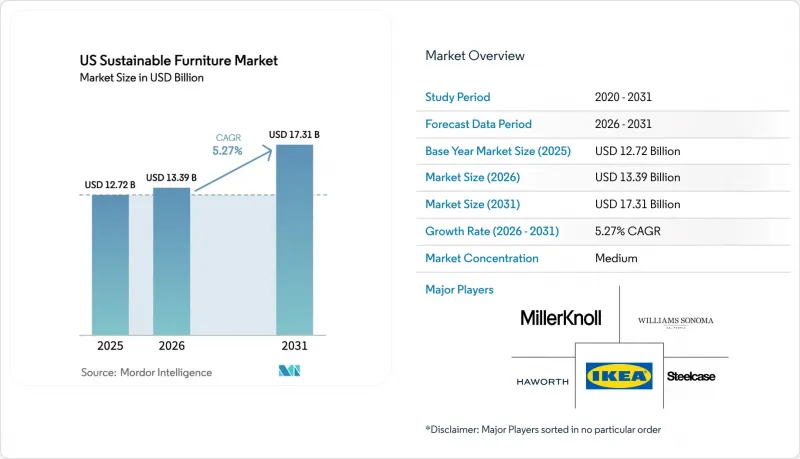
This report is Segmented by Product (Chairs, Tables, Sofas, Beds, and More), Material (Reclaimed/FSC-Certified Wood, Bamboo & Rapidly Renewable Grass, Recycled Metals, Recycled & Bio-Based Plastics, and More), End User (Residential, Commercial), Distribution Channel (B2C/Retail, B2B/Project) and Geography (Northeast, Midwest and More). The Market Forecasts are Provided in Terms of Value (USD).
US Sustainable Furniture Market Trends and Insights
Growing Consumer Awareness of Sustainability
A majority of US shoppers actively research a product's environmental footprint before purchase. Capgemini's January 2024 consumer-behavior tracker, which surveyed 11,300 shoppers in 11 countries (including 1,000 respondents in the United States), found that 60 % of US consumers had bought from companies they regarded as sustainable, a figure that rose to 71 % among Gen Z buyers. This interest is now influencing real purchase decisions: 80 % of environmentally motivated shoppers review a product's verifiable sustainability data before choosing furniture . A March 2025 Britopian study of 2,500 US consumers aged 18-26 reported that 64 % would pay a premium for eco-friendly goods, while 77 % deliberately avoid brands seen as environmentally irresponsible. In response, manufacturers are replacing basic green marketing with supply-chain transparency, deploying blockchain-based tracing systems that allow buyers to confirm the origin of wood, upholstery, and finishes in near real time. These measures help firms defend brand trust and position certified products more competitively as sustainable furniture moves from niche to mainstream demand.
Federal "Buy Clean" Requirements Accelerating Recycled-Content Sourcing
The US General Services Administration began applying "Buy Clean" rules to federal furniture purchases in 2024, requiring public bids to include Environmental Product Declarations for low-carbon materials . By mid-2024, suppliers had filed more than 17,000 extra EPDs, enabling recycled metal frames, reclaimed wood substrates, and certified bio-based foams to scale across the US sustainable furniture market. Commercial suppliers are now standardising these materials across whole catalogues to meet both public and private demand.
Limited Domestic Supply of Sustainable Hardwood Increasing Lead Times
FSC-certified oak and maple stocks remain tight, extending delivery cycles for customised projects and favouring suppliers with secure forestry partnerships. Manufacturers in North Carolina and Michigan are diversifying into bamboo, recycled metals, and engineered grass composites to relieve pressure on scarce hardwood reserves within the US sustainable furniture market.
Other drivers and restraints analyzed in the detailed report include:
- Surge in Millennial/Gen Z Homeowners Seeking FSC & Greenguard-Labeled Products
- Expansion of Municipal Furniture Take-Back/Recycling Programs in Coastal States
- Fire-Safety Regulatory Variability Hindering Bio-Based Material Adoption
For complete list of drivers and restraints, kindly check the Table Of Contents.
Segment Analysis
In 2025, chairs held 39.45% of revenue in the US sustainable furniture market. Frequent replacement cycles at offices and restaurants sustain this dominance. Tables follow as the fastest-growing item at a 6.42% CAGR to 2031, driven by modular tops and tool-free repair features. Sofas remain a staple of residential demand, particularly those upholstered with plant-based leather substitutes. Beds featuring organic latex mattresses and solid wood frames free from formaldehyde are gaining share among health-focused households.
Circular design principles are spreading across categories. Flat-pack connectors allow components to separate easily for refurbishment, while QR-coded parts guide customers to replacement kits. The biophilic style-natural textures, curved lines, and visible grain-aligns aesthetic trends with sustainability goals. Vegan cactus leather and recycled cotton boucle fabrics are appearing on lounge chairs and headboards, broadening material diversity in the US sustainable furniture market.
Reclaimed and FSC-certified wood accounted for 34.60% of 2025 sales, reflecting mature supply chains. The US sustainable furniture market share for bamboo and rapidly renewable grasses is increasing fastest, at a 6.66% CAGR to 2031, supported by the raw material's five-year maturity cycle and compressive strength comparable to steel. Recycled aluminum frames and low-carbon steel bases are gaining popularity in contract seating. Research on cotton-alginate composites signals a future where fire safety and biodegradability converge. Natural fibers such as hemp and jute expand upholstery choices, appealing to buyers looking to avoid polyurethane foam.
Innovation within the "other materials" group includes rubberwood derived from spent latex plantations and parawood treated with water-based stains. These inputs help manufacturers secure cradle-to-cradle certification, heightening differentiation in the US sustainable furniture market.
Complete Report Scope:
- By Product
- Chairs
- Tables
- Sofas
- Beds
- Storage Cabinets
- Other Products
- By Material
- Reclaimed / FSC-Certified Wood
- Bamboo & Rapidly Renewable Grass
- Recycled Metals (Steel & Aluminum)
- Recycled & Bio-Based Plastics
- Organic / Natural Fibers (Rattan, Jute, Hemp)
- Other Materials (parawood, rubberwood, natural fabrics, etc.)
- By End User
- Residential
- Commercial
- Offices
- Hospitality
- Healthcare Facilities
- Educational Institutes
- Other Commercial Users (public places, retail malls, government offices, etc.)
- By Distribution Channel
- B2C/Retail
- Home Centers
- Specialty Furniture Stores
- Online
- B2B /Project
- B2C/Retail
- By Geography
- Northeast
- Midwest
- South
- West
List of Companies Covered in this Report:
- Ashley Furniture Industries
- MillerKnoll Inc.
- Steelcase Inc.
- Haworth Inc.
- HNI Corporation
- Kimball International Inc.
- Williams-Sonoma Inc.
- La-Z-Boy Incorporated
- IKEA
- Room & Board
- Wayfair Inc. (Greyleaf)
- Teknion Corporation
- Global Furniture Group
- Vitra Inc.
- EQ3
- Blu Dot
- Emeco
- Urban Wood Goods
- Maiden Home
- Floyd LLC
- Sabai Design
Additional Benefits:
- The market estimate (ME) sheet in Excel format
- 3 months of analyst support
TABLE OF CONTENTS
1 Introduction
- 1.1 Study Assumptions & Market Definition
- 1.2 Scope of the Study
2 Research Methodology
3 Executive Summary
4 Market Landscape
- 4.1 Market Overview
- 4.2 Market Drivers
- 4.2.1 Growing Consumer Awareness of Sustainability
- 4.2.2 Federal "Buy Clean" Requirements Accelerating Recycled-Content Sourcing
- 4.2.3 Surge in Millennial/Gen-Z Homeowners Seeking FSC & Greenguard-Labeled Products
- 4.2.4 Expansion of Municipal Furniture Take-Back/Recycling Programs in Coastal States
- 4.2.5 Growth of E-Commerce and Online Transparency
- 4.3 Market Restraints
- 4.3.1 Higher Up-Front Pricing vs. Conventional Imports in Mass-Market Channels
- 4.3.2 Limited Domestic Supply of Sustainable Hardwood Increasing Lead-Times
- 4.3.3 Fire-Safety Regulatory Variability Hindering Bio-Based Material Adoption
- 4.4 Industry Value Chain Analysis
- 4.5 Porter's Five Forces Analysis
- 4.5.1 Threat of New Entrants
- 4.5.2 Bargaining Power of Suppliers
- 4.5.3 Bargaining Power of Buyers
- 4.5.4 Threat of Substitutes
- 4.5.5 Competitive Rivalry
- 4.6 Insights into the Latest Trends and Innovations in the Market
- 4.7 Insights on Recent Developments (New Product Launches, Strategic Initiatives, Investments, Partnerships, JVs, Expansion, M&As, etc.) in the Market
5 Market Size & Growth Forecasts (Value)
- 5.1 By Product
- 5.1.1 Chairs
- 5.1.2 Tables
- 5.1.3 Sofas
- 5.1.4 Beds
- 5.1.5 Storage Cabinets
- 5.1.6 Other Products
- 5.2 By Material
- 5.2.1 Reclaimed / FSC-Certified Wood
- 5.2.2 Bamboo & Rapidly Renewable Grass
- 5.2.3 Recycled Metals (Steel & Aluminum)
- 5.2.4 Recycled & Bio-Based Plastics
- 5.2.5 Organic / Natural Fibers (Rattan, Jute, Hemp)
- 5.2.6 Other Materials (parawood, rubberwood, natural fabrics, etc.)
- 5.3 By End User
- 5.3.1 Residential
- 5.3.2 Commercial
- 5.3.2.1 Offices
- 5.3.2.2 Hospitality
- 5.3.2.3 Healthcare Facilities
- 5.3.2.4 Educational Institutes
- 5.3.2.5 Other Commercial Users (public places, retail malls, government offices, etc.)
- 5.4 By Distribution Channel
- 5.4.1 B2C/Retail
- 5.4.1.1 Home Centers
- 5.4.1.2 Specialty Furniture Stores
- 5.4.1.3 Online
- 5.4.2 B2B /Project
- 5.4.1 B2C/Retail
- 5.5 By Geography
- 5.5.1 Northeast
- 5.5.2 Midwest
- 5.5.3 South
- 5.5.4 West
6 Competitive Landscape
- 6.1 Market Concentration
- 6.2 Strategic Moves
- 6.3 Market Share Analysis
- 6.4 Company Profiles {(includes Global level Overview, Market level overview, Core Segments, Financials as available, Strategic Information, Market Rank/Share for key companies, Products & Services, and Recent Developments)}
- 6.4.1 Ashley Furniture Industries
- 6.4.2 MillerKnoll Inc.
- 6.4.3 Steelcase Inc.
- 6.4.4 Haworth Inc.
- 6.4.5 HNI Corporation
- 6.4.6 Kimball International Inc.
- 6.4.7 Williams-Sonoma Inc.
- 6.4.8 La-Z-Boy Incorporated
- 6.4.9 IKEA
- 6.4.10 Room & Board
- 6.4.11 Wayfair Inc. (Greyleaf)
- 6.4.12 Teknion Corporation
- 6.4.13 Global Furniture Group
- 6.4.14 Vitra Inc.
- 6.4.15 EQ3
- 6.4.16 Blu Dot
- 6.4.17 Emeco
- 6.4.18 Urban Wood Goods
- 6.4.19 Maiden Home
- 6.4.20 Floyd LLC
- 6.4.21 Sabai Design
7 Market Opportunities & Future Outlook
- 7.1 Advancements in Green Manufacturing Techniques

