PUBLISHER: Mordor Intelligence | PRODUCT CODE: 2116642

PUBLISHER: Mordor Intelligence | PRODUCT CODE: 2116642
United States Customer Technical Support Services - Market Share Analysis, Industry Trends & Statistics, Growth Forecasts (2026 - 2031)
According to Mordor Intelligence, the customer technical support services market size in 2026 is estimated at USD 10.82 billion, growing from 2025 value of USD 10.06 billion with 2031 projections showing USD 15.61 billion, growing at 7.60% CAGR over 2026-2031.
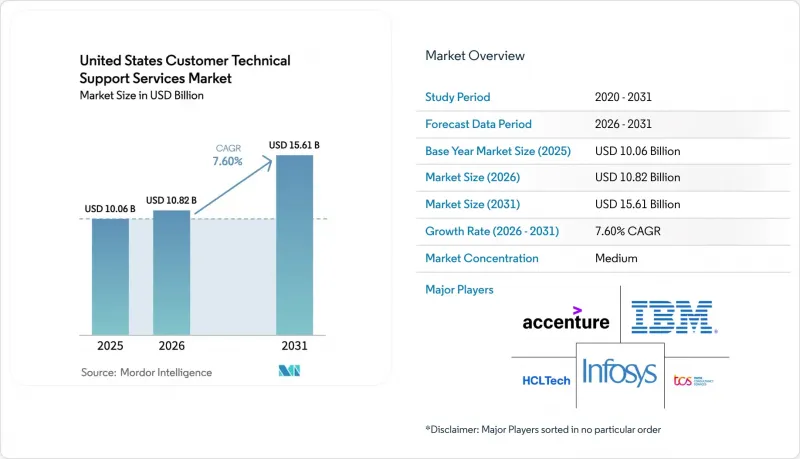
This report is Segmented by Service Type (On-Site Technical Support, Remote/Online Technical Support, and More), Device Type (Computers and Laptops, and More), Channel (Voice/Call-Center, Live Chat, and More), End-User Industry (Residential Consumers, Small and Medium Enterprises, and More). The Market Forecasts are Provided in Terms of Value (USD).
United States Customer Technical Support Services Market Trends and Insights
Proliferation of Smart-Home Devices
Smart-home installations are reshaping support demand as households juggle device compatibility, cybersecurity and network performance issues. IoT-connected thermostats, cameras and appliances now require technicians who can handle interoperability across multiple protocols and platforms. Healthcare-linked smart-home solutions for remote patient monitoring amplify compliance requirements around HIPAA data handling. Vendors such as Mavenoid have introduced specialized protocols for medical-grade equipment, signaling a deeper need for certified support talent. These dynamics are lifting ticket volumes and lengthening average handling times for residential calls.
Growing Complexity of Consumer Electronics
Hardware makers embed AI features, cloud connectivity and subscription applications in devices, turning post-purchase care into an ongoing relationship. Firmware updates, algorithm tuning and data-privacy inquiries often converge in a single case, driving multi-layered workflows. Apple's switch to subscription-only AppleCare+ underscores a shift from episodic repairs to lifecycle management. As AI accelerates, support teams must tackle questions about model performance, personalization and consent, raising training obligations and boosting resolution times.
Rising Tech-Support-Related Fraud
Consumer losses from scams topped USD 175 million in 2023, prompting the Federal Trade Commission to tighten telemarketing rules and impose stronger record-keeping on inbound support calls. Fraudulent voice cloning and deepfake tactics erode trust and push legitimate providers to adopt multi-factor authentication, verified channels and real-time fraud detection. Compliance spend is rising, particularly for outsourcers servicing elderly or low-literacy segments.
Other drivers and restraints analyzed in the detailed report include:
- Expansion of Remote-Work Culture
- Adoption of Predictive-AI Diagnostics
- Self-Service Cannibalizing Paid Support
For complete list of drivers and restraints, kindly check the Table Of Contents.
Segment Analysis
Remote and online assistance accounted for 42.80% of the customer technical support services market size in 2025, reflecting its cost-effective reach and compatibility with distributed work patterns. Subscription-driven programs, such as AppleCare+ and Best Buy memberships, improve lifetime value by bundling priority access, claims handling and device replacement. The self-service and automated support segment, growing at an 8.02% CAGR, benefits from conversational AI and video walkthroughs that resolve simple issues without agent intervention. On-site support remains crucial for enterprise infrastructure rollouts and intricate hardware faults, while managed outsourced support gains traction among budget-constrained SMEs seeking specialized talent. Providers that blend remote diagnostics with field services secure stickier contracts, particularly in regulated verticals that mandate physical verification.
The shift toward predictive maintenance is already reshaping ticket mix. AI engines surface firmware irregularities, prompting pre-emptive outreach that heads off failures and cuts warranty costs. As these capabilities mature, remote resolution is expected to reach 70% of total tickets by 2030, consolidating its market dominance and widening the gap with purely reactive models.
Computers and laptops held 33.90% customer technical support services market share in 2025, tied to their foundational role in productivity and gaming. Smart-home devices, however, register the fastest 8.55% CAGR through 2031 as households adopt connected thermostats, video doorbells and voice assistants. These ecosystems generate cross-device conflicts that elevate troubleshooting complexity. Smartphones and tablets occupy a mature yet stable niche, with calls centering on OS upgrades, cloud sync and app permissions. Consumer electronics such as televisions and consoles see moderate lift, spurred by streaming service integrations and rising esports engagement.
Wearables and ancillary IoT sensors extend support scope into health data and privacy compliance. HIPAA considerations grow in importance when smart-home hubs interface with remote patient monitoring solutions. Providers that certify technicians in medical-device protocols and encryption standards gain an edge when courting healthcare payers and hospital groups.
Complete Report Scope:
- By Service Type
- On-site Technical Support
- Remote / Online Technical Support
- Self-Service / Automated Support
- Managed (Outsourced) Technical Support
- By Device Type
- Computers and Laptops
- Smartphones and Tablets
- Smart-Home Devices
- Consumer Electronics (TV, Consoles)
- Others (Wearables, IoT)
- By Channel
- Voice / Call-Center
- Live Chat
- Social Media
- In-App Support
- By End-User Industry
- Residential Consumers
- Small and Medium Enterprises
- Large Enterprises
List of Companies Covered in this Report:
- Accenture plc
- Apple Inc. (AppleCare)
- Asurion LLC
- ATandT Inc. (Tech360)
- Best Buy Co., Inc. (Geek Squad)
- Cisco Systems, Inc.
- Concentrix Corporation
- Dell Technologies Inc.
- Genpact Limited
- HCL Technologies Limited
- Hewlett Packard Enterprise Company
- IBM Corporation
- Infosys Limited
- Sutherland Global Services Inc.
- Support.com Inc. (Greenidge Generation Holdings)
- Tata Consultancy Services Limited
- Teleperformance SE
- Verizon Communications Inc. (TechSure)
- Wipro Limited
Additional Benefits:
- The market estimate (ME) sheet in Excel format
- 3 months of analyst support
TABLE OF CONTENTS
1 INTRODUCTION
- 1.1 Study Assumptions and Market Definition
- 1.2 Scope of the Study
2 RESEARCH METHODOLOGY
3 EXECUTIVE SUMMARY
4 MARKET LANDSCAPE
- 4.1 Market Overview
- 4.2 Market Drivers
- 4.2.1 Increasing requirement for software updates
- 4.2.2 Proliferation of smart-home devices
- 4.2.3 Growing complexity of consumer electronics
- 4.2.4 Expansion of remote-work culture
- 4.2.5 Adoption of predictive-AI diagnostics
- 4.2.6 Rise of subscription tech-support bundles
- 4.3 Market Restraints
- 4.3.1 Rising tech-support-related fraud
- 4.3.2 High labor and compliance costs
- 4.3.3 Data-privacy concerns in remote diagnostics
- 4.3.4 Self-service cannibalizing paid support
- 4.4 Value / Supply-Chain Analysis
- 4.5 Regulatory Landscape
- 4.6 Technological Outlook
- 4.7 Porter's Five Forces
- 4.7.1 Threat of New Entrants
- 4.7.2 Bargaining Power of Suppliers
- 4.7.3 Bargaining Power of Buyers
- 4.7.4 Threat of Substitutes
- 4.7.5 Degree of Rivalry
- 4.8 Assessment of Impact of COVID-19
- 4.9 Breakdown of Consumers Contacting Customer Support by Channel (2020)
5 MARKET SIZE AND GROWTH FORECASTS (VALUE)
- 5.1 By Service Type
- 5.1.1 On-site Technical Support
- 5.1.2 Remote / Online Technical Support
- 5.1.3 Self-Service / Automated Support
- 5.1.4 Managed (Outsourced) Technical Support
- 5.2 By Device Type
- 5.2.1 Computers and Laptops
- 5.2.2 Smartphones and Tablets
- 5.2.3 Smart-Home Devices
- 5.2.4 Consumer Electronics (TV, Consoles)
- 5.2.5 Others (Wearables, IoT)
- 5.3 By Channel
- 5.3.1 Voice / Call-Center
- 5.3.2 Live Chat
- 5.3.3 E-mail
- 5.3.4 Social Media
- 5.3.5 In-App Support
- 5.4 By End-User Industry
- 5.4.1 Residential Consumers
- 5.4.2 Small and Medium Enterprises
- 5.4.3 Large Enterprises
6 COMPETITIVE LANDSCAPE
- 6.1 Market Concentration
- 6.2 Strategic Moves
- 6.3 Market Share Analysis
- 6.4 Company Profiles (includes Global level Overview, Market level overview, Core Segments, Financials as available, Strategic Information, Market Rank/Share for key companies, Products and Services, and Recent Developments)
- 6.4.1 Accenture plc
- 6.4.2 Apple Inc. (AppleCare)
- 6.4.3 Asurion LLC
- 6.4.4 ATandT Inc. (Tech360)
- 6.4.5 Best Buy Co., Inc. (Geek Squad)
- 6.4.6 Cisco Systems, Inc.
- 6.4.7 Concentrix Corporation
- 6.4.8 Dell Technologies Inc.
- 6.4.9 Genpact Limited
- 6.4.10 HCL Technologies Limited
- 6.4.11 Hewlett Packard Enterprise Company
- 6.4.12 IBM Corporation
- 6.4.13 Infosys Limited
- 6.4.14 Sutherland Global Services Inc.
- 6.4.15 Support.com Inc. (Greenidge Generation Holdings)
- 6.4.16 Tata Consultancy Services Limited
- 6.4.17 Teleperformance SE
- 6.4.18 Verizon Communications Inc. (TechSure)
- 6.4.19 Wipro Limited
7 MARKET OPPORTUNITIES AND FUTURE OUTLOOK
- 7.1 White-space and Unmet-Need Assessment

