PUBLISHER: Mordor Intelligence | PRODUCT CODE: 2116644

PUBLISHER: Mordor Intelligence | PRODUCT CODE: 2116644
Transformer Oil - Market Share Analysis, Industry Trends & Statistics, Growth Forecasts (2026 - 2031)
According to Mordor Intelligence, the transformer oil market size is expected to grow from 5.59 Billion liters in 2025 to 1.09 Billion liters in 2026 and is forecast to reach 1.16 Billion liters by 2031 at 1.31% CAGR over 2026-2031.
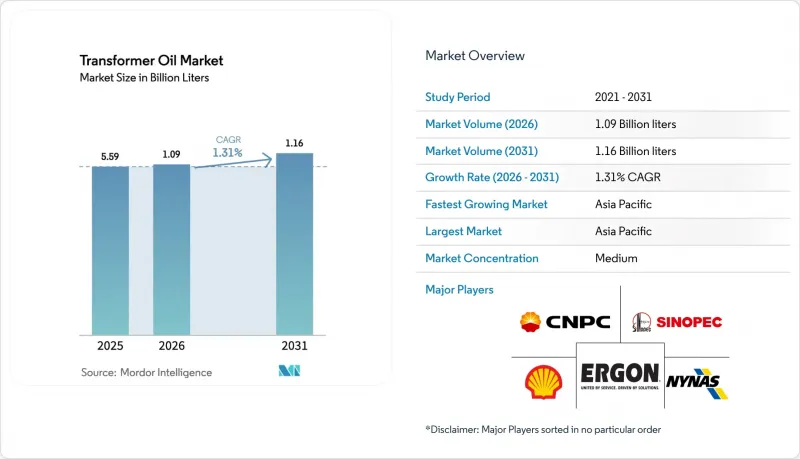
This report is Segmented by Type (Mineral-Based, Silicone-Based, and Bio-Based), Application (Transformer, Switchgear, Circuit Breakers, and More), End-User Industry (Power Generation, Transmission and Distribution, Railways and Metros, and Other), and Geography (Asia-Pacific, North America, Europe, South America, and Middle East and Africa). Market Forecasts are Provided in Terms of Volume (liters).
Global Transformer Oil Market Trends and Insights
Growing Electric Grids in Asia-Pacific
Asia-Pacific utilities are building redundancy into networks, driving step-change transformer oil demand. China's State Grid invested USD 89 billion in 2025 to extend ultra-high-voltage corridors, and each 1,000 kV unit requires 10,000 to 20,000 liters of oil. India has earmarked Rs 9.16 trillion (USD 109 billion) for 1,274 GVA of new transformation capacity by 2032. ASEAN projects will add up to 13,780 MW of cross-border links that rely on synthetic-ester or silicone fluids resilient to tropical humidity. Investment is driven less by electrification and more by network reliability, creating a stable base for the transformer oil market.
Upgradation of Aging Transformers in OECD Markets
North American and European utilities are confronting end-of-life fleets installed during the 1970s-1980s. US lead times have lengthened to 24 months for replacement units, partly due to shortages of electrical steel. Europe anticipates 34,000 tonnes of annual oil demand by 2030 as 400/100 kV substations are modernized to integrate offshore wind. Australia is retrofitting rural assets with fire-resistant esters at insurers' insistence. Replacement schedules remain uneven; Japan and South Korea are delaying upgrades for budgetary reasons, preserving long-tail mineral demand.
Tight Group-I Base-Oil Supply After European Refinery Closures
European shutdowns have removed 2 million tonnes of Group-I capacity since 2024, forcing blenders to import higher-priced feedstock. Freight premiums of 15-20% and six-month delivery lags undermine pricing visibility. North American formulators are migrating to Group-II base oils, necessitating reformulation to match dielectric performance. Asian suppliers in South Korea and Singapore are scaling exports, but their logistics chains add cost and quality variability. Supply tightness, therefore, subtracts about 0.2 percentage points from the transformer oil market CAGR.
Other drivers and restraints analyzed in the detailed report include:
- DOE-Mandated Efficiency Standards for Distribution Transformers
- Offshore-Wind Converter Platforms Demanding High-Flash-Point Oils
- Mineral-Oil Environmental Liabilities and Disposal Costs
For complete list of drivers and restraints, kindly check the Table Of Contents.
Segment Analysis
Mineral-based products accounted for 90.12% of the 2025 volume, reflecting entrenched procurement habits and lower unit cost. Bio-based esters are advancing at a 7.92% CAGR to 2031, anchored in K-class fire-safety performance and rapid biodegradability. Natural esters find favor in data centers and hospitals where fire risks and environmental liabilities are highest. Synthetic esters, engineered from polyol bases, outperform under high thermal cycling, making them the preferred choice for offshore wind platforms and rail traction transformers. The transformer oil market size for bio-based esters is therefore expanding faster than the legacy mineral segment.
Europe specifies natural esters in roughly one-third of new installations, spurred by insurer incentives and carbon-disclosure mandates. North American adoption remains at 15-20% as utilities validate long-term performance. Asia-Pacific remains price-driven, yet China's draft law requiring biodegradable fluids near water bodies could shift 10-15% of its installed base to esters by 2030. Silicone oils occupy a niche for temperatures above 200°C, notable in furnace transformers, but face cost hurdles. Collectively, these trends reshape the product mix within the transformer oil market.
Complete Report Scope:
- By Type
- Mineral-Based
- Silicone-Based
- Bio-Based (Natural and Synthetic Esters)
- By Application
- Transformer
- Switchgear
- Circuit Breakers
- Capacitors
- Other Applications (reactor, etc.)
- By End-User Industry
- Power Generation
- Transmission and Distribution
- Railways and Metros
- Other End-user Industries
- By Geography
- Asia-Pacific
- China
- India
- Japan
- South Korea
- Indonesia
- Malaysia
- Thailand
- Vietnam
- Rest of Asia-Pacific
- North America
- United States
- Canada
- Mexico
- Europe
- Germany
- United Kingdom
- France
- Italy
- Spain
- Nordic Countries
- Russia
- Turkey
- Rest of Europe
- South America
- Brazil
- Argentina
- Rest of South America
- Middle-East and Africa
- Saudi Arabia
- United Arab Emirates
- Qatar
- South Africa
- Nigeria
- Egypt
- Rest of Middle-East and Africa
- Asia-Pacific
Geography Analysis
Asia-Pacific held 47.77% of global volume in 2025 and is expected to grow at 1.82% annually to 2031. China's USD 89 billion grid program and India's USD 109 billion transmission plan underpin the region's leadership. ASEAN interconnection projects call for high-performance esters able to operate in humid, salt-spray environments. Mature markets such as Japan and South Korea generate steady replacement demand for higher-efficiency units.
North America contributed just over some of the 2025 volume. US DOE rules, offshore-wind investments, and 12 GW of new battery storage underpin growth. Canada's export-oriented transmission upgrades and Mexico's substation modernizations add incremental demand.
Europe's market share is driven by 30 GW of offshore wind and urban-substation retrofits that specify fire-resistant fluids. Replacement of 400/100 kV transformers adds 34,000 tonnes of annual oil demand by 2030.
South America and the Middle East & Africa together represent a significantly lower market share. Brazil is extending transmission lines into the Amazon to integrate hydro assets, while Saudi Arabia's Vision 2030 allocates USD 50 billion for grid upgrades. South Africa and Nigeria focus on urban reliability and rural electrification respectively, favoring lower-cost mineral oils but gradually trialing esters in donor-funded projects.
- APAR Industries Ltd.
- Calumet, Inc.
- Cargill, Incorporated
- Chevron Corporation
- China Petrochemical Corporation
- Ergon, Inc.
- Exxon Mobil Corporation
- Gulf Oil International Ltd
- Lukoil
- NYNAS AB
- Petro-Canada Lubricants Inc.
- Phillips 66 Company
- Raj Petro
- Repsol
- San Joaquin Refining Co. Inc.
- Saudi Arabian Oil Co.
- SAVITA OIL TECHNOLOGIES LIMITED
- Shell plc
- TotalEnergies
Additional Benefits:
- The market estimate (ME) sheet in Excel format
- 3 months of analyst support
TABLE OF CONTENTS
1 Introduction
- 1.1 Study Assumptions & Market Definition
- 1.2 Scope of the Study
2 Research Methodology
3 Executive Summary
4 Market Landscape
- 4.1 Market Overview
- 4.2 Market Drivers
- 4.2.1 Growing electric grids in Asia-Pacific
- 4.2.2 Up-gradation of aging transformers in OECD markets
- 4.2.3 DOE-mandated efficiency standards for distribution transformers
- 4.2.4 Offshore-wind converter platforms demanding high-flash-point oils
- 4.2.5 Utility-scale battery storage build-out
- 4.3 Market Restraints
- 4.3.1 Tight Group-I base-oil supply after European refinery closures
- 4.3.2 Mineral-oil environmental liabilities and disposal costs
- 4.3.3 Ester-fluid price premium in cost-sensitive Asia-Pacific utilities
- 4.4 Value Chain Analysis
- 4.5 Porter's Five Forces
- 4.5.1 Bargaining Power of Suppliers
- 4.5.2 Bargaining Power of Buyers
- 4.5.3 Threat of New Entrants
- 4.5.4 Threat of Substitutes
- 4.5.5 Degree of Competition
5 Market Size and Growth Forecasts (Volume )
- 5.1 By Type
- 5.1.1 Mineral-Based
- 5.1.2 Silicone-Based
- 5.1.3 Bio-Based (Natural and Synthetic Esters)
- 5.2 By Application
- 5.2.1 Transformer
- 5.2.2 Switchgear
- 5.2.3 Circuit Breakers
- 5.2.4 Capacitors
- 5.2.5 Other Applications (reactor, etc.)
- 5.3 By End-User Industry
- 5.3.1 Power Generation
- 5.3.2 Transmission and Distribution
- 5.3.3 Railways and Metros
- 5.3.4 Other End-user Industries
- 5.4 By Geography
- 5.4.1 Asia-Pacific
- 5.4.1.1 China
- 5.4.1.2 India
- 5.4.1.3 Japan
- 5.4.1.4 South Korea
- 5.4.1.5 Indonesia
- 5.4.1.6 Malaysia
- 5.4.1.7 Thailand
- 5.4.1.8 Vietnam
- 5.4.1.9 Rest of Asia-Pacific
- 5.4.2 North America
- 5.4.2.1 United States
- 5.4.2.2 Canada
- 5.4.2.3 Mexico
- 5.4.3 Europe
- 5.4.3.1 Germany
- 5.4.3.2 United Kingdom
- 5.4.3.3 France
- 5.4.3.4 Italy
- 5.4.3.5 Spain
- 5.4.3.6 Nordic Countries
- 5.4.3.7 Russia
- 5.4.3.8 Turkey
- 5.4.3.9 Rest of Europe
- 5.4.4 South America
- 5.4.4.1 Brazil
- 5.4.4.2 Argentina
- 5.4.4.3 Rest of South America
- 5.4.5 Middle-East and Africa
- 5.4.5.1 Saudi Arabia
- 5.4.5.2 United Arab Emirates
- 5.4.5.3 Qatar
- 5.4.5.4 South Africa
- 5.4.5.5 Nigeria
- 5.4.5.6 Egypt
- 5.4.5.7 Rest of Middle-East and Africa
- 5.4.1 Asia-Pacific
6 Competitive Landscape
- 6.1 Market Concentration
- 6.2 Strategic Moves
- 6.3 Market Share(%)/Ranking Analysis
- 6.4 Company Profiles (includes Global level Overview, Market level overview, Core Segments, Financials as available, Strategic Information, Market Rank/Share for key companies, Products and Services, and Recent Developments)
- 6.4.1 APAR Industries Ltd.
- 6.4.2 Calumet, Inc.
- 6.4.3 Cargill, Incorporated
- 6.4.4 Chevron Corporation
- 6.4.5 China Petrochemical Corporation
- 6.4.6 Ergon, Inc.
- 6.4.7 Exxon Mobil Corporation
- 6.4.8 Gulf Oil International Ltd
- 6.4.9 Lukoil
- 6.4.10 NYNAS AB
- 6.4.11 Petro-Canada Lubricants Inc.
- 6.4.12 Phillips 66 Company
- 6.4.13 Raj Petro
- 6.4.14 Repsol
- 6.4.15 San Joaquin Refining Co. Inc.
- 6.4.16 Saudi Arabian Oil Co.
- 6.4.17 SAVITA OIL TECHNOLOGIES LIMITED
- 6.4.18 Shell plc
- 6.4.19 TotalEnergies
7 Market Opportunities and Future Outlook
- 7.1 White-Space and Unmet-Need Assessment
- 7.2 Growing Demand for Bio-Based Transformer Oils

