PUBLISHER: Mordor Intelligence | PRODUCT CODE: 2116652

PUBLISHER: Mordor Intelligence | PRODUCT CODE: 2116652
LNG Storage Tank - Market Share Analysis, Industry Trends & Statistics, Growth Forecasts (2026 - 2031)
According to Mordor Intelligence, the LNG storage tank market size was valued at USD 16.45 billion in 2025 and estimated to grow from USD 17.78 billion in 2026 to reach USD 26.27 billion by 2031, at a CAGR of 8.13% during the forecast period (2026-2031).
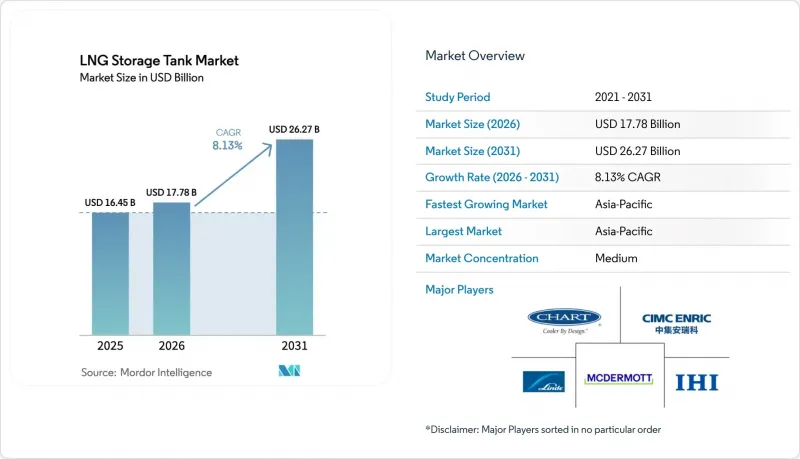
This report is Segmented by Containment Type (Full Containment Tanks, Membrane Tanks, and More), Tank Type (Type-A, Type-B, and Type-C), Material (9%-Nickel Steel, Aluminium Alloys, and More), Location (On-Shore Fixed Tanks, Offshore FLNG/FSRU Tanks, and More), Application (Import and Regasification Terminals, Marine Bunkering Facilities, and More), and Geography (North America, Asia-Pacific, and More).
Global LNG Storage Tank Market Trends and Insights
Expansion of LNG Bunkering Infrastructure for Maritime Decarbonization
International Maritime Organization emission caps are steering shipowners toward LNG propulsion, which is fostering the development of large-scale bunkering nodes in Singapore, Rotterdam, and the US Gulf. The American Bureau of Shipping anticipates that the LNG-powered fleet will exceed 1,000 vessels by 2027, a shift that is stimulating demand for high-pressure Type-C tanks capable of withstanding rapid cyclic loading. Ports are racing to license bunker operators and add dedicated storage berths, which is accelerating project lead-times and encouraging modular tank packages that minimize quayside disruption. The Asia-Pacific region is moving at the fastest pace, thanks to dense feeder routes and flexible ship-to-ship transfers that require compact, high-turnover storage. Suppliers with proven membrane or cylindrical designs are capturing early contracts as charterers seek compatible, future-proof solutions.
Growth in Floating LNG Import Terminals (FSRUs)
Countries facing urgent supply gaps after the 2022 energy shock favor FSRUs, as build times of 18-24 months compare favorably with the 4-6 year horizon of onshore terminals. The U.S. Energy Information Administration estimates 2024 floating regas capacity at 7.8 billion cubic feet per day, or approximately 8% of global send-out . The new units ordered for Pakistan, Egypt, and Germany demonstrate the model's portability and lower permitting requirements. Containment systems tailored to the dynamic motions of floating hulls-predominantly membrane variants-are consequently in high demand. Designers able to guarantee sloshing resistance while enabling high cargo turnover are winning the majority of EPC awards.
Volatility in Steel & Nickel Prices
Nickel content up to 9% makes raw material swings a key cost factor, with Argus assessments showing spot nickel prices gyrating by more than 35% during 2024. For a 180,000 m3 full-containment tank, plate costs can equate to 45% of delivered EPC value, leaving fabricators exposed when hedging fails. Some Asian mills are trialing 7%-nickel TMCP plate to reduce alloying cost without losing low-temperature toughness, and EPCs are locking in longer-term supply contracts to stabilize bids.
Other drivers and restraints analyzed in the detailed report include:
- Surge in Asian Gas Demand & Energy Security Policies
- Adoption of 9%-Nickel Cryogenic Welding Robots
- Permitting Delays for Coastal Tank Farms
For complete list of drivers and restraints, kindly check the Table Of Contents.
Segment Analysis
Full containment systems accounted for 41.75% of 2025 revenues, thanks to robust safety credentials and regulatory familiarity. Operators servicing high-throughput import terminals value the double-wall configuration that confines spills and simplifies maintenance. The LNG storage tank market continues to witness consistent specifications for 160,000 m3-230,000 m3 units at new Chinese, Japanese, and Indian sites, affirming confidence in the design. Membrane tanks, favored for floating and modular projects, are projected to log an 11.02% CAGR through 2031, reflecting yard preferences for faster assembly and superior volumetric efficiency. During 2025-2027, floating regas deployments in Germany and Brazil are expected to anchor further membrane conversions.
Membrane suppliers are investing in sloshing research and barrier-foil alloys to extend design life beyond 40 years. GTT's NEXT1 earned major approvals and several Asian yard orders, signaling broader acceptance. Single containment persists in niche peak-shaving plants where cost is a primary consideration, while concrete in-ground concepts are employed in geologies that allow for mined cavern approaches. Overall, the LNG storage tank market is likely to strike a balance between proven full-containment safety and membrane-driven speed and footprint gains as developers optimize their designs by project context.
Type-A rectangular tanks held a 39.12% share in 2025, dominating land-constrained terminals that utilize their high space efficiency. Mature fabrication lines in Korea, China, and Europe maintain a competitive cost per cubic meter, and retrofits of vapor handling gear extend asset value. Yet small-scale distribution networks and bunkering hubs propel Type-C cylinders at a forecast 10.05% CAGR. Their vacuum insulation slashes boil-off, supporting multi-stop fuel delivery with minimal loss.
Compact reliquefaction modules, showcased by Wartsila in the 4,000-40,000 m3 carrier range, pair naturally with Type-C to enable point-to-point logistics. Type-B spheres maintain a foothold in extreme-pressure contexts but face high capital expenditures and longer build schedules. Across various applications, developers are combining geometries: prismatic shore tanks at the jetty head, cylindrical lag tanks on bunker barges, and spheres on older FLNG conversions, reflecting the diverse service envelopes within the LNG storage tank market.
Complete Report Scope:
- By Containment Type
- Full Containment Tanks
- Single Containment Tanks
- Membrane Tanks
- In-ground/Cryogenic Concrete Tanks
- By Tank Type
- Type-A (Prismatic)
- Type-B (Spherical)
- Type-C (Cylindrical, Vacuum-insulated)
- By Material
- Carbon Steel
- 9 %-Nickel Steel
- Aluminium Alloys
- Prestressed Concrete
- By Location
- On-shore Fixed Tanks
- Offshore FLNG/FSRU Tanks
- LNG Bunkering Barges
- By Application
- Liquefaction Plants
- Import and Regasification Terminals
- Peak-Shaving and Satellite Plants
- Marine Bunkering Facilities
- By Geography
- North America
- United States
- Canada
- Mexico
- Europe
- Germany
- United Kingdom
- France
- Russia
- Spain
- Rest of Europe
- Asia-Pacifc
- China
- Japan
- India
- South Korea
- Singapore
- Malaysia
- Australia
- Rest of Asia-Pacifc
- South America
- Brazil
- Argentina
- Rest of South America
- Middle East and Africa
- Saudi Arabia
- United Arab Emirates
- Qatar
- South Africa
- Rest of Middle East and Africa
- North America
Geography Analysis
Asia-Pacific generated 44.10% of global revenue in 2025 and is on track for a 8.94% CAGR to 2031. China alone is building more than thirty new terminals, each equipped with multiple 220,000 m3 full-containment tanks, to safeguard against spot-market volatility. Japan's newly approved strategic stockpile scheme mandates a standing cargo inventory, adding predictable drawdown and replenishment cycles to storage demand. India is doubling its Eastern-coast capacity and incentivizing city-gas distributors to charter floating storage, thereby broadening the addressable volume. Regional fabricators benefit from shorter logistics chains for plate and alloy supply, which compresses delivery times and solidifies the LNG storage tank market in the area.
Europe's import capacity rose 34% between 2021 and the end of 2024 as Germany, France, and the Netherlands installed emergency FSRUs. Although send-out fell in 2024 due to mild weather curbing gas burn, regulators continue to approve incremental shore tanks sized for future hydrogen or ammonia blends. The policy push for ammonia-ready components has prompted revisions to the design of secondary barriers and boil-off systems. North America hosts the deepest project queue but faces challenges from litigation and federal reviews. Developers prolong schedules by 12-18 months, delaying construction plate demand but not eroding the underlying need for it.
The Middle East and Africa are emerging growth poles. Qatar's expanded North Field output will require new tankage at Ras Laffan to handle incremental trains, while the UAE's Ruwais project awards EPC contracts for dual 200,000 m3 cryogenic tanks delivering by 2029. Africa's FLNG wave will bring floating hulls fitted with multi-row membrane tanks to Congo, Mauritania, and Senegal. Local governments view these assets as revenue boosters for exports and enablers of domestic power, positioning the LNG storage tank market for sustained momentum across multiple regions.
- Chart Industries Inc.
- China International Marine Containers (CIMC Enric)
- Linde plc
- McDermott International
- IHI Corporation
- Wartsila Oyj
- Samsung Heavy Industries
- Mitsubishi Heavy Industries
- KOGAS Tech
- Air Water Inc.
- IsIsan A.S.
- Cryolor SA
- INOX India Ltd.
- Wison Offshore & Marine
- Saipem SpA
- Technip Energies
- Victaulic Company
- Fives
- CSIC Hudong-Zhonghua
- GTT (Gaztransport & Technigaz)
Additional Benefits:
- The market estimate (ME) sheet in Excel format
- 3 months of analyst support
TABLE OF CONTENTS
1 Introduction
- 1.1 Study Assumptions & Market Definition
- 1.2 Scope of the Study
2 Research Methodology
3 Executive Summary
4 Market Landscape
- 4.1 Market Overview
- 4.2 Market Drivers
- 4.2.1 Expansion of LNG bunkering infrastructure for maritime decarbonization
- 4.2.2 Growth in floating LNG import terminals (FSRUs)
- 4.2.3 Surge in Asian gas demand & energy security policies
- 4.2.4 Adoption of 9 %-nickel cryogenic welding robots
- 4.2.5 Modular prefabricated on-ground membrane tanks
- 4.2.6 Small-scale LNG satellite hubs boosting Type-C demand
- 4.3 Market Restraints
- 4.3.1 Volatility in steel & nickel prices
- 4.3.2 Permitting delays for coastal tank farms
- 4.3.3 Emerging underground LNG storage alternatives
- 4.3.4 Membrane-tank patent litigation narrowing supplier base
- 4.4 Supply-Chain Analysis
- 4.5 Regulatory Landscape
- 4.6 Technological Outlook
- 4.7 Porter's Five Forces
- 4.7.1 Threat of New Entrants
- 4.7.2 Bargaining Power of Buyers
- 4.7.3 Bargaining Power of Suppliers
- 4.7.4 Threat of Substitutes
- 4.7.5 Intensity of Competitive Rivalry
5 Market Size & Growth Forecasts
- 5.1 By Containment Type
- 5.1.1 Full Containment Tanks
- 5.1.2 Single Containment Tanks
- 5.1.3 Membrane Tanks
- 5.1.4 In-ground/Cryogenic Concrete Tanks
- 5.2 By Tank Type
- 5.2.1 Type-A (Prismatic)
- 5.2.2 Type-B (Spherical)
- 5.2.3 Type-C (Cylindrical, Vacuum-insulated)
- 5.3 By Material
- 5.3.1 Carbon Steel
- 5.3.2 9 %-Nickel Steel
- 5.3.3 Aluminium Alloys
- 5.3.4 Prestressed Concrete
- 5.4 By Location
- 5.4.1 On-shore Fixed Tanks
- 5.4.2 Offshore FLNG/FSRU Tanks
- 5.4.3 LNG Bunkering Barges
- 5.5 By Application
- 5.5.1 Liquefaction Plants
- 5.5.2 Import and Regasification Terminals
- 5.5.3 Peak-Shaving and Satellite Plants
- 5.5.4 Marine Bunkering Facilities
- 5.6 By Geography
- 5.6.1 North America
- 5.6.1.1 United States
- 5.6.1.2 Canada
- 5.6.1.3 Mexico
- 5.6.2 Europe
- 5.6.2.1 Germany
- 5.6.2.2 United Kingdom
- 5.6.2.3 France
- 5.6.2.4 Russia
- 5.6.2.5 Spain
- 5.6.2.6 Rest of Europe
- 5.6.3 Asia-Pacifc
- 5.6.3.1 China
- 5.6.3.2 Japan
- 5.6.3.3 India
- 5.6.3.4 South Korea
- 5.6.3.5 Singapore
- 5.6.3.6 Malaysia
- 5.6.3.7 Australia
- 5.6.3.8 Rest of Asia-Pacifc
- 5.6.4 South America
- 5.6.4.1 Brazil
- 5.6.4.2 Argentina
- 5.6.4.3 Rest of South America
- 5.6.5 Middle East and Africa
- 5.6.5.1 Saudi Arabia
- 5.6.5.2 United Arab Emirates
- 5.6.5.3 Qatar
- 5.6.5.4 South Africa
- 5.6.5.5 Rest of Middle East and Africa
- 5.6.1 North America
6 Competitive Landscape
- 6.1 Market Concentration
- 6.2 Strategic Moves (M&A, Partnerships, PPAs)
- 6.3 Market Share Analysis (Market Rank/Share for key companies)
- 6.4 Company Profiles (includes Global level Overview, Market level overview, Core Segments, Financials as available, Strategic Information, Products & Services, and Recent Developments)
- 6.4.1 Chart Industries Inc.
- 6.4.2 China International Marine Containers (CIMC Enric)
- 6.4.3 Linde plc
- 6.4.4 McDermott International
- 6.4.5 IHI Corporation
- 6.4.6 Wartsila Oyj
- 6.4.7 Samsung Heavy Industries
- 6.4.8 Mitsubishi Heavy Industries
- 6.4.9 KOGAS Tech
- 6.4.10 Air Water Inc.
- 6.4.11 IsIsan A.S.
- 6.4.12 Cryolor SA
- 6.4.13 INOX India Ltd.
- 6.4.14 Wison Offshore & Marine
- 6.4.15 Saipem SpA
- 6.4.16 Technip Energies
- 6.4.17 Victaulic Company
- 6.4.18 Fives
- 6.4.19 CSIC Hudong-Zhonghua
- 6.4.20 GTT (Gaztransport & Technigaz)
7 Market Opportunities & Future Outlook
- 7.1 White-space & Unmet-Need Assessment

