PUBLISHER: Mordor Intelligence | PRODUCT CODE: 2116688

PUBLISHER: Mordor Intelligence | PRODUCT CODE: 2116688
France Magnetic Resonance Imaging - Market Share Analysis, Industry Trends & Statistics, Growth Forecasts (2026 - 2031)
According to Mordor Intelligence, the France magnetic resonance imaging market size is expected to grow from USD 480.86 million in 2025 to USD 505.82 million in 2026 and is forecast to reach USD 651.27 million by 2031 at 5.19% CAGR over 2026-2031.
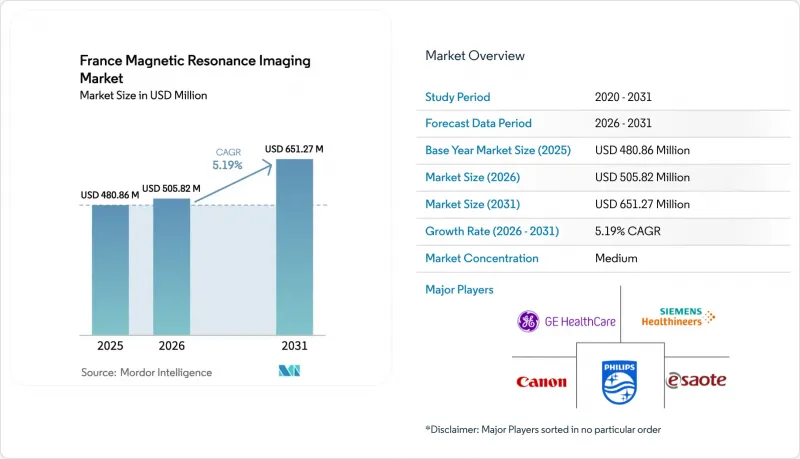
This report is Segmented by Architecture (Closed MRI Systems and Open MRI Systems), Field Strength (Low-Field <=0. 55T, Mid/High-Field 1. 5T, Very-High-Field 3T, and Ultra-High-Field 7T+), and Application (Neurology, Oncology, Musculoskeletal, Cardiology, Gastroenterology, and Other Applications). The Market Forecasts are Provided in Terms of Value (USD).
France Magnetic Resonance Imaging Market Trends and Insights
Rapid Rise in Cancer & Neuro-Degenerative Burden
France's aging population is escalating clinical demand for high-resolution neurological and oncological imaging. Expanded national screening protocols now rely on MRI for early tumor detection and disease staging. The Iseult 11.7 T platform at CEA produced first-in-human brain scans in 2024, demonstrating sub-millimeter resolution that improves hippocampal atrophy measurement and iron mapping for Parkinson's diagnostics. University hospitals are therefore scaling MRI slots dedicated to neuro-oncology pathways, integrating diffusion and perfusion sequences that shorten diagnostic timelines. Steady gains in five-year cancer survival rates further elevate longitudinal monitoring volumes. Together, these demographic and clinical pressures intensify scanner utilization and accelerate replacement demand across the France magnetic resonance imaging market.
Growing Adoption of 3 T Scanners in University Hospitals
Academic centers including CHU Reims and CHU Nancy are moving from 1.5 T to 3 T platforms to unlock advanced research protocols. Higher field strength improves signal-to-noise ratios, enabling functional MRI, diffusion tensor imaging, and proton spectroscopy that previously required referral to national research facilities. France 2030 funds earmark capital for this upgrade cycle, while vendor value partnerships bundle equipment, training, and life-cycle servicing to offset upfront costs. Early adopters report sharper vascular delineation in stroke work-ups and reduced slice thickness in musculoskeletal exams, reinforcing the clinical case for 3 T migration. The resulting rise in high-complexity exams widens reimbursement differentials between university hospitals and private clinics, adding momentum to the France magnetic resonance imaging market expansion.
Capped Public-Hospital Budgets & DRG-Linked Tariffs
Public facilities spend only 5% of operating income on capital investment, down from 10% in 2009, limiting MRI fleet renewal. The EUR 1.3 billion technical forfait allotted to MRI exams faces annual cost-containment reviews by Assurance Maladie, squeezing per-scan reimbursement. Hospital CFOs therefore delay purchases or pivot to vendor-financed value partnerships, lengthening procurement cycles. Competitive tension rises because private clinics can recover costs faster under fee-for-service models, siphoning complex cases. These structural funding barriers dampen large volume orders, tempering the France magnetic resonance imaging market CAGR despite robust clinical demand.
Other drivers and restraints analyzed in the detailed report include:
- National AI-for-Imaging Strategy Under France 2030 Funding
- Expansion of Outpatient MRI Capacity Via 2024 Reforms
- Lengthy ANSM Approval Cycle for Novel Field Strengths
For complete list of drivers and restraints, kindly check the Table Of Contents.
Segment Analysis
Closed scanners anchored 56.03% of the France magnetic resonance imaging market in 2025 thanks to superior homogeneity and high channel coils that satisfy neurology, oncology, and musculoskeletal protocols. Closed units now incorporate BlueSeal and DryCool helium-free designs, which reduce energy consumption and help mitigate global helium shortages. These sustainability gains influence hospital tenders, which score equipment based on carbon criteria. Open platforms remain niche but gather momentum with a 7.39% CAGR because patient comfort improves completion rates among claustrophobic and pediatric cohorts. Outpatient centers in Provence and Brittany advertise panoramic 0.4 T systems as a differentiator, capturing referrals from general practitioners. The France magnetic resonance imaging market size for open architecture will therefore expand while coexistence persists, reflecting complementary-not substitutive-clinical use-cases.
Second-generation open units deploy AI-based reconstruction that compensates for lower field strength, closing the quality gap with closed systems. Portable intraoperative models further extend open design into hybrid operating rooms, adding functional values rather than siphoning demand from mainstream diagnostic suites. Closed scanners, however, retain the premium tier of France magnetic resonance imaging market share because they support 3 T upgrades, spectroscopy adjuncts, and parallel transmit coils essential for clinical research trials.
Complete Report Scope:
- By Architecture
- Closed MRI Systems
- Open MRI Systems
- By Field Strength
- Low-Field (<=0.55 T)
- Mid/High-Field (1.5 T)
- Very-High-Field (3 T)
- Ultra-High-Field (7 T +)
- By Application
- Neurology
- Oncology
- Musculoskeletal
- Cardiology
- Gastroenterology
- Other Applications
List of Companies Covered in this Report:
- Bruker
- Canon
- E-Device
- Esaote
- FUJIFILM
- GE Healthcare
- Guerbet (Radiology IT)
- Hitachi
- Imricor Medical Systems
- Median Technologies
- MinFound Medical
- Koninklijke Philips
- Siemens Healthineers
- Software Republique (Siemens-Atos AI)
- SternMed
- SuperSonic Imagine
Additional Benefits:
- The market estimate (ME) sheet in Excel format
- 3 months of analyst support
TABLE OF CONTENTS
1 Introduction
- 1.1 Study Assumptions & Market Definition
- 1.2 Scope of the Study
2 Research Methodology
3 Executive Summary
4 Market Landscape
- 4.1 Market Overview
- 4.2 Market Drivers
- 4.2.1 Rapid Rise in Cancer & Neuro-Degenerative Disease Burden
- 4.2.2 Growing Adoption of 3 T Scanners In French University Hospitals
- 4.2.3 National AI-For-Imaging Strategy Under "France 2030" Funding
- 4.2.4 Expansion of Outpatient MRI Capacity Mandated By 2024 Social-Security Reforms
- 4.2.5 Vendor Financing Programmes for Private Clinics
- 4.2.6 Ageing Installed Base Reaching End-of-Life Triggers Replacement Wave
- 4.3 Market Restraints
- 4.3.1 Capped Public-Hospital Budgets & DRG-Linked Tariffs
- 4.3.2 Lengthy ANSM Approval Cycle For Novel Field Strengths
- 4.3.3 Persistent Shortage Of MRI Technologists In Regional France
- 4.3.4 High Procurement Cost Vs. CT & Ultrasound Alternatives
- 4.4 Value / Supply-Chain Analysis
- 4.5 Regulatory Landscape
- 4.6 Technological Outlook
- 4.7 Porter's Five Forces
- 4.7.1 Threat of New Entrants
- 4.7.2 Bargaining Power of Buyers/Consumers
- 4.7.3 Bargaining Power of Suppliers
- 4.7.4 Threat of Substitute Products
- 4.7.5 Intensity of Competitive Rivalry
5 Market Size & Growth Forecasts (Value, USD)
- 5.1 By Architecture
- 5.1.1 Closed MRI Systems
- 5.1.2 Open MRI Systems
- 5.2 By Field Strength
- 5.2.1 Low-Field (<=0.55 T)
- 5.2.2 Mid/High-Field (1.5 T)
- 5.2.3 Very-High-Field (3 T)
- 5.2.4 Ultra-High-Field (7 T +)
- 5.3 By Application
- 5.3.1 Neurology
- 5.3.2 Oncology
- 5.3.3 Musculoskeletal
- 5.3.4 Cardiology
- 5.3.5 Gastroenterology
- 5.3.6 Other Applications
6 Competitive Landscape
- 6.1 Market Concentration
- 6.2 Market Share Analysis
- 6.3 Company Profiles (includes Global level Overview, Market level overview, Core Segments, Financials as available, Strategic Information, Market Rank/Share for key companies, Products & Services, Recent Developments)
- 6.3.1 Bruker
- 6.3.2 Canon Medical Systems Corporation
- 6.3.3 E-Device
- 6.3.4 Esaote
- 6.3.5 FUJIFILM Corporation
- 6.3.6 GE HealthCare
- 6.3.7 Guerbet (Radiology IT)
- 6.3.8 Hitachi Medical Systems
- 6.3.9 Imricor Medical Systems
- 6.3.10 Median Technologies
- 6.3.11 MinFound Medical
- 6.3.12 Koninklijke Philips N.V.
- 6.3.13 Siemens Healthineers
- 6.3.14 Software Republique (Siemens-Atos AI)
- 6.3.15 SternMed
- 6.3.16 SuperSonic Imagine
7 Market Opportunities & Future Outlook
- 7.1 White-space & Unmet-need Assessment

