PUBLISHER: Mordor Intelligence | PRODUCT CODE: 2116705

PUBLISHER: Mordor Intelligence | PRODUCT CODE: 2116705
China Magnetic Resonance Imaging - Market Share Analysis, Industry Trends & Statistics, Growth Forecasts (2026 - 2031)
According to Mordor Intelligence, the China MRI market size was valued at USD 387.58 million in 2025 and estimated to grow from USD 407.85 million in 2026 to reach USD 526.3 million by 2031, at a CAGR of 5.23% during the forecast period (2026-2031).
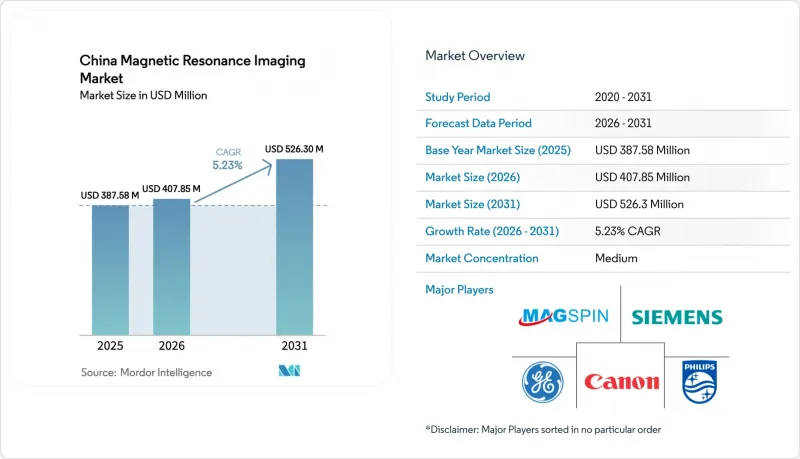
This report is Segmented by Architecture (Closed MRI Systems, Open MRI Systems), Field Strength (Low-Field 3T), Application (Neurology, Oncology, Cardiology, Musculoskeletal, Gastroenterology, Others), End User (Hospitals, Stand-Alone Imaging Centers, Others). The Market Forecasts are Provided in Terms of Value (USD).
China Magnetic Resonance Imaging Market Trends and Insights
Aging Population & Chronic-Disease Burden
China's fast-graying society fuels imaging demand as inpatient costs for citizens aged >= 65 averaged USD 1,199.24 per stay in 2024 and continue to climb . Chronic cardiac and neurovascular conditions often require MRI follow-up, and intracranial-aneurysm prevalence of 7%-well above global norms-further concentrates neurologic workload. Tier-1 hospitals respond with high-field upgrades that improve signal-to-noise ratios essential for micro-vascular scans. AI-enabled cardiac MRI now screens 11 cardiovascular pathologies at AUC 0.988 across eight centers, illustrating clinical gains that reinforce adoption. Together these demographic and disease trends lift exam volumes and justify broader capital budgets for next-generation systems.
Expansion of Universal Health Coverage
Commercial medical-insurance premiums reached RMB 900 billion in 2025, complementing public insurance and broadening reimbursement for advanced imaging. Diagnosis-Related Group payment caps cover more than 80% of inpatient expenditure, motivating hospitals to buy faster multipurpose scanners that clear patient backlogs. Rural capsule-clinic pilots rely on portable units that plug into wall outlets and deliver stroke triage accuracy comparable to fixed 1.5 T rooms, bridging access gaps. Together, coverage expansion and flexible reimbursement frameworks extend MRI utilization well beyond metropolitan corridors.
High Capital & Helium-Related Opex
China consumes 25.65 million m3 of helium annually yet produces only 1.3 million m3, driving 95% import dependence. Spot prices have spiked 250% since 2015, squeezing hospital budgets and delaying service contracts. Conventional scanners consume roughly 27% of global helium each year, prompting shutdowns when supply is rationed . OEMs now race to deploy solid-cooling magnets; Wandong Medical's helium-free 1.5 T system maintains -269 °C coil temperature while reducing operating costs by more than one-half. These engineering gains mitigate, but do not yet eliminate, cost pressure in lower-tier cities.
Other drivers and restraints analyzed in the detailed report include:
- Strong Central-Government Commitments under "Healthy China 2030"
- Adoption of High-/Ultra-High-Field & Hybrid MRI
- Lengthy NMPA Class III Device Approval
For complete list of drivers and restraints, kindly check the Table Of Contents.
Segment Analysis
Closed units accounted for 82.73% of the China MRI market in 2025 because their higher field strength supports complex neuro-oncologic and cardiac protocols. Throughput pressure and newer algorithms that automate patient positioning now let these sealed tunnels finish a brain scan in as little as 4 minutes. The arrival of wider-bore closed systems further improves patient comfort, eroding historical open-MRI advantages. Open designs nonetheless grow at a 6.02% CAGR as surgeons adopt intra-operative guidance and imaging centers cater to bariatric or claustrophobic populations. Hospitals in secondary cities increasingly buy hybrid models that promise closed-style image fidelity within semi-open form factors, balancing versatility with workflow efficiency.
A parallel engineering trend focuses on helium-free closed magnets, which slash long-term ownership costs and temper supply-chain exposure. Domestic vendors leverage government grants to redesign coil architecture around solid cryogens, strengthening their value proposition in tender documents. As end users weigh capital expenditure against function, closed systems retain the largest slice of the China MRI market size even as architectural preferences diversify.
Mid/high-field 1-3 T units captured 55.74% of the China MRI market size in 2025 thanks to their clinical versatility and moderate siting requirements. Dual-gradient hardware and AI-driven reconstruction now let 1.5 T scanners rival 3 T detail in some orthopedic tests, protecting installed mid-field bases from immediate obsolescence. Concurrently, ultra-high-field >3 T platforms post a 5.63% CAGR on the back of precision-medicine research, advanced epilepsy mapping, and micro-vasculature imaging in dementia trials. United Imaging's 5 T entry offers a pragmatic bridge that fits existing suites yet unlocks sub-millimeter resolution, foreshadowing broader ultra-high-field clinical mainstreaming.
Low-field systems, once relegated to niche uses, return to relevance via deep-learning reconstruction that compensates for weaker signal. Whole-body 0.05 T prototypes now produce diagnostic images in open wards without RF-shielded rooms. This resurgence addresses access inequity in county-level hospitals while offering stroke care within ambulance-based units.
Complete Report Scope:
- By Architecture
- Closed MRI Systems
- Open MRI Systems
- By Field Strength
- Low-Field (<vv1T)
- Mid/High-Field (1-3T)
- Very- & Ultra-High-Field (>3T)
- By Application
- Neurology
- Oncology
- Cardiology
- Musculoskeletal
- Gastroenterology
- Others (urology, gynecology, etc.)
- By End User
- Hospitals
- Stand-alone Imaging Centers
- Others
List of Companies Covered in this Report:
- GE Healthcare
- Siemens Healthineers
- Koninklijke Philips
- Canon Medical
- United Imaging Healthcare
- Neusoft Medical Systems
- Shenzhen Basda Medical Apparatus
- Shenzhen Anke High-Tech
- Wandong Medical
- Aurora Imaging Technology
- Esaote
- Hitachi (Healthcare)
- FUJIFILM
- Ray Plus Medical Technology
- Mindray Medical
- Jiangsu Magspin Instrument
- Time Medical Systems
- Alltech Medical Systems
- Sinovision Imaging
- Aspect Imaging
Additional Benefits:
- The market estimate (ME) sheet in Excel format
- 3 months of analyst support
TABLE OF CONTENTS
1 Introduction
- 1.1 Study Assumptions & Market Definition
- 1.2 Scope of the Study
2 Research Methodology
3 Executive Summary
4 Market Landscape
- 4.1 Market Overview
- 4.2 Market Drivers
- 4.2.1 Aging Population & Chronic-Disease Burden
- 4.2.2 Expansion Of Universal Health Coverage
- 4.2.3 Strong Central-Government Commitments Under "Healthy China 2030"
- 4.2.4 Adoption Of High-/Ultra-High-Field & Hybrid MRI
- 4.2.5 Volume-Based Procurement Fueling Domestic Oems
- 4.2.6 Rise Of Portable Low-Field MRI For Stroke Triage
- 4.3 Market Restraints
- 4.3.1 High Capital & Helium-Related Opex
- 4.3.2 Lengthy NMPA Class III Device Approval
- 4.3.3 Radiologist Shortage & Workflow Bottlenecks
- 4.3.4 Margin Squeeze From Centralized Price Caps
- 4.4 Value / Supply-Chain Analysis
- 4.5 Regulatory Landscape
- 4.6 Technological Outlook
- 4.7 Porter's Five Forces
- 4.7.1 Threat of New Entrants
- 4.7.2 Bargaining Power of Buyers
- 4.7.3 Bargaining Power of Suppliers
- 4.7.4 Threat of Substitutes
- 4.7.5 Competitive Rivalry
5 Market Size & Growth Forecasts (Value, USD million)
- 5.1 By Architecture
- 5.1.1 Closed MRI Systems
- 5.1.2 Open MRI Systems
- 5.2 By Field Strength
- 5.2.1 Low-Field (<1T)
- 5.2.2 Mid/High-Field (1-3T)
- 5.2.3 Very- & Ultra-High-Field (>3T)
- 5.3 By Application
- 5.3.1 Neurology
- 5.3.2 Oncology
- 5.3.3 Cardiology
- 5.3.4 Musculoskeletal
- 5.3.5 Gastroenterology
- 5.3.6 Others (urology, gynecology, etc.)
- 5.4 By End User
- 5.4.1 Hospitals
- 5.4.2 Stand-alone Imaging Centers
- 5.4.3 Others
6 Competitive Landscape
- 6.1 Market Concentration
- 6.2 Market Share Analysis
- 6.3 Company Profiles (includes Global-level Overview, Market-level Overview, Core Segments, Financials as available, Strategic Information, Market Rank/Share, Products & Services, Recent Developments)
- 6.3.1 GE Healthcare
- 6.3.2 Siemens Healthineers
- 6.3.3 Philips Healthcare
- 6.3.4 Canon Medical
- 6.3.5 United Imaging Healthcare
- 6.3.6 Neusoft Medical Systems
- 6.3.7 Shenzhen Basda Medical Apparatus
- 6.3.8 Shenzhen Anke High-Tech
- 6.3.9 Wandong Medical
- 6.3.10 Aurora Imaging Technology
- 6.3.11 Esaote SpA
- 6.3.12 Hitachi (Healthcare)
- 6.3.13 Fujifilm Healthcare
- 6.3.14 Ray Plus Medical Technology
- 6.3.15 Mindray Medical
- 6.3.16 Jiangsu Magspin Instrument
- 6.3.17 Time Medical Systems
- 6.3.18 Alltech Medical Systems
- 6.3.19 Sinovision Imaging
- 6.3.20 Aspect Imaging
7 Market Opportunities & Future Outlook
- 7.1 White-space & Unmet-need Assessment

