PUBLISHER: Mordor Intelligence | PRODUCT CODE: 2116727

PUBLISHER: Mordor Intelligence | PRODUCT CODE: 2116727
Medical Supplies - Market Share Analysis, Industry Trends & Statistics, Growth Forecasts (2026 - 2031)
According to Mordor Intelligence, the medical supplies market size was valued at USD 180.2 billion in 2025 and estimated to grow from USD 198.17 billion in 2026 to reach USD 318.77 billion by 2031, at a CAGR of 9.97% during the forecast period (2026-2031).
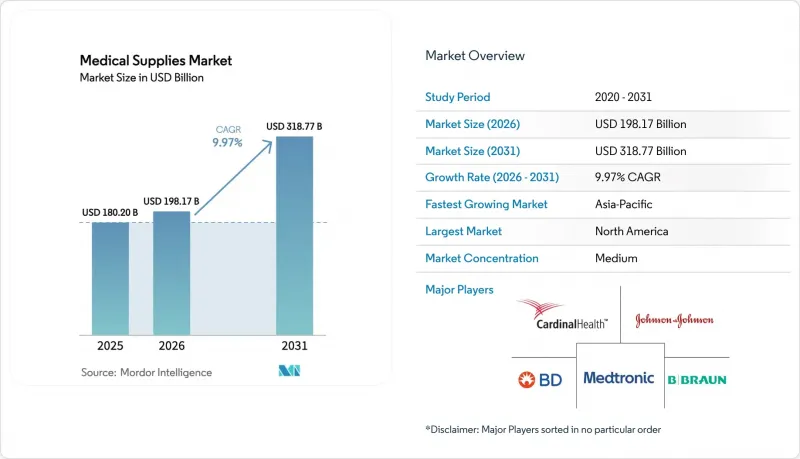
This report is Segmented by Product Type (Diagnostic Supplies, Infusion & Injectable Supplies, and More), Application (Urology, Wound Care, Radiology, Respiratory, Infection Control, and More), End-User (Hospitals, Clinics/Physician Offices, Home-Care Settings), and Geography (North America, Europe, Asia Pacific, Middle East & Africa, South America). The Market Forecasts are Provided in Terms of Value (USD).
Global Medical Supplies Market Trends and Insights
Rapid Growth of Ambulatory Surgery Centers
Ambulatory surgery centers (ASCs) now handle more than 25 million U.S. procedures each year, growing 3-4% annually as payers widen approved procedure lists. ASCs deliver 40-60% cost savings over hospital outpatient departments, so suppliers are redesigning single-use kits that compress turnover times and cut waste. The Food and Drug Administration (FDA) guidance on Predetermined Change Control Plans, effective August 2024, lets manufacturers iterate devices faster to match ASC workflow needs. Portfolio shifts toward low-complexity disposables with embedded safety features boost recurring revenue and deepen penetration of the medical supplies market.
Shift to Home-Based Care & Hospital-at-Home Programs
Hospital-at-home models cover more than 300 U.S. health systems and deliver 25-30% cost reductions with higher patient-satisfaction scores than inpatient wards. Medical supplies must now feature simpler packaging, longer shelf life and intuitive instructions suited to residential caregivers. Suppliers are investing in last-mile logistics and digital reorder platforms to maintain uninterrupted supply streams. As decentralized care expands in Europe, Australia and Japan, the medical supplies market gains a durable growth avenue anchored in recurring home-therapy consumption.
Heightened FDA & MDR Post-Market Recalls
Class I recalls climbed 35% in 2024 and predominantly involved sterility lapses. In Europe, MDR audits expose latent quality issues and trigger market withdrawals. Providers facing shortages shift to substitute products, but manufacturers absorb 8-12% higher compliance costs that thin margins across the medical supplies market.
Other drivers and restraints analyzed in the detailed report include:
- Growing Chronic-Care Patient Pool
- Rising PPE Replenishment Cycles Post-COVID
- Volatile Resin & Nitrile Prices
For complete list of drivers and restraints, kindly check the Table Of Contents.
Segment Analysis
Infusion and injectable supplies contributed 23.12% of the medical supplies market size in 2025, underscoring the universal requirement for intravenous therapy across every care level. Growth is held steady by safety-engineered needles and smart infusion pumps that curb medication errors. Emerging volume now stems from home-infusion programs backed by reimbursement expansion, prompting vendors to bundle devices and disposables for at-home regimens.
Dialysis consumables deliver the swiftest rise with a 7.55% CAGR through 2031. Prevalence gains in diabetes and hypertension enlarge the renal patient pool, while policy incentives for home peritoneal dialysis push demand for compact bags, cassettes and sterile connectors. Suppliers that document reduced infection rates and easier self-administration can capture share in this premium slice of the medical supplies market. Advanced polymer membranes and antimicrobial coatings remain differentiation levers as competition intensifies.
Complete Report Scope:
- By Product Type
- Diagnostic Supplies
- Infusion & Injectable Supplies
- Intubation & Ventilation Supplies
- Disinfectants
- Personal Protective Equipment
- Sterilization Consumables
- Wound-Care Consumables
- Dialysis Consumables
- Radiology Consumables
- Catheters
- Other Product Types
- By Application
- Urology
- Wound Care
- Radiology
- Respiratory
- Infection Control
- Cardiology
- In-Vitro Diagnostics
- Other Applications
- By End-User
- Hospitals
- Clinics / Physician Offices
- Home-Care Settings
- Other End-Users
- Geography
- North America
- United States
- Canada
- Mexico
- Europe
- Germany
- United Kingdom
- France
- Italy
- Spain
- Rest of Europe
- Asia Pacific
- China
- Japan
- India
- South Korea
- Australia
- Rest of Asia Pacific
- Middle East & Africa
- GCC
- South Africa
- Rest of Middle East & Africa
- South America
- Brazil
- Argentina
- Rest of South America
- North America
Geography Analysis
North America remained the most significant contributor in 2024, owing to entrenched reimbursement schemes and rapid uptake of best-in-class infection-control products. Predictable FDA user-fee structures and alignment with ISO 13485:2016 lower regulatory friction for international suppliers. Canada accelerates device approvals through its Medical Device Single Audit Program, while Mexican private hospitals import premium disposables to serve medical tourism. Together, these factors stabilize regional growth and sustain high purchasing power within the medical supplies market.
Europe's trajectory is steadier as MDR documentation expenses and PFAS restrictions weigh on smaller suppliers. Germany leads export value with its embedded manufacturing base, and the United Kingdom refines its post-Brexit conformity rules to mirror global standards, providing dual-pathway access for transatlantic producers. Southern European markets, despite fiscal constraints, channel structural funds into infection-prevention upgrades, securing incremental expansion for sterilization and respiratory disposables.
Asia Pacific delivers the fastest CAGR at 11.45% through 2031. China's volume-based procurement favors cost-efficient domestic producers for high-volume items, while preference remains for imported premium consumables in tertiary hospitals. Japan's aging society drives steady uptake of wound-care and ostomy supplies, and South Korea layers digital connectivity onto disposables to enable device-agnostic data capture. India scales its Pradhan Mantri Jan Arogya Yojana insurance scheme, broadening access to interventional procedures that utilize medical supplies market offerings. Manufacturing clusters in Malaysia, Thailand and Vietnam expand export capacity, reducing dependence on single-country sourcing.
- Medtronic
- Cardinal Health
- Beckton Dickinson
- Johnson & Johnson
- B. Braun
- Boston Scientific
- Thermo Fisher Scientific
- Baxter
- 3M
- Smiths Group
- Abbott Laboratories
- Convatec Group
- Cook Group
- Stryker
- Hamilton Medical
- Terumo
- Fresenius
- Coloplast
- Molnlycke Health Care
- ICU Medical
- Avanos Medical
- Hollister
Additional Benefits:
- The market estimate (ME) sheet in Excel format
- 3 months of analyst support
TABLE OF CONTENTS
1 Introduction
- 1.1 Study Assumptions & Market Definition
- 1.2 Scope of the Study
2 Research Methodology
3 Executive Summary
4 Market Landscape
- 4.1 Market Overview
- 4.2 Market Drivers
- 4.2.1 Rapid Growth Of Ambulatory Surgery Centers
- 4.2.2 Shift To Home-Based Care & Hospital-At-Home Programs
- 4.2.3 Growing Chronic-Care Patient Pool
- 4.2.4 Rising PPE Replenishment Cycles Post-COVID Stockpiles
- 4.2.5 AI-Enabled Predictive Maintenance Lowering Device Downtime
- 4.2.6 Circular-Economy Mandates Spurring Single-Use Device Re-Processing
- 4.3 Market Restraints
- 4.3.1 Heightened FDA & MDR Post-Market Surveillance Recalls
- 4.3.2 Volatile Resin & Nitrile Prices Squeezing Consumable Margins
- 4.3.3 ESG Pressure Against Single-Use Plastics In Hospitals
- 4.3.4 Tight Global Ethylene Oxide Sterilization Capacity
- 4.4 Supply Chain Analysis
- 4.5 Regulatory Landscape
- 4.6 Technological Outlook
- 4.7 Porter's Five Forces Analysis
- 4.7.1 Threat of New Entrants
- 4.7.2 Bargaining Power of Buyers
- 4.7.3 Bargaining Power of Suppliers
- 4.7.4 Threat of Substitutes
- 4.7.5 Intensity of Rivalry
5 Market Size & Growth Forecasts (USD)
- 5.1 By Product Type
- 5.1.1 Diagnostic Supplies
- 5.1.2 Infusion & Injectable Supplies
- 5.1.3 Intubation & Ventilation Supplies
- 5.1.4 Disinfectants
- 5.1.5 Personal Protective Equipment
- 5.1.6 Sterilization Consumables
- 5.1.7 Wound-Care Consumables
- 5.1.8 Dialysis Consumables
- 5.1.9 Radiology Consumables
- 5.1.10 Catheters
- 5.1.11 Other Product Types
- 5.2 By Application
- 5.2.1 Urology
- 5.2.2 Wound Care
- 5.2.3 Radiology
- 5.2.4 Respiratory
- 5.2.5 Infection Control
- 5.2.6 Cardiology
- 5.2.7 In-Vitro Diagnostics
- 5.2.8 Other Applications
- 5.3 By End-User
- 5.3.1 Hospitals
- 5.3.2 Clinics / Physician Offices
- 5.3.3 Home-Care Settings
- 5.3.4 Other End-Users
- 5.4 Geography
- 5.4.1 North America
- 5.4.1.1 United States
- 5.4.1.2 Canada
- 5.4.1.3 Mexico
- 5.4.2 Europe
- 5.4.2.1 Germany
- 5.4.2.2 United Kingdom
- 5.4.2.3 France
- 5.4.2.4 Italy
- 5.4.2.5 Spain
- 5.4.2.6 Rest of Europe
- 5.4.3 Asia Pacific
- 5.4.3.1 China
- 5.4.3.2 Japan
- 5.4.3.3 India
- 5.4.3.4 South Korea
- 5.4.3.5 Australia
- 5.4.3.6 Rest of Asia Pacific
- 5.4.4 Middle East & Africa
- 5.4.4.1 GCC
- 5.4.4.2 South Africa
- 5.4.4.3 Rest of Middle East & Africa
- 5.4.5 South America
- 5.4.5.1 Brazil
- 5.4.5.2 Argentina
- 5.4.5.3 Rest of South America
- 5.4.1 North America
6 Competitive Landscape
- 6.1 Market Concentration
- 6.2 Market Share Analysis
- 6.3 Company Profiles (includes Global level Overview, Market level overview, Core Segments, Financials as available, Strategic Information, Market Rank/Share for key companies, Products & Services, and Recent Developments)
- 6.3.1 Medtronic plc
- 6.3.2 Cardinal Health
- 6.3.3 Becton, Dickinson & Co.
- 6.3.4 Johnson & Johnson
- 6.3.5 B. Braun Melsungen
- 6.3.6 Boston Scientific
- 6.3.7 Thermo Fisher Scientific
- 6.3.8 Baxter International
- 6.3.9 3M Company
- 6.3.10 Smith & Nephew
- 6.3.11 Abbott Laboratories
- 6.3.12 Convatec Group
- 6.3.13 Cook Medical
- 6.3.14 Stryker Corporation
- 6.3.15 Hamilton Medical
- 6.3.16 Terumo Corporation
- 6.3.17 Fresenius Medical Care
- 6.3.18 Coloplast
- 6.3.19 Molnlycke Health Care
- 6.3.20 ICU Medical
- 6.3.21 Avanos Medical
- 6.3.22 Hollister Inc.
7 Market Opportunities & Future Outlook

