PUBLISHER: Mordor Intelligence | PRODUCT CODE: 2116769

PUBLISHER: Mordor Intelligence | PRODUCT CODE: 2116769
Europe Solar Inverter - Market Share Analysis, Industry Trends & Statistics, Growth Forecasts (2026 - 2031)
According to Mordor Intelligence, the Europe solar inverter market size is expected to increase from USD 2.98 billion in 2025 to USD 3.12 billion in 2026 and reach USD 4.18 billion by 2031, growing at a CAGR of 6.01% over 2026-2031.
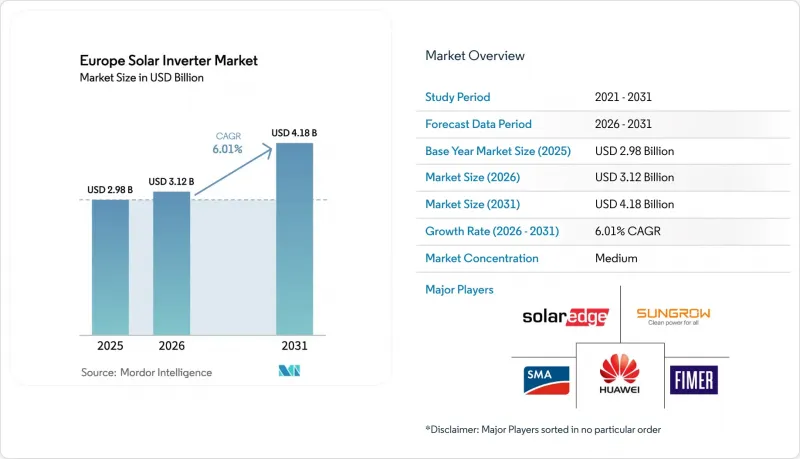
This report is Segmented by Inverter Type (Central Inverters, String Inverters, Microinverters, and Hybrid/Battery-Ready Inverters), Phase (Single-Phase and Three-Phase), Connection Type (On-Grid and Off-Grid), Application (Residential, Commercial and Industrial, and Utility-Scale), and Geography (Germany, United Kingdom, Spain, Italy, France, NORDIC Countries, Netherlands, Russia, and Rest of Europe).
Europe Solar Inverter Market Trends and Insights
EU Fit-for-55 & REPowerEU Deployment Targets
Binding 42.5% renewable-energy legislation and the EU Solar Strategy lift average annual installations to 60-70 GW, more than double the 2019-2023 pace. Faster rooftop approvals under Council Regulation 2022/2577 compressed permitting to three months, steering demand toward string and microinverters. Germany added 14.6 GW and Italy 5.3 GW in 2024, underscoring early policy traction. The Iberian pipeline illustrates geographic concentration where high irradiance and PPAs intersect. Collectively, these factors underpin the 6.01% CAGR projected for the European solar inverters market.
Rooftop Self-Consumption Boom Amid High Retail Electricity Prices
EU household tariffs averaged EUR 0.28 per kWh in 2025, about 40% above pre-2021 levels, sustaining sub-7-year payback for solar-plus-storage. Germany's EUR 0.32 per kWh retail price drove a rooftop wave that relied on hybrid inverters capable of battery arbitrage. The Netherlands accelerated battery adoption by phasing out net metering in 2025. Microinverters benefited from shade mitigation in dense urban roofs, while software features such as dynamic tariff response became key differentiators. The residential up-trend explains why the European solar inverters market is tilting toward premium, software-rich products.
Semiconductor Supply Bottlenecks for IGBTs & SiC MOSFETs
Lead times for 1200 V SiC devices averaged 26-32 weeks in 2025, double pre-pandemic norms, as electric-vehicle demand competed for wafers. SMA reported shipment delays totalling 1.5 GW in its 2024 filings. Substituting lower-spec IGBTs reduces efficiency and raises thermal losses, squeezing project margins. New fabs from Infineon and Wolfspeed will ease scarcity after 2027, but short-term friction persists, trimming expected growth in the European solar inverters market.
Other drivers and restraints analyzed in the detailed report include:
- Declining $/W of String & Hybrid Inverters
- Utility-Scale PPA Pipeline Acceleration Across Spain, Portugal & Greece
- Grid-Connection Delays & Curtailment Risks in DE/NL/IT
For complete list of drivers and restraints, kindly check the Table Of Contents.
Segment Analysis
Central units controlled 48.6% of 2025 revenue, riding Spain's and Portugal's utility pipelines where single 1-5 MW blocks minimize balance-of-system expense. String designs, at roughly 35% share, gained in commercial rooftops and terrain-complex solar fields that need finer MPPT granularity. Hybrid variants lifted their slice amid rising prosumer storage demand. Microinverters held just under 10% but will outpace all others at a 7.3% CAGR through 2031 as rooftops in Germany and the Netherlands favor module-level optimization.
Regulation magnifies differentiation. Grid-forming mandates above 1 MW threaten legacy central designs that lack virtual-synchronous capability, steering developers toward compliant string products or next-generation central architectures. Microinverters remain exempt due to small unit size, yet benefit from heightened safety codes that require rapid shutdown and arc-fault detection. Consequently, the European solar inverters market rewards suppliers able to juggle cost-competitive central units and premium micro or hybrid lines with advanced firmware.
Three-phase equipment represented 73.4% of revenue in 2025, omnipresent in C&I rooftops and utility arrays where balanced load flow is mandatory. Modular 20-100 kW three-phase strings allow factories to scale generation without oversizing. Single-phase devices, linked to systems below 10 kW, are set for a 6.4% CAGR in line with residential growth. Italy's 5.3 GW 2024 rooftop tally underlines single-phase momentum.
Compliance drives product roadmaps: national codes such as VDE-AR-N 4105 require firmware updates that smaller suppliers sometimes lag. Hybrid single-phase inverters with battery ports and blackout protection strengthen supplier lock-in at the household level, adding stickiness to the European solar inverters market.
Complete Report Scope:
- By Inverter Type
- Central Inverters
- String Inverters
- Microinverters
- Hybrid/Battery-Ready Inverters
- By Phase
- Single-Phase
- Three-Phase
- By Connection Type
- On-Grid
- Off-Grid
- By Application
- Residential
- Commercial and Industrial
- Utility-Scale
- Geography
- Germany
- United Kingdom
- Spain
- Italy
- France
- NORDIC Countries
- Netherlands
- Russia
- Rest of Europe
List of Companies Covered in this Report:
- SMA Solar Technology AG
- Huawei Technologies Co. Ltd.
- Sungrow Power Supply Co. Ltd.
- SolarEdge Technologies Inc.
- FIMER SpA
- Fronius International GmbH
- Schneider Electric SE
- Siemens AG
- Delta Energy Systems Inc.
- GoodWe Power Supply Co. Ltd.
- Growatt New Energy
- Enphase Energy Inc.
- KACO new energy GmbH
- Power Electronics Espana
- Ingeteam S.A.
- Omron Corporation
- General Electric Company
- Victron Energy B.V.
- Ginlong Technologies (Solis)
- Mitsubishi Electric Corporation
Additional Benefits:
- The market estimate (ME) sheet in Excel format
- 3 months of analyst support
TABLE OF CONTENTS
1 Introduction
- 1.1 Study Assumptions & Market Definition
- 1.2 Scope of the Study
2 Research Methodology
3 Executive Summary
4 Market Landscape
- 4.1 Market Overview
- 4.2 Market Drivers
- 4.2.1 EU Fit-for-55 & REPowerEU deployment targets
- 4.2.2 Rooftop self-consumption boom amid high retail electricity prices
- 4.2.3 Declining $/W of string & hybrid inverters
- 4.2.4 Utility-scale PPA pipeline acceleration across Spain, Portugal & Greece
- 4.2.5 Mandatory grid-forming "smart inverter" codes (NC RfG 2026 update)
- 4.2.6 IPCEI-backed reshoring of European inverter manufacturing
- 4.3 Market Restraints
- 4.3.1 Semiconductor supply bottlenecks for IGBTs & SiC MOSFETs
- 4.3.2 Grid-connection delays & curtailment risks in DE/NL/IT
- 4.3.3 Cyber-security scrutiny on imported inverters (ENISA guidelines)
- 4.3.4 Sunset of net-metering incentives in key markets
- 4.4 Supply-Chain Analysis
- 4.5 Regulatory Landscape
- 4.6 Technological Outlook
- 4.7 Porter's Five Forces
- 4.7.1 Bargaining Power of Suppliers
- 4.7.2 Bargaining Power of Buyers
- 4.7.3 Threat of New Entrants
- 4.7.4 Threat of Substitutes
- 4.7.5 Competitive Rivalry
5 Market Size & Growth Forecasts
- 5.1 By Inverter Type
- 5.1.1 Central Inverters
- 5.1.2 String Inverters
- 5.1.3 Microinverters
- 5.1.4 Hybrid/Battery-Ready Inverters
- 5.2 By Phase
- 5.2.1 Single-Phase
- 5.2.2 Three-Phase
- 5.3 By Connection Type
- 5.3.1 On-Grid
- 5.3.2 Off-Grid
- 5.4 By Application
- 5.4.1 Residential
- 5.4.2 Commercial and Industrial
- 5.4.3 Utility-Scale
- 5.5 Geography
- 5.5.1 Germany
- 5.5.2 United Kingdom
- 5.5.3 Spain
- 5.5.4 Italy
- 5.5.5 France
- 5.5.6 NORDIC Countries
- 5.5.7 Netherlands
- 5.5.8 Russia
- 5.5.9 Rest of Europe
6 Competitive Landscape
- 6.1 Market Concentration
- 6.2 Strategic Moves (M&A, Partnerships, PPAs)
- 6.3 Market Share Analysis (Market Rank/Share for key companies)
- 6.4 Company Profiles (includes Global level Overview, Market level overview, Core Segments, Financials as available, Strategic Information, Products & Services, and Recent Developments)
- 6.4.1 SMA Solar Technology AG
- 6.4.2 Huawei Technologies Co. Ltd.
- 6.4.3 Sungrow Power Supply Co. Ltd.
- 6.4.4 SolarEdge Technologies Inc.
- 6.4.5 FIMER SpA
- 6.4.6 Fronius International GmbH
- 6.4.7 Schneider Electric SE
- 6.4.8 Siemens AG
- 6.4.9 Delta Energy Systems Inc.
- 6.4.10 GoodWe Power Supply Co. Ltd.
- 6.4.11 Growatt New Energy
- 6.4.12 Enphase Energy Inc.
- 6.4.13 KACO new energy GmbH
- 6.4.14 Power Electronics Espana
- 6.4.15 Ingeteam S.A.
- 6.4.16 Omron Corporation
- 6.4.17 General Electric Company
- 6.4.18 Victron Energy B.V.
- 6.4.19 Ginlong Technologies (Solis)
- 6.4.20 Mitsubishi Electric Corporation
7 Market Opportunities & Future Outlook
- 7.1 White-space & Unmet-Need Assessment

