PUBLISHER: Mordor Intelligence | PRODUCT CODE: 2116775

PUBLISHER: Mordor Intelligence | PRODUCT CODE: 2116775
North America Wood Pellet - Market Share Analysis, Industry Trends & Statistics, Growth Forecasts (2026 - 2031)
According to Mordor Intelligence, the North America wood pellet market size is expected to increase from USD 0.88 billion in 2025 to USD 0.91 billion in 2026 and reach USD 1.09 billion by 2031, growing at a CAGR of 3.65% over 2026-2031.
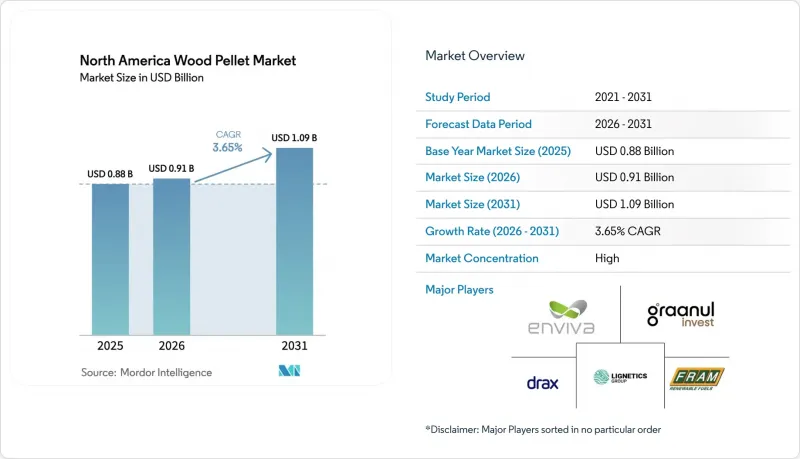
This report is Segmented by Feedstock (Forest/Wood Residue, Agricultural Residue, and Energy-Crop and Sawdust Mix), Grade (Utility-Grade, Premium-Grade, Standard-Grade, and Torrefied Black Pellets), Application (Heating, Power Generation, and Combined Heat and Power), End-User (Residential, Commercial, Industrial and Utility, and Animal Bedding), and Geography (United States, Canada, and Mexico).
North America Wood Pellet Market Trends and Insights
Federal and State Renewable Targets Drive Utility Demand
State renewable portfolio standards and enhanced federal clean-energy incentives continue to anchor the offtake strategies of electric utilities. Drax committed USD 12.5 billion to build new U.S. biomass power plants by 2030, and each project is being designed with carbon-capture systems to qualify for premium 45Q credits. Georgia Power likewise proposed 80 MW of biomass capacity under contracts exceeding 30 years to lock in dispatchable generation and hedge gas-price volatility. Regulators are validating this approach; in March 2024, the Michigan Public Service Commission ruled that dispatchable biomass remains vital for resource adequacy, rejecting early contract terminations. These decisions reinforce the view that wood pellets are a bridge fuel capable of meeting near-term decarbonization targets while preserving grid reliability.
Volatile Fossil-Fuel Prices Enhance Pellet Competitiveness
Propane and heating-oil price spikes during the 2025-26 winter narrowed the cost gap with pellets, improving payback periods for stove and boiler upgrades. Henry Hub natural gas averaged USD 4.30 per MMBtu, yet rural households paid the propane equivalent of USD 27.50 per MMBtu, while delivered premium pellets cost roughly USD 15 per MMBtu. The arbitrage is most compelling in off-pipeline regions of the Northeast, Upper Midwest, and Atlantic Canada, although the Inflation Reduction Act's USD 2,000 federal heat-pump tax credit, alongside state rebates up to USD 8,000, is incentivizing homeowners to electrify. Residential pellet suppliers must therefore emphasize predictable fuel costs and local sourcing to remain competitive, particularly as utilities introduce time-of-use tariffs that favor overnight heat-pump operation.
Logistics Inflation Squeezes Pellet Margins
Railroad tariff increases and trucking cost inflation pushed delivered pellet prices higher in 2025. For Southeast mills serving Midwest utilities, rail can account for up to 40% of delivered cost, especially when ports such as Savannah and Mobile experience congestion that triggers demurrage fees. Producers with torrefaction lines partially offset these costs by shipping more energy per tonne, yet the USD 50-100 million capex requirement sidelines smaller operators. Retail-oriented mills face their own pressure as short-haul trucking rates rise faster than stove-grade pellet prices, forcing some to consolidate or close.
Other drivers and restraints analyzed in the detailed report include:
- Clean Fuel Standard Credits in Canada Stimulate Uptake
- Torrefied-Pellet Technology Boosts Energy Density and Lowers Logistics Cost
- Sawmill Curtailments Tighten Fiber Supply
For complete list of drivers and restraints, kindly check the Table Of Contents.
Segment Analysis
Forest and wood residues commanded 66.6% of the North America wood pellet market share in 2025, reflecting the dominance of sawdust, chips, and forest thinnings sourced from integrated timber operations. Agricultural residue pellets, however, are projected to register a 4.8% CAGR to 2031 as producers hedge against sawmill curtailments that constrained fiber supply during 2024-25. Agricultural feedstocks such as corn stover and wheat straw can theoretically provide 200-300 million dry tonnes annually, but seasonal collection logistics, variable moisture, and higher ash contents of 3-6% complicate scale-up. Producers that master preprocessing and ash-mitigation technologies can capture industrial and utility demand, provided they secure boilers capable of handling less-pure fuels.
Toward the end of the decade, short-rotation woody crops like hybrid poplar and willow may supply select mills willing to invest in dedicated plantations, enabling predictable yields on marginal land. Although these energy crops remain a niche today, their strategic value lies in stable pricing and carbon-sequestration benefits that appeal to ESG-minded buyers. The feedstock landscape is therefore bifurcating: commodity white pellets destined for residential stoves remain wood-residue dominant, while industrial and utility buyers increasingly accept diversified blends to secure volume and carbon-credit eligibility.
Utility-grade white pellets accounted for 58.2% of 2025 revenues, serving power plants under multi-year offtake agreements. Premium-grade pellets, distinguished by moisture below 8% and ash under 0.5%, capture residential and commercial users who prioritize low maintenance. Standard-grade material fills the middle tier for small industrial boilers that tolerate slightly higher impurities. Torrefied black pellets, however, are forecast to grow at an 8.4% CAGR through 2031, fueled by their 20-22 GJ/t energy density and hydrophobic properties.
ANDRITZ's 2025 commercial line proved that mass and energy yields above 85% and 95% are attainable, while Drax's Alabama pilot signals U.S. commitment to scale. Torrefied pellets eliminate the need for covered storage and minimize moisture-linked degradation during trans-Pacific shipments, opening Asian and Middle Eastern markets that were previously risky for white pellets. Utilities value the ability to co-fire at higher rates without costly boiler derates, reinforcing the premium pricing potential despite higher production capex. The grade mix is therefore expected to evolve toward a dual-track system: affordable white pellets for heating and premium black pellets for utility and industrial buyers focused on logistics savings and carbon strategy.
Complete Report Scope:
- By Feedstock
- Forest/Wood Residue
- Agricultural Residue
- Energy-Crop and Sawdust Mix
- By Grade
- Utility-Grade (White)
- Premium-Grade
- Standard-Grade
- Torrefied "Black" Pellets
- By Application
- Heating
- Power Generation
- Combined Heat and Power (CHP)
- By End-user
- Residential
- Commercial
- Industrial and Utility
- Animal Bedding
- By Geography
- United States
- Canada
- Mexico
List of Companies Covered in this Report:
- Enviva Inc.
- Drax Group plc (incl. Pinnacle Renewable Energy)
- Lignetics, Inc.
- Highland Pellets LLC
- Fram Renewable Fuels LLC
- Fiber Energy Products
- Curran Renewable Energy LLC
- Westervelt Renewable Energy (LaSalle BioEnergy)
- Pacific BioEnergy Corp.
- AS Graanul Invest
- Energy Pellets of America LLC
- Biopower Sustainable Energy Corp.
- Green Circle Bio Energy (Enviva)
- Rentech Inc.
- Maine Energy Systems
- Energex Pellet Fuel, Inc.
- Great Northern Timber Group
- Viridis Energy Inc.
- Lost Creek Holdings
- Georgia Biomass (Enviva-Jesup Plant)
Additional Benefits:
- The market estimate (ME) sheet in Excel format
- 3 months of analyst support
TABLE OF CONTENTS
1 Introduction
- 1.1 Study Assumptions & Market Definition
- 1.2 Scope of the Study
2 Research Methodology
3 Executive Summary
4 Market Landscape
- 4.1 Market Overview
- 4.2 Market Drivers
- 4.2.1 Federal & state renewable targets drive utility demand
- 4.2.2 Volatile fossil-fuel prices enhance pellet competitiveness
- 4.2.3 Clean Fuel Standard credits in Canada stimulate uptake
- 4.2.4 Carbon-neutral corporate thermal certificates emerge
- 4.2.5 Torrefied-pellet tech boosts energy density & lowers cost
- 4.3 Market Restraints
- 4.3.1 Logistics inflation squeezes pellet margins
- 4.3.2 Sawmill curtailments tighten fiber supply
- 4.3.3 ESG scrutiny on forest biomass dampens investment
- 4.3.4 Rapid heat-pump adoption in cold-climate states
- 4.4 Supply-Chain Analysis
- 4.5 Regulatory Landscape
- 4.6 Technological Outlook
- 4.7 Porter's Five Forces
- 4.7.1 Bargaining Power of Suppliers
- 4.7.2 Bargaining Power of Consumers
- 4.7.3 Threat of New Entrants
- 4.7.4 Threat of Substitutes
- 4.7.5 Intensity of Competitive Rivalry
5 Market Size & Growth Forecasts
- 5.1 By Feedstock
- 5.1.1 Forest/Wood Residue
- 5.1.2 Agricultural Residue
- 5.1.3 Energy-Crop and Sawdust Mix
- 5.2 By Grade
- 5.2.1 Utility-Grade (White)
- 5.2.2 Premium-Grade
- 5.2.3 Standard-Grade
- 5.2.4 Torrefied "Black" Pellets
- 5.3 By Application
- 5.3.1 Heating
- 5.3.2 Power Generation
- 5.3.3 Combined Heat and Power (CHP)
- 5.4 By End-user
- 5.4.1 Residential
- 5.4.2 Commercial
- 5.4.3 Industrial and Utility
- 5.4.4 Animal Bedding
- 5.5 By Geography
- 5.5.1 United States
- 5.5.2 Canada
- 5.5.3 Mexico
6 Competitive Landscape
- 6.1 Market Concentration
- 6.2 Strategic Moves (M&A, Partnerships, PPAs)
- 6.3 Market Share Analysis (Market Rank/Share for key companies)
- 6.4 Company Profiles (includes Global level Overview, Market level overview, Core Segments, Financials as available, Strategic Information, Products & Services, and Recent Developments)
- 6.4.1 Enviva Inc.
- 6.4.2 Drax Group plc (incl. Pinnacle Renewable Energy)
- 6.4.3 Lignetics, Inc.
- 6.4.4 Highland Pellets LLC
- 6.4.5 Fram Renewable Fuels LLC
- 6.4.6 Fiber Energy Products
- 6.4.7 Curran Renewable Energy LLC
- 6.4.8 Westervelt Renewable Energy (LaSalle BioEnergy)
- 6.4.9 Pacific BioEnergy Corp.
- 6.4.10 AS Graanul Invest
- 6.4.11 Energy Pellets of America LLC
- 6.4.12 Biopower Sustainable Energy Corp.
- 6.4.13 Green Circle Bio Energy (Enviva)
- 6.4.14 Rentech Inc.
- 6.4.15 Maine Energy Systems
- 6.4.16 Energex Pellet Fuel, Inc.
- 6.4.17 Great Northern Timber Group
- 6.4.18 Viridis Energy Inc.
- 6.4.19 Lost Creek Holdings
- 6.4.20 Georgia Biomass (Enviva-Jesup Plant)
7 Market Opportunities & Future Outlook
- 7.1 White-space & Unmet-Need Assessment

