PUBLISHER: Mordor Intelligence | PRODUCT CODE: 2116784

PUBLISHER: Mordor Intelligence | PRODUCT CODE: 2116784
Waste Disposal Equipment - Market Share Analysis, Industry Trends & Statistics, Growth Forecasts (2026 - 2031)
According to Mordor Intelligence, global waste disposal equipment market size in 2026 is estimated at USD 4.7 billion, growing from 2025 value of USD 4.46 billion with 2031 projections showing USD 6.08 billion, growing at 5.30% CAGR over 2026-2031.
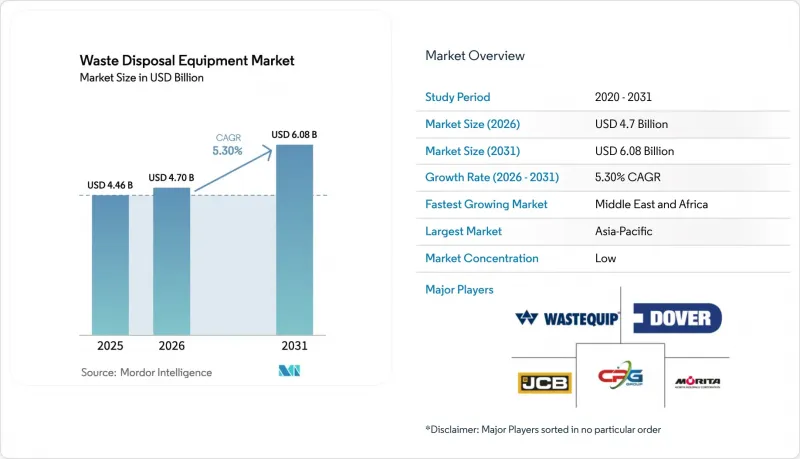
This report is Segmented by Equipment Type (Waste Recycling Equipment and More), by Waste Type (Hazardous Waste and More), by End User (Industrial Facilities and More), by Mode of Operation (Stationary Equipment and More), by Automation Level (Manual and More), by Geography (Asia and More) and More. The Report Offers Market Size and Forecasts in Value (USD) for all the Above Segments.
Global Waste Disposal Equipment Market Trends and Insights
Accelerated Adoption of AI-enabled Optical Sorters
AI-guided optical sorters now reach 99% material-recognition accuracy, unlocking higher recovery rates for metals and wood and trimming operating budgets for large material-recovery facilities. A seven-year cost comparison shows an automated plant all-in expense of USD 14.0 million, versus USD 23.6 million for a similarly sized manual operation, translating to a 40.6% life-cycle saving.These financial gains, coupled with labor-shortage relief and tighter purity mandates, are propelling deployment across Europe's high-labor-cost markets and spilling into North America and advanced Asian hubs.
Post-ban E-waste Recycling Stimulus
Regional bans on electronic waste imports and the domestic generation of 2.9 million tons of obsolete devices have galvanized Asia-Pacific governments to expand local processing. The Global e-Waste Monitor notes USD 62 billion in recoverable resources locked in unprocessed scrap. Investment is flowing into shredders, depollution lines, and robotic dismantlers capable of safely extracting lithium batteries, encouraging faster uptake of specialized equipment across the region.
Long Payback for Robotic Pickers
Smaller facilities struggle to justify multi-robot systems where throughput is modest and capital budgets are tight, prolonging break-even horizons beyond five years. Financing programs and equipment-as-a-service models are gradually easing this barrier, but uptake remains slow in developing regions.
Other drivers and restraints analyzed in the detailed report include:
- Transition to Electric Refuse Collection Fleets
- Mandatory Source Segregation Laws
- Semiconductor Shortages
For complete list of drivers and restraints, kindly check the Table Of Contents.
Segment Analysis
Waste recycling equipment held a 35.40% revenue share of the Global waste disposal equipment market in 2025. Manufacturers are integrating near-infrared sensors, machine learning, and robotics to raise purity and reduce labor costs. AI-driven systems are projected to post a 11.9% CAGR, outpacing conventional screen-and-magnet lines as facilities chase higher commodity yields and automate low-value tasks. Traditional brands are retrofitting optical detection kits into existing sorters to protect installed bases, while specialized startups push modular, trailer-mounted units for smaller municipalities.
The electric shift in collection and transfer vehicles mirrors broader decarbonization trends; battery packs, electric PTOs, and regenerative braking are now standard in new refuse-truck tenders. Ancillary smart devices, fill-level sensors, route-optimization software, and compactor-pressure monitors extend digital oversight beyond the tipping floor. Early adopters report preventive-maintenance savings and clearer material-flow data that underpin circular economy targets inside the Global waste disposal equipment market.
Non-hazardous streams generated 69.80% of 2025 revenue, yet hazardous-waste solutions are advancing fastest at 7.7% CAGR through 2031. Regulatory focus on medical, chemical, and electronic residues boosts demand for sealed shredders, negative-pressure feeding systems, and thermal destruction units. The Global waste disposal equipment market size for hazardous-waste treatment is expected to expand as lithium-battery recovery plants and solvent-recapture lines come online.
E-waste, with only 22.3% formal recycling, underlines a widening opportunity. Robotic depollution stations now remove batteries and capacitors at 98% purity, alleviating safety risks and retrieving high-value metals. Construction-and-demolition debris also prompts investments in mobile crushers and automated density-based separators, which reclaim concrete and metals for reuse.
Complete Report Scope:
- By Equipment Type
- Waste Sorting Equipment
- Mechanical Sorting Systems
- Optical / AI-based Sorting Systems
- Robotic Picking Systems
- Waste Recycling Equipment
- Shredders
- Balers & Compactors
- Crushers & Pulverizers
- Conveying & Screening Systems
- Waste Collection & Transportation Vehicles
- Refuse Collection Trucks
- Hook-lift & Skip Loaders
- Automated Vacuum Collection Systems
- Waste Landfill & Treatment Equipment
- Landfill Compactors & Dozers
- Incinerators & Thermal Treatment Units
- Composting & Anaerobic Digestion Units
- Ancillary & Smart Monitoring Devices
- Smart Bins & Fill-level Sensors
- Software & Digital Platforms
- Waste Sorting Equipment
- By Waste Type
- Municipal Solid Waste
- Industrial Waste (Non-Hazardous)
- Hazardous Waste
- Medical & Bio-hazardous Waste
- Electronic Waste (E-waste)
- Construction & Demolition Debris
- By End-user
- Municipal Authorities
- Waste Management Service Providers
- Industrial Facilities
- Commercial Establishments
- Residential Sector
- By Mode of Operation
- Stationary Equipment
- Mobile / Portable Equipment
- By Automation Level
- Manual
- Semi-automatic
- Fully Automatic / Smart
- By Power Source
- Diesel
- Electric
- Hybrid
- Hydraulic / PTO-driven
- By Geography
- North America
- United States
- Canada
- Mexico
- South America
- Brazil
- Argentina
- Colombia
- Rest of South America
- Europe
- Germany
- United Kingdom
- France
- Italy
- Spain
- NORDICS (Denmark, Finland, Iceland, Norway, and Sweden)
- Rest of Europe
- Middle East and Africa
- GCC
- Israel
- Turkey
- South Africa
- Egypt
- Rest of Middle East and Africa
- Asia-Pacific
- China
- Japan
- India
- South Korea
- ASEAN (Indonesia, Thailand, Philippines, Malaysia, Vietnam)
- Australia & New Zealand
- Rest of Asia-Pacific
- North America
Geography Analysis
Asia-Pacific held 46.50% of the Global waste disposal equipment market revenue in 2025. China and India anchor this leadership as urban populations climb and industrial activity intensifies, fostering investments in MRF networks, source-segregated collection, and e-waste dismantling. National subsidies and technology partnerships drive AI-enabled sorters and lithium-battery recovery lines, enlarging the regional Global waste disposal equipment market size at above-average speed.
The Middle East and Africa represent the most dynamic growth trajectory at 6.95% CAGR through 2031. The continent generated 125 million tons of municipal solid waste in 2024 and faces a projected 244 million tons load next year. Recycling lags at 4%, yet an 80-90% recyclable content signals latent demand. East African economies endorsed a ten-point action plan in 2025 to boost e-waste infrastructure, encouraging capital inflows and technology transfer that widen African participation in the Global waste disposal equipment market.
Europe maintains a robust stance thanks to stringent directives on landfill diversion, producer responsibility, and carbon neutrality. Escalating landfill taxes and circular-economy policy packages fund compactor, baler, and depot refurbishment programs. Regions within Scandinavia lead adoption of high-density presses and electric refuse trucks, setting performance benchmarks that ripple across the continent.
North America continues steady equipment renewal, guided by a C+ infrastructure grade that highlights deferred asset replacement. Federal zero-emission vehicle targets and expanding extended-producer-responsibility statutes sustain investment in electrified fleets and smart MRF upgrades. The Middle East, led by GCC nations, channels oil-revenues into waste-to-energy plants, automated sorting, and advanced composting, adding a noteworthy niche within the Global waste disposal equipment market.
- Wastequip
- CP Manufacturing Inc.
- Dover Corporation
- Morita Holdings Corporation
- JCB
- Caterpillar Inc.
- TOMRA Systems ASA
- Veolia Environment S.A.
- SUEZ Group
- Babcock & Wilcox Enterprises
- Metso Outotec
- Komptech GmbH
- Tana Oy
- McNeilus Truck and Manufacturing Inc.
- Kirchhoff Group
- Blue Group
- Sierra International Machinery
- Fujian Longma Environmental Sanitation Equipment
- Henan Winner Vibrating Equipment
- Danieli Centro Recycling
- Terex Corporation
- Covanta
- Bollegraaf Recycling Solutions
- Steinert GmbH
Additional Benefits:
- The market estimate (ME) sheet in Excel format
- 3 months of analyst support
TABLE OF CONTENTS
1 Introduction
- 1.1 Study Assumptions & Market Definition
- 1.2 Scope of the Study
2 Research Methodology
3 Executive Summary
4 Market Landscape
- 4.1 Market Overview
- 4.2 Market Drivers
- 4.2.1 Accelerated adoption of AI-enabled optical sorters across Europe
- 4.2.2 Transition to electric refuse-collection fleets across North America
- 4.2.3 Post-ban e-waste recycling stimulus throughout Asia-Pacific
- 4.2.4 Mandatory source-segregation laws in South Asia's metropolitan clusters
- 4.2.5 Escalating landfill-tax regimes across the Nordic region driving compactor demand
- 4.2.6 Extended Producer Responsibility (EPR) funds boosting baler upgrades in Latin America
- 4.3 Market Restraints
- 4.3.1 Long payback for robotic pickers in midsize MRFs
- 4.3.2 Semiconductor shortages inflating PLC lead-times
- 4.3.3 Fragmented municipal procurement processes across Africa
- 4.3.4 Costly EU battery-safety certification for lithium-shredding equipment
- 4.4 Value / Supply-Chain Analysis
- 4.5 Regulatory Outlook
- 4.6 Technological Outlook
- 4.7 Porter's Five Forces
- 4.7.1 Threat of New Entrants
- 4.7.2 Bargaining Power of Buyers
- 4.7.3 Bargaining Power of Suppliers
- 4.7.4 Threat of Substitute Products
- 4.7.5 Intensity of Competitive Rivalry
- 4.8 Regional Insights on Waste Disposal Equipment
5 Market Size & Growth Forecasts (Value, In USD Billion)
- 5.1 By Equipment Type
- 5.1.1 Waste Sorting Equipment
- 5.1.1.1 Mechanical Sorting Systems
- 5.1.1.2 Optical / AI-based Sorting Systems
- 5.1.1.3 Robotic Picking Systems
- 5.1.2 Waste Recycling Equipment
- 5.1.2.1 Shredders
- 5.1.2.2 Balers & Compactors
- 5.1.2.3 Crushers & Pulverizers
- 5.1.2.4 Conveying & Screening Systems
- 5.1.3 Waste Collection & Transportation Vehicles
- 5.1.3.1 Refuse Collection Trucks
- 5.1.3.2 Hook-lift & Skip Loaders
- 5.1.3.3 Automated Vacuum Collection Systems
- 5.1.4 Waste Landfill & Treatment Equipment
- 5.1.4.1 Landfill Compactors & Dozers
- 5.1.4.2 Incinerators & Thermal Treatment Units
- 5.1.4.3 Composting & Anaerobic Digestion Units
- 5.1.5 Ancillary & Smart Monitoring Devices
- 5.1.5.1 Smart Bins & Fill-level Sensors
- 5.1.5.2 Software & Digital Platforms
- 5.1.1 Waste Sorting Equipment
- 5.2 By Waste Type
- 5.2.1 Municipal Solid Waste
- 5.2.2 Industrial Waste (Non-Hazardous)
- 5.2.3 Hazardous Waste
- 5.2.4 Medical & Bio-hazardous Waste
- 5.2.5 Electronic Waste (E-waste)
- 5.2.6 Construction & Demolition Debris
- 5.3 By End-user
- 5.3.1 Municipal Authorities
- 5.3.2 Waste Management Service Providers
- 5.3.3 Industrial Facilities
- 5.3.4 Commercial Establishments
- 5.3.5 Residential Sector
- 5.4 By Mode of Operation
- 5.4.1 Stationary Equipment
- 5.4.2 Mobile / Portable Equipment
- 5.5 By Automation Level
- 5.5.1 Manual
- 5.5.2 Semi-automatic
- 5.5.3 Fully Automatic / Smart
- 5.6 By Power Source
- 5.6.1 Diesel
- 5.6.2 Electric
- 5.6.3 Hybrid
- 5.6.4 Hydraulic / PTO-driven
- 5.7 By Geography
- 5.7.1 North America
- 5.7.1.1 United States
- 5.7.1.2 Canada
- 5.7.1.3 Mexico
- 5.7.2 South America
- 5.7.2.1 Brazil
- 5.7.2.2 Argentina
- 5.7.2.3 Colombia
- 5.7.2.4 Rest of South America
- 5.7.3 Europe
- 5.7.3.1 Germany
- 5.7.3.2 United Kingdom
- 5.7.3.3 France
- 5.7.3.4 Italy
- 5.7.3.5 Spain
- 5.7.3.6 NORDICS (Denmark, Finland, Iceland, Norway, and Sweden)
- 5.7.3.7 Rest of Europe
- 5.7.4 Middle East and Africa
- 5.7.4.1 GCC
- 5.7.4.2 Israel
- 5.7.4.3 Turkey
- 5.7.4.4 South Africa
- 5.7.4.5 Egypt
- 5.7.4.6 Rest of Middle East and Africa
- 5.7.5 Asia-Pacific
- 5.7.5.1 China
- 5.7.5.2 Japan
- 5.7.5.3 India
- 5.7.5.4 South Korea
- 5.7.5.5 ASEAN (Indonesia, Thailand, Philippines, Malaysia, Vietnam)
- 5.7.5.6 Australia & New Zealand
- 5.7.5.7 Rest of Asia-Pacific
- 5.7.1 North America
6 Competitive Landscape
- 6.1 Market Concentration
- 6.2 Strategic Moves by Key Players in the Industry
- 6.3 Market Share Analysis (Key Players)
- 6.4 Company Profiles (includes Global level Overview, Market level overview, Core Segments, Financials as available, Strategic Information, Products & Services, and Recent Developments)
- 6.4.1 Wastequip
- 6.4.2 CP Manufacturing Inc.
- 6.4.3 Dover Corporation
- 6.4.4 Morita Holdings Corporation
- 6.4.5 JCB
- 6.4.6 Caterpillar Inc.
- 6.4.7 TOMRA Systems ASA
- 6.4.8 Veolia Environment S.A.
- 6.4.9 SUEZ Group
- 6.4.10 Babcock & Wilcox Enterprises
- 6.4.11 Metso Outotec
- 6.4.12 Komptech GmbH
- 6.4.13 Tana Oy
- 6.4.14 McNeilus Truck and Manufacturing Inc.
- 6.4.15 Kirchhoff Group
- 6.4.16 Blue Group
- 6.4.17 Sierra International Machinery
- 6.4.18 Fujian Longma Environmental Sanitation Equipment
- 6.4.19 Henan Winner Vibrating Equipment
- 6.4.20 Danieli Centro Recycling
- 6.4.21 Terex Corporation
- 6.4.22 Covanta
- 6.4.23 Bollegraaf Recycling Solutions
- 6.4.24 Steinert GmbH
7 Market Opportunities & Future Outlook

