PUBLISHER: Mordor Intelligence | PRODUCT CODE: 2116794

PUBLISHER: Mordor Intelligence | PRODUCT CODE: 2116794
PCR Packaging - Market Share Analysis, Industry Trends & Statistics, Growth Forecasts (2026 - 2031)
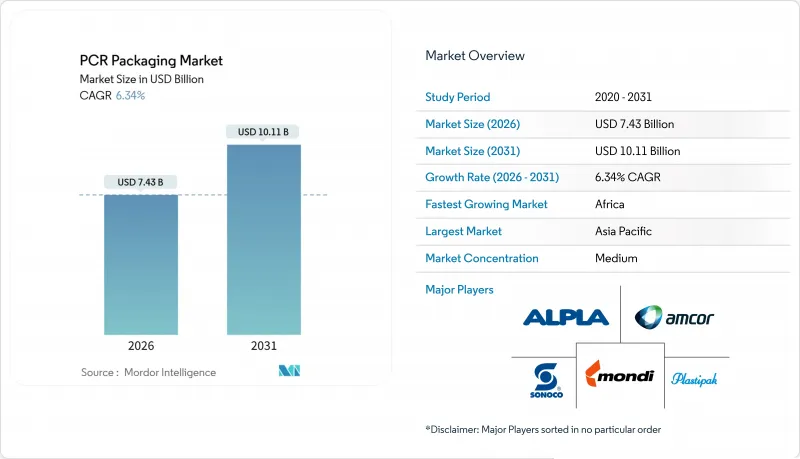
According to Mordor Intelligence, the PCR packaging market size stands at USD 7.43 billion in 2026 and is projected to reach USD 10.11 billion by 2031, reflecting a 6.34% CAGR.
This report is Segmented by Material Types (PET, PE, PVC, PP, and PS), Product Type (Bottles, Trays, and Pouches), End-Use Industry (Food, Beverage, Healthcare, Cosmetics and Personal Care, and Industrial), Recycling Source (Post-Consumer, and Post-Industrial), and Geography. The Market Forecasts are Provided in Terms of Value (USD).
Global PCR Packaging Market Trends and Insights
FMCG Brands' Recycled-Content Pledges Accelerate Volume Demand
Global consumer-goods companies have locked in public targets that require minimum recycled content across packaging portfolios. Nestle Purina converted its Friskies canisters to 100% mechanically recycled plastic in 2025, removing 500 metric tons of virgin material annually . Mars Petcare Australia followed with Schmackos packs that integrate 60% ISCC PLUS-certified resin, demonstrating price-tolerant adoption even in treat categories. Multi-year supply contracts arising from these pledges give converters the demand certainty needed to finance new extrusion lines and decontamination assets. Beverage and personal-care brands feel the greatest consumer scrutiny, yet industrial film categories are beginning to align as Scope 3 emissions enter procurement scorecards. The overall effect is a structural pull that disciplines recycled-resin demand even when virgin-polymer prices soften.
Government EPR and Recycled-Content Mandates Tighten After 2025
Regulators are translating voluntary frameworks into enforceable quotas. California's Plastic Pollution Prevention and Packaging Producer Responsibility Act sets a 25% cut in single-use plastics by 2032, subjecting non-compliant producers to per-ton fees. The European Union's updated Packaging and Packaging Waste Regulation widens recycled-content thresholds beyond polyethylene terephthalate bottles to include flexible films and closures. Japan revised its recycling targets in 2024, and South Korea now pilots deposit-return for polyethylene pouches. These policies create a compliance floor: brand owners must secure certified post-consumer resin regardless of the virgin-to-recycled price spread. Certification frameworks such as ISCC PLUS and RecyClass have consequently become market-access passports for converters serving multinational clients.
Quality Variability and Contamination of PCR Resins
Mixed-polymer bales, adhesive residues, and food soils degrade melt flow and color, compelling converters to blend recycled resin with virgin feedstock at 30%-50% ratios . Optical sorters reach 98% accuracy on clear polyethylene terephthalate but stumble on black pigments and multilayer sachets. Hot-caustic washes remove labels, yet residual adhesive manifests as gels during extrusion, limiting film aesthetics. Odor-causing volatiles generated from food soils restrict usage in dairy and bakery packaging. Super-clean wash lines and reactive extrusion can restore virgin-like quality, though each line costs upward of USD 10 million, restricting adoption to large converters with assured feedstock.
Other drivers and restraints analyzed in the detailed report include:
- Improved Global PCR Resin Supply Narrows Price Gap with Virgin Plastics
- Closed-Loop Brand Take-Back Programs Unlock New Feedstock Pools
- Under-Developed Collection and Sorting in Emerging Markets
For complete list of drivers and restraints, kindly check the Table Of Contents.
Segment Analysis
Polyethylene terephthalate accounted for 46.50% of PCR packaging market share in 2025. Strong bottle-to-bottle loops, FDA and EFSA approvals, and brand commitments collectively drive a forecast 10.80% CAGR to 2031. Klockner Pentaplast's 15,000-metric-ton expansion backs kpNext blister films and kp Elite trays made with up to 100% recycled content. Polyethylene follows on industrial and agricultural films but faces sensory hurdles in food-contact formats despite advances in vacuum distillation. Polypropylene gains traction in hot-fill and retort packaging via mono-material retort pouches such as Huhtamaki's Blueloop PP Retort, yet limited recycling infrastructure inflates price premiums. Polyvinyl chloride and polystyrene together remain below 10%, restricted by adverse regulations and limited end-of-life pathways.
Mono-material design trends cut across all polymers, spurring investment in co-extrusion lines that eliminate aluminum foil and ethylene-vinyl-alcohol layers. Advanced barrier coatings now enable polyethylene and polypropylene pouches to meet oxygen-transmission targets without multi-layer laminates, widening the addressable scope for high-recycled-content solutions. As regulators raise recycled-content thresholds, these materials will need decontamination innovations to match polyethylene terephthalate's established food-grade pathways.
Bottles retained 37.90% revenue contribution in 2025, bolstered by deposit-return systems that secure high-quality feedstock and permit multiple closed-loop cycles. Trays remain pivotal for meat and ready-meal applications, with Amcor and kp expanding clear recycled-polyethylene terephthalate thermoforms that satisfy modified-atmosphere packaging needs. The standout growth, however, comes from pouches, projected at an 11.50% CAGR through 2031. Huhtamaki's Blueloop PE pouch replaces multi-layer structures, cutting carbon footprint by 73% and retaining mechanical recyclability.
Converter investments support this shift. TC Transcontinental's USD 60 million biaxially oriented polyethylene film line in South Carolina delivers recyclability without sacrificing form-fill-seal efficiency. Caps, closures, and clamshells round out the portfolio, with molded-fiber formats beginning to displace polystyrene foam in takeaway channels.
Complete Report Scope:
- By Material Types
- Polyethylene Terephthalate (PET)
- Polyethylene (PE)
- Polyvinyl Chloride (PVC)
- Polypropylene (PP)
- Polystyrene (PS)
- Other Material Types
- By Product Type
- Bottles
- Trays
- Pouches
- Other Product Types
- By End-Use Industry
- Food
- Beverage
- Healthcare
- Cosmetics and Personal Care
- Industrial
- Other End-Use Industry
- By Recycling Source
- Post-Consumer
- Post-Industrial
- By Geography
- North America
- United States
- Canada
- Mexico
- Europe
- Germany
- United Kingdom
- France
- Italy
- Spain
- Russia
- Rest of Europe
- Asia-Pacific
- China
- Japan
- India
- South Korea
- Australia
- Rest of Asia-Pacific
- Middle East
- Saudi Arabia
- United Arab Emirates
- Turkey
- Rest of Middle East
- Africa
- South Africa
- Nigeria
- Rest of Africa
- South America
- Brazil
- Argentina
- Rest of South America
- North America
Geography Analysis
Asia-Pacific remained the largest regional hub, holding 38.50% share in 2025. China's updated packaging-waste rules and Japan's mature bottle-recycling networks ensure a steady supply of food-grade resin. India's informal aggregators fill volume gaps, although inconsistent quality constrains applications in dairy and ready meals. Australia and New Zealand achieve over 80% polyethylene terephthalate bottle recovery via container-deposit laws, giving converters reliable feedstock.
Africa is set to record a 14.10% CAGR, the highest globally. South Africa's deposit-return system secures more than 70% polyethylene terephthalate recovery, attracting converter investments in wash-line capacity. Nigeria and Egypt deploy optical sorters through public-private partnerships, lifting bale purity and enabling production of mechanically recycled polyethylene suitable for personal-care packaging. Infrastructure gaps persist for flexible films, yet pilot modular wash lines signal momentum.
North America benefits from California's producer-responsibility act and well-established polyethylene terephthalate recycling infrastructure. Flexible formats remain under-collected, but investments such as Novolex's plastic-film recycling centers elevate supply. Mexico gains traction as brands localize supply chains, yet collection rates hover below 40%. Europe sustains strong demand through the Packaging and Packaging Waste Regulation, with Germany, France, Italy, Spain, and the United Kingdom offering comprehensive curbside and deposit-return coverage and stringent thresholds for recycled content.
- Amcor plc
- ALPLA Group
- Mondi plc
- Sonoco Products Co.
- Transcontinental Inc.
- ePac Holdings
- Sealed Air Corporation
- Plastipak
- Huhtamaki Oyj
- Klockner Pentaplast
- Spectra Packaging
- IDEALPAK
- Genpak LLC
- PakTech
- Pactiv Evergreen
- Greiner Packaging
- AptarGroup
- Gerresheimer AG
- Logoplaste
- Consolidated Container Co.
Additional Benefits:
- The market estimate (ME) sheet in Excel format
- 3 months of analyst support
TABLE OF CONTENTS
1 INTRODUCTION
- 1.1 Study Assumptions and Market Definition
- 1.2 Scope of the Study
2 RESEARCH METHODOLOGY
3 EXECUTIVE SUMMARY
4 MARKET LANDSCAPE
- 4.1 Market Overview
- 4.2 Market Drivers
- 4.2.1 FMCG Brands Recycled-Content Pledges Accelerate Volume Demand
- 4.2.2 Government EPR and Recycled-Content Mandates Tighten After 2025
- 4.2.3 Improved Global PCR Resin Supply Narrows Price Gap with Virgin Plastics
- 4.2.4 Closed-Loop Brand Take-Back Programs Unlock New Feedstock Pools
- 4.2.5 Advanced Decontamination Technologies Enable Food-Grade PCR
- 4.2.6 Blockchain Traceability Platforms Boost Compliance Confidence
- 4.3 Market Restraints
- 4.3.1 Quality Variability and Contamination of PCR Resins
- 4.3.2 Under-Developed Collection and Sorting in Emerging Markets
- 4.3.3 Recycled-Resin Price Volatility from Oil-Price Swings
- 4.3.4 ESG-Audit Failures Cause Recalls and Brand-Equity Risk
- 4.4 Industry Value Chain Analysis
- 4.5 Regulatory Landscape
- 4.6 Technological Outlook
- 4.7 Impact of Macroeconomic Factors
- 4.8 Porter's Five Forces Analysis
- 4.8.1 Threat of New Entrants
- 4.8.2 Bargaining Power of Suppliers
- 4.8.3 Bargaining Power of Buyers
- 4.8.4 Threat of Substitutes
- 4.8.5 Competitive Rivalry
5 MARKET SIZE AND GROWTH FORECASTS (VALUE)
- 5.1 By Material Types
- 5.1.1 Polyethylene Terephthalate (PET)
- 5.1.2 Polyethylene (PE)
- 5.1.3 Polyvinyl Chloride (PVC)
- 5.1.4 Polypropylene (PP)
- 5.1.5 Polystyrene (PS)
- 5.1.6 Other Material Types
- 5.2 By Product Type
- 5.2.1 Bottles
- 5.2.2 Trays
- 5.2.3 Pouches
- 5.2.4 Other Product Types
- 5.3 By End-Use Industry
- 5.3.1 Food
- 5.3.2 Beverage
- 5.3.3 Healthcare
- 5.3.4 Cosmetics and Personal Care
- 5.3.5 Industrial
- 5.3.6 Other End-Use Industry
- 5.4 By Recycling Source
- 5.4.1 Post-Consumer
- 5.4.2 Post-Industrial
- 5.5 By Geography
- 5.5.1 North America
- 5.5.1.1 United States
- 5.5.1.2 Canada
- 5.5.1.3 Mexico
- 5.5.2 Europe
- 5.5.2.1 Germany
- 5.5.2.2 United Kingdom
- 5.5.2.3 France
- 5.5.2.4 Italy
- 5.5.2.5 Spain
- 5.5.2.6 Russia
- 5.5.2.7 Rest of Europe
- 5.5.3 Asia-Pacific
- 5.5.3.1 China
- 5.5.3.2 Japan
- 5.5.3.3 India
- 5.5.3.4 South Korea
- 5.5.3.5 Australia
- 5.5.3.6 Rest of Asia-Pacific
- 5.5.4 Middle East
- 5.5.4.1 Saudi Arabia
- 5.5.4.2 United Arab Emirates
- 5.5.4.3 Turkey
- 5.5.4.4 Rest of Middle East
- 5.5.5 Africa
- 5.5.5.1 South Africa
- 5.5.5.2 Nigeria
- 5.5.5.3 Rest of Africa
- 5.5.6 South America
- 5.5.6.1 Brazil
- 5.5.6.2 Argentina
- 5.5.6.3 Rest of South America
- 5.5.1 North America
6 COMPETITIVE LANDSCAPE
- 6.1 Market Concentration
- 6.2 Strategic Moves
- 6.3 Market Share Analysis
- 6.4 Company Profiles (includes Global level Overview, Market level overview, Core Segments, Financials as available, Strategic Information, Market Rank/Share for key companies, Products and Services, and Recent Developments)
- 6.4.1 Amcor plc
- 6.4.2 ALPLA Group
- 6.4.3 Mondi plc
- 6.4.4 Sonoco Products Co.
- 6.4.5 Transcontinental Inc.
- 6.4.6 ePac Holdings
- 6.4.7 Sealed Air Corporation
- 6.4.8 Plastipak
- 6.4.9 Huhtamaki Oyj
- 6.4.10 Klockner Pentaplast
- 6.4.11 Spectra Packaging
- 6.4.12 IDEALPAK
- 6.4.13 Genpak LLC
- 6.4.14 PakTech
- 6.4.15 Pactiv Evergreen
- 6.4.16 Greiner Packaging
- 6.4.17 AptarGroup
- 6.4.18 Gerresheimer AG
- 6.4.19 Logoplaste
- 6.4.20 Consolidated Container Co.
7 MARKET OPPORTUNITIES AND FUTURE OUTLOOK
- 7.1 White-Space and Unmet-Need Assessment

