PUBLISHER: Mordor Intelligence | PRODUCT CODE: 2116807

PUBLISHER: Mordor Intelligence | PRODUCT CODE: 2116807
North America Craft Beer - Market Share Analysis, Industry Trends & Statistics, Growth Forecasts (2026 - 2031)
According to Mordor Intelligence, the North America craft beer market size was valued at USD 64.02 billion in 2025 and estimated to grow from USD 69.45 billion in 2026 to reach USD 104.32 billion by 2031, at a CAGR of 8.48% during the forecast period (2026-2031).
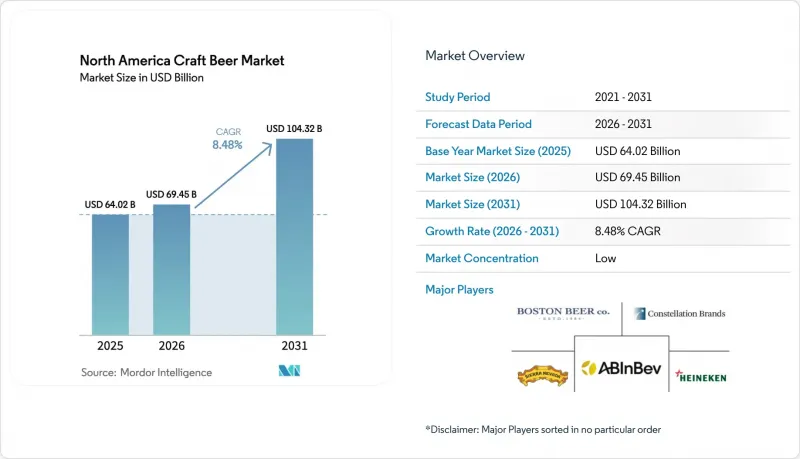
This report is Segmented by Product Type (Ale, Lager and Other Beer Types), End User (Men and Women), Packaging (Bottles, Cans and Others), Distribution Channels (On-Trade and Off-Trade), and Geography (United States, Canada, Mexico, and Rest of North America). The Market Forecasts are Provided in Terms of Value (USD).
North America Craft Beer Market Trends and Insights
Rising Number of Microbreweries Due to Strong Demand
The proliferation of microbreweries across North America demonstrates a significant shift in consumer preferences toward locally produced, authentic craft beer experiences. These establishments effectively capitalize on their local presence by fostering strong community relationships and minimizing distribution expenses through shorter supply chains. According to the Brewers Association, the United States recorded 9,796 operational craft breweries in 2024, comprising 2,029 microbreweries and 279 regional craft breweries . The growth of these establishments is supported by reduced regulatory requirements and the increasing mainstream acceptance of craft beer as a premium beverage choice across various age groups and consumer segments. The microbrewery expansion trend continues to shape the North American craft beer market, supported by consumers seeking unique, locally produced beverages and a regulatory environment that enables new market entrants to establish and operate brewing facilities. The emergence of microbreweries has also encouraged innovation in brewing techniques and flavor profiles, leading to a diverse range of craft beer offerings that cater to evolving consumer tastes.
Product Differentiation in Terms of Ingredients, Flavors, and Alcohol Content
Innovation in craft beer ingredients and flavor profiles remains a significant market driver in North America, as breweries strive to establish competitive differentiation through ongoing experimentation and innovation. The development of unique taste experiences enables craft brewers to capture and retain consumer interest in an increasingly competitive market. Breweries actively invest in research and development to create distinctive flavor combinations using specialized ingredients, helping them maintain their market position and meet evolving consumer demands. The industry's emphasis on product differentiation extends beyond traditional brewing methods to incorporate novel ingredients and brewing techniques. For instance, Lallemand Brewing's introduction of Aurora Northern IPA Yeast in April 2025 exemplifies this trend, combining the drinkability of West Coast IPAs with enhanced yeast aromatics. This innovation exemplifies how ingredient development directly addresses consumer preferences for balanced, flavorful options. These strategic ingredients and flavor innovations align with current consumer trends toward moderation and unique sensory experiences.
Stringent Government Regulations
Regulatory complexity in the North American craft beer market continues to escalate, primarily due to the implementation of new U.S. tariffs that impose a 25% duty on imports from Canada and Mexico. These tariffs particularly affect aluminum packaging materials, which are essential for craft beer canning operations. The trade tensions have further intensified with Canada's retaliatory measures, including 25% counter-tariffs on USD 30 billion worth of U.S. goods. This bilateral trade friction, combined with varying state-level regulatory requirements, creates substantial operational and compliance challenges for craft breweries operating across multiple jurisdictions. The impact of these regulatory hurdles extends to tax revenue, with the Federation of Tax Administrators projecting potential losses of USD 5 billion in alcohol tax revenue due to market disruptions . The intricate web of federal, state, and international regulations, coupled with trade barriers, creates a challenging business environment that significantly constrains the growth potential of the North American craft beer market.
Other drivers and restraints analyzed in the detailed report include:
- Rising Disposable Income and Willingness to Pay Premium Prices for High-Quality, Artisanal Beverages
- Growing Beer Tourism and Brewery Experiences Attracting Domestic and International Visitors
- Raw Material Cost Inflation and Supply Chain Challenges Impact Beer Production
For complete list of drivers and restraints, kindly check the Table Of Contents.
Segment Analysis
Ale beer dominates the market, accounting for a 38.02% share in 2025, driven by consumer preference for hop-forward flavor profiles and traditional brewing methods. The category's strength stems from the continued popularity of IPAs and the established brewing expertise across North America's craft brewery network, where traditional styles experience a resurgence alongside modern interpretations. Regional craft breweries consistently expand their ale portfolios to include session ales, barrel-aged varieties, and small-batch experimental releases. The robust distribution networks across major metropolitan areas facilitate wider access to craft ales, while taproom culture continues to foster direct consumer engagement. Local ingredients and terroir-driven brewing approaches further differentiate North American ales in the craft beer landscape.
Lager is the fastest-growing category, expanding at a 12.37% CAGR driven by a resurgence in the popularity of clean, crisp beer styles and advancements in production techniques. Craft brewers, leveraging technological innovations such as temperature-controlled fermentation, are not only achieving the refined quality synonymous with traditional lagers but also preserving the authenticity of small-batch production. This segment is further bolstered by a growing demand for low- and no-alcohol variants, reflecting the broader trend of health-conscious consumption. Moreover, partnerships between American and Mexican brewers have birthed a wave of hybrid styles, broadening the category's appeal. The rising trend of fruit-infused lagers, coupled with contemporary takes on European classics, underscores the category's momentum in North America's dynamic craft beer scene.
Men account for 68.75% of craft beer consumption in 2025, maintaining their traditional demographic dominance through established preferences for hop-forward ales and brewery experiences. However, the women's segment demonstrates significant growth with a 12.58% CAGR, driven by industry inclusivity initiatives and product diversification efforts across the market. The North American craft beer landscape continues to evolve, with male consumers showing strong brand loyalty and preference for higher ABV offerings. Regional breweries report that male consumers frequently participate in beer festivals and taproom events, contributing to sustained market engagement.
Companies like Talea Beer Co. are implementing gender-inclusive approaches through targeted product development and marketing that emphasize community building over traditional masculine imagery. This shift reflects broader cultural changes toward inclusive consumption experiences, with craft breweries leveraging storytelling and authenticity to connect with expanding consumer bases while maintaining their core customer relationships. North American breweries are increasingly hosting women-focused tasting events and educational sessions to foster market growth. Many craft breweries have expanded their product portfolios to include fruit-forward beers and lower-alcohol options that appeal to diverse taste preferences.
Complete Report Scope:
- By Product Type
- Ale
- Lager
- Other Beer Types
- By End User
- Men
- Women
- By Packaging
- Bottles
- Cans
- Others
- By Distribution Channel
- On-Trade
- Off-Trade
- By Geography
- United States
- Canada
- Mexico
- Rest of North America
List of Companies Covered in this Report:
- Boston Beer Company
- Heineken NV
- Constellation Brands
- Anheuser-Busch InBev
- Sierra Nevada Brewing Co.
- D. G. Yuengling & Son Inc.
- Monster Beverage Corporation (CANarchy)
- Gambrinus Company
- Bell's Brewery
- Deschutes Brewery
- Bellwoods Brewery
- Stone Brewing
- Brooklyn Brewery
- Trillium Brewing Company
- Odell Brewing Co.
- AleSmith Brewing Company
- Founders Brewing Co.
- Great Lakes Brewing Co.
- Three Floyds Brewing
- Allagash Brewing Company
Additional Benefits:
- The market estimate (ME) sheet in Excel format
- 3 months of analyst support
TABLE OF CONTENTS
1 INTRODUCTION
- 1.1 Study Assumptions and Market Definition
- 1.2 Scope of the Study
2 RESEARCH METHODOLOGY
3 EXECUTIVE SUMMARY
4 MARKET LANDSCAPE
- 4.1 Market Overview
- 4.2 Market Drivers
- 4.2.1 Rising number of microbreweries due to strong demand
- 4.2.2 Product diffrentiation in terms of ingredients, flavors, and alcohol content
- 4.2.3 Rising disposable income and willingness to pay premium prices for high-quality, artisanal beverages
- 4.2.4 Growing beer tourism and brewery experiences attracting domestic and international visitors
- 4.2.5 Surge in demand for low alcohol beverages
- 4.2.6 Technological advancement in terms of production
- 4.3 Market Restraints
- 4.3.1 Stringent government regulations
- 4.3.2 Consumer's inclination toward no/low alcohol products
- 4.3.3 Raw material cost inflation and supply chain challenges impact beer production
- 4.3.4 Religious and cultural constraints affecting beer market growth
- 4.4 Consumer Behaviour Analysis
- 4.5 Regulatory Outlook
- 4.6 Porter's Five Forces Analysis
- 4.6.1 Threat of New Entrants
- 4.6.2 Bargaining Power of Buyers/Consumers
- 4.6.3 Bargaining Power of Suppliers
- 4.6.4 Threat of Substitute Products
- 4.6.5 Intensity of Competitive Rivalry
5 MARKET SIZE AND GROWTH FORECASTS (VALUE)
- 5.1 By Product Type
- 5.1.1 Ale
- 5.1.2 Lager
- 5.1.3 Other Beer Types
- 5.2 By End User
- 5.2.1 Men
- 5.2.2 Women
- 5.3 By Packaging
- 5.3.1 Bottles
- 5.3.2 Cans
- 5.3.3 Others
- 5.4 By Distribution Channel
- 5.4.1 On-Trade
- 5.4.2 Off-Trade
- 5.5 By Geography
- 5.5.1 United States
- 5.5.2 Canada
- 5.5.3 Mexico
- 5.5.4 Rest of North America
6 COMPETITIVE LANDSCAPE
- 6.1 Market Concentration
- 6.2 Strategic Moves
- 6.3 Market Share Analysis
- 6.4 Company Profiles (includes Global level Overview, Market level overview, Core Segments, Financials as available, Strategic Information, Market Rank/Share for key companies, Products and Services, and Recent Developments)
- 6.4.1 Boston Beer Company
- 6.4.2 Heineken NV
- 6.4.3 Constellation Brands
- 6.4.4 Anheuser-Busch InBev
- 6.4.5 Sierra Nevada Brewing Co.
- 6.4.6 D. G. Yuengling & Son Inc.
- 6.4.7 Monster Beverage Corporation (CANarchy)
- 6.4.8 Gambrinus Company
- 6.4.9 Bell's Brewery
- 6.4.10 Deschutes Brewery
- 6.4.11 Bellwoods Brewery
- 6.4.12 Stone Brewing
- 6.4.13 Brooklyn Brewery
- 6.4.14 Trillium Brewing Company
- 6.4.15 Odell Brewing Co.
- 6.4.16 AleSmith Brewing Company
- 6.4.17 Founders Brewing Co.
- 6.4.18 Great Lakes Brewing Co.
- 6.4.19 Three Floyds Brewing
- 6.4.20 Allagash Brewing Company
7 MARKET OPPORTUNITIES AND FUTURE OUTLOOK

