PUBLISHER: Mordor Intelligence | PRODUCT CODE: 2125499

PUBLISHER: Mordor Intelligence | PRODUCT CODE: 2125499
Europe Craft Beer - Market Share Analysis, Industry Trends & Statistics, Growth Forecasts (2026 - 2031)
According to Mordor Intelligence, the Europe craft beer market size is expected to grow from USD 48.69 billion in 2025 to USD 53.81 billion in 2026 and is forecast to reach USD 88.73 billion by 2031 at 10.52% CAGR over 2026-2031.
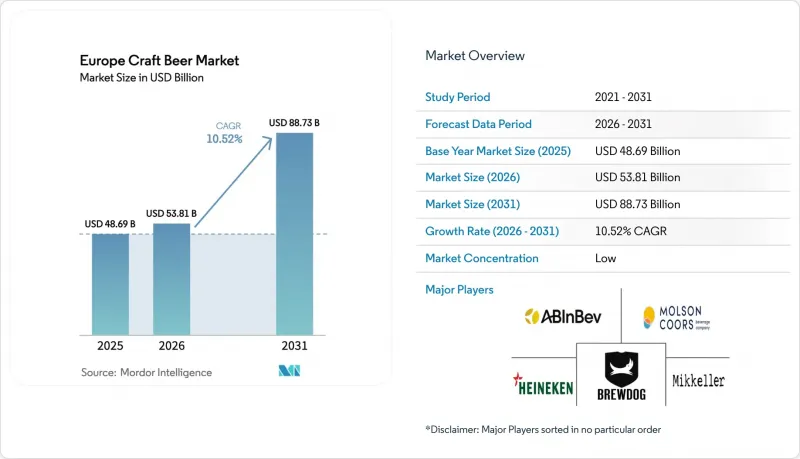
This report is Segmented by Product Type (Ale, Lager, Other Beer Types), End User (Men and Women), Packaging (Bottles, Cans, Others), Distribution Channel (On-Trade and Off-Trade), and Geography (United Kingdom, Germany, France, Italy, Spain, Russia, Sweden, Belgium, Poland, Netherlands, Rest of Europe). The Market Forecasts are Provided in Terms of Value (USD) and Volume (Liters).
Europe Craft Beer Market Trends and Insights
Rising consumer preference for premium and artisanal beverages
In Europe, a surge in consumer preference for premium and artisanal beverages has significantly propelled the craft beer market. Drinkers are increasingly favoring small-batch, flavorful brews over the traditional mass-produced lagers. Emphasizing authenticity, local sourcing, and craftsmanship, consumers are gravitating towards breweries that spotlight their origin stories, innovative recipes, and superior ingredients. This trend reflects a broader shift in consumer behavior, where quality and uniqueness are prioritized over quantity. With rising disposable incomes and a culture leaning towards experiential drinking, many are opting for pricier specialty beers. This includes IPAs, barrel-aged varieties, and seasonal releases, which offer distinct and memorable drinking experiences. Notably, urban millennials are at the forefront of this trend, showcasing a keen interest in diverse flavors and limited-edition launches. They are actively supporting taprooms, microbreweries, and beer festivals in major European cities, further driving the growth of the craft beer market.
Growing number of microbreweries and brewpubs across European countries
The growing number of microbreweries and brewpubs across European countries acted as a major driver for the Europe craft beer market, as it significantly expanded local production capacity and product diversity. This proliferation enabled more experimentation with beer styles, ingredients, and flavor profiles, catering to consumers seeking unique and regionally distinctive offerings. France emerged as one of the key examples, with over 2,500 microbreweries in 2024 and production reaching 24 million hectoliters, positioning the country as the fifth-largest beer producer in Europe. This rapid expansion illustrated how microbreweries helped shift the market away from standardized lagers toward differentiated craft products. In the United Kingdom, the momentum continued, with the total number of active breweries reaching 1,641 by the end of March 2025, as reported by the Society of Independent Brewers Association. This dense brewery network, spanning rural areas, towns, and major cities, strengthened local supply, shortened distribution chains, and fostered closer connections between brewers and consumers.
High production and raw material costs impacting profitability of small breweries
High production and raw material costs significantly constrained the profitability of small breweries in the Europe craft beer market. Rising prices of key inputs such as malt, hops, specialty yeasts, and energy increased per-unit production costs, which were harder to absorb at low volumes. Small brewers lacked the purchasing power and long-term supplier contracts enjoyed by large multinationals, so they often paid higher prices and faced more volatile input costs. Investment in quality equipment, packaging, and compliance with stringent food safety and environmental regulations further added to fixed cost burdens. Because many craft beers used premium or experimental ingredients, their recipes were inherently more expensive to produce than standard lagers. Passing these costs on to consumers via higher prices risked narrowing the customer base, especially in price-sensitive markets or economic downturns. Limited access to financing also restricted the ability of small breweries to modernize, scale up, or improve efficiency, keeping unit costs elevated.
Other drivers and restraints analyzed in the detailed report include:
- Increasing demand for innovative flavors and experimental brewing styles
- Strong tourism and beer festival culture supporting craft beer awareness
- Limited distribution networks restricting market reach of independent brewers
For complete list of drivers and restraints, kindly check the Table Of Contents.
Segment Analysis
Ale accounted for the largest share of the Europe craft beer market in 2025, representing 38.23% of total market revenue. The dominance of ale can be attributed to its wide variety of styles, flavors, and brewing techniques that appeal strongly to craft beer consumers seeking diversity and authenticity. Many craft breweries prioritize ale production due to shorter fermentation times and greater flexibility for experimentation with ingredients and flavor profiles. Consumer preference for bold, aromatic, and specialty beers has further strengthened the position of ales across both on-trade and off-trade channels. Additionally, the strong presence of pale ales, IPAs, and specialty seasonal variants has supported consistent demand across key European markets.
Lager is emerging as the fastest-growing segment in the Europe craft beer market and is projected to expand at a CAGR of 10.83% through 2031. The growth of craft lager is largely driven by increasing consumer demand for lighter, more refreshing beer options that offer both quality and drinkability. Craft brewers are increasingly introducing premium and specialty lagers that combine traditional brewing methods with modern flavor innovation. The segment is also benefiting from the transition of mainstream beer consumers toward craft alternatives without significantly changing taste preferences. Improved brewing technologies have enabled smaller breweries to produce high-quality lagers more efficiently, supporting wider product availability.
Men accounted for the largest share of the Europe craft beer market by end user in 2025, contributing 68.31% of total market value. This substantial share reflects the traditionally higher beer consumption rates among male consumers across many European countries. Craft beer brands have historically targeted male demographics through product positioning, flavor intensity, and marketing strategies centered on heritage and brewing craftsmanship. Established social drinking cultures and strong participation of men in beer festivals, pub gatherings, and tasting events have further reinforced this dominance. Additionally, men tend to exhibit higher brand loyalty within the craft segment, supporting consistent repeat purchases. The broad acceptance of diverse ale and specialty beer styles among male consumers continues to underpin their leading contribution to overall market revenue.
Women represent the fastest-growing end-user segment in the Europe craft beer market and are projected to expand at a CAGR of 11.23% through 2031. This accelerated growth is driven by changing social norms, rising disposable incomes, and increasing participation of women in premium beverage consumption. Craft breweries are introducing lighter, fruit-infused, low-alcohol, and aesthetically branded options that appeal to evolving female preferences. Marketing strategies are also becoming more inclusive, moving away from traditionally male-focused branding toward gender-neutral and experience-driven positioning. Growing interest in artisanal, locally produced, and premium beverages among women is further stimulating demand.
Complete Report Scope:
- By Product Type
- Ale
- Lager
- Other Beer Types (Specialty Beers)
- By End User
- Men
- Women
- By Packaging
- Bottles
- Cans
- Others
- By Distribution Channel
- On-Trade
- Off-Trade
- By Country
- United Kingdom
- Germany
- France
- Italy
- Spain
- Russia
- Sweden
- Belgium
- Poland
- Netherlands
- Rest of Europe
List of Companies Covered in this Report:
- Anheuser-Busch InBev
- BrewDog PLC
- Heineken Holding N.V.
- Molson Coors Beverage Company
- Mikkeller A/S
- Beavertown Brewery
- Camden Town Brewery
- Cloudwater Brew Co.
- Omnipollo AB
- Stone Brewing Co.
- Magic Rock Brewing Ltd.
- Sierra Nevada Brewing Co.
- D.G. Yuengling and Son Inc.
- Carlsberg Group (Jacobsen)
- Stone and Wood Brewing Co.
- La Trappe / De Koningshoeven
- Duvel Moortgat Brewery
- Siren Craft Brew
- Tiny Rebel Brewing Co.
- BrauKunstKeller
Additional Benefits:
- The market estimate (ME) sheet in Excel format
- 3 months of analyst support
TABLE OF CONTENTS
1 INTRODUCTION
- 1.1 Study Assumptions and Market Definition
- 1.2 Scope of the Study
2 RESEARCH METHODOLOGY
3 EXECUTIVE SUMMARY
4 MARKET LANDSCAPE
- 4.1 Market Overview
- 4.2 Market Drivers
- 4.2.1 Rising consumer preference for premium and artisanal beverages
- 4.2.2 Growing number of microbreweries and brewpubs across European countries
- 4.2.3 Increasing demand for innovative flavors and experimental brewing styles
- 4.2.4 Premiumization trend encouraging higher spending on specialty beverages
- 4.2.5 Increasing consumer interest in locally produced and authentic products
- 4.2.6 Strong tourism and beer festival culture supporting craft beer awareness
- 4.3 Market Restraints
- 4.3.1 High production and raw material costs impacting profitability of small breweries
- 4.3.2 Limited distribution networks restricting market reach of independent brewers
- 4.3.3 Strict alcohol taxation and regulatory compliance requirements across countries
- 4.3.4 Operational complexity due to small-batch and artisanal production methods
- 4.4 Supply-Chain Analysis
- 4.5 Regulatory Landscape
- 4.6 Technological Outlook
- 4.7 Porter's Five Forces
- 4.7.1 Threat of New Entrants
- 4.7.2 Bargaining Power of Buyers
- 4.7.3 Bargaining Power of Suppliers
- 4.7.4 Threat of Substitutes
- 4.7.5 Competitive Rivalry
5 MARKET SIZE AND GROWTH FORECASTS (VALUE AND VOLUME)
- 5.1 By Product Type
- 5.1.1 Ale
- 5.1.2 Lager
- 5.1.3 Other Beer Types (Specialty Beers)
- 5.2 By End User
- 5.2.1 Men
- 5.2.2 Women
- 5.3 By Packaging
- 5.3.1 Bottles
- 5.3.2 Cans
- 5.3.3 Others
- 5.4 By Distribution Channel
- 5.4.1 On-Trade
- 5.4.2 Off-Trade
- 5.5 By Country
- 5.5.1 United Kingdom
- 5.5.2 Germany
- 5.5.3 France
- 5.5.4 Italy
- 5.5.5 Spain
- 5.5.6 Russia
- 5.5.7 Sweden
- 5.5.8 Belgium
- 5.5.9 Poland
- 5.5.10 Netherlands
- 5.5.11 Rest of Europe
6 COMPETITIVE LANDSCAPE
- 6.1 Market Concentration
- 6.2 Strategic Moves
- 6.3 Market Share Analysis
- 6.4 Company Profiles (includes Global level Overview, Market level overview, Core Segments, Financials as available, Strategic Information, Market Rank/Share for key companies, Products and Services, and Recent Developments)
- 6.4.1 Anheuser-Busch InBev
- 6.4.2 BrewDog PLC
- 6.4.3 Heineken Holding N.V.
- 6.4.4 Molson Coors Beverage Company
- 6.4.5 Mikkeller A/S
- 6.4.6 Beavertown Brewery
- 6.4.7 Camden Town Brewery
- 6.4.8 Cloudwater Brew Co.
- 6.4.9 Omnipollo AB
- 6.4.10 Stone Brewing Co.
- 6.4.11 Magic Rock Brewing Ltd.
- 6.4.12 Sierra Nevada Brewing Co.
- 6.4.13 D.G. Yuengling and Son Inc.
- 6.4.14 Carlsberg Group (Jacobsen)
- 6.4.15 Stone and Wood Brewing Co.
- 6.4.16 La Trappe / De Koningshoeven
- 6.4.17 Duvel Moortgat Brewery
- 6.4.18 Siren Craft Brew
- 6.4.19 Tiny Rebel Brewing Co.
- 6.4.20 BrauKunstKeller
7 MARKET OPPORTUNITIES AND FUTURE OUTLOOK

