PUBLISHER: Mordor Intelligence | PRODUCT CODE: 2116824

PUBLISHER: Mordor Intelligence | PRODUCT CODE: 2116824
United States Advanced Metering Infrastructure (AMI) - Market Share Analysis, Industry Trends & Statistics, Growth Forecasts (2026 - 2031)
According to Mordor Intelligence, the US AMI market size is expected to grow from USD 23.23 billion in 2025 to USD 25.63 billion in 2026 and is forecast to reach USD 41.84 billion by 2031 at 10.33% CAGR over 2026-2031.
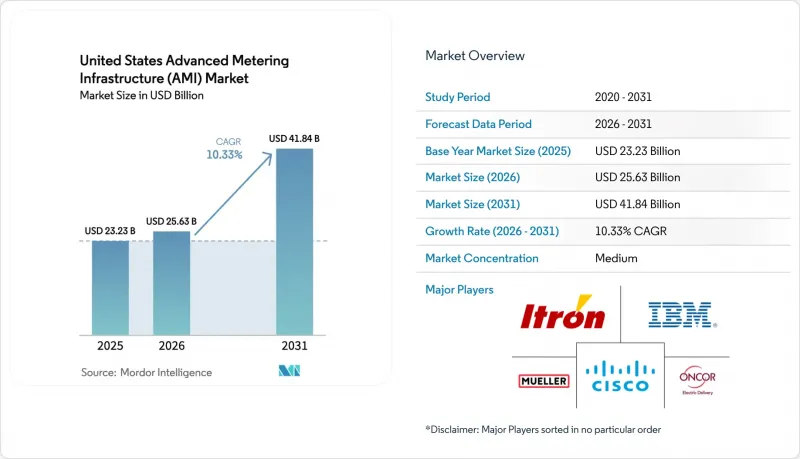
This report is Segmented by Component (Smart Metering Devices, Solutions, and Services), End-User (Residential, Commercial, and Industrial), Communication Technology (RF Mesh, Power Line Carrier, Cellular, Wi-Fi, and More), and Utility Ownership Type (Investor-Owned Utilities, Public Power Utilities, and Electric Cooperatives) and Geography. The Market Forecasts are Provided in Terms of Value (USD).
United States Advanced Metering Infrastructure (AMI) Market Trends and Insights
Federal Roll-Out Mandates and Funding Surge
Historic federal spending is changing the economics of the US AMI market by providing direct capital that lowers upfront cost risk for utilities. The Grid Resilience and Innovation Partnerships program has directed USD 5.7 billion across two rounds, with smart grid grants covering AMI, monitoring tools, and automation hardware. State and tribal formula grants have added USD 1.3 billion for resilience projects, many tagged specifically as "monitoring and control technologies." Direct-pay tax credits under the Inflation Reduction Act allow municipal utilities and cooperatives to claim up to 30% of qualifying AMI investments, which improves project cash flow. These mechanisms shorten regulatory approval cycles and let smaller utilities bundle AMI upgrades with broader grid projects. Procurement momentum that once peaked near rate-case windows now continues year-round, giving vendors steadier order books across the US AMI market.
Rising Grid Modernization and DER Integration Needs
Distributed energy resource growth is forcing utilities to replace legacy meters that lack time-synchronized data. The Department of Energy's Connected Communities 2.0 program awarded USD 32 million to pilot projects that rely on interval data for EV charging management and renewable coordination. AMI datasets now feed queue-management software that accelerates clean-energy interconnections, as seen in the i2X Innovative Queue Management Solutions program. Utilities need deterministic visibility at the feeder level to run hosting-capacity studies in hours rather than months. This operational requirement turns AMI from a billing upgrade into a core grid-sensing layer for the US AMI market. States with high renewable targets are issuing guidance that any distribution upgrade plan must include metering visibility enhancements, feeding a virtuous cycle of demand.
Legacy IT/OT Interoperability Gaps
Many first-generation rollouts underinvested in enterprise architecture, producing siloed systems that complicate data exchange. Utilities now face costly middleware deployments to link AMI head-ends with outage, distribution, and customer platforms. Integration of labour shortages inflates project budgets, especially for small public power entities that lack in-house talent. Cloud-native head-ends and open APIs promise relief, yet migration from on-premises environments remains a multiyear process. These technical complexities can delay procurement and slow revenue realization for vendors in the US AMI market.
Other drivers and restraints analyzed in the detailed report include:
- Increasing Cybersecurity Standards for Critical Infrastructure
- AI-Driven Meter Data Analytics Monetization
- Persistent Consumer Privacy Pushback
For complete list of drivers and restraints, kindly check the Table Of Contents.
Segment Analysis
Smart Metering Devices represented 46.62% of the US AMI market in 2025, underlining ongoing meter replacement programs, yet Software is set to outpace with a 13.62% CAGR to 2031. This growth pivots on analytics modules that transform interval data into revenue-generating grid services and customer-focused insights. The US AMI market size for software is forecast to narrow the revenue gap with devices before the forecast horizon ends. Utilities pair communication gateways and head-end systems with cloud dashboards that benchmark transformer loading and automate voltage set-points. As data value overtakes meter counts, vendors bundle subscription layers into contracts, creating an annuity stream that boosts margins.
Services are evolving from basic installation to outcome-based agreements, such as guaranteed read-success thresholds and analytics-driven energy savings. Managed services appeal to utilities that cannot staff new data science teams. In the US AMI market, suppliers now propose turnkey models where they own backend infrastructure and deliver meter data through secure APIs. This reduces customer capex and speeds adoption while enlarging vendors' total contract value.
Residential connections made up 88.35% of 2025 revenue, reflecting household volume and federal equity priorities. Large utilities tie AMI rollouts to rate structures that reward conservation, reinforcing residential penetration. Industrial accounts, however, are posting the highest 12.92% CAGR through 2031 as factories electrify processes and integrate renewables. The US AMI market share for industrial users is still modest, yet high growth stems from granular metering needed for demand charges, power-quality monitoring, and wholesale participation.
Many industrial sites operate as prosumers with behind-the-meter solar, storage, or microgrids. They rely on time-synchronized data for settlement and reliability assurances. Some plants require redundant communications paths and cybersecurity certifications because outages translate directly to production losses. Vendors with hardened meters and real-time analytics capture this opportunity, raising the visibility of the industrial segment inside the US AMI market.
Complete Report Scope:
- By Component
- Smart Metering Devices (Electricity - Water - Gas)
- Solutions
- Meter Communication Infrastructure
- Software
- Meter Data Management
- Meter Data Analytics
- Services
- By End-User
- Residential
- Commercial
- Industrial
- By Communication Technology
- RF Mesh
- Power Line Carrier (PLC)
- Cellular
- Wi-Fi and Other Communication Technologies
- By Utility Ownership Type
- Investor-Owned Utilities
- Public Power Utilities
- Electric Cooperatives
List of Companies Covered in this Report:
- Itron Inc.
- Landis+Gyr AG
- Sensus USA Inc.
- Honeywell International Inc.
- Aclara Technologies LLC
- Cisco Systems Inc.
- Siemens Industry Inc.
- Eaton Corporation plc
- Trilliant Holdings Inc.
- NuriFlex Inc.
- General Electric Company
- Mitsubishi Electric Power Products Inc.
- Schneider Electric USA Inc.
- Silver Spring Networks LLC
- Mueller Systems LLC
- Oracle America Inc.
- Badger Meter Inc.
- Kamstrup A/S
- Elster Solutions LLC
Additional Benefits:
- The market estimate (ME) sheet in Excel format
- 3 months of analyst support
TABLE OF CONTENTS
1 INTRODUCTION
- 1.1 Study Assumptions and Market Definition
- 1.2 Scope of the Study
2 RESEARCH METHODOLOGY
3 EXECUTIVE SUMMARY
4 MARKET LANDSCAPE
- 4.1 Market Overview
- 4.2 Market Drivers
- 4.2.1 Federal Roll-out Mandates and Funding Surge
- 4.2.2 Rising Grid Modernization and DER Integration Needs
- 4.2.3 Increasing Cybersecurity Standards for Critical Infrastructure
- 4.2.4 Customer Demand for Near Real-Time Billing Insights
- 4.2.5 Shift Toward Cellular-Based AMI Backhaul
- 4.2.6 AI-Driven Meter Data Analytics Monetization
- 4.3 Market Restraints
- 4.3.1 Legacy IT/OT Interoperability Gaps
- 4.3.2 Persistent Consumer-Privacy Pushback
- 4.3.3 Utility Workforce Skill Shortages for DI Apps
- 4.3.4 Semiconductor Supply Constraints for Meter ICs
- 4.4 Industry Value-Chain Analysis
- 4.5 Regulatory Landscape
- 4.6 Impact of Macroeconomic Factors
- 4.7 Technological Outlook
- 4.8 Porter's Five Forces Analysis
- 4.8.1 Threat of New Entrants
- 4.8.2 Bargaining Power of Buyers
- 4.8.3 Bargaining Power of Suppliers
- 4.8.4 Threat of Substitute Products
- 4.8.5 Intensity of Competitive Rivalry
5 MARKET SIZE AND GROWTH FORECASTS (VALUE)
- 5.1 By Component
- 5.1.1 Smart Metering Devices (Electricity - Water - Gas)
- 5.1.2 Solutions
- 5.1.2.1 Meter Communication Infrastructure
- 5.1.2.2 Software
- 5.1.2.2.1 Meter Data Management
- 5.1.2.2.2 Meter Data Analytics
- 5.1.3 Services
- 5.2 By End-User
- 5.2.1 Residential
- 5.2.2 Commercial
- 5.2.3 Industrial
- 5.3 By Communication Technology
- 5.3.1 RF Mesh
- 5.3.2 Power Line Carrier (PLC)
- 5.3.3 Cellular
- 5.3.4 Wi-Fi and Other Communication Technologies
- 5.4 By Utility Ownership Type
- 5.4.1 Investor-Owned Utilities
- 5.4.2 Public Power Utilities
- 5.4.3 Electric Cooperatives
6 COMPETITIVE LANDSCAPE
- 6.1 Market Concentration
- 6.2 Strategic Moves
- 6.3 Market Share Analysis
- 6.4 Company Profiles (includes Global level Overview, Market level overview, Core Segments, Financials as available, Strategic Information, Market Rank/Share for key companies, Products AND Services, and Recent Developments)
- 6.4.1 Itron Inc.
- 6.4.2 Landis+Gyr AG
- 6.4.3 Sensus USA Inc.
- 6.4.4 Honeywell International Inc.
- 6.4.5 Aclara Technologies LLC
- 6.4.6 Cisco Systems Inc.
- 6.4.7 Siemens Industry Inc.
- 6.4.8 Eaton Corporation plc
- 6.4.9 Trilliant Holdings Inc.
- 6.4.10 NuriFlex Inc.
- 6.4.11 General Electric Company
- 6.4.12 Mitsubishi Electric Power Products Inc.
- 6.4.13 Schneider Electric USA Inc.
- 6.4.14 Silver Spring Networks LLC
- 6.4.15 Mueller Systems LLC
- 6.4.16 Oracle America Inc.
- 6.4.17 Badger Meter Inc.
- 6.4.18 Kamstrup A/S
- 6.4.19 Elster Solutions LLC
7 MARKET OPPORTUNITIES AND FUTURE OUTLOOK
- 7.1 White-Space and Unmet-Need Assessment

