PUBLISHER: Mordor Intelligence | PRODUCT CODE: 2116835

PUBLISHER: Mordor Intelligence | PRODUCT CODE: 2116835
Europe Nut-Based Spreads - Market Share Analysis, Industry Trends & Statistics, Growth Forecasts (2026 - 2031)
According to Mordor Intelligence, european nut-based spreads market size in 2026 is estimated at USD 2.54 billion, growing from 2025 value of USD 2.39 billion with 2031 projections showing USD 3.41 billion, growing at 6.08% CAGR over 2026-2031.
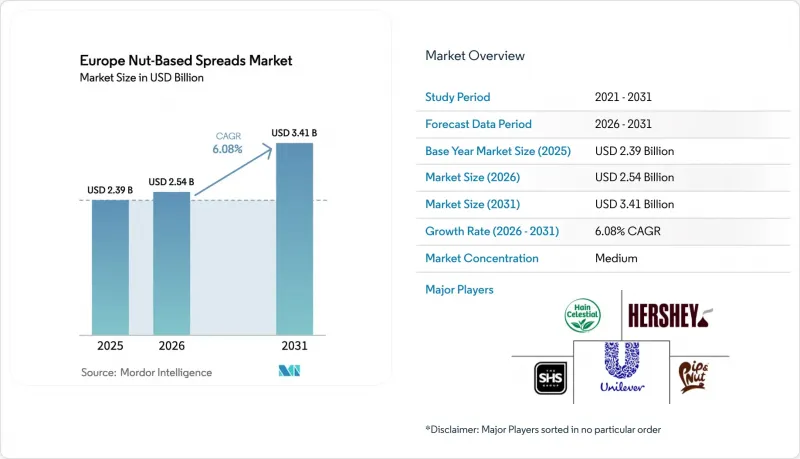
This report is Segmented by Product Type (Peanut-Based Spreads, Hazelnut-Based Spreads, and More), Nature (Conventional and Organic), Packaging Type (Jars, Tubs, Sachets/Pouches and Others), Distribution Channel (Supermarkets/Hypermarkets and More), and Geography (United Kingdom, Germany, France, Italy, Spain, and More). The Market Forecasts are Provided in Terms of Value (USD).
Europe Nut-Based Spreads Market Trends and Insights
Growing Awareness of Health Benefits Associated with Nuts Fuels Consumption
Growing consumer awareness of the nutritional benefits of nuts is driving manufacturers to transform their products from snacks to functional foods. According to the National Library of Medicine , regular nut consumption reduces the risks of cardiovascular disease, cancer mortality, and all-cause mortality, providing scientific support for product claims. This understanding influences manufacturers to develop formulations that maintain nuts' natural nutritional properties, emphasizing protein content, healthy fats, and micronutrients. In March 2024, Whole Earth launched a limited-edition protein-enhanced peanut butter featuring crunchy pea protein pieces, which provides higher protein content than standard crunchy peanut butter, meeting the criteria for a "high in protein" claim. These developments indicate a continued shift toward healthier, nutrient-dense spreads that align with consumer preferences for functional foods.
Expansion of clean label and natural product offerings aligns with European consumer trends
The clean label movement is transforming product development priorities across the food and beverages industry. Manufacturers are eliminating artificial additives, preservatives, and palm oil from their formulations, which presents technical challenges while offering differentiation opportunities. According to research by CBI ministry of foreign affairs , clean-label products are projected to constitute over 70% of portfolios in 2025 and 2026, increasing from 52% in 2021. Companies are adopting transparent sourcing practices and simplified ingredient declarations, while also emphasizing ethical sourcing through certification schemes and supply chain transparency initiatives. This comprehensive approach to clean label positioning enables premium pricing strategies, expanding category margins despite rising input costs. In response to this trend, companies continue to innovate, as demonstrated by Pip & Nut's May 2025 release of new Chocolate Hazelnut Spread with 63% nuts and over six times less sugar than Nutella. Free from palm oil and ultra-processed fillers, it's the UK's first chocolate spread using ethically sourced cocoa from Tony's Chocolonely's Open Chain.
Allergies To Peanuts and Tree Nuts Restrict Potential Consumer Base
The prevalence of nut allergies in Europe influences regulatory frameworks and product development in the market. The European Food Safety Authority's focus on Precautionary Allergen Labelling (PAL) requires manufacturers to meet strict compliance requirements. Industry participants seek unified standards to replace diverse national regulations. The absence of uniform quantitative risk assessment methods creates regulatory uncertainty and potential trade barriers. Manufacturers are responding by developing hypoallergenic processing methods to reduce allergen levels while maintaining nutritional content. Companies are also producing alternative spreads using seeds and legumes to provide comparable taste and texture without allergen risks. These adaptations in regulatory compliance and product innovation demonstrate the market's responsiveness to addressing allergen-related challenges while ensuring consumer safety.
Other drivers and restraints analyzed in the detailed report include:
- Innovation In Flavors, Ingredients Appeals to Millennials and Health-Focused Consumers
- Expansion of retail and online channels increases availability of nut based spreads across Europe
- Fluctuating Prices of Raw Nuts Impact Production Costs and Profit Margins
For complete list of drivers and restraints, kindly check the Table Of Contents.
Segment Analysis
Peanut-based spreads dominate the European market with a 42.86% share in 2025, leveraging their established consumer acceptance and cost advantages over other nut varieties. While peanut spreads maintain their market leadership, they face growing competition from emerging alternatives, particularly cashew-based products, which are projected to grow at a 6.18% CAGR from 2026 to 2031. Cashew spreads are gaining popularity due to their creamy texture and versatile flavor profile, supported by sustainable farming initiatives in regions like Ghana, according to Olam Food Ingredients.
The nut spread market demonstrates diverse regional preferences, with hazelnut-based products maintaining strong positions in Italy and France due to cultural traditions and local sourcing. Almond spreads attract health-conscious consumers through their nutritional benefits, while walnut spreads serve premium market segments. The market landscape continues to evolve as manufacturers develop hybrid formulations, combining different nut varieties to create unique flavor profiles and nutritional offerings.
The conventional segment maintains a commanding 87.55% share of the European nut-based spreads market in 2025, leveraging its established production infrastructure and competitive pricing. While conventional products dominate current sales, the organic segment is experiencing rapid growth, with a projected CAGR of 7.22% from 2026 to 2031, driven by consumers increasingly willing to pay premium prices for products they perceive as healthier and more environmentally sustainable.
The organic segment's growth has catalyzed significant changes in the market, with manufacturers investing in supply chain transparency and certification programs to verify organic compliance. Companies like Rapunzel Naturkost, Jean Herve, and Campo d'Oro are capitalizing on this trend by offering organic spreads that align with the clean label movement. This combination of organic certification and clean label attributes creates compelling product positioning that appeals to health-conscious consumers seeking premium food options.
Complete Report Scope:
- By Product Type
- Peanut-Based Spreads
- Hazelnut-Based Spreads
- Almond-Based Spreads
- Walnut-Based Spreads
- Cashew-Based Spreads
- Other Product Types
- By Nature
- Conventional
- Organic
- By Packaging Type
- Jars
- Tubs
- Sachets/Pouches
- Others
- By Distribution Channel
- Supermarkets/Hypermarkets
- Convenience Stores
- Online Retail Stores
- Other Distribution Channels
- By Geography
- Germany
- France
- United Kingdom
- Spain
- Netherlands
- Italy
- Sweden
- Poland
- Belgium
- Rest of Europe
List of Companies Covered in this Report:
- SHS Group
- Unilever PLC
- Pip & Nut Ltd.
- The Hershey Company
- The Hain Celestial Group Inc.
- Intersnack Group GmbH & Co. KG
- Hormel Foods Corp.
- The J.M. Smucker Company
- Windmill Organics Ltd.
- EricsPeanuts Ltd.
- Ferrero International S.A.
- Kraft Heinz Co.
- Mondelez International Inc.
- B&G Foods, Inc.
- Nutkao S.r.l.
- Valsoia S.p.A.
- Yumello Ltd.
- Rigoni di Asiago S.r.l.:
- Otis McAllister Inc
- Andros Group
Additional Benefits:
- The market estimate (ME) sheet in Excel format
- 3 months of analyst support
TABLE OF CONTENTS
1 INTRODUCTION
- 1.1 Study Assumptions and Market Definition
- 1.2 Scope of the Study
2 RESEARCH METHODOLOGY
3 EXECUTIVE SUMMARY
4 MARKET LANDSCAPE
- 4.1 Market Overview
- 4.2 Market Drivers
- 4.2.1 Growing Awareness of Health Benefits Associated with Nuts Fuels Consumption
- 4.2.2 Rising Demand for Exotic and Regionally Sourced Fruit Flavors Drives Product Innovation
- 4.2.3 Expansion of clean label and natural product offerings aligns with European consumer trends
- 4.2.4 Aggressive Marketing and Branding Influences Market Growth
- 4.2.5 Innovation In Flavors, Ingredients Appeals to Millennials and Health-Focused Consumers
- 4.2.6 Expansion of retail and online channels increases availability of nut based spreads across Europe
- 4.3 Market Restraints
- 4.3.1 Health Concerns Over High Sugar and Fat Content in Certain Spread Restricts Growth
- 4.3.2 Fluctuating Prices of Raw Nuts Impact Production Costs and Profit Margins
- 4.3.3 Allergies To Peanuts and Tree Nuts Restrict Potential Consumer Base
- 4.3.4 Competition From Chocolate and Fruit-Based Spreads Challenges Market Share
- 4.4 Regulatory Outlook
- 4.5 Technology Outlook
- 4.6 Porter's Five Forces
- 4.6.1 Threat of New Entrants
- 4.6.2 Bargaining Power of Buyers
- 4.6.3 Bargaining Power of Suppliers
- 4.6.4 Threat of Substitute Products
- 4.6.5 Intensity of Competitive Rivalry
5 MARKET SIZE AND GROWTH FORECASTS (VALUE)
- 5.1 By Product Type
- 5.1.1 Peanut-Based Spreads
- 5.1.2 Hazelnut-Based Spreads
- 5.1.3 Almond-Based Spreads
- 5.1.4 Walnut-Based Spreads
- 5.1.5 Cashew-Based Spreads
- 5.1.6 Other Product Types
- 5.2 By Nature
- 5.2.1 Conventional
- 5.2.2 Organic
- 5.3 By Packaging Type
- 5.3.1 Jars
- 5.3.2 Tubs
- 5.3.3 Sachets/Pouches
- 5.3.4 Others
- 5.4 By Distribution Channel
- 5.4.1 Supermarkets/Hypermarkets
- 5.4.2 Convenience Stores
- 5.4.3 Online Retail Stores
- 5.4.4 Other Distribution Channels
- 5.5 By Geography
- 5.5.1 Germany
- 5.5.2 France
- 5.5.3 United Kingdom
- 5.5.4 Spain
- 5.5.5 Netherlands
- 5.5.6 Italy
- 5.5.7 Sweden
- 5.5.8 Poland
- 5.5.9 Belgium
- 5.5.10 Rest of Europe
6 COMPETITIVE LANDSCAPE
- 6.1 Market Concentration
- 6.2 Strategic Moves
- 6.3 Market Ranking
- 6.4 Company Profiles (includes Global level Overview, Market level overview, Core Segments, Financials as available, Strategic Information, Market Rank/Share for key companies, Products and Services, and Recent Developments)
- 6.4.1 SHS Group
- 6.4.2 Unilever PLC
- 6.4.3 Pip & Nut Ltd.
- 6.4.4 The Hershey Company
- 6.4.5 The Hain Celestial Group Inc.
- 6.4.6 Intersnack Group GmbH & Co. KG
- 6.4.7 Hormel Foods Corp.
- 6.4.8 The J.M. Smucker Company
- 6.4.9 Windmill Organics Ltd.
- 6.4.10 EricsPeanuts Ltd.
- 6.4.11 Ferrero International S.A.
- 6.4.12 Kraft Heinz Co.
- 6.4.13 Mondelez International Inc.
- 6.4.14 B&G Foods, Inc.
- 6.4.15 Nutkao S.r.l.
- 6.4.16 Valsoia S.p.A.
- 6.4.17 Yumello Ltd.
- 6.4.18 Rigoni di Asiago S.r.l.:
- 6.4.19 Otis McAllister Inc
- 6.4.20 Andros Group
7 MARKET OPPORTUNITIES AND FUTURE OUTLOOK

