PUBLISHER: Mordor Intelligence | PRODUCT CODE: 2118930

PUBLISHER: Mordor Intelligence | PRODUCT CODE: 2118930
Organic Chocolate Spreads - Market Share Analysis, Industry Trends & Statistics, Growth Forecasts (2026 - 2031)
According to Mordor Intelligence, the organic chocolate spreads market size is expected to grow from USD 357.41 million in 2025 to USD 374.44 million in 2026 and is forecast to reach USD 488.66 million by 2031 at a 5.47% CAGR over 2026-2031.
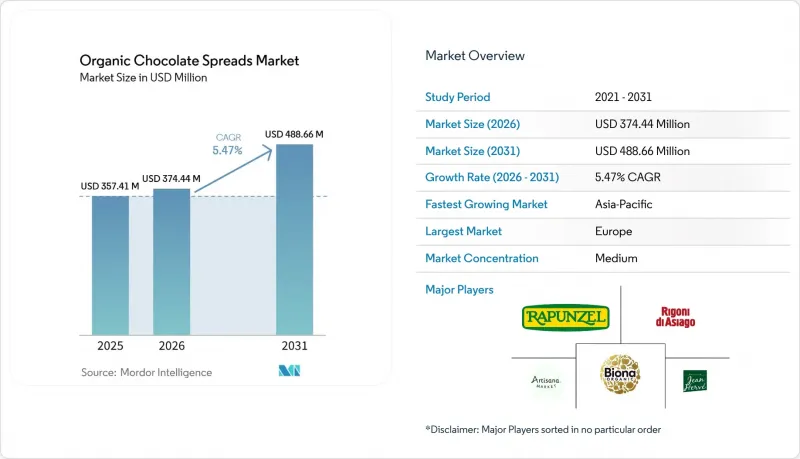
This report is Segmented by Product Type (Hazelnut Chocolate Spreads, Milk Chocolate Spreads, and More), Distribution Channel (Supermarkets/Hypermarkets, Convenience Stores, Specialty Stores, Online Retail Stores, and Other Distribution Channels), and Geography (North America, Europe, Asia-Pacific, South America, and Middle East and Africa). Market Forecasts are Provided in Terms of Value (USD).
Global Organic Chocolate Spreads Market Trends and Insights
Health-conscious demand for organic and clean-label indulgence
Health-conscious consumer preferences for clean-label and organic foods are driving demand for organic chocolate spreads, as shoppers increasingly prioritize products made without synthetic pesticides, GMOs, artificial additives, and synthetic hormones. According to the Organic Trade Association's 2025 Consumer Perception Survey, nearly 90% of Gen Z consumers are either committed or relatively new organic consumers, highlighting strong adoption of organic products among younger demographics. The survey also found that 90% of consumers surveyed were familiar with organic, making it one of the most widely recognized food claims, while over two-thirds of younger consumers seek out the USDA Organic label in almost every food purchase. These evolving preferences are encouraging manufacturers to expand certified organic and clean-label chocolate spread portfolios to meet growing consumer demand for healthier indulgent foods.
Expansion of plant-based, vegan, and dairy-free formulations
The growth of plant-based, vegan, and dairy-free product offerings is driving expansion in the organic chocolate spreads market, as consumers increasingly seek alternatives that align with ethical, environmental, and dietary preferences. Manufacturers are introducing formulations made with plant-based ingredients such as hazelnuts, almonds, oats, and coconut, while eliminating dairy and other animal-derived ingredients to appeal to a broader consumer base. The combination of organic certification with vegan and clean-label positioning is strengthening product differentiation and expanding shelf presence across multiple channels. Ongoing innovation in ingredient sourcing and formulation is enabling brands to meet evolving consumer expectations for premium, plant-based indulgent foods without compromising taste or texture.
Competition from other healthy spread categories
Competition from other healthy spread categories is restraining the growth of the organic chocolate spreads market, as consumers increasingly choose alternatives that offer comparable nutritional benefits and broader functional appeal. Products such as natural nut butters, seed-based spreads, fruit spreads, and protein-enriched spreads compete for the same breakfast and snacking occasions, and are often perceived as healthier or more versatile. Many of these alternatives also carry organic, clean-label, or plant-based claims, intensifying competition within premium retail shelves and online channels. As a result, organic chocolate spread manufacturers face increasing pressure to differentiate their products through ingredient quality, flavor innovation, and nutritional positioning.
Other drivers and restraints analyzed in the detailed report include:
- Continuous flavor innovation and product diversification
- Growing consumer awareness of sustainable cocoa sourcing
- Cocoa, hazelnut, sugar, and oil cost volatility
For complete list of drivers and restraints, kindly check the Table Of Contents.
Segment Analysis
Hazelnut chocolate spreads accounted for 38.46% of the organic chocolate spreads market in 2025, making them the largest product type. The segment's dominance is driven by strong consumer preference for the cocoa-hazelnut flavor profile across breakfast and snacking occasions. Widespread availability through supermarkets, specialty organic retailers, and online channels, combined with growing demand for organic and clean-label products, continues to support this segment's market position.
Dark chocolate spreads are projected to register the fastest growth, expanding at a CAGR of 6.68% during 2026-2031. The segment is benefiting from increasing consumer interest in premium chocolate products with higher cocoa content and reduced-sugar formulations. Rising demand for plant-based, organic, and functional food products is encouraging manufacturers to introduce new dark chocolate spread variants, supporting segment growth over the forecast period.
Complete Report Scope:
- By Product Type
- Hazelnut Chocolate Spreads
- Milk Chocolate Spreads
- Dark Chocolate Spreads
- White Chocolate Spreads
- Other Product Types
- By Distribution Channel
- Supermarkets/Hypermarkets
- Convenience Stores
- Specialty Stores
- Online Retail Stores
- Other Distribution Channels
- By Geography
- North America
- United States
- Canada
- Mexico
- Rest of North America
- Europe
- Germany
- United Kingdom
- Italy
- France
- Spain
- Netherlands
- Poland
- Belgium
- Sweden
- Rest of Europe
- Asia-Pacific
- China
- India
- Japan
- Australia
- Indonesia
- South Korea
- Thailand
- Singapore
- Rest of Asia-Pacific
- South America
- Brazil
- Argentina
- Colombia
- Chile
- Peru
- Rest of South America
- Middle East and Africa
- South Africa
- Saudi Arabia
- United Arab Emirates
- Nigeria
- Egypt
- Morocco
- Turkey
- Rest of Middle East and Africa
- North America
Geography Analysis
Europe accounted for 35.13% of the global organic chocolate spreads market in 2025, making it the largest regional market. The region's position is supported by strong consumer awareness of organic foods, well-established organic certification frameworks, and widespread demand for premium chocolate-based breakfast and snacking products. A mature retail infrastructure, extensive availability of certified organic products, and growing preference for clean-label and sustainably sourced ingredients continue to drive market growth across major European countries.
Asia-Pacific is projected to register the fastest growth, expanding at a CAGR of 6.86% during 2026-2031. Rising health awareness, increasing disposable incomes, and growing adoption of organic and premium food products are driving demand across the region. The rapid expansion of modern retail, e-commerce platforms, and specialty organic food stores is improving product accessibility, while changing dietary preferences among urban consumers continue to support market growth.
North America represents a significant market for organic chocolate spreads, supported by high consumer spending on organic packaged foods and the growing popularity of plant-based and clean-label products. Emerging demand in Latin America and the Middle East is also creating new growth opportunities as awareness of organic food products, premium snacking, and sustainable consumption continues to rise.
- Meridian Foods
- JUSTIN'S
- Rigoni di Asiago S.r.l.
- Rapunzel Naturkost
- Artisana Organics
- BIONA
- Pana Organic
- The Organic Family Ltd.
- Cocofina
- Mason & Co
- Askinosie Chocolate LLC
- Phalada Pure & Sure
- THE ORGANIC FAMILY LTD.
- Allos Hof-Manufaktur GmbH
- Jean Herve SAS
- Bio Today B.V.
- Good Good
- Bett'r Food
- Iswari Superfoods
- Perl'Amande
Additional Benefits:
- The market estimate (ME) sheet in Excel format
- 3 months of analyst support
TABLE OF CONTENTS
1 INTRODUCTION
- 1.1 Study Assumptions and Market Definition
- 1.2 Scope of the Study
2 RESEARCH METHODOLOGY
3 EXECUTIVE SUMMARY
4 MARKET LANDSCAPE
- 4.1 Market Overview
- 4.2 Market Drivers
- 4.2.1 Health-conscious demand for organic and clean-label indulgence
- 4.2.2 Expansion of plant-based, vegan, and dairy-free formulations
- 4.2.3 Continuous flavor innovation and product diversification
- 4.2.4 Growing consumer awareness of sustainable cocoa sourcing
- 4.2.5 Growth in premium artisan and small-batch food brands
- 4.2.6 Product innovation with functional and nutrient-rich ingredients
- 4.3 Market Restraints
- 4.3.1 Competition from other healthy spread categories
- 4.3.2 Cocoa, hazelnut, sugar, and oil cost volatility
- 4.3.3 Organic certification and labeling compliance complexity
- 4.3.4 Shorter shelf life due to minimal synthetic preservatives
- 4.4 Consumer Behavior Analysis
- 4.5 Regulatory Landscape
- 4.6 Porter's Five Forces Analysis
- 4.6.1 Threat of New Entrants
- 4.6.2 Bargaining Power of Suppliers
- 4.6.3 Bargaining Power of Buyers
- 4.6.4 Threat of Substitutes
- 4.6.5 Industry Rivalry
5 MARKET SIZE AND GROWTH FORECASTS (VALUE)
- 5.1 By Product Type
- 5.1.1 Hazelnut Chocolate Spreads
- 5.1.2 Milk Chocolate Spreads
- 5.1.3 Dark Chocolate Spreads
- 5.1.4 White Chocolate Spreads
- 5.1.5 Other Product Types
- 5.2 By Distribution Channel
- 5.2.1 Supermarkets/Hypermarkets
- 5.2.2 Convenience Stores
- 5.2.3 Specialty Stores
- 5.2.4 Online Retail Stores
- 5.2.5 Other Distribution Channels
- 5.3 By Geography
- 5.3.1 North America
- 5.3.1.1 United States
- 5.3.1.2 Canada
- 5.3.1.3 Mexico
- 5.3.1.4 Rest of North America
- 5.3.2 Europe
- 5.3.2.1 Germany
- 5.3.2.2 United Kingdom
- 5.3.2.3 Italy
- 5.3.2.4 France
- 5.3.2.5 Spain
- 5.3.2.6 Netherlands
- 5.3.2.7 Poland
- 5.3.2.8 Belgium
- 5.3.2.9 Sweden
- 5.3.2.10 Rest of Europe
- 5.3.3 Asia-Pacific
- 5.3.3.1 China
- 5.3.3.2 India
- 5.3.3.3 Japan
- 5.3.3.4 Australia
- 5.3.3.5 Indonesia
- 5.3.3.6 South Korea
- 5.3.3.7 Thailand
- 5.3.3.8 Singapore
- 5.3.3.9 Rest of Asia-Pacific
- 5.3.4 South America
- 5.3.4.1 Brazil
- 5.3.4.2 Argentina
- 5.3.4.3 Colombia
- 5.3.4.4 Chile
- 5.3.4.5 Peru
- 5.3.4.6 Rest of South America
- 5.3.5 Middle East and Africa
- 5.3.5.1 South Africa
- 5.3.5.2 Saudi Arabia
- 5.3.5.3 United Arab Emirates
- 5.3.5.4 Nigeria
- 5.3.5.5 Egypt
- 5.3.5.6 Morocco
- 5.3.5.7 Turkey
- 5.3.5.8 Rest of Middle East and Africa
- 5.3.1 North America
6 COMPETITIVE LANDSCAPE
- 6.1 Market Concentration
- 6.2 Strategic Moves
- 6.3 Market Share Analysis
- 6.4 Company Profiles (includes Company Highlights, Core Segments, Financials (if available), Strategic Information, Market Share Analysis for Key Companies, Products, and Recent Developments)
- 6.4.1 Meridian Foods
- 6.4.2 JUSTIN'S
- 6.4.3 Rigoni di Asiago S.r.l.
- 6.4.4 Rapunzel Naturkost
- 6.4.5 Artisana Organics
- 6.4.6 BIONA
- 6.4.7 Pana Organic
- 6.4.8 The Organic Family Ltd.
- 6.4.9 Cocofina
- 6.4.10 Mason & Co
- 6.4.11 Askinosie Chocolate LLC
- 6.4.12 Phalada Pure & Sure
- 6.4.13 THE ORGANIC FAMILY LTD.
- 6.4.14 Allos Hof-Manufaktur GmbH
- 6.4.15 Jean Herve SAS
- 6.4.16 Bio Today B.V.
- 6.4.17 Good Good
- 6.4.18 Bett'r Food
- 6.4.19 Iswari Superfoods
- 6.4.20 Perl'Amande
7 MARKET OPPORTUNITIES AND FUTURE OUTLOOK

