PUBLISHER: Mordor Intelligence | PRODUCT CODE: 2116847

PUBLISHER: Mordor Intelligence | PRODUCT CODE: 2116847
Europe Telehealth Services - Market Share Analysis, Industry Trends & Statistics, Growth Forecasts (2026 - 2031)
According to Mordor Intelligence, the Europe telehealth services market size is expected to grow from USD 30.49 billion in 2025 to USD 37.94 billion in 2026 and is forecast to reach USD 113.22 billion by 2031 at a 24.44% CAGR over 2026-2031.
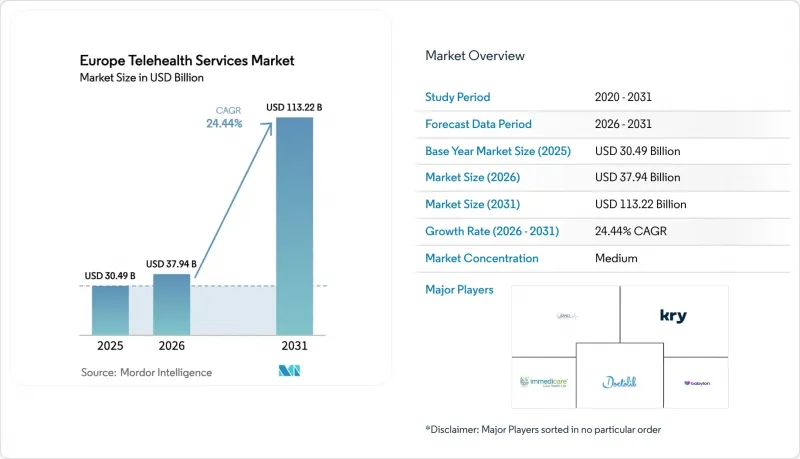
This report is Segmented by Service Type (Telemedicine, and More), Application (Tele-Consultation, and More), End User (Providers, Patients, and Payers), Category (Hardware and Software), Delivery Mode (Cloud-Based, Web-Based, and On-Premise), and Geography (Germany, United Kingdom, France, Italy, Spain, and Rest of Europe). The Market Forecasts are Provided in Terms of Value (USD).
Europe Telehealth Services Market Trends and Insights
Aging Population & Chronic Disease Burden Escalating Demand for Remote Care
Citizens aged 65 and above represented 21% of Europe's population in 2023, and projections indicate that the cohort will reach 30% by 2050, with concentrations in Germany, Italy, and Spain. Chronic illnesses already account for 70%-80% of health budgets, and telehealth reduces the need for frequent travel by shifting routine monitoring to patients' homes. A 2024 WHO tool listed 15 European countries that have embedded telemedicine into their national strategies, underlining policy alignment with demographic realities. Hospital-at-home models, which cut inpatient costs by up to 30%, rely on continuous vital-sign feeds that the Europe telehealth service market now readily supplies. These factors combine to fuel remote monitoring's status as the fastest-growing service type.
Post-COVID Regulatory Reimbursement Reforms Enabling Teleconsultations
Temporary pandemic measures have become permanent: France now reimburses video visits for established patients, Germany removed prior authorization for remote encounters in 2024, and the UK scaled virtual wards within the National Health Service . Southern Europe remains patchy, but the formal inclusion of teleconsultation codes into fee schedules anchors revenue visibility, inviting platform investment. Divergent fee levels still temper uptake among specialists who rely on procedure-based income. Nonetheless, standardized billing in core markets establishes a foundation for the broader Europe telehealth service market to mature.
Fragmented National Reimbursement Frameworks Limiting Cross-Border Scaling
Even with shared data rails, payment rules remain local. France underpays video visits relative to in-person care, Germany links reimbursement to diagnosis codes, and Spain's 17 regions apply separate criteria. Remote monitoring, which requires continuous billing, suffers most. The absence of mutual recognition forces platforms to tailor products market by market, hampering economies of scale and slowing the wider Europe telehealth service market.
Other drivers and restraints analyzed in the detailed report include:
- High Smartphone & Broadband Penetration Supporting Video Visits
- PSTN Switch-Off Catalyzing Migration To IP-Based Remote Monitoring Platforms
- Data Privacy & GDPR Compliance Costs Burdening Small Providers
For complete list of drivers and restraints, kindly check the Table Of Contents.
Segment Analysis
Remote patient monitoring is projected to expand at a 26.75% CAGR, eclipsing all other modalities, while telemedicine still generated 61.45% of 2025 revenue for the Europe telehealth service market. The combination of continuous vital sign capture and algorithmic alerts enables clinicians to intervene early, reducing hospitalization costs by up to 30%. Hospital-at-home programs anchor payer willingness to reimburse long-term monitoring, thus crystallizing a durable revenue stream.
Telemedicine's video and phone visits remain indispensable for initial assessment and follow-up. Consumer familiarity with mainstream video apps eases adoption, but reimbursement ceilings temper growth in specialist care. Store-and-forward services, such as tele-dermatology, thrive where broadband is weak, while asynchronous chat attracts younger users who value convenience. The PSTN sunset compels legacy alarm vendors to re-engineer their devices, unlocking a new installed base for platforms that integrate both monitoring and consulting functionality.
Tele-psychiatry is advancing at a 27.45% CAGR, propelled by a lingering post-pandemic mental-health backlog and a limited psychiatric workforce. Chat-based sessions skirt AI Act high-risk rules, easing compliance hurdles and catering to patients who prefer text-based interactions over video. Tele-consultation, by contrast, retained 21.43% of the Europe telehealth service market size in 2025 because it spans broad primary-care use cases.
Cardiology follows as remote ECG and rehabilitation protocols achieve insurer acceptance, buttressed by professional guidelines that codify monitoring thresholds. Pathology and radiology utilize asynchronous uploads, but concerns about malpractice and uneven reimbursement slow growth. The WHO's 2024 support tool endorses mental health and chronic disease management as top telehealth value areas, reinforcing the focus on investment.
Complete Report Scope:
- By Service Type
- Telemedicine
- Video Conferencing
- Remote Patient Monitoring
- App-Based Consultation
- Other Service Types
- By Application
- Tele-Consultation
- Tele-Pathology
- Patient Care
- Tele-Psychiatry
- Tele-Cardiology
- Other Applications
- By End User
- Providers
- Patients
- Payers
- By Category
- Hardware
- Software
- By Delivery Mode
- Cloud-Based
- Web-Based
- On-Premise
- Geography
- Germany
- United Kingdom
- France
- Italy
- Spain
- Rest of Europe
List of Companies Covered in this Report:
- AccuRx
- Ada Health
- Babylon Health
- Doccla
- Docplanner
- Doctolib
- eConsult Health
- Huma Therapeutics
- Immedicare
- Kry
- Luscii
- Medgate
- Min Doktor
- Push Doctor
- SHL Telemedicine
- Teladoc Health
- Tunstall Healthcare
- Visionable
- Zava
Additional Benefits:
- The market estimate (ME) sheet in Excel format
- 3 months of analyst support
TABLE OF CONTENTS
1 Introduction
- 1.1 Study Assumptions & Market Definition
- 1.2 Scope of the Study
2 Research Methodology
3 Executive Summary
4 Market Landscape
- 4.1 Market Overview
- 4.2 Market Drivers
- 4.2.1 Ageing Population & Chronic Disease Burden Escalating Demand for Remote Care
- 4.2.2 Post-COVID Regulatory Reimbursement Reforms Enabling Teleconsultations
- 4.2.3 High Smartphone & Broadband Penetration Supporting Video Visits
- 4.2.4 PSTN Switch-Off Catalyzing Migration to IP-Based Remote Monitoring Platforms
- 4.2.5 EU Digital Health Data Space Opening Cross-Border Telehealth Market Access
- 4.2.6 AI-Driven Clinical Decision Support Increasing Telehealth Productivity
- 4.3 Market Restraints
- 4.3.1 Fragmented National Reimbursement Frameworks Limiting Cross-Border Scaling
- 4.3.2 Data Privacy & GDPR Compliance Costs Burdening Small Providers
- 4.3.3 Looming EU AI Act Increasing Certification Complexity for Tele-Diagnosis Algorithms
- 4.3.4 Telehealth Workforce Shortages Creating Bottlenecks in Service Provision
- 4.4 Value / Supply-Chain Analysis
- 4.5 Regulatory Landscape
- 4.6 Technological Outlook
- 4.7 Porter's Five Forces Analysis
- 4.7.1 Threat of New Entrants
- 4.7.2 Bargaining Power of Buyers
- 4.7.3 Bargaining Power of Suppliers
- 4.7.4 Threat of Substitutes
- 4.7.5 Intensity of Competitive Rivalry
5 Market Size & Growth Forecasts (Value, USD)
- 5.1 By Service Type
- 5.1.1 Telemedicine
- 5.1.2 Video Conferencing
- 5.1.3 Remote Patient Monitoring
- 5.1.4 App-Based Consultation
- 5.1.5 Other Service Types
- 5.2 By Application
- 5.2.1 Tele-Consultation
- 5.2.2 Tele-Pathology
- 5.2.3 Patient Care
- 5.2.4 Tele-Psychiatry
- 5.2.5 Tele-Cardiology
- 5.2.6 Other Applications
- 5.3 By End User
- 5.3.1 Providers
- 5.3.2 Patients
- 5.3.3 Payers
- 5.4 By Category
- 5.4.1 Hardware
- 5.4.2 Software
- 5.5 By Delivery Mode
- 5.5.1 Cloud-Based
- 5.5.2 Web-Based
- 5.5.3 On-Premise
- 5.6 Geography
- 5.6.1 Germany
- 5.6.2 United Kingdom
- 5.6.3 France
- 5.6.4 Italy
- 5.6.5 Spain
- 5.6.6 Rest of Europe
6 Competitive Landscape
- 6.1 Market Concentration
- 6.2 Market Share Analysis
- 6.3 Company Profiles {(includes Global Level Overview, Market Level Overview, Core Segments, Financials as available, Strategic Information, Market Rank/Share for key companies, Products & Services, and Recent Developments)}
- 6.3.1 AccuRx
- 6.3.2 Ada Health
- 6.3.3 Babylon Health
- 6.3.4 Doccla
- 6.3.5 Docplanner
- 6.3.6 Doctolib
- 6.3.7 eConsult Health
- 6.3.8 Huma Therapeutics
- 6.3.9 Immedicare
- 6.3.10 Kry
- 6.3.11 Luscii
- 6.3.12 Medgate
- 6.3.13 Min Doktor
- 6.3.14 Push Doctor
- 6.3.15 SHL Telemedicine
- 6.3.16 Teladoc Health
- 6.3.17 Tunstall Healthcare
- 6.3.18 Visionable
- 6.3.19 Zava
7 Market Opportunities & Future Outlook
- 7.1 White-Space & Unmet-Need Assessment

