PUBLISHER: Mordor Intelligence | PRODUCT CODE: 2116848

PUBLISHER: Mordor Intelligence | PRODUCT CODE: 2116848
ASEAN Telehealth Services - Market Share Analysis, Industry Trends & Statistics, Growth Forecasts (2026 - 2031)
According to Mordor Intelligence, the ASEAN telehealth services market size was valued at USD 2.83 billion in 2025 and estimated to grow from USD 3.44 billion in 2026 to reach USD 9.2 billion by 2031, at a CAGR of 21.72% during the forecast period (2026-2031).
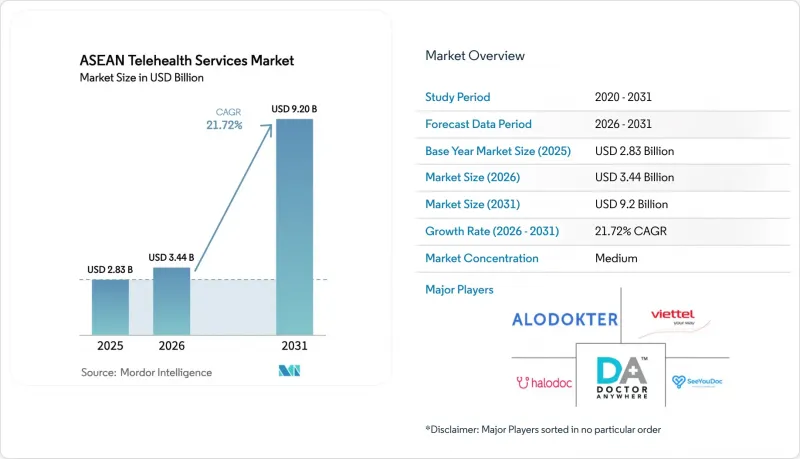
This report is Segmented by Service Type (Remote Patient Monitoring, Real-Time Interactions, Other Services), Mode of Delivery (Cloud-Based, Web-Based, On-Premises), Application Type (e-Consultation, Online Appointment Booking, and More), End User (Providers, Patients, and More), and Geography (Singapore, Indonesia, Vietnam, and More). The Market Forecasts are Provided in Terms of Value (USD).
ASEAN Telehealth Services Market Trends and Insights
Post-COVID Reimbursement Parity and E-Prescription Rules
Unified payment frameworks now place telemedicine on equal footing with in-person visits. Indonesia's Presidential Regulation 59/2024 mandates universal insurance participation, closing historic reimbursement gaps. Thailand's Ministry of Public Health has followed suit, while Vietnam's amended pharmacy law enables direct-to-consumer prescription fulfillment from July 2025. These moves support chronic-care monitoring and open cross-border scaling opportunities under consistent pay-rules.
5G and Broadband Roll-outs Boosting Video Quality and Uptime
Network upgrades eliminate historical bandwidth bottlenecks. Telkomsel aims to complete 1,400 5G base stations across Greater Jakarta by February 2025, posting 227 Mbps averages. Singapore's hybrid 5G trials deliver surgical-grade sub-10 ms latency, while Thailand's urban speeds of 196 Mbps dwarf outer-city rates yet still sustain HD video. Improved connectivity unlocks remote surgery guidance and continuous monitoring. Cambodia's nationwide 5G approval signals the technology's expansion beyond tier-1 markets, creating opportunities for telehealth platforms to penetrate previously underserved rural populations.
Fragmented Regulatory and Data-Residency Requirements
Indonesia's Personal Data Protection Law forces local data hosting, while Malaysia's 2025 PDPA amendments require data-protection officers for large health processors. Vietnam's privacy rules differ again, compelling multi-instance architecture that raises cost and slows regional scaling. Thailand's telemedicine regulations require patient location verification for licensing compliance, creating technical barriers for platforms serving mobile populations or cross-border medical tourists. These fragmented requirements force telehealth companies to develop market-specific solutions rather than leveraging economies of scale across the region.
Other drivers and restraints analyzed in the detailed report include:
- Ageing Population and NCD Burden Raising Chronic-Care Demand
- Surge in Venture-Capital Funding And Insurer Partnerships
- Heightened Cybersecurity / PDPA Compliance Costs
For complete list of drivers and restraints, kindly check the Table Of Contents.
Segment Analysis
Remote patient monitoring represented 33.21% revenue in 2025, the largest slice of the ASEAN telehealth services market. Wearable biosensors now deliver 99% vital-sign accuracy, enabling early deterioration alerts that cut readmissions by 25%. Biofourmis's January 2024 in-home ecosystem shows the shift from single-point devices to integrated care programs. Real-time interactions benefit directly from 5G latency drops below 10 ms, supporting complex remote diagnostics.
The ASEAN telehealth services market size for real-time interactions is poised to grow at a CAGR of 23.11% by 2031 as consumers accept video as default first touch. Platform stickiness rises when monitoring pairs with synchronous visits, creating bundled memberships attractive to insurers seeking outcome-based payment models.
Cloud-hosted platforms held 47.88% share in 2025 as hospital groups migrate data to hyperscale providers; IHH Healthcare moved Malaysia and Singapore records to Oracle Cloud in mid-2024. Web-based tools post a robust 22.31% CAGR, popular in low-bandwidth zones that rely on browser access rather than heavy mobile apps.
Southeast Asia's data center capacity is growing by up to 20% annually, with major technology companies committing billions to enhance cloud infrastructure that supports telehealth scalability. Cloud lets smaller clinics tap AI modules without capital hardware, while on-premises systems persist where legislation enforces strict data sovereignty. The ASEAN Digital Masterplan 2025 emphasizes cloud infrastructure development as essential for regional digital integration, creating supportive policy environments for cloud-based telehealth expansion.
Complete Report Scope:
- By Service Type
- Remote Patient Monitoring
- Real-time Interactions
- Other Services
- By Mode of Delivery
- Cloud-Based
- Web-Based
- On-Premises
- By Application Type
- e-Consultation
- Online Appointment Booking
- Tele-pharmacy / e-Prescription
- Diagnostics and Fitness Monitors
- By End User
- Providers
- Patients
- Payers
- Others
- By Geography
- Singapore
- Indonesia
- Vietnam
- Thailand
- Philippines
- Malaysia
- Rest of ASEAN
List of Companies Covered in this Report:
- Doctor Anywhere
- Halodoc
- Alodokter
- MyDoc
- Speedoc
- WhiteCoat
- Viettel Digital Health
- Doctor Raksa
- Good Doctor Technology / GrabHealth
- SeeYouDoc
- HealthNow
- KonsultaMD
- BookDoc
- Ooca
- mClinica
- Biofourmis
- Telkomsel Health
- Jio Health (Vietnam)
- Medifi
- Teleme Malaysia
- Med247
- Pulse by Prudential
Additional Benefits:
- The market estimate (ME) sheet in Excel format
- 3 months of analyst support
TABLE OF CONTENTS
1 Introduction
- 1.1 Study Assumptions & Market Definition
- 1.2 Scope of the Study
2 Research Methodology
3 Executive Summary
4 Market Landscape
- 4.1 Market Overview
- 4.2 Market Drivers
- 4.2.1 Post-COVID Reimbursement Parity and E-Prescription Rules
- 4.2.2 5G and Broadband Roll-Outs Boosting Video Quality and Uptime
- 4.2.3 Ageing Population and NCD Burden Raising Chronic-Care Demand
- 4.2.4 Surge in Venture Capital Funding and Insurer Partnerships Across ASEAN
- 4.2.5 Cross-Border Medical-Tourism "Virtual Second Opinions"
- 4.2.6 AI-Based Mental-Health Triage Chatbots Proving ROI
- 4.3 Market Restraints
- 4.3.1 Fragmented Regulatory and Data-Residency Requirements
- 4.3.2 Heightened Cybersecurity / PDPA Compliance Costs
- 4.3.3 Inter-Country Physician-Licence Portability Gaps
- 4.3.4 Low Public-Payer Reimbursement Outside Tier-1 Cities
- 4.4 Regulatory Landscape
- 4.5 Technological Outlook
- 4.6 Porter's Five Forces Analysis
- 4.6.1 Threat of New Entrants
- 4.6.2 Bargaining Power of Buyers
- 4.6.3 Bargaining Power of Suppliers
- 4.6.4 Threat of Substitutes
- 4.6.5 Intensity of Competitive Rivalry
5 Market Size & Growth Forecasts (Value)
- 5.1 By Service Type
- 5.1.1 Remote Patient Monitoring
- 5.1.2 Real-time Interactions
- 5.1.3 Other Services
- 5.2 By Mode of Delivery
- 5.2.1 Cloud-Based
- 5.2.2 Web-Based
- 5.2.3 On-Premises
- 5.3 By Application Type
- 5.3.1 e-Consultation
- 5.3.2 Online Appointment Booking
- 5.3.3 Tele-pharmacy / e-Prescription
- 5.3.4 Diagnostics and Fitness Monitors
- 5.4 By End User
- 5.4.1 Providers
- 5.4.2 Patients
- 5.4.3 Payers
- 5.4.4 Others
- 5.5 By Geography
- 5.5.1 Singapore
- 5.5.2 Indonesia
- 5.5.3 Vietnam
- 5.5.4 Thailand
- 5.5.5 Philippines
- 5.5.6 Malaysia
- 5.5.7 Rest of ASEAN
6 Competitive Landscape
- 6.1 Market Concentration
- 6.2 Market Share Analysis
- 6.3 Company Profiles (includes Global level Overview, Market level overview, Core Segments, Financials as available, Strategic Information, Market Rank/Share for key companies, Products & Services, and Recent Developments)
- 6.3.1 Doctor Anywhere
- 6.3.2 Halodoc
- 6.3.3 Alodokter
- 6.3.4 MyDoc
- 6.3.5 Speedoc
- 6.3.6 WhiteCoat
- 6.3.7 Viettel Digital Health
- 6.3.8 Doctor Raksa
- 6.3.9 Good Doctor Technology / GrabHealth
- 6.3.10 SeeYouDoc
- 6.3.11 HealthNow
- 6.3.12 KonsultaMD
- 6.3.13 BookDoc
- 6.3.14 Ooca
- 6.3.15 mClinica
- 6.3.16 Biofourmis
- 6.3.17 Telkomsel Health
- 6.3.18 Jio Health (Vietnam)
- 6.3.19 Medifi
- 6.3.20 Teleme Malaysia
- 6.3.21 Med247
- 6.3.22 Pulse by Prudential
7 Market Opportunities & Future Outlook
- 7.1 White-space & Unmet-Need Assessment

