PUBLISHER: Mordor Intelligence | PRODUCT CODE: 2116859

PUBLISHER: Mordor Intelligence | PRODUCT CODE: 2116859
US Investment Banking - Market Share Analysis, Industry Trends & Statistics, Growth Forecasts (2026 - 2031)
According to Mordor Intelligence, the US investment banking market size is expected to grow from USD 54.74 billion in 2025 to USD 56.68 billion in 2026 and is forecast to reach USD 67.47 billion by 2031 at 3.55% CAGR over 2026-2031.
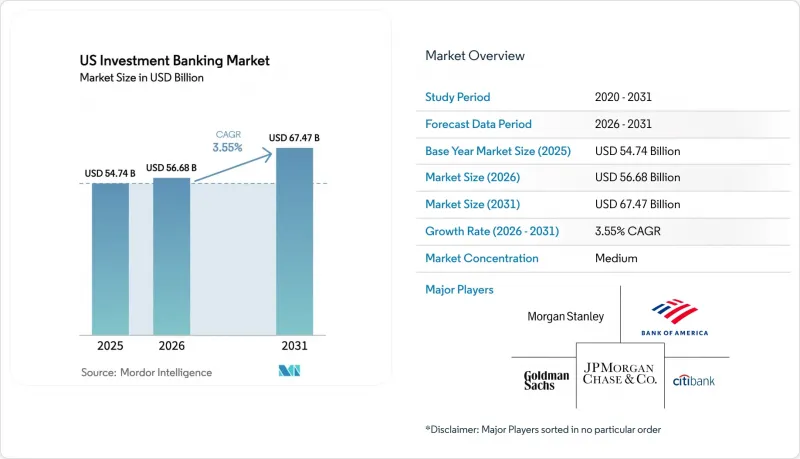
This report is Segmented by Product Type (Mergers and Acquisitions, Debt Capital Markets, Equity Capital Markets, and More), by Deal Size (Mega-Cap, Large-Cap, Mid-Market, Small-Cap), by Client Type (Large Enterprises, Small and Medium-Sized Enterprises), and by Industrial Vertical (BFSI, IT and Telecommunication, Manufacturing, and More). The Market Forecasts are Provided in Terms of Value (USD).
US Investment Banking Market Trends and Insights
Surge in Private-Equity Dry-Powder Driving Sponsor-Led M&A
A record USD 1.6 trillion in uninvested capital is fueling sponsor activity, sustaining fee generation across the US investment banking market despite rate volatility. Sponsors facing deployment deadlines are closing mega-cap transactions that typically command 20-30% higher advisory spreads than corporate combinations. The scale of dry powder is also encouraging club deals, where multiple funds partner on a single target, further increasing fee complexity for advisors. Headline examples include ConocoPhillips' USD 22.5 billion acquisition of Marathon Oil, which required intricate integration plans and bridge financing structures. As these large deals become more common in technology and healthcare, banks with deep sector knowledge and balance-sheet capacity are best positioned to win mandates and protect pricing power in the US investment banking market.
Balance-Sheet Restructuring Amid Higher Rates Boosting Debt Advisory
Policy rates above 5% have raised corporate refinancing costs, driving a surge in demand for liability-management advice. Citigroup's Q4 2024 debt-advisory revenue spike highlights how issuers are leaning on banks to manage maturities and covenant pressure. Companies with upcoming 2025-2026 rollovers are requesting ESG-linked repricings, exchange offers, and hybrid securities that mitigate earnings risk. Banks able to combine derivatives, private-credit placements, and bond issuance in one proposal are capturing a larger wallet share. This environment turns debt advisory into a strategic entry point for cross-selling, supporting overall fee resilience inside the US investment banking market even while new-money deal flow softens.
Elevated Interest Rates Suppressing Leveraged-Finance Volumes
All-in yields topping 8% have rendered many private-equity buyouts uneconomical, forcing sponsors to shelve or resize transactions. Loan desks report thinner order books as traditional CLO investors demand wider spreads to absorb duration and credit risk. In response, banks are downsizing bridge commitments and demanding higher market-flex cushions, dampening underwriting fee potential. Although advisory mandates rise for capital-structure optimization, they seldom match the economics of fully underwritten financings. Until benchmark rates fall or EBITDA multiples reset, leveraged-finance softness will continue to weigh on the US investment banking market's near-term growth.
Other drivers and restraints analyzed in the detailed report include:
- Infrastructure & Energy-Transition Financing Momentum
- IPO Pipeline Rebound in Tech & Healthcare
- Basel III "Endgame" Capital Charges Squeezing Returns
For complete list of drivers and restraints, kindly check the Table Of Contents.
Segment Analysis
Mergers & Acquisitions retained a 40.72% share of the US investment banking market size in 2025. Advisory depth, sector specialization, and sponsor demand keep activity resilient even when capital-market windows narrow. Equity Capital Markets ranks as the fastest riser, projected at 4.74% CAGR, as postponed IPOs and SPAC conversions feed the backlog. Debt Capital Markets faces rate headwinds, yet complex liability-management assignments fetch premium spreads, cushioning revenue declines. Strategically, platforms integrating M&A, private credit, and ECM pitches hold an edge, exemplified by Goldman Sachs' Capital Solutions Group.
Large-cap transactions in the USD 1-5 billion bracket controlled 36.95% share of the US investment banking market size in 2025, but mega-cap deals above USD 5 billion are forecasted to post a 4.31% CAGR, expanding their contribution to the US investment banking market. Bigger deals carry heightened regulatory scrutiny and multi-jurisdictional risk, prompting corporates to hire top-tier advisors such as those coordinating the Capital One-Discover combination. Mid-market activity faces margin compression as AI analytics empower boutiques to compete on price. To protect economics, banks deploy automated diligence, segmenting teams to align resource intensity with potential fees. When mega-cap volumes spike, market size grows disproportionately because headline fees scale non-linearly with consideration value.
Complete Report Scope:
- By Product Type
- Mergers & Acquisitions
- Debt Capital Markets
- Equity Capital Markets
- Syndicated Loans & Others
- By Deal Size
- Mega-cap ( More than USD 5 billion)
- Large-cap (USD 1-5 billion)
- Mid-market (USD 250 million - 1 billion)
- Small-cap (Less than USD 250 million)
- By Client Type
- Large Enterprises
- Small and Medium-sized Enterprises (SMEs)
- By Industry Vertical
- Banking, Financial Services, Insurance (BFSI)
- IT & Telecommunication
- Manufacturing
- Retail And E-Commerce
- Public Sector
- Healthcare And Pharmaceuticals
- Other Industry Verticals
List of Companies Covered in this Report:
- J.P. Morgan Chase & Co.
- Goldman Sachs
- Bank of America
- Morgan Stanley
- Citi
- Barclays
- Credit Suisse
- UBS
- Wells Fargo
- Jefferies
- Evercore
- Lazard
- Houlihan Lokey
- Moelis & Company
- Piper Sandler
- Raymond James
- Stifel
- Baird
- Lincoln International
- Guggenheim Partners
Additional Benefits:
- The market estimate (ME) sheet in Excel format
- 3 months of analyst support
TABLE OF CONTENTS
1 Introduction
- 1.1 Study Assumptions & Market Definition
- 1.2 Scope of the Study
2 Research Methodology
3 Executive Summary
4 Market Landscape
- 4.1 Market Overview
- 4.2 Market Drivers
- 4.2.1 Surge in private-equity dry-powder driving sponsor-led M&A
- 4.2.2 Balance-sheet restructuring amid higher rates boosting debt advisory
- 4.2.3 Infrastructure & energy-transition financing momentum
- 4.2.4 IPO pipeline rebound in tech & healthcare
- 4.2.5 SPAC-to-traditional-deal conversions expanding hybrid fee pools
- 4.2.6 Tokenization of securities opening new fee structures
- 4.3 Market Restraints
- 4.3.1 Elevated interest rates suppressing leveraged-finance volumes
- 4.3.2 Basel III "Endgame" capital charges squeezing returns
- 4.3.3 Private-credit rise disintermediating syndicated loans
- 4.3.4 AI capital-raising platforms eroding mid-market advisory fees
- 4.4 Value / Supply-Chain Analysis
- 4.5 Regulatory Landscape
- 4.6 Technological Outlook
- 4.7 Porter's Five Forces
- 4.7.1 Bargaining Power of Buyers
- 4.7.2 Bargaining Power of Suppliers
- 4.7.3 Threat of New Entrants
- 4.7.4 Threat of Substitutes
- 4.7.5 Intensity of Competitive Rivalry
5 Market Size & Growth Forecasts (Value)
- 5.1 By Product Type
- 5.1.1 Mergers & Acquisitions
- 5.1.2 Debt Capital Markets
- 5.1.3 Equity Capital Markets
- 5.1.4 Syndicated Loans & Others
- 5.2 By Deal Size
- 5.2.1 Mega-cap ( More than USD 5 billion)
- 5.2.2 Large-cap (USD 1-5 billion)
- 5.2.3 Mid-market (USD 250 million - 1 billion)
- 5.2.4 Small-cap (Less than USD 250 million)
- 5.3 By Client Type
- 5.3.1 Large Enterprises
- 5.3.2 Small and Medium-sized Enterprises (SMEs)
- 5.4 By Industry Vertical
- 5.4.1 Banking, Financial Services, Insurance (BFSI)
- 5.4.2 IT & Telecommunication
- 5.4.3 Manufacturing
- 5.4.4 Retail And E-Commerce
- 5.4.5 Public Sector
- 5.4.6 Healthcare And Pharmaceuticals
- 5.4.7 Other Industry Verticals
6 Competitive Landscape
- 6.1 Market Concentration
- 6.2 Strategic Moves
- 6.3 Market Share Analysis
- 6.4 Company Profiles (includes Global Level Overview, Market Level Overview, Core Segments, Financials as available, Strategic Information, Market Rank/Share for Key Companies, Products & Services, and Recent Developments)
- 6.4.1 J.P. Morgan Chase & Co.
- 6.4.2 Goldman Sachs
- 6.4.3 Bank of America
- 6.4.4 Morgan Stanley
- 6.4.5 Citi
- 6.4.6 Barclays
- 6.4.7 Credit Suisse
- 6.4.8 UBS
- 6.4.9 Wells Fargo
- 6.4.10 Jefferies
- 6.4.11 Evercore
- 6.4.12 Lazard
- 6.4.13 Houlihan Lokey
- 6.4.14 Moelis & Company
- 6.4.15 Piper Sandler
- 6.4.16 Raymond James
- 6.4.17 Stifel
- 6.4.18 Baird
- 6.4.19 Lincoln International
- 6.4.20 Guggenheim Partners
7 Market Opportunities & Future Outlook
- 7.1 White-space & Unmet-Need Assessment

