PUBLISHER: Mordor Intelligence | PRODUCT CODE: 2116883

PUBLISHER: Mordor Intelligence | PRODUCT CODE: 2116883
India Battery Swapping For Electric Two-Wheelers - Market Share Analysis, Industry Trends & Statistics, Growth Forecasts (2026 - 2031)
According to Mordor Intelligence, the India battery swapping for electric two-wheelers market size was valued at USD 26.72 million in 2025 and estimated to grow from USD 33.59 million in 2026 to reach USD 105.54 million by 2031, at a CAGR of 25.72% during the forecast period (2026-2031).
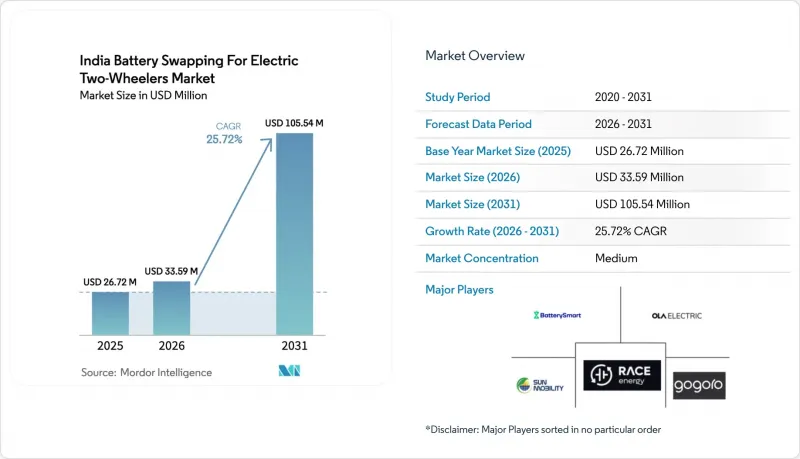
This report is Segmented by Service Model (Pay-Per-Use, and More), Battery Chemistry (Lithium-Ion NMC/NCA, and More), Vehicle Category (Electric Scooters, and More), End User (Personal Commuters, and More), Battery Capacity (Up To 2. 0, 2. 1-3. 0, and More), Swap Station Type (Fixed Cabinet, Mobile Kiosk, and More). The Market Forecasts are Provided in Terms of Value (USD).
India Battery Swapping For Electric Two-Wheelers Market Trends and Insights
Rapid Growth in E-Two-Wheeler Sales Via FAME-II Incentives
PM e-DRIVE was approved on June 26, 2025, with an outlay of ₹10,900 crore for 2024-25 to 2028-29 to support demand incentives for EVs. With the phasing out of previous subsidy schemes, manufacturers are channeling their efforts into innovation and operational efficiency to maintain price competitiveness. Adoption is rising, especially in states like Maharashtra, Karnataka, and Tamil Nadu, which offer extra incentives. This has led to a broader user base, many turning to battery-swapping infrastructure for its convenience and cost benefits.
Declining Li-Ion Costs and Localization of Pack Assembly
India is witnessing a pivotal shift in its battery ecosystem, with domestic production lines poised to commence operations. This transition aims to curtail import dependence, alleviate foreign exchange strains, and trim overall expenses. Lithium iron phosphate (LFP) is gaining traction among battery chemistries, especially for high-usage applications like swapping, due to its extended lifespan and cost-effectiveness compared to other options.
Domestic manufacturing fosters nimble supply chains, facilitating just-in-time deliveries and diminishing the necessity for extensive inventory. Moreover, standardized battery housings for robotic handling enhance operational efficiency. As these efficiencies accumulate, subscription costs are anticipated to decrease, broadening the accessibility of electric mobility and amplifying market reach.
Fire-Safety Incidents Dent Consumer Confidence
Safety concerns loom large over the electric two-wheeler market, especially when incidents gain traction on social media. Even when fires stem from unauthorized aftermarket conversions, the public often generalizes the risk across the entire category.
While regulatory standards like BIS norms provide a framework for safer products, merely adhering to these standards isn't enough to rebuild consumer trust. To reassure price-sensitive buyers and maintain momentum in the shift to electric mobility, it's crucial to ensure consistent safety performance, conduct transparent investigations, and communicate incidents clearly.
Other drivers and restraints analyzed in the detailed report include:
- Draft Battery Swapping Policy Enabling Interoperability
- BIS Safety Standards Unlocking Financing and Insurance
- Import-Dependent Cell Supply Exposed to Geo-Political Risk
For complete list of drivers and restraints, kindly check the Table Of Contents.
Segment Analysis
Subscription plans increased their footprint even though the Pay-Per-Use option retained 42.80% of 2025 revenue. Commercial fleets value fixed monthly outlays and off-balance-sheet treatment, helping the subscription segment log a forecast 27.36% CAGR. Hero MotoCorp's July 2025 VIDA VX2 launch separates chassis and battery financing, showcasing OEM agility in serving gig-economy clients.
Subscription contracts convert capex into opex, mitigating the 30-40% battery cost that often stalls purchases. Tiered plans from Battery Smart align pricing with daily-kilometer bands, ensuring fleets avoid overpaying during slack demand. Predictable revenue streams lower lenders' risk, reducing interest burdens. Individual commuters still lean toward Pay-Per-Use to avoid fixed commitments, while fleet-leasing hybrids fill mid-tenure niches.
Lithium-ion NMC/NCA held 62.40% share in 2025, yet LFP's 27.70% CAGR suggests the safety-value trade-off tilts in its favor. LFP's 3,000-5,000 cycle life pairs naturally with high-throughput swapping, and inherent thermal stability curbs fire risks, a vital reputation safeguard.
OEM moves validate the shift: Ola Electric's Gen 3 platform pivots to LFP, while domestic cell lines favor iron-phosphate chemistry due to raw-material availability. The India battery swapping for electric two-wheelers market size tied to LFP packs is forecast to close the gap with NMC by 2031 as vertical integration compresses pack costs. Lead-acid persists only in low-speed, sub-25 km/h vehicles, a niche eroding fast as lithium prices fall.
Complete Report Scope:
- By Service Model
- Pay-Per-Use
- Subscription
- Fleet Leasing (Long-Term)
- By Battery Chemistry
- Lithium-ion (NMC/NCA)
- Lithium-ion (LFP)
- Lead-acid
- By Vehicle Category
- Electric Scooters
- Electric Motorcycles
- Electric Mopeds
- By End User
- Personal Commuters
- Gig-Economy Delivery Fleets
- Ride-Sharing / Subscription Platforms
- By Battery Capacity (kWh)
- Up to 2.0
- 2.1-3.0
- 3.1-5.0
- Above 5.0
- By Swap Station Type
- Fixed Cabinet
- Mobile Kiosk
- Fully-Automated Robotic
- Retail-Outlet Integrated (Battery ATM)
List of Companies Covered in this Report:
- SUN Mobility
- Upgrid Solutions Private Limited (Battery Smart)
- Ola Electric Mobility Limited
- RACE Energy Ltd.
- Lithion Power Private Limited
- VoltUp Mobility Pvt. Ltd.
- Esmito Solutions Pvt. Ltd.
- Numocity Technologies Pvt. Ltd.
- Charge-up Mobility Pvt. Ltd.
- Okaya Power Group
- Bounce Infinity
- Yulu Bikes Pvt. Ltd.
- Gogoro
- Hero MotoCorp Ltd.
- Kinetic Green Energy and Power Solutions Ltd.
- Ampere Vehicles Pvt. Ltd.
- Exide Industries Ltd.
- Bharat Petroleum Corporation Ltd. (BPCL)
- Indian Oil Corporation Ltd. (IOCL)
- Zypp Electric Pvt. Ltd.
- eBikeGo Mobility Pvt. Ltd.
Additional Benefits:
- The market estimate (ME) sheet in Excel format
- 3 months of analyst support
TABLE OF CONTENTS
1 Introduction
- 1.1 Study Assumptions and Market Definition
- 1.2 Scope of the Study
2 Research Methodology
3 Executive Summary
4 Market Landscape
- 4.1 Market Overview
- 4.2 Market Drivers
- 4.2.1 Rapid Growth in E-Two-Wheeler Sales Via FAME-II Incentives
- 4.2.2 Draft Battery Swapping Policy Enabling Interoperability
- 4.2.3 VC and OMC Investments Accelerating Swap Station Roll-Out
- 4.2.4 High-Utilization Gig-Economy Demand for Near-Zero Downtime
- 4.2.5 Declining Li-Ion Costs and Localization of Pack Assembly
- 4.2.6 BIS Safety Standards Unlocking Financing and Insurance
- 4.3 Market Restraints
- 4.3.1 Fragmented Battery Form-Factors Hinder Interoperability
- 4.3.2 Uncertain GST On Battery-as-a-Service Revenues
- 4.3.3 Fire-Safety Incidents Dent Consumer Confidence
- 4.3.4 Import-Dependent Cell Supply Exposed to Geo-Political Risk
- 4.4 Value / Supply-Chain Analysis
- 4.5 Regulatory Landscape
- 4.6 Technological Outlook
- 4.7 Porter's Five Forces
- 4.7.1 Threat of New Entrants
- 4.7.2 Bargaining Power of Buyers/Consumers
- 4.7.3 Bargaining Power of Suppliers
- 4.7.4 Threat of Substitute Products
- 4.7.5 Intensity of Competitive Rivalry
5 Market Size and Growth Forecasts (Value, USD)
- 5.1 By Service Model
- 5.1.1 Pay-Per-Use
- 5.1.2 Subscription
- 5.1.3 Fleet Leasing (Long-Term)
- 5.2 By Battery Chemistry
- 5.2.1 Lithium-ion (NMC/NCA)
- 5.2.2 Lithium-ion (LFP)
- 5.2.3 Lead-acid
- 5.3 By Vehicle Category
- 5.3.1 Electric Scooters
- 5.3.2 Electric Motorcycles
- 5.3.3 Electric Mopeds
- 5.4 By End User
- 5.4.1 Personal Commuters
- 5.4.2 Gig-Economy Delivery Fleets
- 5.4.3 Ride-Sharing / Subscription Platforms
- 5.5 By Battery Capacity (kWh)
- 5.5.1 Up to 2.0
- 5.5.2 2.1-3.0
- 5.5.3 3.1-5.0
- 5.5.4 Above 5.0
- 5.6 By Swap Station Type
- 5.6.1 Fixed Cabinet
- 5.6.2 Mobile Kiosk
- 5.6.3 Fully-Automated Robotic
- 5.6.4 Retail-Outlet Integrated (Battery ATM)
6 Competitive Landscape
- 6.1 Market Concentration
- 6.2 Strategic Moves
- 6.3 Market Share Analysis
- 6.4 Company Profiles (Includes Global level Overview, Market level overview, Core Segments, Financials as available, Strategic Information, Market Rank/Share for key companies, Products & Services, and Recent Developments)
- 6.4.1 SUN Mobility
- 6.4.2 Upgrid Solutions Private Limited (Battery Smart)
- 6.4.3 Ola Electric Mobility Limited
- 6.4.4 RACE Energy Ltd.
- 6.4.5 Lithion Power Private Limited
- 6.4.6 VoltUp Mobility Pvt. Ltd.
- 6.4.7 Esmito Solutions Pvt. Ltd.
- 6.4.8 Numocity Technologies Pvt. Ltd.
- 6.4.9 Charge-up Mobility Pvt. Ltd.
- 6.4.10 Okaya Power Group
- 6.4.11 Bounce Infinity
- 6.4.12 Yulu Bikes Pvt. Ltd.
- 6.4.13 Gogoro
- 6.4.14 Hero MotoCorp Ltd.
- 6.4.15 Kinetic Green Energy and Power Solutions Ltd.
- 6.4.16 Ampere Vehicles Pvt. Ltd.
- 6.4.17 Exide Industries Ltd.
- 6.4.18 Bharat Petroleum Corporation Ltd. (BPCL)
- 6.4.19 Indian Oil Corporation Ltd. (IOCL)
- 6.4.20 Zypp Electric Pvt. Ltd.
- 6.4.21 eBikeGo Mobility Pvt. Ltd.
7 Market Opportunities & Future Outlook

