PUBLISHER: Mordor Intelligence | PRODUCT CODE: 2116908

PUBLISHER: Mordor Intelligence | PRODUCT CODE: 2116908
Europe Offshore Energy - Market Share Analysis, Industry Trends & Statistics, Growth Forecasts (2026 - 2031)
According to Mordor Intelligence, europe offshore energy market size in 2026 is estimated at 54.18 gigawatt, growing from 2025 value of 45.10 gigawatt with 2031 projections showing 135.79 gigawatt, growing at 20.16% CAGR over 2026-2031.
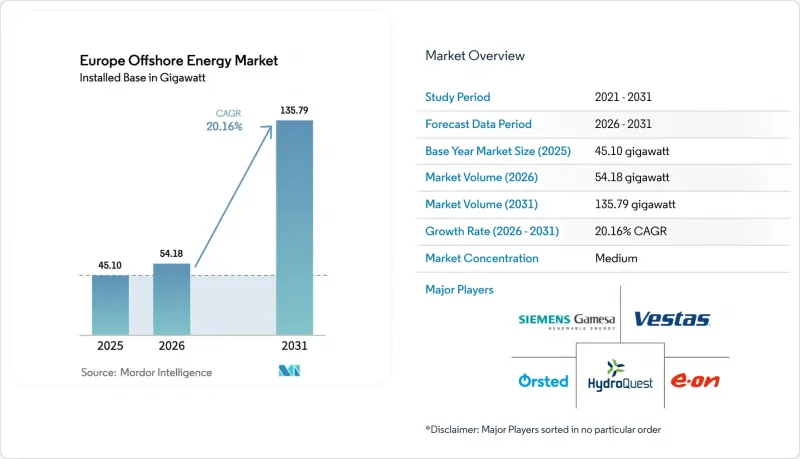
This report is Segmented by Technology (Wind Energy, Tidal and Wave Energy, Ocean Thermal Energy Conversion, and Other Technologies), Water Depth (0 To 30 M, 30 To 60 M, and Others), Capacity Rating (Up To 5 MW, 5 To 10 MW, 10 To 15 MW, and Above 15 MW), and Geography (United Kingdom, Germany, Netherlands, Denmark, Norway, France, Belgium, Sweden, Ireland, and Rest of Europe).
Europe Offshore Energy Market Trends and Insights
EU Green Deal-Driven Capacity Targets & National Offshore Auctions
Binding Green Deal legislation has set an 86-89 GW offshore target for 2030 and 356-366 GW for 2050, triggering a pan-European cascade of national auction calendars that give developers long-range visibility into seabed leases, CfD strike prices, and grid connections. France plans 10 GW of tenders by 2035, while Denmark's latest round could power the nation's electricity demand. Hornsea 3 in UK waters secured a GBP 37.35/MWh inflation-indexed CfD, demonstrating how policy certainty compresses financing costs and lowers bid pricing. Coupled with the REPowerEU "Accele-RES" digital permitting platform and the European Wind Charter signed by 26 countries, administrative bottlenecks are easing, evidenced by more than 20 competitive auctions across Europe in 2024 that collectively allocated over 55 GW of capacity.
Rapid Cost Declines in Above 15 MW Turbines Enabling Deep-Water Projects
Commercial orders for 15 MW platforms, such as Vestas' nod for Germany's Nordlicht 1, illustrate that turbine scaling has crossed from prototype to bankable product class. These machines push capacity factors toward 70% in steady North Sea wind regimes and reduce foundation counts by up to 40% compared with 8 MW layouts, cutting installed cost per megawatt even after factoring recent steel volatility. Forward pipelines already feature 20 MW prototypes from European and Asian OEMs, indicating an entrenched trend. The remaining friction point lies with installation logistics: only a handful of jack-ups can manage nacelles weighing more than 1,200 tons, so shipbuilders must accelerate newbuild cycles over the next three years to prevent execution lags.
Limited Heavy-Lift Vessel Availability for Next-Gen Turbines
Only 15-20 heavy-lift units worldwide can erect above 15 MW turbines, and day rates jumped 75% between 2022 and 2024, echoing the tight LNG carrier market a decade ago. Developers with legacy charters-Orsted, RWE, Vattenfall-have locked in multiyear slots, leaving newer entrants to scramble or delay. Financing a newbuild costs USD 400 million and can take three years; cumulative capex of USD 14.8 billion is needed to bridge the fleet gap. Until then, schedule slips risk eroding auction bid economics, especially in emerging markets like Spain, where floating pilots hinge on vessel availability.
Other drivers and restraints analyzed in the detailed report include:
- Green Hydrogen (Power-to-X) Demand for Offshore Wind Integration
- Commercialisation of Floating Wind Unlocking Atlantic & Med Sites
- Supply-Chain Inflation in Steel & Rare-Earth Components
For complete list of drivers and restraints, kindly check the Table Of Contents.
Segment Analysis
Wind energy accounted for 82.60% of the European offshore energy market size in 2025 and is pacing a 21.34% CAGR through 2031, far outstripping tidal and wave pilots that remain pre-commercial. Despite recent input inflation, its installed base benefits from two decades of learning curves, bankable performance histories, and fully amortised supply chains that drive down per-unit costs. The wider policy ecosystem anchors its lead: North Sea states align seabed grants with dedicated grid build-outs, while developers secure CfDs at sub-40 EUR/MWh prices that keep merchant exposure low. Though technically promising in Atlantic gateways, tidal and wave technology still confront higher levelized costs and limited OEM competition; demonstration units such as Magallanes Renovables' floating tidal platform post 45% capacity factors but lack the multi-sourcing that de-risks procurement. Ocean Thermal Energy Conversion projects remain confined to warmer equatorial waters, leaving European waters outside their economically viable envelope. Consequently, the European offshore energy market continues to channel the vast majority of capital toward wind build-outs, cementing its prominence through 2031.
The spread of technology also reveals an accelerating pivot to floating sub-segments within wind. Spain, France, and Portugal are aligning industrial roadmaps with floating prototypes that marry serial hull fabrication techniques to modular topside assemblies, aiming at sub-100 EUR/MWh price points by mid-decade. These cost curves rely on standardised anchor systems and lightweight composite blades that mitigate port draft constraints. Wave and tidal advocates nonetheless draw policy attention for grid-balancing attributes: multiple governments now include technology-neutral innovation pots in auction designs, offering floor revenues that could lift niche renewables to 5% market share after 2030. Until then, wind remains the default investment choice, supported by mature O&M contracting structures and insurance products that protect lenders from weather-related downtime.
Complete Report Scope:
- By Technology
- Wind Energy
- Tidal and Wave Energy
- Ocean Thermal Energy Conversion (OTEC)
- Other Technologies
- By Water Depth
- 0 to 30 m (Shallow)
- 30 to 60 m (Transitional)
- Above 60 m (Deep-water)
- By Installation Type (Qualitative analysis only)
- Fixed Foundation (includes Monopile, Jacket, Gravity-based)
- Floating Platform (Semi-submersible, Spar-Buoy, Tension-Leg Platform)
- By Component (Qualitative analysis only)
- Turbine
- Substructure and Foundation
- Electrical Infrastructure
- Sub-sea Cables
- Mooring and Anchoring Systems
- Control and Monitoring
- By Capacity Rating (Turbine Output)
- Up to 5 MW
- 5 to 10 MW
- 10 to 15 MW
- Above 15 MW
- By Geography
- United Kingdom
- Germany
- Netherlands
- Denmark
- Norway
- France
- Belgium
- Sweden
- Ireland
- Rest of Europe
List of Companies Covered in this Report:
- Siemens Gamesa Renewable Energy SA
- Vestas Wind Systems AS
- GE Vernova (GE Renewable Energy)
- Nordex SE
- HydroQuest
- MHI Vestas Offshore Wind
- Hitachi Energy
- Orsted AS
- SSE Renewables
- Equinor ASA
- Iberdrola SA
- RWE Renewables GmbH
- EDF Renewables
- E.ON SE
- Copenhagen Infrastructure Partners
- Ocean Winds (EDP x Engie)
- TotalEnergies Renewables
- Shell New Energies
- Statkraft AS
- Northland Power Inc.
Additional Benefits:
- The market estimate (ME) sheet in Excel format
- 3 months of analyst support
TABLE OF CONTENTS
1 Introduction
- 1.1 Study Assumptions & Market Definition
- 1.2 Scope of the Study
2 Research Methodology
3 Executive Summary
4 Market Landscape
- 4.1 Market Overview
- 4.2 Offshore Energy Installed Capacity Analysis & Forecast (GW)
- 4.3 Market Drivers
- 4.3.1 EU Green Deal-Driven Capacity Targets & National Offshore Auctions
- 4.3.2 Rapid Cost Declines in Above 15 MW Turbines Enabling Deep-Water Projects
- 4.3.3 Oil & Gas Platform Electrification & Decarbonisation Mandates
- 4.3.4 Green Hydrogen (Power-to-X) Demand for Offshore Wind Integration
- 4.3.5 Offshore Grid Interconnection & OFTO/HVDC Tender Pipeline
- 4.3.6 Commercialisation of Floating Wind Unlocking Atlantic & Med Sites
- 4.4 Market Restraints
- 4.4.1 Limited Heavy-Lift Vessel Availability for Next-Gen Turbines
- 4.4.2 Lengthy Permitting & Coastal Visual-Impact Opposition
- 4.4.3 Supply-Chain Inflation in Steel & Rare-Earth Components
- 4.4.4 Offshore Grid Congestion & Limited On-shore Landing Points
- 4.5 Supply-Chain Analysis
- 4.6 Regulatory Landscape
- 4.7 Technological Outlook
- 4.8 Porter's Five Forces Analysis
- 4.8.1 Bargaining Power of Suppliers
- 4.8.2 Bargaining Power of Buyers
- 4.8.3 Threat of New Entrants
- 4.8.4 Threat of Substitutes
- 4.8.5 Intensity of Competitive Rivalry
5 Market Size & Growth Forecasts
- 5.1 By Technology
- 5.1.1 Wind Energy
- 5.1.2 Tidal and Wave Energy
- 5.1.3 Ocean Thermal Energy Conversion (OTEC)
- 5.1.4 Other Technologies
- 5.2 By Water Depth
- 5.2.1 0 to 30 m (Shallow)
- 5.2.2 30 to 60 m (Transitional)
- 5.2.3 Above 60 m (Deep-water)
- 5.3 By Installation Type (Qualitative analysis only)
- 5.3.1 Fixed Foundation (includes Monopile, Jacket, Gravity-based)
- 5.3.2 Floating Platform (Semi-submersible, Spar-Buoy, Tension-Leg Platform)
- 5.4 By Component (Qualitative analysis only)
- 5.4.1 Turbine
- 5.4.2 Substructure and Foundation
- 5.4.3 Electrical Infrastructure
- 5.4.4 Sub-sea Cables
- 5.4.5 Mooring and Anchoring Systems
- 5.4.6 Control and Monitoring
- 5.5 By Capacity Rating (Turbine Output)
- 5.5.1 Up to 5 MW
- 5.5.2 5 to 10 MW
- 5.5.3 10 to 15 MW
- 5.5.4 Above 15 MW
- 5.6 By Geography
- 5.6.1 United Kingdom
- 5.6.2 Germany
- 5.6.3 Netherlands
- 5.6.4 Denmark
- 5.6.5 Norway
- 5.6.6 France
- 5.6.7 Belgium
- 5.6.8 Sweden
- 5.6.9 Ireland
- 5.6.10 Rest of Europe
6 Competitive Landscape
- 6.1 Market Concentration
- 6.2 Strategic Moves (M&A, Partnerships, PPAs)
- 6.3 Market Share Analysis (Market Rank/Share for key companies)
- 6.4 Company Profiles (includes Global level Overview, Market level overview, Core Segments, Financials as available, Strategic Information, Products & Services, and Recent Developments)
- 6.4.1 Siemens Gamesa Renewable Energy SA
- 6.4.2 Vestas Wind Systems AS
- 6.4.3 GE Vernova (GE Renewable Energy)
- 6.4.4 Nordex SE
- 6.4.5 HydroQuest
- 6.4.6 MHI Vestas Offshore Wind
- 6.4.7 Hitachi Energy
- 6.4.8 Orsted AS
- 6.4.9 SSE Renewables
- 6.4.10 Equinor ASA
- 6.4.11 Iberdrola SA
- 6.4.12 RWE Renewables GmbH
- 6.4.13 EDF Renewables
- 6.4.14 E.ON SE
- 6.4.15 Copenhagen Infrastructure Partners
- 6.4.16 Ocean Winds (EDP x Engie)
- 6.4.17 TotalEnergies Renewables
- 6.4.18 Shell New Energies
- 6.4.19 Statkraft AS
- 6.4.20 Northland Power Inc.
7 Market Opportunities & Future Outlook
- 7.1 White-Space & Unmet-Need Assessment

