PUBLISHER: Mordor Intelligence | PRODUCT CODE: 2116911

PUBLISHER: Mordor Intelligence | PRODUCT CODE: 2116911
Road Safety - Market Share Analysis, Industry Trends & Statistics, Growth Forecasts (2026 - 2031)
According to Mordor Intelligence, the road safety market size is expected to grow from USD 5.14 billion in 2025 to USD 5.71 billion in 2026 and is forecast to reach USD 9.66 billion by 2031 at 11.09% CAGR over 2026-2031.
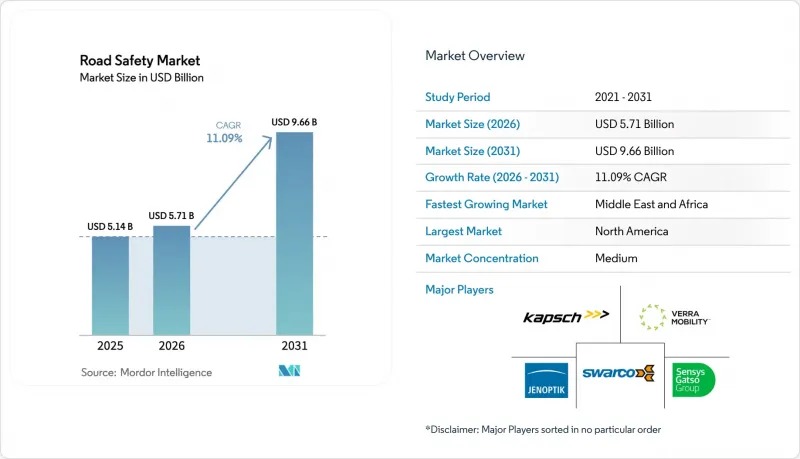
This report is Segmented by Solution (Red-Light Enforcement, Speed Enforcement, and More), Component (Hardware, Software, Services), Enforcement Type (Fixed Systems, Mobile/In-Vehicle Systems, and More), System Type (ALPR/ANPR Systems, Automatic Incident-Detection, and More), End-User (Municipal and Urban Road Authorities, and More), and by Geography. The Market Forecasts are Provided in Terms of Value (USD).
Global Road Safety Market Trends and Insights
EU 2030 enforcement-camera mandates drive equipment refresh
Mandatory advanced safety provisions effective July 2024 have forced European municipalities to overhaul legacy cameras and connect them with intelligent speed assistance and emergency-braking systems. Prague's AI-enabled traffic control rollout by Yunex Traffic shows how enforcement assets migrate toward platform-based, predictive ecosystems. Cross-border suppliers have standardized on EU-compliant firmware, pushing similar refresh programs into export markets. Contract structures are shifting from one-off hardware sales to 7- to 10-year managed-service agreements that lock in analytics subscriptions and cybersecurity updates
Vision Zero plans propel U.S. speed-management budgets
The USD 5 billion Safe Streets and Roads for All grant and USD 96 million in advanced technology awards have re-directed city budgets from reactive citation models to data-driven speed management. Oakland, San Francisco, and New York City have contracted Verra Mobility for turnkey speed-safety programs, specifying performance clauses tied to collision-reduction metrics. This guaranteed outcome model incentivizes vendors to bundle AI analytics, sensor calibration, and cloud evidence management in a single service stack.
GDPR and CCPA data-retention limits on enforcement cameras
Meta's EUR 1.2 billion (USD 1.296 billion) fine in 2025 underscored regulatory willingness to penalize non-compliance. Road safety operators must now build local processing nodes, avoid cross-border evidence storage, and automate deletion routines that sometimes conflict with evidentiary-chain rules. Compliance overhead tilts the playing field toward multinationals with in-house legal, security, and DevSecOps resources.
Other drivers and restraints analyzed in the detailed report include:
- China ITS upgrade fund accelerates ANPR rollout
- India Bharatmala II highway safety corridors
- High capex for AI multi-sensor systems in LMICs
For complete list of drivers and restraints, kindly check the Table Of Contents.
Segment Analysis
Red-light systems retained a 29.65% road safety market share in 2025, indicating that intersection protection remains foundational to municipal safety strategies. However, the corridor-based approach propelled Section/Average-Speed Enforcement to a 12.35% CAGR, demonstrating that continuous driver behavior modulation outperforms point-specific deterrence. That momentum is reinforced by national speed-harm studies feeding Vision Zero dashboards in the United States and speed-camera networks in France. The road safety market size attached to corridor monitoring is projected to expand faster than legacy intersection programs, incentivizing suppliers to bundle radar, lidar, and ALPR across contiguous segments.
The pivot from reactive ticketing to proactive analytics is reshaping revenue mechanics. Agencies now score bidders on crash-reduction forecasts, demanding configurable AI models that adapt to evolving traffic patterns. Vendors capable of integrating violation, congestion, and green-wave metrics into unified dashboards secure higher recurring fees and longer support contracts, mitigating lump-sum hardware margins.
Hardware still dominated 54.85% of the road safety market size in 2025 due to camera, radar, and sensor procurement cycles. Yet software's 10.8% CAGR signals that analytic layers, not steel and silicon, now dictate competitive differentiation. Cloud-native modules provide real-time edge processing, video redaction for GDPR, and fleet-operator APIs, enabling cities to pivot swiftly when grant stipulations evolve. ISS's IntelliSection embeds computer-vision algorithms that triage intersection conflicts and recommend optimal phasing without civil-works upgrades.
Services revenue, anchored by 24X7 monitoring and KPI compliance reporting, climbs steadily as agencies outsource upkeep to contain payroll overhead. This services glide path erodes traditional pay-per-citation dependencies and drives multipliers on installed base valuation during M&A due diligence.
Complete Report Scope:
- By Solution
- Red-Light Enforcement
- Speed Enforcement
- Section / Average-Speed Enforcement
- Bus-Lane Enforcement
- Incident Detection and Response
- By Component
- Hardware
- Software
- Services
- By Enforcement Type
- Fixed Systems
- Mobile / In-Vehicle Systems
- Portable / Tripod Systems
- By System Type
- ALPR / ANPR Systems
- Automatic Incident-Detection (AID)
- Intersection-Safety Cameras
- Variable Message / Warning Signs
- By End-User
- Municipal and Urban Road Authorities
- National Highway Agencies
- Law-Enforcement and Police Departments
- Toll-Road / Concession Operators
- Commercial Fleet Operators
- By Geography
- North America
- United States
- Canada
- Mexico
- South America
- Brazil
- Argentina
- Rest of South America
- Europe
- United Kingdom
- Germany
- France
- Italy
- Spain
- Nordics
- Rest of Europe
- Asia-Pacific
- China
- Japan
- India
- South Korea
- ASEAN
- Australia
- New Zealand
- Rest of Asia-Pacific
- Middle East and Africa
- Middle East
- GCC
- Turkey
- Israel
- Rest of Middle East
- Africa
- South Africa
- Nigeria
- Egypt
- Rest of Africa
- Middle East
- North America
Geography Analysis
North America generated 38.55% of 2025 revenue, buoyed by Vision Zero mandates and USD 60 million worth of federal V2X grants across Arizona, Texas, and Utah highways. The region continues to favor outcome-based procurements, forcing vendors to underwrite performance guarantees and embed continuous-improvement provisions in service-level agreements. Canada's ITS-focused infrastructure bank and Mexico's highway modernization targets extend addressable demand, with NAFTA-wide interoperability requirements driving standards harmonization.
Europe's trajectory remains steady as the 2019/2144 regulation orchestrates synchronized refresh cycles. Privacy and cybersecurity directives are stringent, but they also create export-ready compliance frameworks adopted by Asia and Latin America. Consolidation is accelerating; SWARCO's Elmore Group purchase and Lacroix bid deepen supply-chain verticalization and broaden software stacks. Eastern Europe benefits from EU-funded smart-mobility corridors, expanding TAM without commensurate competitive intensity.
The Middle East and Africa deliver a 12.3% CAGR, the fastest worldwide. Saudi Arabia's NEOM blueprint and UAE's ITS Master Plan roll out smart-city infrastructure unconstrained by legacy assets, letting AI-native platforms leapfrog older systems. African Union safety corridors-such as Kenya's Road Safety Action Plan-attract blended-finance packages that reduce sovereign debt burden, creating predictable pipelines for mid-tier suppliers.
- Kapsch TrafficCom AG
- Jenoptik AG
- Sensys Gatso Group AB
- SWARCO AG
- Verra Mobility Corp.
- Redflex Holdings Ltd.
- FLIR Systems Inc.
- VITRONIC GmbH
- Motorola Solutions Inc.
- Thales Group
- Siemens Mobility
- Cubic Transportation Systems
- Information Engineering Group Inc.
- Clearview Intelligence Ltd.
- Conduent Business Services LLC
- Connected Wise LLC
- Dahua Technology Co. Ltd.
- Hikvision Digital Technology Co.
- Iteris Inc.
- Citilog SA
- AllGoVision Technologies Pvt Ltd.
- FRED Engineering
Additional Benefits:
- The market estimate (ME) sheet in Excel format
- 3 months of analyst support
TABLE OF CONTENTS
1 INTRODUCTION
- 1.1 Study Assumptions and Market Definition
- 1.2 Scope of the Study
2 RESEARCH METHODOLOGY
3 EXECUTIVE SUMMARY
4 MARKET LANDSCAPE
- 4.1 Market Overview
- 4.2 Market Drivers
- 4.2.1 EU 2030 Enforcement-Camera Mandates Drive Equipment Refresh
- 4.2.2 Vision Zero Plans Propel U.S. Municipal Speed-Management Budgets
- 4.2.3 China ITS Upgrade Fund Accelerates ANPR Rollout
- 4.2.4 India Bharatmala II Highway Safety Corridors
- 4.2.5 Smart-City Mega-Projects (e.g., NEOM) Adopt AI Road-Safety Analytics
- 4.2.6 Insurance Fleet Telematics Partnerships Boost Video-Analytics Adoption
- 4.3 Market Restraints
- 4.3.1 GDPR and CCPA Data-Retention Limits on Enforcement Cameras
- 4.3.2 High Capex for AI Multi-Sensor Systems in LMICs
- 4.3.3 Litigation Push-back on Automated Speed Enforcement
- 4.3.4 Cyber-Vulnerability in Road-side IoT Sensors
- 4.4 Value / Supply-Chain Analysis
- 4.5 Regulatory or Technological Outlook
- 4.6 Porter's Five Forces
- 4.6.1 Bargaining Power of Suppliers
- 4.6.2 Bargaining Power of Buyers
- 4.6.3 Threat of New Entrants
- 4.6.4 Threat of Substitutes
- 4.6.5 Intensity of Competitive Rivalry
- 4.7 Traffic-Infrastructure Investment Outlook
- 4.8 Traffic-Congestion Ranking Analysis
5 MARKET SIZE AND GROWTH FORECASTS (VALUE)
- 5.1 By Solution
- 5.1.1 Red-Light Enforcement
- 5.1.2 Speed Enforcement
- 5.1.3 Section / Average-Speed Enforcement
- 5.1.4 Bus-Lane Enforcement
- 5.1.5 Incident Detection and Response
- 5.2 By Component
- 5.2.1 Hardware
- 5.2.2 Software
- 5.2.3 Services
- 5.3 By Enforcement Type
- 5.3.1 Fixed Systems
- 5.3.2 Mobile / In-Vehicle Systems
- 5.3.3 Portable / Tripod Systems
- 5.4 By System Type
- 5.4.1 ALPR / ANPR Systems
- 5.4.2 Automatic Incident-Detection (AID)
- 5.4.3 Intersection-Safety Cameras
- 5.4.4 Variable Message / Warning Signs
- 5.5 By End-User
- 5.5.1 Municipal and Urban Road Authorities
- 5.5.2 National Highway Agencies
- 5.5.3 Law-Enforcement and Police Departments
- 5.5.4 Toll-Road / Concession Operators
- 5.5.5 Commercial Fleet Operators
- 5.6 By Geography
- 5.6.1 North America
- 5.6.1.1 United States
- 5.6.1.2 Canada
- 5.6.1.3 Mexico
- 5.6.2 South America
- 5.6.2.1 Brazil
- 5.6.2.2 Argentina
- 5.6.2.3 Rest of South America
- 5.6.3 Europe
- 5.6.3.1 United Kingdom
- 5.6.3.2 Germany
- 5.6.3.3 France
- 5.6.3.4 Italy
- 5.6.3.5 Spain
- 5.6.3.6 Nordics
- 5.6.3.7 Rest of Europe
- 5.6.4 Asia-Pacific
- 5.6.4.1 China
- 5.6.4.2 Japan
- 5.6.4.3 India
- 5.6.4.4 South Korea
- 5.6.4.5 ASEAN
- 5.6.4.6 Australia
- 5.6.4.7 New Zealand
- 5.6.4.8 Rest of Asia-Pacific
- 5.6.5 Middle East and Africa
- 5.6.5.1 Middle East
- 5.6.5.1.1 GCC
- 5.6.5.1.2 Turkey
- 5.6.5.1.3 Israel
- 5.6.5.1.4 Rest of Middle East
- 5.6.5.2 Africa
- 5.6.5.2.1 South Africa
- 5.6.5.2.2 Nigeria
- 5.6.5.2.3 Egypt
- 5.6.5.2.4 Rest of Africa
- 5.6.5.1 Middle East
- 5.6.1 North America
6 COMPETITIVE LANDSCAPE
- 6.1 Market Concentration
- 6.2 Strategic Moves
- 6.3 Market Share Analysis
- 6.4 Company Profiles (includes Global level Overview, Market level overview, Core Segments, Financials as available, Strategic Information, Market Rank/Share for key companies, Products and Services, and Recent Developments)
- 6.4.1 Kapsch TrafficCom AG
- 6.4.2 Jenoptik AG
- 6.4.3 Sensys Gatso Group AB
- 6.4.4 SWARCO AG
- 6.4.5 Verra Mobility Corp.
- 6.4.6 Redflex Holdings Ltd.
- 6.4.7 FLIR Systems Inc.
- 6.4.8 VITRONIC GmbH
- 6.4.9 Motorola Solutions Inc.
- 6.4.10 Thales Group
- 6.4.11 Siemens Mobility
- 6.4.12 Cubic Transportation Systems
- 6.4.13 Information Engineering Group Inc.
- 6.4.14 Clearview Intelligence Ltd.
- 6.4.15 Conduent Business Services LLC
- 6.4.16 Connected Wise LLC
- 6.4.17 Dahua Technology Co. Ltd.
- 6.4.18 Hikvision Digital Technology Co.
- 6.4.19 Iteris Inc.
- 6.4.20 Citilog SA
- 6.4.21 AllGoVision Technologies Pvt Ltd.
- 6.4.22 FRED Engineering
7 MARKET OPPORTUNITIES AND FUTURE OUTLOOK
- 7.1 White-Space and Unmet-Need Assessment

