PUBLISHER: Mordor Intelligence | PRODUCT CODE: 2116953

PUBLISHER: Mordor Intelligence | PRODUCT CODE: 2116953
China BOPP Film - Market Share Analysis, Industry Trends & Statistics, Growth Forecasts (2026 - 2031)
According to Mordor Intelligence, China BOPP film market size in 2026 is estimated at USD 2.12 billion, growing from 2025 value of USD 2.02 billion with 2031 projections showing USD 2.7 billion, growing at 4.96% CAGR over 2026-2031.
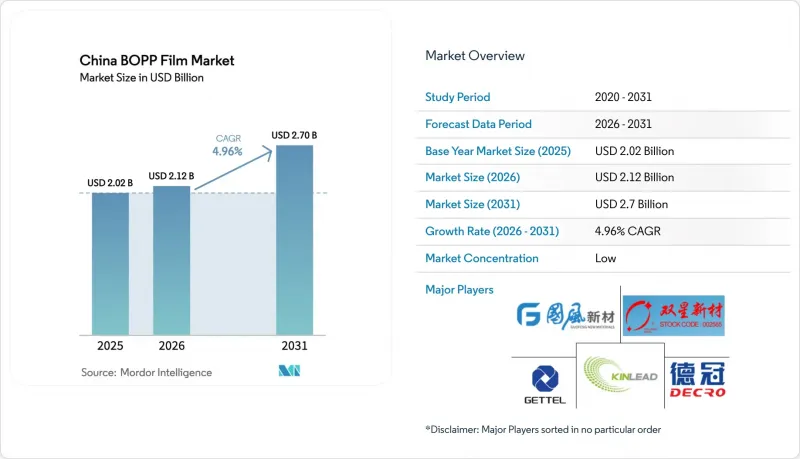
This report is Segmented by Film Type (Transparent, Metallized, Opaque/White, Pearlescent, and More), Thickness (45 Mm), Application (Packaging, Labeling and Wrap-Arounds, and More), End-User Vertical (Food, Beverage, Pharmaceutical and Medical, Personal Care and Cosmetics, and More). The Market Forecasts are Provided in Terms of Value (USD).
China BOPP Film Market Trends and Insights
Surging E-commerce Packaging Demand
Rapid growth of online retail continues to lift shipment volumes for courier bags, mailers and single-serve product packs that favor thin, printable BOPP substrates. Converters serving grocery delivery and pharmaceutical fulfillment increasingly request co-extruded films engineered for low-temperature seal initiation to protect temperature-sensitive goods. Producers reply with 12-15 micron transparent grades that retain puncture resistance while shaving resin use, thereby protecting margins even as freight costs stay elevated. Ink-receptive surface chemistries and improved anti-static packages shorten press setup time, a decisive edge for short-run personalization programs popular on livestream platforms.
Government Push for High-Barrier Food Safety Standards
Implementation of GB 4806.15-2024 for food-contact adhesives compels lamination houses to tighten migration controls and to document every batch of inks, primers and tie-layers. Large-scale China BOPP film market producers have responded by installing multi-layer on-line thickness gauges and investing in ISO 17025-accredited labs so they can issue certificates of analysis within 24 hours. The new rules favor high-barrier metallized and coated grades that extend shelf life under stricter distribution temperatures, especially for ready-to-eat meals and dairy snacks sold via convenience stores.
Volatility in Polypropylene Feedstock Prices
Spot PP resin hovered in a USD 740-755 per-ton band during early 2025, but order lead times shortened to one week as traders hesitated to build stocks amid uncertain macro conditions. Larger China BOPP film market producers now hedge up to 50% of their forward resin requirements under term contracts indexed to China-created benchmarks, while midsize players rely on syndicated purchasing pools to buffer weekly swings. Nonetheless, abrupt spikes can still compress film margins by 300-400 basis points in a single quarter.
Other drivers and restraints analyzed in the detailed report include:
- Shift from PVC to BOPP Labels in Beverages
- Rising Demand for Low-Gauge Cost-Saving Films
- Stringent Single-Use Plastic Waste Regulations
For complete list of drivers and restraints, kindly check the Table Of Contents.
Segment Analysis
Metallized structures accounted for a modest slice of China BOPP film market size in 2025, yet their 6.23% CAGR signals accelerating traction in moisture-sensitive snacks, powdered beverages and over-the-counter medicines. Transparent films still held 39.98% China BOPP film market share in 2025, largely due to their versatility in horizontal form-fill-seal operations. Demand for metallized film rises where <=0.5 g/m2 oxygen transmission rate is non-negotiable, pushing suppliers to retrofit vacuum metallizers with plasma pretreatment for tighter adhesion. Brand owners also embrace clear barrier coatings as an alternative route to see-through, recyclable windows that maintain aluminum-equivalent barrier. The result is a premiumization path where converters secure higher per-kilogram profits while brand owners improve shelf appeal.
Second-generation coated metallized grades now combine half-mirror aesthetics with de-inkable surfaces, unlocking mainstream recyclability under APR guidelines. Pilot projects with beverage closures demonstrate that aluminum deposition as low as 300 angstroms still meets carbonation retention targets, proving viable across high-speed bottling. Multinational snack players structure two-year supply agreements to lock in capacity and reduce exposure to coated PET, signaling confidence that metallized BOPP will continue displacing incumbent substrates in rigid-to-flexible conversions.
The dominant 15-30 micron band retained 36.22% China BOPP film market share in 2025, yet gauges above 45 microns will grow fastest at 5.94% over 2026-2031 on the back of stand-up pouch zippers, retort lids and industrial over-wraps. Producers strategically balance line mixes to capture both ends, dedicating older legacy widths to thin-gauge runs and saving new 10.4-meter assets for high-value thick products where output-per-millimeter is lower but price-per-ton higher. Inline IR cameras integrated with AI-driven feedback loops now deliver +-0.3 micron profiles, an essential requirement for converter uptime.
Demand for sub-12 micron transparent film grows in sachets and micro-pouches, but process windows tighten sharply; thus, only operators with high-precision chill-roll systems and positron thickness modeling can meet defect targets. Conversely, 60-micron oriented insulation tapes for motor windings draw interest from EV manufacturers because of dielectric strength and abrasion resistance. Together these trends illustrate how the China BOPP film market keeps diversifying thickness spectrums to fulfill disparate performance codes rather than converging on a single optimized gauge.
Complete Report Scope:
- By Film Type
- Transparent
- Metallized
- Opaque / White
- Pearlescent
- Other Film Type
- By Thickness
- < 15 µm
- 15 - 30 µm
- 30 - 45 µm
- > 45 µm
- By Application
- Packaging
- Labeling and Wrap-Arounds
- Laminating
- Pressure-Sensitive Tapes
- Other Application
- By End-user Vertical
- Food
- Beverage
- Pharmaceutical and Medical
- Personal Care and Cosmetics
- Industrial
- Other End-user Vertical
List of Companies Covered in this Report:
- Qingdao Kingchuan Packaging Co., Ltd.
- RuiYann Industrial Co., Ltd.
- Zhejiang Haibin Film Technology Co., Ltd.
- Zhejiang Kinlead Innovative Materials Co., Ltd.
- Zhejiang Changyu New Materials Co., Ltd.
- Quanzhou Lichang Plastic Co., Ltd.
- Zhejiang Yimei Film Industry Group Co., Ltd.
- Anhui Guofeng Plastic Industry Co., Ltd.
- Foshan Plastics Group Co., Ltd.
- San-East Group Limited
- Guangdong Decro Film New Materials Co., Ltd.
- Jiangsu Shuangxing Color Plastic New Materials Co., Ltd.
- Sichuan Yongfeng Lingyun Industrial Co., Ltd.
- Shaanxi Huatai Color Film Packaging Co., Ltd.
- Shanghai Brilliant Film Co., Ltd.
- Wenzhou Zhongda Packaging Material Co., Ltd.
- Gettel Group Co., Ltd.
- Yunnan Energy New Material Co., Ltd.
- Nan Ya Plastics Corporation
- Jiangxi Kewei Film New Materials Co., Ltd.
Additional Benefits:
- The market estimate (ME) sheet in Excel format
- 3 months of analyst support
TABLE OF CONTENTS
1 INTRODUCTION
- 1.1 Study Assumptions and Market Definition
- 1.2 Scope of the Study
2 RESEARCH METHODOLOGY
3 EXECUTIVE SUMMARY
4 MARKET LANDSCAPE
- 4.1 Market Overview
- 4.2 Market Drivers
- 4.2.1 Surging e-commerce packaging demand
- 4.2.2 Government push for high-barrier food safety standards
- 4.2.3 Shift from PVC to BOPP labels in beverages
- 4.2.4 Rising demand for low-gauge cost-saving films
- 4.2.5 Expansion of BOPP-based lithium battery separator films
- 4.2.6 Investments in high-speed domestic tenter lines
- 4.3 Market Restraints
- 4.3.1 Volatility in polypropylene feedstock prices
- 4.3.2 Stringent single-use plastic waste regulations
- 4.3.3 Capacity overbuild causing price compression
- 4.3.4 Emerging bio-based film alternatives
- 4.4 Industry Value Chain Analysis
- 4.5 Regulatory Landscape
- 4.6 Technological Outlook
- 4.7 Porter's Five Forces Analysis
- 4.7.1 Threat of New Entrants
- 4.7.2 Bargaining Power of Buyers
- 4.7.3 Bargaining Power of Suppliers
- 4.7.4 Threat of Substitute Products
- 4.7.5 Intensity of Competitive Rivalry
- 4.8 Impact of Macroeconomic Factors on the Market
5 MARKET SIZE AND GROWTH FORECASTS (VALUE)
- 5.1 By Film Type
- 5.1.1 Transparent
- 5.1.2 Metallized
- 5.1.3 Opaque / White
- 5.1.4 Pearlescent
- 5.1.5 Other Film Type
- 5.2 By Thickness
- 5.2.1 < 15 µm
- 5.2.2 15 - 30 µm
- 5.2.3 30 - 45 µm
- 5.2.4 > 45 µm
- 5.3 By Application
- 5.3.1 Packaging
- 5.3.2 Labeling and Wrap-Arounds
- 5.3.3 Laminating
- 5.3.4 Pressure-Sensitive Tapes
- 5.3.5 Other Application
- 5.4 By End-user Vertical
- 5.4.1 Food
- 5.4.2 Beverage
- 5.4.3 Pharmaceutical and Medical
- 5.4.4 Personal Care and Cosmetics
- 5.4.5 Industrial
- 5.4.6 Other End-user Vertical
6 COMPETITIVE LANDSCAPE
- 6.1 Market Concentration
- 6.2 Strategic Moves
- 6.3 Market Share Analysis
- 6.4 Company Profiles (includes Global-level Overview, Market-level Overview, Core Segments, Financials as available, Strategic Information, Market Rank/Share for key companies, Products and Services, and Recent Developments)
- 6.4.1 Qingdao Kingchuan Packaging Co., Ltd.
- 6.4.2 RuiYann Industrial Co., Ltd.
- 6.4.3 Zhejiang Haibin Film Technology Co., Ltd.
- 6.4.4 Zhejiang Kinlead Innovative Materials Co., Ltd.
- 6.4.5 Zhejiang Changyu New Materials Co., Ltd.
- 6.4.6 Quanzhou Lichang Plastic Co., Ltd.
- 6.4.7 Zhejiang Yimei Film Industry Group Co., Ltd.
- 6.4.8 Anhui Guofeng Plastic Industry Co., Ltd.
- 6.4.9 Foshan Plastics Group Co., Ltd.
- 6.4.10 San-East Group Limited
- 6.4.11 Guangdong Decro Film New Materials Co., Ltd.
- 6.4.12 Jiangsu Shuangxing Color Plastic New Materials Co., Ltd.
- 6.4.13 Sichuan Yongfeng Lingyun Industrial Co., Ltd.
- 6.4.14 Shaanxi Huatai Color Film Packaging Co., Ltd.
- 6.4.15 Shanghai Brilliant Film Co., Ltd.
- 6.4.16 Wenzhou Zhongda Packaging Material Co., Ltd.
- 6.4.17 Gettel Group Co., Ltd.
- 6.4.18 Yunnan Energy New Material Co., Ltd.
- 6.4.19 Nan Ya Plastics Corporation
- 6.4.20 Jiangxi Kewei Film New Materials Co., Ltd.
7 MARKET OPPORTUNITIES AND FUTURE OUTLOOK
- 7.1 White-space and Unmet-Need Assessment

