PUBLISHER: Mordor Intelligence | PRODUCT CODE: 2124243

PUBLISHER: Mordor Intelligence | PRODUCT CODE: 2124243
India BOPP Films - Market Share Analysis, Industry Trends & Statistics, Growth Forecasts (2026 - 2031)
According to Mordor Intelligence, the India BOPP films market size is expected to grow from USD 5.78 billion in 2025 to USD 6.05 billion in 2026 and is forecast to reach USD 7.62 billion by 2031 at 4.72% CAGR over 2026-2031.
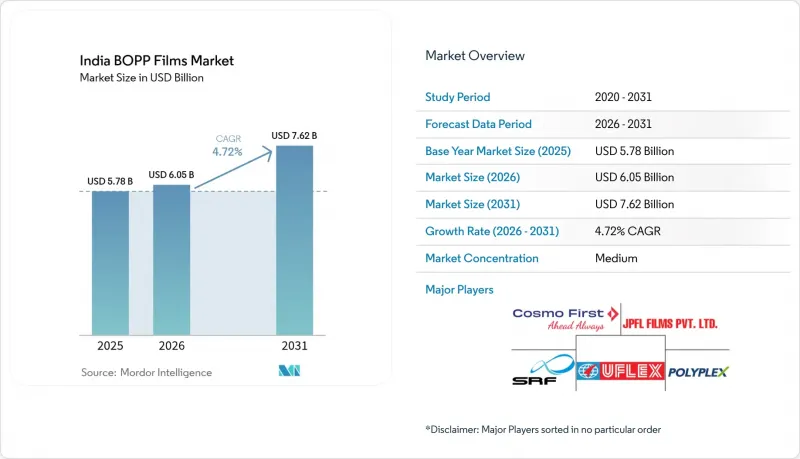
This report is Segmented by End-User Vertical (Flexible Packaging, Industrial, Tapes and Labels, and Other End-User Verticals), Film Type (Transparent/Plain, Metallized, and White/Opaque/Matt, Specialty), Application (Food Packaging, Non-Food Consumer Goods, Industrial Packaging, and Labelling and Wrap-Around), and Geography (India). The Market Forecasts are Provided in Terms of Value (USD).
India BOPP Films Market Trends and Insights
Rapid penetration of packaged and ready-to-eat foods
India's surging processed-food ecosystem is a primary engine for the India BOPP films market. The FMCG sector is expanding retail distribution into tier-2 and tier-3 cities, lifting demand for cost-effective barrier films that lengthen shelf life and boost shelf appeal. Southern states Tamil Nadu, Karnataka, and Andhra Pradesh anchor export-oriented plants requiring high-barrier laminates for overseas shipments. Gen Z shoppers value convenience and aesthetics, so brand owners specify printable, puncture-resistant films with matte finishes. The upshot is rising average selling prices within the India BOPP films market as converters shift toward premium SKUs. Equipment upgrades for faster line speeds and inline coating stations are becoming commonplace to service this growth pocket.
E-commerce boom raising demand for protective mailer films
Online retail growth is fueling a new stream of protective packaging needs, particularly mailers that guard against moisture, abrasion and pilferage during multi-node delivery. Lightweight but tough BOPP envelopes minimize shipping weight yet resist tears better than paper-based alternatives, making them a favorite for apparel and consumer electronics shipments. Converters have rolled out post-consumer-recycled (PCR) grades to align with seller sustainability pledges, unlocking premium margins. Planned mega-ports such as Vadhvan will cut logistics costs and shorten export lead times, positioning domestic producers to supply global e-commerce packaging networks.
Tightening EPR and plastic-waste rules inflating compliance costs
India's EPR framework obliges packaging producers to recycle up to 70% of their plastic footprint by FY 2028, raising operating overhead for film converters. Because fewer than 5% of current recycling units can deliver closed-loop outputs at requisite purity levels, companies are financing new washing lines, digital traceability systems, and audit processes. These expenditures trim industry EBITDA by an estimated 2-4 percentage points and could slow near-term expansion across the India BOPP films market.
Other drivers and restraints analyzed in the detailed report include:
- Shift by FMCG brands toward mono-material flexible packs
- Government PLI and PCPIR incentives for petrochemicals
- Persistent over-capacity pressuring film margins
For complete list of drivers and restraints, kindly check the Table Of Contents.
Segment Analysis
Flexible packaging retained 67.90% of India BOPP films market share in 2025 as snack food, confectionery and personal-care brands favored lightweight rollstock for cost and logistical savings. Within this huge base, the India BOPP films market size for flexible packs is projected to expand modestly as volume growth is balanced by unit-weight light-weighting. Despite commoditization, brand owners increasingly specify matte coatings, anti-fog and cold-seal layers, generating revenue uplift for suppliers capable of rapid grade customization. Tapes and labels constitute the fastest-growing vertical, advancing at a 5.68% CAGR through 2031 amid booming e-commerce shipments, POS-label demand and brand-security applications. Suppliers that mastered top-coat formulation and surface-energy consistency enjoy higher realizations here. Industrial uses such as lamination base film or capacitor dielectrics provide steady volumes but limited margin headroom. Balanced portfolios blending high-volume flexible packs with higher-margin labels help producers navigate the cyclical swings inherent to the India BOPP films industry.
Beyond 2025, converters anticipate a portfolio pivot: commodity plain films will cede share to printable white and coated barrier grades that combine down-gauging with performance retention. In parallel, fast-moving D2C brands are driving niche applications such as tamper-evident courier bags, lifting specialty demand inside the India BOPP films market. To capture this upside, leading producers are investing in wide-width tenter lines coupled with in-line metallizers and high-vacuum coaters, a strategy expected to lift asset utilization and sustain earnings.
Complete Report Scope:
- By End-user Vertical
- Flexible Packaging
- Industrial (Lamination, Adhesive, Capacitor)
- Tapes and Labels
- Other End-user Verticals
- By Film Type
- Transparent/Plain
- Metallized
- White/Opaque/Matt
- Specialty (Barrier, Anti-fog, Heat-seal, Pearlised)
- By Application
- Food Packaging
- Non-Food Consumer Goods
- Industrial Packaging
- Labelling and Wrap-around
List of Companies Covered in this Report:
- Jindal Poly Films Limited
- Cosmo First Limited
- UFlex Limited
- SRF Limited
- Polyplex Corporation Limited
- Vacmet India Limited
- Garware Hi-Tech Films Limited
- Toppan Speciality Films Private Limited
- Chiripal Poly Films Limited
- Ester Industries Limited
- Nahar Poly Films Limited
- Canpac Trends Private Limited
- Manjushree Technopack Limited
Additional Benefits:
- The market estimate (ME) sheet in Excel format
- 3 months of analyst support
TABLE OF CONTENTS
1 INTRODUCTION
- 1.1 Study Assumptions And Market Definition
- 1.2 Scope of the Study
2 RESEARCH METHODOLOGY
3 EXECUTIVE SUMMARY
4 MARKET LANDSCAPE
- 4.1 Market Overview
- 4.2 Market Drivers
- 4.2.1 Rapid penetration of packaged and ready-to-eat foods
- 4.2.2 E-commerce boom raising demand for protective mailer films
- 4.2.3 Shift by FMCG brands toward mono-material flexible packs
- 4.2.4 Government PLI and PCPIR incentives for petrochemicals
- 4.2.5 Brand owner mandates for high-barrier recyclable labels
- 4.2.6 Rising Flexible Packaging Demand Driving Growth in BOPP Film Consumption
- 4.3 Market Restraints
- 4.3.1 Tightening EPR and plastic-waste rules inflating compliance costs
- 4.3.2 Persistent over-capacity pressuring film margins
- 4.3.3 PP feedstock volatility linked to crude swings
- 4.3.4 Port congestion hindering export fulfilment
- 4.4 Industry Value Chain Analysis
- 4.5 Regulatory Landscape
- 4.6 Technological Outlook
- 4.7 Porter's Five Forces Analysis
- 4.7.1 Threat of New Entrants
- 4.7.2 Bargaining Power of Buyers/Consumers
- 4.7.3 Bargaining Power of Suppliers
- 4.7.4 Threat of Substitute Products
- 4.7.5 Intensity of Competitive Rivalry
5 MARKET SIZE AND GROWTH FORECASTS (VALUE)
- 5.1 By End-user Vertical
- 5.1.1 Flexible Packaging
- 5.1.2 Industrial (Lamination, Adhesive, Capacitor)
- 5.1.3 Tapes and Labels
- 5.1.4 Other End-user Verticals
- 5.2 By Film Type
- 5.2.1 Transparent/Plain
- 5.2.2 Metallized
- 5.2.3 White/Opaque/Matt
- 5.2.4 Specialty (Barrier, Anti-fog, Heat-seal, Pearlised)
- 5.3 By Application
- 5.3.1 Food Packaging
- 5.3.2 Non-Food Consumer Goods
- 5.3.3 Industrial Packaging
- 5.3.4 Labelling and Wrap-around
6 COMPETITIVE LANDSCAPE
- 6.1 Market Concentration
- 6.2 Strategic Moves
- 6.3 Market Share Analysis
- 6.4 Company Profiles (includes Global level Overview, Market level overview, Core Segments, Financials as available, Strategic Information, Market Rank/Share for key companies, Products and Services, and Recent Developments)
- 6.4.1 Jindal Poly Films Limited
- 6.4.2 Cosmo First Limited
- 6.4.3 UFlex Limited
- 6.4.4 SRF Limited
- 6.4.5 Polyplex Corporation Limited
- 6.4.6 Vacmet India Limited
- 6.4.7 Garware Hi-Tech Films Limited
- 6.4.8 Toppan Speciality Films Private Limited
- 6.4.9 Chiripal Poly Films Limited
- 6.4.10 Ester Industries Limited
- 6.4.11 Nahar Poly Films Limited
- 6.4.12 Canpac Trends Private Limited
- 6.4.13 Manjushree Technopack Limited
7 MARKET OPPORTUNITIES AND FUTURE OUTLOOK
- 7.1 White-space And Unmet-Need Assessment

