PUBLISHER: Mordor Intelligence | PRODUCT CODE: 2116964

PUBLISHER: Mordor Intelligence | PRODUCT CODE: 2116964
Europe IT Asset Disposition - Market Share Analysis, Industry Trends & Statistics, Growth Forecasts (2026 - 2031)
According to Mordor Intelligence, the europe iT asset disposition market size was valued at USD 7.21 billion in 2025 and estimated to grow from USD 8.14 billion in 2026 to reach USD 14.89 billion by 2031, at a CAGR of 12.86% during the forecast period (2026-2031).
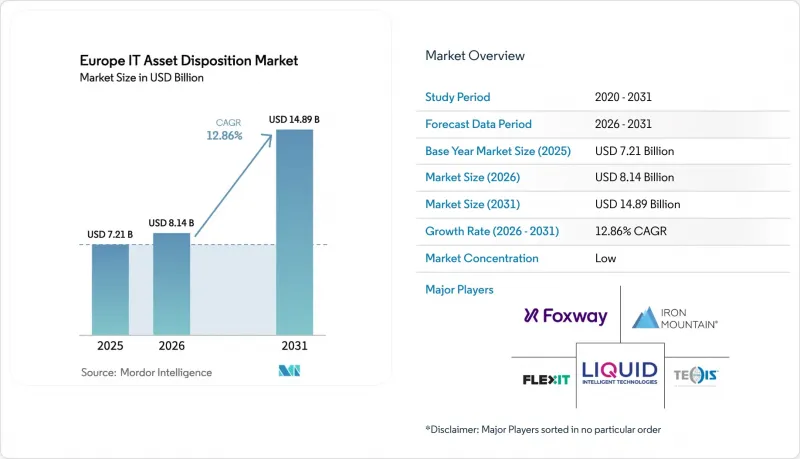
This report is Segmented by Service Type (Data Sanitization/Destruction, Remarketing and Value Recovery, and More), Asset Type (Computers and Laptops, Mobile Devices, and More), Enterprise Size (Large Enterprises and SMEs), End-User Vertical (BFSI, IT and Telecom, and More), and by Country. The Market Forecasts are Provided in Terms of Value (USD).
Europe IT Asset Disposition Market Trends and Insights
Accelerated PC Refresh from EU 2026 Energy-Label Ban
The upcoming EU energy-efficiency label effectively removes low-performing computers from sale and pushes enterprises to replace legacy PCs before the 2026 deadline. Many procurement teams are front-loading refresh budgets to avoid non-compliant inventory, which is set to lift Europe's IT Asset Disposition market volumes significantly. Providers able to capture these units early profit from higher residual values before secondary-market saturation sets in, and the regulation dovetails with the broader Ecodesign for Sustainable Products framework that introduces Digital Product Passports starting in 2027.As a result, certified recyclers and refurbishers see a window to lock in supply contracts with large corporates and speed up capacity investments.
Corporate-wide CSRD Reporting Pushes Audited ITAD
From January 2024, the CSRD obliges around 50,000 European companies to disclose Scope 3 emissions, making verifiable end-of-life tracking for devices a board-level issue. Large multinationals are now awarding disposition contracts based on audit readiness, chain-of-custody transparency, and carbon-impact reporting rather than unit fees alone. ITAD providers with integrated data-destruction, recycling, and remarketing workflows, each accompanied by tamper-proof documentation, rise to preferred-supplier status in requests for proposals. Healthcare chains, for instance, increasingly select vendors that can prove Health Insurance Portability and Accountability Act (HITECH) compliance alongside greenhouse-gas savings, moving the Europe IT Asset Disposition market toward service-quality differentiation.
Fragmented WEEE Enforcement Across EU-27
Regulators interpret WEEE rules differently, so cross-border asset flows must comply with several record-keeping procedures, each adding cost. Germany's 12.5 kg per-capita e-waste generation contrasts with less-stringent enforcement in Poland, forcing providers to maintain multiple licences and audits, complicating route planning and undermining potential economies of scale. Until harmonisation improves, operators incur duplicated compliance overheads and slower customs clearance on trans-EU lanes.
Other drivers and restraints analyzed in the detailed report include:
- OEM Take-Back Schemes Subsidise Remarketing Margins
- Shift to Device-as-a-Service Contracts Bundles ITAD
- Inflation-Linked Logistics Costs Squeeze Margins
For complete list of drivers and restraints, kindly check the Table Of Contents.
Segment Analysis
Remarketing and Value Recovery held 37.12% of 2025 revenue, underlining the appetite for refurbished gear that meets budget and sustainability goals. Certified grading and robust warranty programs assure buyers, while OEM take-back schemes buttress minimum buy-back prices, letting providers capture extra margin on resale. Reverse Logistics and De-installation, the fastest-growing line at 13.48% CAGR, reflects multi-site enterprises scheduling simultaneous refreshes ahead of the energy-label deadline. Secure chain-of-custody removal services command price premiums, ensuring data and brand protection throughout transit. Lease Return and End-of-Life Management enjoys a tailwind from finance houses keen to present circular-economy credentials. Data Sanitisation gains steady demand as customers align with ISO 27001 and NIST SP 800-88 protocols.
Integrated contract structures dominate client procurement. Single-vendor frameworks covering collection, erasure, resale, and reporting remove coordination overhead. AI-enabled optical inspection and Internet-of-Things (IoT) trackers improve yield forecasting and increase labour productivity on the testing line. Battery-recovery and urban-mining offerings sit in the "Other" bucket and win share in markets where raw-material scarcity raises the value of critical minerals. Providers that master both component harvesting and full-device resale achieve higher return per kilogram and widen the moat around their platforms. The Europe IT Asset Disposition market thus continues to prize remarketing skills while rewarding logistical precision.
Computers and Laptops accounted for 34.92% of 2025 turnover, underpinned by a corporate fleet swap that accelerates through 2026. Yet Mobile Devices, from smartphones to rugged tablets, are the fastest-rising pool at 14.35% CAGR. Shorter two-to-three-year refresh intervals and the bring-your-own-device trend feed unit volumes, while strong secondary demand in Africa and South-East Asia lifts average selling prices. Servers and Storage arrays, although fewer in number, deliver high value density due to gold-plated connectors and aluminium casings. Their disposal schedules align with cloud migration milestones, and strict data-wiping needs make them premium margin for secure ITAD vendors.
Edge computing produces a new wave of micro-servers and gateways scattered across retail or industrial sites, adding collection complexity. Meanwhile, Advania's Swedish refurbishment centre highlights the scale investments needed to process 1 million devices annually, reinforcing how capacity build-outs set the competitive pace. Emerging streams such as electric-vehicle chargers and renewables control boards sit within "Other Assets" and signal the broader electronic-waste spectrum the Europe IT Asset Disposition market will tackle over the next decade. For each category, providers must balance secure data handling against efficient material harvesting to maximise residual values.
Complete Report Scope:
- By Service Type
- Data Sanitization / Destruction
- Remarketing and Value Recovery
- Reverse Logistics and De-installation
- Lease-Return / End-of-Life Mgmt.
- Others
- By Asset Type
- Computers and Laptops
- Mobile Devices
- Servers and Storage
- Others
- By Enterprise Size
- Large Enterprises
- Small and Medium Enterprises
- By End-User Vertical
- BFSI
- IT and Telecom
- Healthcare
- Government and Public Institutions
- Manufacturing
- Others
- By Country
- United Kingdom
- Germany
- France
- Italy
- Spain
- Netherlands
- Nordics (Sweden, Denmark, Finland)
- Poland
- Russia
- Rest of Europe
List of Companies Covered in this Report:
- Iron Mountain
- Foxway
- Sims Lifecycle Services
- Econocom Group
- TES (SK ecoplant)
- Dell Technologies Asset Recovery
- HPE Asset Upcycling
- IBM Global Asset Recovery Services
- Flex IT
- Wisetek
- BNP Paribas 3 Step IT
- Liquid Technology
- CentricsIT
- CNE Direct
- TecDis Network
- Sims Recycling Solutions
- Ingram Micro ITAD
- Arrow Electronics
- Dynamic Lifecycle Innovations
- Sipi Asset Recovery
Additional Benefits:
- The market estimate (ME) sheet in Excel format
- 3 months of analyst support
TABLE OF CONTENTS
1 INTRODUCTION
- 1.1 Study Assumptions and Market Definition
- 1.2 Scope of the Study
2 RESEARCH METHODOLOGY
3 EXECUTIVE SUMMARY
4 MARKET LANDSCAPE
- 4.1 Market Overview
- 4.2 Market Drivers
- 4.2.1 Accelerated PC refresh from EUs 2026 energy-label ban
- 4.2.2 Corporate-wide CSRD reporting pushes audited ITAD
- 4.2.3 OEM take-back schemes subsidize remarketing margins
- 4.2.4 Shift to Device-as-a-Service contracts bundles ITAD
- 4.2.5 Cloud exit from ageing on-premise data-centre hardware
- 4.2.6 Private-equity roll-ups create pan-EU disposal hubs
- 4.3 Market Restraints
- 4.3.1 Fragmented WEEE enforcement across EU-27
- 4.3.2 Inflation-linked logistics costs squeeze margins
- 4.3.3 Grey-market exports erode certified recyclers volume
- 4.3.4 Refurb device stigma among enterprise buyers
- 4.4 Supply-Chain Analysis
- 4.5 Regulatory Landscape (WEEE, CSRD, GDPR, Right-to-Repair)
- 4.6 Technological Outlook (IoT asset-tracking, AI grading)
- 4.7 Porter's Five Force Analysis
- 4.7.1 Bargaining Power of Suppliers
- 4.7.2 Bargaining Power of Buyers
- 4.7.3 Threat of New Entrants
- 4.7.4 Threat of Substitutes
- 4.7.5 Intensity of Competitive Rivalry
- 4.8 Key Metrics for EU IT Assets
- 4.8.1 Installed Base by Device (PC, Laptop, Tablet, Mobile)
- 4.8.2 E-waste Generation Share (%)
- 4.8.3 Recycling Rate by Major EU Countries
5 MARKET SIZE AND GROWTH FORECASTS (VALUE)
- 5.1 By Service Type
- 5.1.1 Data Sanitization / Destruction
- 5.1.2 Remarketing and Value Recovery
- 5.1.3 Reverse Logistics and De-installation
- 5.1.4 Lease-Return / End-of-Life Mgmt.
- 5.1.5 Others
- 5.2 By Asset Type
- 5.2.1 Computers and Laptops
- 5.2.2 Mobile Devices
- 5.2.3 Servers and Storage
- 5.2.4 Others
- 5.3 By Enterprise Size
- 5.3.1 Large Enterprises
- 5.3.2 Small and Medium Enterprises
- 5.4 By End-User Vertical
- 5.4.1 BFSI
- 5.4.2 IT and Telecom
- 5.4.3 Healthcare
- 5.4.4 Government and Public Institutions
- 5.4.5 Manufacturing
- 5.4.6 Others
- 5.5 By Country
- 5.5.1 United Kingdom
- 5.5.2 Germany
- 5.5.3 France
- 5.5.4 Italy
- 5.5.5 Spain
- 5.5.6 Netherlands
- 5.5.7 Nordics (Sweden, Denmark, Finland)
- 5.5.8 Poland
- 5.5.9 Russia
- 5.5.10 Rest of Europe
6 COMPETITIVE LANDSCAPE
- 6.1 Market Concentration
- 6.2 Strategic Moves
- 6.3 Market Share Analysis
- 6.4 Company Profiles (includes global overview, market-level overview, core segments, financials, strategic information, market rank/share, products and services, recent developments)
- 6.4.1 Iron Mountain
- 6.4.2 Foxway
- 6.4.3 Sims Lifecycle Services
- 6.4.4 Econocom Group
- 6.4.5 TES (SK ecoplant)
- 6.4.6 Dell Technologies Asset Recovery
- 6.4.7 HPE Asset Upcycling
- 6.4.8 IBM Global Asset Recovery Services
- 6.4.9 Flex IT
- 6.4.10 Wisetek
- 6.4.11 BNP Paribas 3 Step IT
- 6.4.12 Liquid Technology
- 6.4.13 CentricsIT
- 6.4.14 CNE Direct
- 6.4.15 TecDis Network
- 6.4.16 Sims Recycling Solutions
- 6.4.17 Ingram Micro ITAD
- 6.4.18 Arrow Electronics
- 6.4.19 Dynamic Lifecycle Innovations
- 6.4.20 Sipi Asset Recovery
7 MARKET OPPORTUNITIES AND FUTURE OUTLOOK
- 7.1 White-Space and Unmet-Need Assessment

