PUBLISHER: Mordor Intelligence | PRODUCT CODE: 2117204

PUBLISHER: Mordor Intelligence | PRODUCT CODE: 2117204
IT Asset Disposition - Market Share Analysis, Industry Trends & Statistics, Growth Forecasts (2026 - 2031)
According to Mordor Intelligence, the IT asset disposition market size is expected to grow from USD 24.4 billion in 2025 to USD 26.46 billion in 2026 and is forecast to reach USD 39.66 billion by 2031 at 8.45% CAGR over 2026-2031.
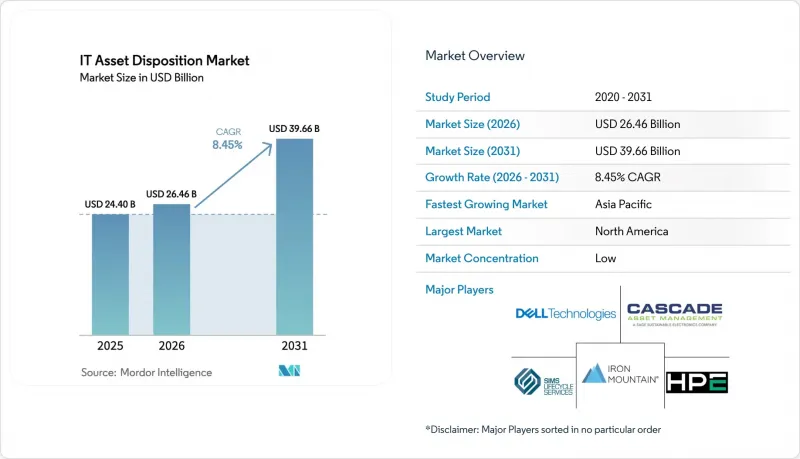
This report is Segmented by Service (Data Sanitisation and Destruction, Resale / Remarketing, Recycling and Material Recovery, Reverse Logistics and Warehousing, Full-Stack Asset Lifecycle Management), Asset Type (Desktop / Laptop, Mobile Devices, Servers, and More), Enterprise Size (Large Enterprises, Small and Medium Enterprises), End-User Industry (BFSI, IT and Telecom, Healthcare, and More), and Geography.
Global IT Asset Disposition Market Trends and Insights
Explosion of AI-ready Data-Centre Refresh Cycles
Compressed refresh intervals for AI-optimized infrastructure are channeling unprecedented hardware volumes into the IT asset disposition market. Enterprises are retiring an estimated 240 million Windows 10 PCs during 2025 as they transition to AI-capable devices, forcing disposition providers to expand capacity while elevating data-sanitization rigor. Data centers generated 61.9 million metric tonnes of e-waste in 2022, yet formal recycling captured only 22.3% of that stream, underscoring a gap that certified vendors are rushing to fill. Microsoft's investment in Cyclic Materials illustrates the pivot toward rare-earth recovery from retired hard drives, intertwining data security with advanced materials extraction. Providers able to integrate shredding, degaussing, and precision metals separation now command premium margins. As AI workloads proliferate, demand for server-grade GPUs will further compress server refresh timelines, sustaining long-run growth for the IT asset disposition market.
Device-as-a-Service Contracts Embedding Reverse-Logistics Clauses
DaaS models shift end-of-life obligations from buyers to vendors, guaranteeing certified take-back pathways and stabilizing disposition volumes. The 2025 Cascade Asset Management survey of 55 enterprises reported that 34% of respondents embed ESG benchmarks in IT procurement, up from 18% two years earlier. Large, distributed workforces rely on courier-based pick-up and validated chain-of-custody tracking, which is prompting disposition firms to invest in geofenced scheduling software and tamper-evident packaging. Standardized return clauses reduce leakage into grey markets and improve forecasting for remarketing channels. Over the long term, embedded reverse logistics is expected to normalize re-commerce flows, underpinning price stability for refurbished laptops and smartphones in the IT asset disposition market.
Fragmented Global Chain-of-Custody Standards
Multinational corporations often wrestle with conflicting national rules on waste classification, shipment permits, and data-destruction attestations. The European Round Table for Industry catalogued more than 100 regulatory barriers hampering cross-border e-waste flows in 2025, including diverging lithium-ion battery transit requirements. Basel Convention amendments effective January 2025 now obligate exporters to secure prior informed consent for many e-scrap categories, prolonging transit times and elevating administrative overhead. Disposition firms with multinational footprints absorb these costs through compliance departments, but smaller specialists lose margin or cede business, tempering overall IT asset disposition market growth.
Other drivers and restraints analyzed in the detailed report include:
- Mandatory Carbon-Accounting Disclosures Elevating ITAD Demand
- ESG-Linked Credit Pricing Rewarding Certified Circular-Tech Practices
- Talent Shortages in Certified Data-Destruction Operatives
For complete list of drivers and restraints, kindly check the Table Of Contents.
Segment Analysis
Resale and remarketing captured 36.95% of 2025 revenue, anchoring the IT asset disposition market through predictable secondary-device demand. Yet the fast-growing Full-Stack Asset Lifecycle Management suite is posting a 12.25% CAGR that will lift its contribution within the overall IT asset disposition market size over the forecast period. Enterprises are bundling procurement, maintenance, and disposition under a single master service agreement to simplify compliance and unlock residual-value insights early in the buying cycle.
Full-stack programs integrate asset tagging at deployment, firmware erasure at retirement, and materials reclamation for critical minerals such as neodymium. Providers that combine real-time inventory portals, certified logistics, and downstream refining partnerships can defend pricing, even as pure-play resale margins commoditize. This integrated stance blurs the line between ITAD and managed services, deepening stickiness in the IT asset disposition market.
Desktop and laptop devices held 30.45% of the IT asset disposition market share in 2025 due to persistent enterprise mobility refreshes. However, server volumes are slated to expand at a 12% CAGR, enlarging their slice of the IT asset disposition market size as hyperscalers replace x86 racks with GPU-dense nodes. Rack-scale retirements favor on-site shredding and serialized component tracking, elevating logistics complexity.
Blades housing AI accelerators fetch a premium in secondary markets, encouraging meticulous cosmetic handling to maximize resale value. The convergence of storage, compute, and networking within hyper-converged infrastructure also raises the technical bar for disposition specialists. Firms capable of separating solid-state drives for secure erasure while harvesting heat-sink copper are best positioned to capture upside in the IT asset disposition market.
Complete Report Scope:
- By Service
- Data Sanitisation and Destruction
- Resale / Remarketing
- Recycling and Material Recovery
- Reverse Logistics and Warehousing
- Full-Stack Asset Lifecycle Management
- By Asset Type
- Desktop / Laptop
- Mobile Devices
- Servers
- Storage Devices
- Networking and Edge Equipment
- Others
- By Enterprise Size
- Large Enterprises
- Small and Medium Enterprises
- By End-user Industry
- BFSI
- IT and Telecom
- Healthcare
- Government and Public Institutions
- Industrial and Energy
- Education and Others
- By Geography
- North America
- United States
- Canada
- Europe
- Germany
- United Kingdom
- France
- Rest of Europe
- Asia-Pacific
- China
- Japan
- India
- South Korea
- Rest of Asia-Pacific
- South America
- Brazil
- Rest of South America
- Middle East and Africa
- Middle East
- GCC
- Turkey
- Africa
- South Africa
- Rest of Africa
- North America
Geography Analysis
North America retained a 41.35% revenue stake in 2025, underpinned by SEC climate disclosures, mature secondary-hardware channels, and entrenched certification protocols such as R2v3. Government contracts accessed through distributors like Carahsoft ensure predictable federal demand, keeping utilization rates high for shredding plants in Texas, Ohio, and Ontario.
Europe leverages CSRD and WEEE legislation to enforce circular-economy targets, making documentation depth a competitive differentiator. Regulatory heterogeneity across the bloc heightens compliance costs but also invites premium pricing for vendors that can navigate multi-language audit regimes. Basel Convention export revisions add administrative layers for cross-channel flows, favoring disposition firms with local processing capacity in Germany, France, and the Nordics.
Asia-Pacific is expanding at a 12.8% CAGR, reflecting digital government programs and booming hyperscale investments. SK Tes's joint venture with VSD Holdings will open a Hanoi plant by early 2026, underlining Southeast Asia's shift from collection to full processing. Chinese Extended Producer Responsibility rules and India's e-Waste (Management) Amendment impel OEMs to prove domestic recycling, presenting an entry path for global ITAD brands through licensed local partnerships. Together these dynamics diversify revenue for the IT asset disposition market and hedge currency risk.
- Iron Mountain
- Dell Technologies
- Sims Lifecycle Services
- Hewlett Packard Enterprise
- Cascade Asset Management
- Apto Solutions
- SK tes
- Ingram Micro
- Procurri
- Wisetek
- Sage Sustainable Electronics
- Arrow Value Recovery
- DMD Systems
- CloudBlue
- Celestica
- IBM Global Asset Recovery
- Global Resale
- TES-AMM
- ERI
- PlanITROI
Additional Benefits:
- The market estimate (ME) sheet in Excel format
- 3 months of analyst support
TABLE OF CONTENTS
1 INTRODUCTION
- 1.1 Study Assumptions and Market Definition
- 1.2 Scope of the Study
2 RESEARCH METHODOLOGY
3 EXECUTIVE SUMMARY
4 MARKET LANDSCAPE
- 4.1 Market Overview
- 4.2 Market Drivers
- 4.2.1 Explosion of AI-Ready Data-Centre Refresh Cycles
- 4.2.2 Device-As-A-Service (Daas) Contracts Embedding Reverse-Logistics Clauses
- 4.2.3 Mandatory Carbon-Accounting Disclosures (SEC, CSRD) Elevating ITAD Demand
- 4.2.4 ESG-Linked Credit Pricing Rewarding Certified Circular-Tech Practices
- 4.2.5 Hyperscaler Divest-to-Invest Model for Legacy Servers in Emerging Regions
- 4.2.6 On-Premise HSM/TPM Retirement Triggered by Post-Quantum Crypto Migrations
- 4.3 Market Restraints
- 4.3.1 Fragmented Global Chain-of-Custody Standards
- 4.3.2 Talent Shortages in Certified Data-Destruction Operatives
- 4.3.3 Battery-Fire Insurance Premiums for Logistics Providers
- 4.3.4 Growing Grey-Market Exports Driving Price Compression
- 4.4 Regulatory Landscape
- 4.5 Technological Outlook
- 4.6 Porter's Five Forces Analysis
- 4.6.1 Bargaining Power of Suppliers
- 4.6.2 Bargaining Power of Buyers
- 4.6.3 Threat of New Entrants
- 4.6.4 Threat of Substitute Products
- 4.6.5 Intensity of Competitive Rivalry
5 MARKET SIZE AND GROWTH FORECASTS (VALUE)
- 5.1 By Service
- 5.1.1 Data Sanitisation and Destruction
- 5.1.2 Resale / Remarketing
- 5.1.3 Recycling and Material Recovery
- 5.1.4 Reverse Logistics and Warehousing
- 5.1.5 Full-Stack Asset Lifecycle Management
- 5.2 By Asset Type
- 5.2.1 Desktop / Laptop
- 5.2.2 Mobile Devices
- 5.2.3 Servers
- 5.2.4 Storage Devices
- 5.2.5 Networking and Edge Equipment
- 5.2.6 Others
- 5.3 By Enterprise Size
- 5.3.1 Large Enterprises
- 5.3.2 Small and Medium Enterprises
- 5.4 By End-user Industry
- 5.4.1 BFSI
- 5.4.2 IT and Telecom
- 5.4.3 Healthcare
- 5.4.4 Government and Public Institutions
- 5.4.5 Industrial and Energy
- 5.4.6 Education and Others
- 5.5 By Geography
- 5.5.1 North America
- 5.5.1.1 United States
- 5.5.1.2 Canada
- 5.5.2 Europe
- 5.5.2.1 Germany
- 5.5.2.2 United Kingdom
- 5.5.2.3 France
- 5.5.2.4 Rest of Europe
- 5.5.3 Asia-Pacific
- 5.5.3.1 China
- 5.5.3.2 Japan
- 5.5.3.3 India
- 5.5.3.4 South Korea
- 5.5.3.5 Rest of Asia-Pacific
- 5.5.4 South America
- 5.5.4.1 Brazil
- 5.5.4.2 Rest of South America
- 5.5.5 Middle East and Africa
- 5.5.5.1 Middle East
- 5.5.5.2 GCC
- 5.5.5.3 Turkey
- 5.5.6 Africa
- 5.5.6.1 South Africa
- 5.5.6.2 Rest of Africa
- 5.5.1 North America
6 COMPETITIVE LANDSCAPE
- 6.1 Market Concentration
- 6.2 Strategic Moves
- 6.3 Market Share Analysis
- 6.4 Company Profiles (Includes global-level overview, market-level overview, core segments, financials (as available), strategic information, market rank/share, products and services, and recent developments)
- 6.4.1 Iron Mountain
- 6.4.2 Dell Technologies
- 6.4.3 Sims Lifecycle Services
- 6.4.4 Hewlett Packard Enterprise
- 6.4.5 Cascade Asset Management
- 6.4.6 Apto Solutions
- 6.4.7 SK tes
- 6.4.8 Ingram Micro
- 6.4.9 Procurri
- 6.4.10 Wisetek
- 6.4.11 Sage Sustainable Electronics
- 6.4.12 Arrow Value Recovery
- 6.4.13 DMD Systems
- 6.4.14 CloudBlue
- 6.4.15 Celestica
- 6.4.16 IBM Global Asset Recovery
- 6.4.17 Global Resale
- 6.4.18 TES-AMM
- 6.4.19 ERI
- 6.4.20 PlanITROI
7 MARKET OPPORTUNITIES AND FUTURE OUTLOOK
- 7.1 White-space and Unmet-Need Assessment

