PUBLISHER: Mordor Intelligence | PRODUCT CODE: 2117230

PUBLISHER: Mordor Intelligence | PRODUCT CODE: 2117230
United Kingdom Hedge Funds - Market Share Analysis, Industry Trends & Statistics, Growth Forecasts (2026 - 2031)
According to Mordor Intelligence, the United Kingdom hedge funds market size was valued at USD 531.22 billion in 2025 and is estimated to grow from USD 552.37 billion in 2026 to reach USD 671.47 billion by 2031, at a CAGR of 3.98% during the forecast period (2026-2031).
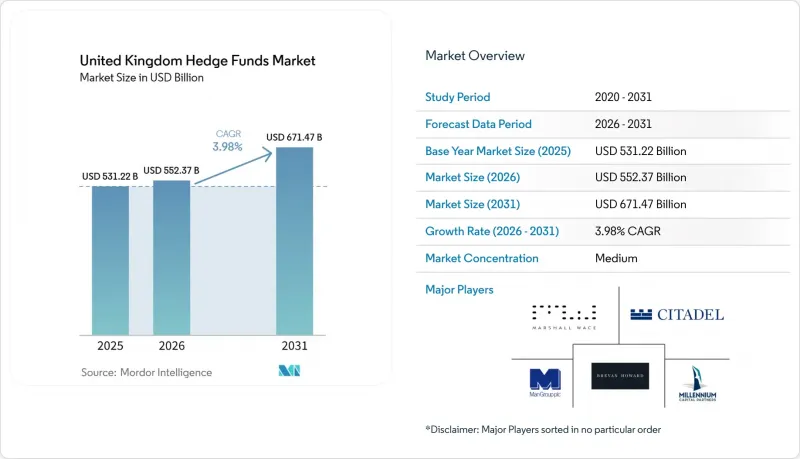
This report is Segmented by Investment Strategy (Equity Long/Short, Global Macro, Event-Driven, and More), Investor Type (Pension Funds, Insurance Companies, and More), Distribution Channel (Direct Sales, Placement Agents/Intermediaries, and More), Fund Domicile & Structure (UK-Onshore, Offshore, Cayman, and More), and Region. The Market Forecasts are Provided in Value (USD).
United Kingdom Hedge Funds Market Trends and Insights
UK Pension Schemes' post-LDI Shift to Alternatives
The gilt-market shock of 2022 exposed leverage vulnerabilities in LDI portfolios, triggering a structural rethink among trustees. Defined-benefit schemes have raised alternative allocations from 14% to 39% of risky assets, and hedge-fund exposure now stands near 6% of total scheme assets, up from zero at the start of the millennium. An estimated USD 254 billion in redeployed assets is expected to filter into hedge funds before 2030. Added oversight from the pensions regulator and stricter leverage caps on LDI mandates create durable tailwinds for uncorrelated strategies. Managers able to package downside-risk mitigation and liquidity management are best placed to win these mandates.
Rise of UCITS/AIFMD-compliant hedge-fund structures
Since the Overseas Funds Regime launched in September 2024, 47 new UCITS hedge funds have debuted, marking a 34% increase from 2023, and have drawn in USD 19.05 billion from European investors. This growth highlights the increasing appeal of UCITS wrappers as the primary passport for European distribution. Insurers and wealth managers eager for hedge-fund-style returns within a retail framework are drawn to UCITS wrappers. These wrappers provide liquidity and daily NAV reporting and enforce strict risk-diversification rules, making them a preferred choice for institutional and retail investors alike. While the AIFMD delegation rules pose challenges, UCITS vehicles present a scalable solution, allowing London-based portfolio management to align with EU marketing regulations. This adaptability ensures that UCITS funds remain a competitive and compliant option for cross-border distribution in Europe.
Regulatory uncertainty on EU passporting post-Brexit
Due to the lack of comprehensive equivalence, the EU investor base has contracted by roughly 35%. It has compelled managers to navigate private placement filings across all 27 member states, significantly increasing the complexity of compliance processes. Stricter reporting and delegation clauses under AIFMD II, set to take effect in April 2024, have led to a surge in legal fees and operational costs, rising by as much as 60%. These changes have placed additional pressure on mid-tier firms, many of which lack the scale to absorb such costs. As a result, several firms have shifted their trading and compliance functions to Dublin or Luxembourg, undermining London's traditional clustering advantage and reducing its role as a central hub. Furthermore, as clarity on these regulations remains elusive, the incentive for new fund launches to establish themselves within the EU bloc continues to grow, driven by the need to ensure smoother access to the European investor market.
Other drivers and restraints analyzed in the detailed report include:
- ESG-driven capital inflows into sustainable strategies
- Volatility-rich macro environment unlocking alpha.
- HMRC tightening on performance fee and carried-interest tax
For complete list of drivers and restraints, kindly check the Table Of Contents.
Segment Analysis
Equity long-short strategies captured 34.12% of the United Kingdom hedge fund market in 2025, driven by improved factor-decomposition tools and real-time risk dashboards that refine gross and net exposure limits. Managers exploit single-stock dispersion, which widened as retail flows and thematic rotations heightened idiosyncratic volatility. Global Macro, though smaller today, is projected to expand at a 6.22% CAGR, buoyed by central-bank divergence that creates persistent currency and rates trades. Event-driven books revived alongside a 38% pick-up in United Kingdom-listed M&A announcements, while Relative-Value desks profit from widening credit-curve kinks as quantitative tightening drains primary-dealer balance sheets.
Multi-strategy giants such as Citadel and Millennium allocate incremental capital dynamically across these sleeves, using risk-budgeting engines that optimize marginal Sharpe contribution. The United Kingdom hedge fund market size tied to quantitative signals keeps rising as systematic funds represent 60% of recent launches, integrating alternative datasets on supply chains, satellite imagery, and consumer web traffic. Managers spent USD 1.50 billion in 2024 on data curation, feature engineering, and GPU clusters. London's deep pool of PhDs fuels machine-learning adoption, and Man Group's rebuilt Condor platform showcases the direction of travel with real-time data ingestion and reinforced model governance.
Pension funds controlled 56.25% of the United Kingdom hedge fund market in 2025 as stricter funding ratio targets compelled trustees to diversify beyond traditional 60/40 mixes. The shift away from leveraged LDI structures following gilt turmoil anchors stable long-term capital for hedge-fund managers. Family offices, though smaller in absolute terms, are growing at 6.78% CAGR as multi-generational wealth transfer aligns with direct relationships and bespoke mandates. Insurers remain steady allocators, targeting capital-efficient strategies compatible with Solvency II.
Sovereign wealth funds have opened London offices to secure deal flow and co-investment rights, enhancing the prestige of the United Kingdom hedge fund market. Digital onboarding portals reduce operational friction, letting smaller institutions and charities allocate with lower minimums. Funds-of-funds face fee compression as allocators opt for direct exposure and co-investment, forcing them to pivot toward operational due diligence services. Family offices' appetite for ESG-aligned systematic products boosts seeding opportunities for niche managers, fostering a vibrant start-up pipeline.
Complete Report Scope:
- By Investment Strategy
- Equity Long/Short
- Global Macro
- Event-Driven
- Relative Value / Arbitrage
- Quantitative / Systematic
- Multi-Strategy
- Credit / Fixed-Income
- By Investor Type
- Pension Funds
- Insurance Companies
- Sovereign Wealth Funds
- Family Offices
- High-Net-Worth Individuals
- Funds of Funds
- By Distribution Channel
- Direct Sales
- Placement Agents / Intermediaries
- Digital / Online Platforms
- By Fund Domicile & Structure
- UK-Onshore (Ltd / LLP / AIF)
- Offshore (Channel Islands, Cayman)
- EU Onshore (Ireland, Luxembourg)
- UCITS-Compliant Hedge Funds
- By Region
- London
- South East England
- Scotland
- North West England
List of Companies Covered in this Report:
- Man Group plc
- Marshall Wace LLP
- Citadel Europe LLP
- Millennium Capital Partners LLP
- Brevan Howard Asset Management LLP
- Rokos Capital Management LLP
- Capula Investment Management LLP
- Winton Group Ltd
- Lansdowne Partners (UK) LLP
- AQR Capital Management (Europe) LLP
- Point72 UK Ltd
- Balyasny Asset Management (UK) LLP
- Squarepoint Capital LLP
- CQS (UK) LLP
- Egerton Capital (UK) LLP
- Aspect Capital Ltd
- AKO Capital LLP
- Pharo Management (UK) LLP
- Polygon Global Partners LP
- Tudor Capital Europe Ltd
- TT International Asset Management
- DE Shaw & Co. (UK) Ltd
Additional Benefits:
- The market estimate (ME) sheet in Excel format
- 3 months of analyst support
TABLE OF CONTENTS
1 Introduction
- 1.1 Study Assumptions & Market Definition * Scope of the Study
2 Research Methodology
3 Executive Summary
4 Market Landscape
- 4.1 Market Overview
- 4.2 Market Drivers
- 4.2.1 UK Pension Schemes' Post-LDI Re-allocation Toward Alternatives
- 4.2.2 Proliferation of UCITS/AIFMD-Compliant Hedge-Fund Structures
- 4.2.3 ESG-Driven Capital Inflows into Sustainable Hedge-Fund Strategies
- 4.2.4 Volatility-Rich Macro Environment Unlocking Alpha Opportunities
- 4.2.5 London's Post-Brexit Quant-Talent Magnetism
- 4.2.6 Adoption of Alternative-Data & Cloud-Native Execution Platforms
- 4.3 Market Restraints
- 4.3.1 Regulatory Uncertainty on EU Passporting Post-Brexit
- 4.3.2 HMRC Tightening on Performance-Fee & Carried-Interest Tax
- 4.3.3 Compensation-Led Talent Drain to US-Based Hedge Funds
- 4.3.4 Rising ODD & Cyber-Security Compliance Costs for Small Managers
- 4.4 Value / Supply-Chain Analysis
- 4.5 Regulatory Outlook
- 4.6 Technological Outlook
- 4.7 Porter's Five Forces
- 4.7.1 Competitive Rivalry
- 4.7.2 Bargaining Power of Investors
- 4.7.3 Bargaining Power of Service Providers
- 4.7.4 Threat of New Entrants
- 4.7.5 Threat of Substitutes
5 Market Size & Growth Forecasts (Value in USD billion)
- 5.1 By Investment Strategy
- 5.1.1 Equity Long/Short
- 5.1.2 Global Macro
- 5.1.3 Event-Driven
- 5.1.4 Relative Value / Arbitrage
- 5.1.5 Quantitative / Systematic
- 5.1.6 Multi-Strategy
- 5.1.7 Credit / Fixed-Income
- 5.2 By Investor Type
- 5.2.1 Pension Funds
- 5.2.2 Insurance Companies
- 5.2.3 Sovereign Wealth Funds
- 5.2.4 Family Offices
- 5.2.5 High-Net-Worth Individuals
- 5.2.6 Funds of Funds
- 5.3 By Distribution Channel
- 5.3.1 Direct Sales
- 5.3.2 Placement Agents / Intermediaries
- 5.3.3 Digital / Online Platforms
- 5.4 By Fund Domicile & Structure
- 5.4.1 UK-Onshore (Ltd / LLP / AIF)
- 5.4.2 Offshore (Channel Islands, Cayman)
- 5.4.3 EU Onshore (Ireland, Luxembourg)
- 5.4.4 UCITS-Compliant Hedge Funds
- 5.5 By Region
- 5.5.1 London
- 5.5.2 South East England
- 5.5.3 Scotland
- 5.5.4 North West England
6 Competitive Landscape
- 6.1 Market Concentration
- 6.2 Strategic Moves
- 6.3 Market Share Analysis
- 6.4 Company Profiles {(includes Global level Overview, Market level overview, Core Segments, Financials as available, Strategic Information, Market Rank/Share for key companies, Products & Services, and Recent Developments)}
- 6.4.1 Man Group plc
- 6.4.2 Marshall Wace LLP
- 6.4.3 Citadel Europe LLP
- 6.4.4 Millennium Capital Partners LLP
- 6.4.5 Brevan Howard Asset Management LLP
- 6.4.6 Rokos Capital Management LLP
- 6.4.7 Capula Investment Management LLP
- 6.4.8 Winton Group Ltd
- 6.4.9 Lansdowne Partners (UK) LLP
- 6.4.10 AQR Capital Management (Europe) LLP
- 6.4.11 Point72 UK Ltd
- 6.4.12 Balyasny Asset Management (UK) LLP
- 6.4.13 Squarepoint Capital LLP
- 6.4.14 CQS (UK) LLP
- 6.4.15 Egerton Capital (UK) LLP
- 6.4.16 Aspect Capital Ltd
- 6.4.17 AKO Capital LLP
- 6.4.18 Pharo Management (UK) LLP
- 6.4.19 Polygon Global Partners LP
- 6.4.20 Tudor Capital Europe Ltd
- 6.4.21 TT International Asset Management
- 6.4.22 DE Shaw & Co. (UK) Ltd
7 Market Opportunities & Future Outlook
- 7.1 White-space & Unmet-Need Assessment

