PUBLISHER: Mordor Intelligence | PRODUCT CODE: 2117233

PUBLISHER: Mordor Intelligence | PRODUCT CODE: 2117233
Train Battery - Market Share Analysis, Industry Trends & Statistics, Growth Forecasts (2026 - 2031)
According to Mordor Intelligence, the train battery market size is expected to grow from USD 288.15 billion in 2025 to USD 302.73 billion in 2026 and is forecast to reach USD 387.45 billion by 2031 at 5.06% CAGR over 2026-2031.
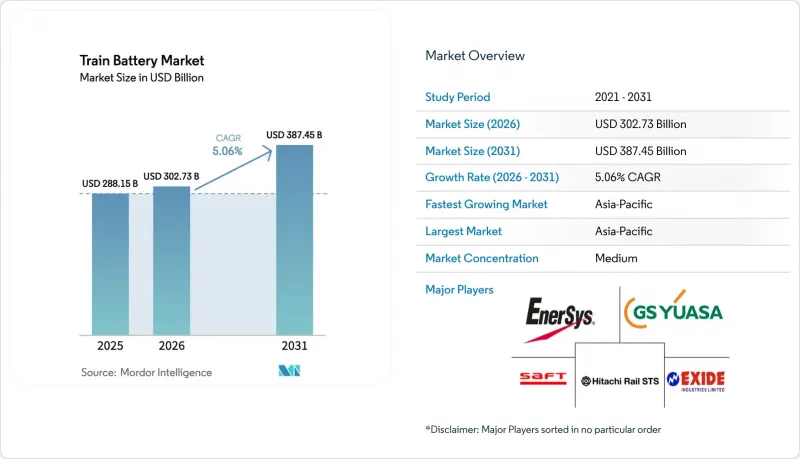
This report is Segmented by Battery Chemistry (Lead-Acid - Flooded, Lithium-Ion - LFP, and More), Capacity Range (Less Than 50 Ah, 50-150 Ah, and More), Application (Starter/Cranking, Auxiliary (Lighting, HVAC, Doors), and More), Rolling Stock (Locomotive - Diesel-Electric & Battery-Electric, and More), and Geography. The Market Forecasts are Provided in Terms of Value (USD).
Global Train Battery Market Trends and Insights
Rapid Electrification of Urban & Regional Rail Corridors
Policy mandates for carbon neutrality are pushing electrification into secondary and branch lines previously viewed as uneconomic for catenary. India lifted electrification to 96% of its network in 2024, more than tripling its annual track-wire rate over the last decade. Germany's Schleswig-Holstein region will save 10 million L of diesel yearly once battery EMUs take over rural routes. Because overhead lines on low-density corridors can exceed USD 3 million per kilometer, batteries now represent a lower-risk path to decarbonization. Operators value the flexibility of trains that bridge electrified and non-electrified sections without service cuts, enabling step-wise capex profiles rather than all-or-nothing infrastructure outlays.
Cost / Weight Advantages of Next-Gen Li-Ion & LFP Chemistries
Lithium carbonate tumbled from USD 70,000 to under USD 15,000 per tonne between 2023 and 2025, pushing LFP system costs toward parity with lead-acid while slashing pack mass by 40% over five years. CATL now advertises 6C charging that fills a train pack in 10 minutes, meeting heavy-turnback urban timetables. Toshiba's SCiB modules show 10,000 cycles with low fade, translating to longer intervals between overhauls . The resulting total-life economics drive broader uptake, particularly where labour costs and energy prices reinforce the benefits.
High Upfront Li-Ion Cost vs. Legacy Lead-Acid
Even after recent price drops, Li-ion packs still cost 3-5 times more than flooded lead-acid, so budget-constrained agencies often delay migration. Lead-acid's 28.66% share in 2024 underscores its staying power in auxiliary duties where price trumps performance. Federal incentives such as EnerSys's USD 199 million DOE grant soften the blow and create beachheads for higher-spec chemistries.
Other drivers and restraints analyzed in the detailed report include:
- Mandates for Phasing-Out Diesel Locomotives in Europe by 2030
- AI-Enabled Predictive BMS Extends Duty Cycles
- Thermal-Runaway & Certification Hurdles for Large Rail Packs
For complete list of drivers and restraints, kindly check the Table Of Contents.
Segment Analysis
Lead-acid flooded units retained 28.14% of 2025 revenue, a figure that pins down much of the starter and auxiliary space in the train battery market. Yet lithium-ion LFP packs are forecast to grow 7.12% annually, lifted by falling material costs and inherent thermal stability. The train battery market size for LFP traction systems is projected to widen especially quickly on regional lines that demand 100-km off-wire range.
Nickel-cadmium persists in critical safety roles, while lithium-ion NMC/NCA caters to space-constrained premium services despite higher commodity exposure. Emerging solid-state prototypes in Japan and China could enter service after 2028, promising another wave of density gains. Each step in chemistry evolution tilts life-cycle economics further toward advanced lithium platforms, tightening the grip on growth segments of the train battery market.
Packs rated 50-150 Ah held 48.25% of 2025 revenue, reflecting continued dominance in mixed auxiliary and hybrid propulsion duties within the train battery market. The >150 Ah bracket, however, records 6.62% CAGR as freight locomotives and regional EMUs specify multi-megawatt-hour arrays. A single FLXdrive can mount 8.5 MWh, equivalent to roughly 16,000 Ah at 525 V, underscoring the demand for ultra-high current architectures.
Project calls from Irish Rail and Caltrans each stipulate battery-only ranges above 80 km, a requirement met only with large-format modules and sophisticated thermal management. As traction-heavy-duty use cases accelerate, the train battery market share for high-capacity packs will expand, with swap-pack logistics further smoothing depot workflows.
Complete Report Scope:
- By Battery Chemistry
- Lead-acid - Flooded
- Lead-acid - VRLA (AGM / Gel)
- Nickel-Cadmium
- Lithium-ion - LFP
- Lithium-ion - NMC / NCA
- Lithium-ion - LTO
- Nickel - Metal Hydride
- By Capacity Range
- Below 50 Ah
- 50 - 150 Ah
- Above 150 Ah
- By Application
- Starter / Cranking
- Auxiliary (Lighting, HVAC, Doors)
- Traction Propulsion (Hybrid and Battery trains)
- On-board Regenerative-Braking Storage
- By Rolling Stock
- Locomotive - Diesel-electric and Battery-electric
- Electric Multiple Unit (EMU) / Battery-EMU
- Diesel Multiple Unit Hybrid
- Metro and Light Rail
- Monorail and People-Mover
- High-speed Train
- Freight Wagon (Cold-move, E-axle)
- Passenger Coaches
- By End-User
- Public Rail Operators
- Private Freight Operators
- Urban Transit Agencies
- OEM Train Manufacturers
- By Geography
- North America
- United States
- Canada
- Rest of North America
- South America
- Brazil
- Argentina
- Rest of South America
- Europe
- Germany
- United Kingdom
- France
- Italy
- Spain
- Russia
- Rest of Europe
- Asia-Pacific
- China
- Japan
- India
- South Korea
- Australia & New Zealand
- Rest of Asia-Pacific
- Middle East and Africa
- Middle East
- Saudi Arabia
- United Arab Emirates
- Turkey
- Rest of Middle East
- Africa
- South Africa
- Egpyt
- Rest of Africa
- Middle East
- North America
Geography Analysis
Asia-Pacific controlled 47.30% of 2025 revenue and is forecast to grow 7.18% annually by 2031, anchoring both size and momentum for the train battery market. India's near-total rail electrification and China's factory-to-network vertical integration secure supply and demand at scale. Japan continues to field-test solid-state packs, while South Korea's battery firms eye export consortia with local rolling-stock OEMs.
Europe ranks second by value and remains the regulatory bellwether. EU diesel-phase-out rules, Germany's 70% wiring target, and France's TER battery fleet all combine to pull forward orders across Spain, Italy, and the Nordics. Funding through CEF and national climate banks lowers the weighted average cost of capital, giving smaller regional operators a path into battery programs. As these fleets enter daily service, they feed proven-platform confidence back into global tenders.
North America begins with low electrification (≈1%) yet shows accelerating take-up. California's zero-emission rail blueprint and federal production credits under the Inflation Reduction Act spur domestic supply chains. EnerSys's government-backed plant in Pennsylvania and Wabtec-GM's Ultium pact both target "Made in USA" compliance, opening slots for battery locomotives on freight short lines and passenger corridors. Given the vast length of non-electrified track, batteries provide a practical bridge while wiring economics remain prohibitive.
- EnerSys
- Saft
- GS Yuasa Corporation
- Exide Industries
- Hitachi Rail
- BorgWarner Akasol
- Amara Raja Batteries
- Shuangdeng Group
- Toshiba (SCiB)
- HBL Power Systems
- East Penn Manufacturing
- Hoppecke Batteries
- Forsee Power
- CATL
- BYD Co Ltd
Additional Benefits:
- The market estimate (ME) sheet in Excel format
- 3 months of analyst support
TABLE OF CONTENTS
1 Introduction
- 1.1 Study Assumptions & Market Definition
- 1.2 Scope of the Study
2 Research Methodology
3 Executive Summary
4 Market Landscape
- 4.1 Market Overview
- 4.2 Market Drivers
- 4.2.1 Rapid Electrification of Urban & Regional Rail Corridors
- 4.2.2 Mandates for Phasing-Out Diesel Locomotives in Europe by 2030
- 4.2.3 Cost / Weight Advantages of Next-Gen Li-Ion & LFP Chemistries
- 4.2.4 EU Funding for Battery-Electric Multiple Units (BEMU)
- 4.2.5 Modular Swap-Pack Maintenance Model Cuts Depot Downtime
- 4.2.6 AI-Enabled Predictive BMS Extends Duty Cycles
- 4.3 Market Restraints
- 4.3.1 High Upfront Li-Ion Cost vs. Legacy Lead-Acid
- 4.3.2 Thermal-Runaway & Certification Hurdles for Large Rail Packs
- 4.3.3 Nickel & Lithium Price Volatility Delaying Tenders
- 4.3.4 Nickel & Lithium Price Volatility Delaying Tenders
- 4.4 Value / Supply-Chain Analysis
- 4.5 Technological Outlook
- 4.6 Regulatory Landscape
- 4.7 Porter's Five Forces
- 4.7.1 Threat of New Entrants
- 4.7.2 Bargaining Power of Buyers
- 4.7.3 Bargaining Power of Suppliers
- 4.7.4 Threat of Substitutes
- 4.7.5 Intensity of Competitive Rivalry
- 4.8 Battery-Safety Standards Benchmarking
5 Market Size & Growth Forecasts (Value, USD)
- 5.1 By Battery Chemistry
- 5.1.1 Lead-acid - Flooded
- 5.1.2 Lead-acid - VRLA (AGM / Gel)
- 5.1.3 Nickel-Cadmium
- 5.1.4 Lithium-ion - LFP
- 5.1.5 Lithium-ion - NMC / NCA
- 5.1.6 Lithium-ion - LTO
- 5.1.7 Nickel - Metal Hydride
- 5.2 By Capacity Range
- 5.2.1 Below 50 Ah
- 5.2.2 50 - 150 Ah
- 5.2.3 Above 150 Ah
- 5.3 By Application
- 5.3.1 Starter / Cranking
- 5.3.2 Auxiliary (Lighting, HVAC, Doors)
- 5.3.3 Traction Propulsion (Hybrid and Battery trains)
- 5.3.4 On-board Regenerative-Braking Storage
- 5.4 By Rolling Stock
- 5.4.1 Locomotive - Diesel-electric and Battery-electric
- 5.4.2 Electric Multiple Unit (EMU) / Battery-EMU
- 5.4.3 Diesel Multiple Unit Hybrid
- 5.4.4 Metro and Light Rail
- 5.4.5 Monorail and People-Mover
- 5.4.6 High-speed Train
- 5.4.7 Freight Wagon (Cold-move, E-axle)
- 5.4.8 Passenger Coaches
- 5.5 By End-User
- 5.5.1 Public Rail Operators
- 5.5.2 Private Freight Operators
- 5.5.3 Urban Transit Agencies
- 5.5.4 OEM Train Manufacturers
- 5.6 By Geography
- 5.6.1 North America
- 5.6.1.1 United States
- 5.6.1.2 Canada
- 5.6.1.3 Rest of North America
- 5.6.2 South America
- 5.6.2.1 Brazil
- 5.6.2.2 Argentina
- 5.6.2.3 Rest of South America
- 5.6.3 Europe
- 5.6.3.1 Germany
- 5.6.3.2 United Kingdom
- 5.6.3.3 France
- 5.6.3.4 Italy
- 5.6.3.5 Spain
- 5.6.3.6 Russia
- 5.6.3.7 Rest of Europe
- 5.6.4 Asia-Pacific
- 5.6.4.1 China
- 5.6.4.2 Japan
- 5.6.4.3 India
- 5.6.4.4 South Korea
- 5.6.4.5 Australia & New Zealand
- 5.6.4.6 Rest of Asia-Pacific
- 5.6.5 Middle East and Africa
- 5.6.5.1 Middle East
- 5.6.5.1.1 Saudi Arabia
- 5.6.5.1.2 United Arab Emirates
- 5.6.5.1.3 Turkey
- 5.6.5.1.4 Rest of Middle East
- 5.6.5.2 Africa
- 5.6.5.2.1 South Africa
- 5.6.5.2.2 Egpyt
- 5.6.5.2.3 Rest of Africa
- 5.6.5.1 Middle East
- 5.6.1 North America
6 Competitive Landscape
- 6.1 Market Concentration
- 6.2 Strategic Moves
- 6.3 Market Share Analysis
- 6.4 Company Profiles (Includes Global Level Overview, Market Level Overview, Core Segments, Financials as Available, Strategic Information, Market Rank/Share for Key Companies, Products and Services, and Recent Developments)
- 6.4.1 EnerSys
- 6.4.2 Saft
- 6.4.3 GS Yuasa Corporation
- 6.4.4 Exide Industries
- 6.4.5 Hitachi Rail
- 6.4.6 BorgWarner Akasol
- 6.4.7 Amara Raja Batteries
- 6.4.8 Shuangdeng Group
- 6.4.9 Toshiba (SCiB)
- 6.4.10 HBL Power Systems
- 6.4.11 East Penn Manufacturing
- 6.4.12 Hoppecke Batteries
- 6.4.13 Forsee Power
- 6.4.14 CATL
- 6.4.15 BYD Co Ltd
7 Market Opportunities & Future Outlook
- 7.1 White-space & Unmet-Need Assessment

