PUBLISHER: Mordor Intelligence | PRODUCT CODE: 2117238

PUBLISHER: Mordor Intelligence | PRODUCT CODE: 2117238
Asia-Pacific Formaldehyde - Market Share Analysis, Industry Trends & Statistics, Growth Forecasts (2026 - 2031)
According to Mordor Intelligence, the Asia-Pacific formaldehyde market size is expected to grow from 16.09 Million tons in 2025 to 16.95 Million tons in 2026 and is forecast to reach 22.01 Million tons by 2031 at 5.36% CAGR over 2026-2031.
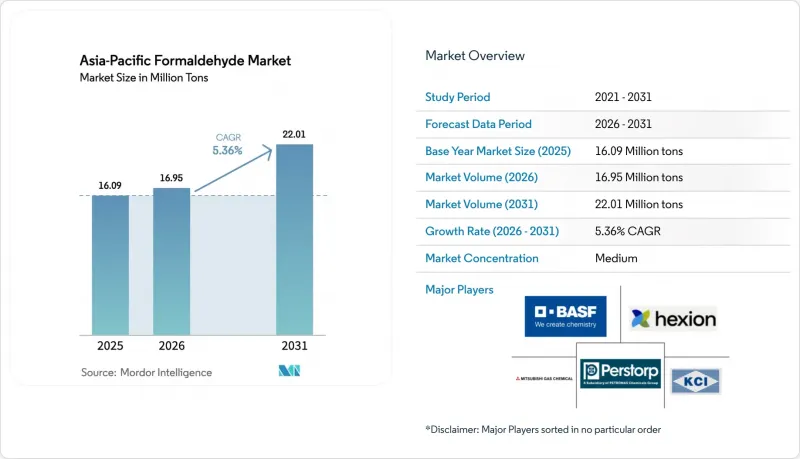
This report is Segmented by Derivative (Urea Formaldehyde, Phenol Formaldehyde, Melamine Formaldehyde, and More), End-User Industry (Construction, Automotive, Agriculture, and More), Application (Plywood and Wood Products, Textiles and Fabrics, Automotive and Transportation, and More), and Geography (China, India, Japan, and More). The Market Forecasts are Provided in Terms of Volume (Tons).
Asia-Pacific Formaldehyde Market Trends and Insights
Rising Demand From Construction Composites
India and China continue to channel infrastructure capex into bridges, metro corridors, and data centers. Formaldehyde-based phenol resins dominate plywood used for exterior cladding because they tolerate monsoon humidity and seismic stress. India's plywood output rose 6.71% year-on-year in FY 2024, underpinned by a five-year 6.00% CAGR, yet MDF and particleboard still hold only 20% domestic share, leaving headroom for resin consumption growth. Luxury housing transactions in India climbed 37.8% between January-September 2024, lifting demand for low-emission laminates that comply with emerging indoor-air standards. China produced more than 250 million m3 of wood-based panels in 2023, locking in sustained adhesive demand, while public-housing specifications already require ENF-grade products.
Expanding Automotive Plastics And Coatings Adoption
Electric-vehicle (EV) assembly is redirecting derivatives toward POM and phenolic composites that satisfy stringent cabin-air protocols. BASF raised Asia-Pacific Ultraform POM prices by USD 350/t in March 2025 to offset energy and freight inflation and continued compliance spending. Japan Automobile Manufacturers Association limits cabin formaldehyde to 100 µg m-3, a threshold now mirrored across ASEAN sourcing contracts. Hybrid powertrains also accelerate phenolic resin uptake in brake pads and clutch facings that require heat stability.
Toxic And Carcinogenic Classification Tightening Exposure Limits
Singapore bans formaldehyde in interior paints from 2026, capping content at 0.01 wt%, which pushes formulators toward acrylic and silicone binders. Japan's Building Standard Law demands F4 board ratings of <=0.04 mg m-3, while vehicle makers limit cabin exposure to 100 µg m-3, forcing resin upgrades. China's GB/T 39600-2021 added an ENF tier at <=0.025 mg m-3, and typical adhesive retrofits cost USD 1.2 million per panel plant. Compliance erodes smaller mills' margins and accelerates substitution by melamine-urea or phenolic alternatives.
Other drivers and restraints analyzed in the detailed report include:
- Surge In Engineered-Wood Output
- Growth Of UF/PF Resin Usage In Furniture Adhesives
- Stringent APAC Environmental Regulations And Emission Caps
For complete list of drivers and restraints, kindly check the Table Of Contents.
Segment Analysis
Urea formaldehyde contributed 46.50% of Asia-Pacific formaldehyde market share in 2025, reflecting its low unit cost in particleboard and MDF lines. The sub-segment is forecast to advance at a 5.97% CAGR through 2031, keeping absolute volume leadership despite regulatory headwinds. Polyoxymethylene demand is propelled by EV interior and precision gear demand that tracks a near 7% CAGR. Phenol formaldehyde gains niche adoption in fire-resistant plywood favored in metro and data-center builds, while melamine formaldehyde caters to decorative laminates where scratch resistance commands a price premium.
Technological upgrades in UF enable ENF-grade panels without sacrificing press throughput, mitigating substitution risk. Hexamine retains importance in explosives and veterinary applications but faces gradual displacement in fuel tablets. BASF's 2025 renewable-powered Zhanjiang unit and Hexion's ENF-compliant UF lines illustrate how global suppliers pivot toward low-emission chemistries aligned with China's standards. Concurrently, in-house formaldehyde capacity integrated into MDI routes anchors captive demand obscured from headline statistics.
Complete Report Scope:
- By Derivative
- Urea Formaldehyde (UF)
- Phenol Formaldehyde (PF)
- Melamine Formaldehyde (MF)
- Hexamine
- Polyoxymethylene (POM)
- Others (MDI, BDO)
- By End-user Industry
- Construction
- Automotive
- Agriculture
- Healthcare
- Chemical and Petrochemical
- Other End-User Industries (Paints and Textiles)
- By Application
- Plywood and Wood Products
- Textiles and Fabrics
- Automotive and Transportation
- Construction and Building Materials
- Chemical Manufacturing
- Others
- By Geography
- China
- India
- Japan
- South Korea
- Malaysia
- Thailand
- Indonesia
- Vietnam
- Rest of Asia-Pacific
List of Companies Covered in this Report:
- Anhui Jinrui Investment Group Co., Ltd.
- ARCL Organics Ltd
- Asta Chemicals
- Atul Ltd
- Bakelite Synthetics
- Balaji Formalin Private Limited
- BASF
- Celanese Corporation
- Hexion
- Hexza Corporation Berhad
- Kanoria Chemicals & Industries Ltd (KCI)
- Mitsubishi Gas Chemical Company Inc.
- Perstorp
- Simalin Chemical Industries Pvt. Ltd
- Vechem Organics Pvt. Ltd
Additional Benefits:
- The market estimate (ME) sheet in Excel format
- 3 months of analyst support
TABLE OF CONTENTS
1 Introduction
- 1.1 Study Assumptions and Market Definition
- 1.2 Scope of the Study
2 Research Methodology
3 Executive Summary
4 Market Landscape
- 4.1 Market Overview
- 4.2 Market Drivers
- 4.2.1 Rising demand from construction composites
- 4.2.2 Expanding automotive plastics and coatings adoption
- 4.2.3 Surge in engineered-wood (MDF/particleboard) output
- 4.2.4 Growth of UF / PF resin usage in furniture adhesives
- 4.2.5 Methanol-to-olefins (MTO) integration boosting captive demand
- 4.3 Market Restraints
- 4.3.1 Toxic and carcinogenic classification tightening exposure limits
- 4.3.2 Stringent APAC environmental regulations and emission caps
- 4.3.3 Shift toward formaldehyde-free resins in wood panels
- 4.4 Value Chain Analysis
- 4.5 Porter's Five Forces Analysis
- 4.5.1 Bargaining Power of Suppliers
- 4.5.2 Bargaining Power of Buyers
- 4.5.3 Threat of New Entrants
- 4.5.4 Threat of Substitutes
- 4.5.5 Degree of Competition
5 Market Size and Growth Forecasts (Volume)
- 5.1 By Derivative
- 5.1.1 Urea Formaldehyde (UF)
- 5.1.2 Phenol Formaldehyde (PF)
- 5.1.3 Melamine Formaldehyde (MF)
- 5.1.4 Hexamine
- 5.1.5 Polyoxymethylene (POM)
- 5.1.6 Others (MDI, BDO)
- 5.2 By End-user Industry
- 5.2.1 Construction
- 5.2.2 Automotive
- 5.2.3 Agriculture
- 5.2.4 Healthcare
- 5.2.5 Chemical and Petrochemical
- 5.2.6 Other End-User Industries (Paints and Textiles)
- 5.3 By Application
- 5.3.1 Plywood and Wood Products
- 5.3.2 Textiles and Fabrics
- 5.3.3 Automotive and Transportation
- 5.3.4 Construction and Building Materials
- 5.3.5 Chemical Manufacturing
- 5.3.6 Others
- 5.4 By Geography
- 5.4.1 China
- 5.4.2 India
- 5.4.3 Japan
- 5.4.4 South Korea
- 5.4.5 Malaysia
- 5.4.6 Thailand
- 5.4.7 Indonesia
- 5.4.8 Vietnam
- 5.4.9 Rest of Asia-Pacific
6 Competitive Landscape
- 6.1 Market Concentration
- 6.2 Strategic Moves
- 6.3 Market Share/Ranking Analysis
- 6.4 Company Profiles (includes Global-level Overview, Market-level Overview, Core Segments, Financials, Strategic Information, Market Rank/Share, Products and Services, Recent Developments)
- 6.4.1 Anhui Jinrui Investment Group Co., Ltd.
- 6.4.2 ARCL Organics Ltd
- 6.4.3 Asta Chemicals
- 6.4.4 Atul Ltd
- 6.4.5 Bakelite Synthetics
- 6.4.6 Balaji Formalin Private Limited
- 6.4.7 BASF
- 6.4.8 Celanese Corporation
- 6.4.9 Hexion
- 6.4.10 Hexza Corporation Berhad
- 6.4.11 Kanoria Chemicals & Industries Ltd (KCI)
- 6.4.12 Mitsubishi Gas Chemical Company Inc.
- 6.4.13 Perstorp
- 6.4.14 Simalin Chemical Industries Pvt. Ltd
- 6.4.15 Vechem Organics Pvt. Ltd
7 Market Opportunities and Future Outlook
- 7.1 White-space and Unmet-need Assessment

