PUBLISHER: Mordor Intelligence | PRODUCT CODE: 2117271

PUBLISHER: Mordor Intelligence | PRODUCT CODE: 2117271
Cloud Automation - Market Share Analysis, Industry Trends & Statistics, Growth Forecasts (2026 - 2031)
According to Mordor Intelligence, the cloud automation market size in 2026 is estimated at USD 9.69 billion, growing from 2025 value of USD 8.10 billion with 2031 projections showing USD 23.75 billion, growing at 19.64% CAGR over 2026-2031.
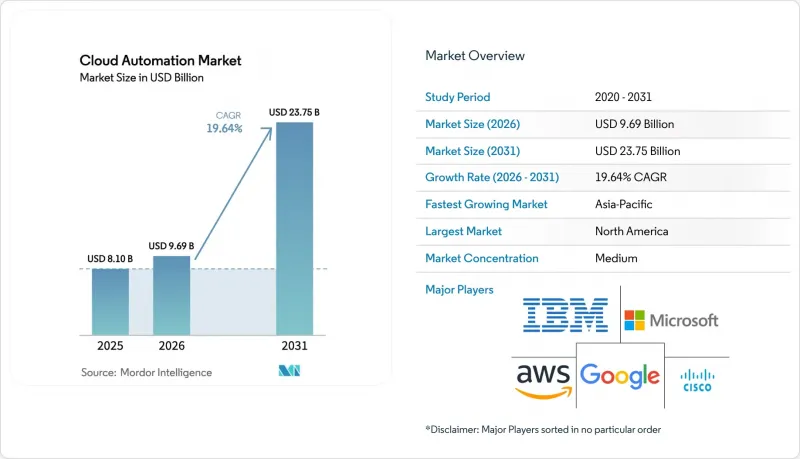
This report is Segmented by Deployment Model (Public Cloud, Private Cloud, and More), End-User Industry (BFSI, Healthcare, and More), Organization Size (Small and Medium Enterprises, and More), Workload/Process Type (Infrastructure Provisioning, Application Deployment, and More), and Geography (North America, South America, Europe, and More). The Market Forecasts are Provided in Terms of Value (USD).
Global Cloud Automation Market Trends and Insights
Proliferation of Multi-/Hybrid-Cloud Architectures
Multi-cloud and hybrid-cloud strategies have evolved beyond risk mitigation to become competitive differentiators, with several enterprises expected to operate across multiple cloud providers by 2024. This architectural shift drives demand for unified orchestration platforms that can abstract infrastructure complexity while maintaining workload portability and flexibility. The trend accelerates as data sovereignty regulations in the EU and Asia-Pacific require localized processing capabilities, forcing enterprises to deploy geographically distributed automation frameworks that can seamlessly manage workloads across sovereign boundaries.
DevOps and CI/CD Adoption Driving "Everything-as-Code"
As large enterprises increasingly form dedicated platform teams, platform engineering emerges as the dominant strategy for scaling DevOps practices. This evolution has spurred a heightened demand for self-service automation tools, empowering developers to provision infrastructure, deploy applications, and oversee security policies via code-driven workflows. Furthermore, this trend is paving the way for smaller automation vendors, who prioritize enhancing the developer experience. Organizations are actively seeking these nimble alternatives, moving away from traditional monolithic platforms that often stifle innovation and agility.
Persistent Privacy and Security Vulnerabilities
Cloud automation platforms are facing escalating security challenges as the attack surface expands across distributed infrastructure environments. The 2024 Cloud Security Alliance report documented a 47% increase in automation-related security incidents, primarily attributed to misconfigured access policies and inadequate management of secrets. This vulnerability creates hesitation among risk-averse enterprises, particularly in financial services and healthcare sectors, where regulatory compliance requirements demand zero-tolerance approaches to security breaches.
Other drivers and restraints analyzed in the detailed report include:
- FinOps Automation for Real-Time Cloud Cost Governance
- Accelerated Research and Development Spending on Cloud-Native Automation Tool-Sets
- Acute Skills Gap in Policy-as-Code Scripting
For complete list of drivers and restraints, kindly check the Table Of Contents.
Segment Analysis
Hybrid cloud automation commands the fastest growth trajectory, with a 19.98% CAGR through 2031, despite the public cloud maintaining the largest market share at 46.95% in 2025. This divergence reflects enterprises' strategic preference for workload flexibility over single-vendor dependencies, particularly as data residency requirements intensify across jurisdictions. Public cloud automation benefits from hyperscaler investments in AI-driven optimization capabilities, while private cloud segments serve specialized use cases requiring air-gapped security or ultra-low latency performance.
The deployment model landscape reveals distinct regional preferences, with North American enterprises favoring public cloud automation for cost efficiency, while European organizations prioritize hybrid approaches to address GDPR compliance requirements. Private cloud automation, although representing the smallest segment, remains relevant in highly regulated industries where data sovereignty concerns outweigh cost considerations. Edge computing integration is increasingly blurring traditional deployment boundaries, creating a demand for unified automation platforms that can orchestrate workloads across diverse infrastructure environments.
Manufacturing emerges as the fastest-growing end-user segment, with a 20.52% CAGR through 2031, driven by Industry 4.0 initiatives that require real-time automation across production environments. Smart factory implementations demand edge-to-cloud orchestration capabilities that can manage thousands of IoT devices while maintaining millisecond response times for critical control systems. IT and telecom maintain the largest market share at 26.35% in 2025, benefiting from early automation adoption and continuous infrastructure modernization requirements.
Healthcare automation adoption is accelerating as regulatory frameworks evolve to accommodate cloud-based patient data processing, with HIPAA-compliant automation platforms experiencing an 18.12% growth rate in 2025. BFSI segments demonstrate measured adoption patterns, prioritizing security and compliance automation over operational efficiency gains. Retail automation focuses on supply chain optimization and enhancing the customer experience, while other industries explore vertical-specific use cases, ranging from energy grid management to transportation logistics coordination.
Complete Report Scope:
- By Deployment Model
- Public Cloud
- Private Cloud
- Hybrid Cloud
- By End-user Industry
- BFSI
- Healthcare
- IT and Telecom
- Manufacturing
- Retail
- Other End-user Industry
- By Organization Size
- Small and Medium Enterprises (SMEs)
- Large Enterprises
- By Workload / Process Type
- Infrastructure Provisioning
- Application Deployment
- Security and Compliance
- Monitoring and Performance Management
- By Geography
- North America
- United States
- Canada
- Mexico
- South America
- Brazil
- Argentina
- Rest of South America
- Europe
- Germany
- United Kingdom
- France
- Italy
- Spain
- Russia
- Rest of Europe
- Asia-Pacific
- China
- Japan
- India
- South Korea
- South-East Asia
- Rest of Asia-Pacific
- Middle East and Africa
- Middle East
- Saudi Arabia
- United Arab Emirates
- Rest of Middle East
- Africa
- South Africa
- Egypt
- Rest of Africa
- Middle East
- North America
Geography Analysis
North America is expected to command a 32.75% market share in 2025, leveraging its mature cloud infrastructure and early enterprise adoption of automation frameworks. The region's growth trajectory reflects hyperscaler investments in AI-driven optimization capabilities and the proliferation of platform engineering practices among Fortune 500 companies. Canadian enterprises, in particular, focus on hybrid cloud automation to address data residency requirements while maintaining cross-border operational efficiency. Mexico's emerging manufacturing sector drives demand for Industry 4.0 automation solutions that can integrate with North American supply chains, creating opportunities for specialized automation platforms targeting cross-border operations.
The Asia-Pacific region's 20.64% CAGR through 2031 positions it as the primary growth engine for global cloud automation adoption. China's emphasis on domestic cloud platforms drives demand for automation tools that can operate within the country's unique regulatory environment, while Japan's aging workforce accelerates the adoption of automation across traditional industries. India's IT services sector serves as a global automation hub, with domestic vendors developing specialized platforms for international markets while addressing the cost-sensitive requirements of local enterprises. Southeast Asian economies benefit from government digitalization initiatives that mandate cloud-first approaches for public sector operations.
Europe's automation adoption reflects the region's dual focus on regulatory compliance and technological sovereignty, with GDPR and emerging AI regulations shaping platform selection criteria. Germany's Industrie 4.0 initiative drives demand for manufacturing automation, while the UK's post-Brexit regulatory landscape creates opportunities for automation platforms that can manage compliance across multiple jurisdictions. The region's commitment to sustainable technology practices favors automation platforms that can demonstrate measurable environmental benefits through optimized resource utilization and energy efficiency improvements.
- Amazon Web Services, Inc.
- Microsoft Corporation (Azure)
- Google LLC (Google Cloud Platform)
- IBM Corporation
- Oracle Corporation
- Cisco Systems, Inc.
- Hewlett Packard Enterprise Company
- Citrix Systems, Inc.
- Alibaba Cloud (Alibaba Group Holding Ltd.)
- Red Hat, Inc.
- ServiceNow, Inc.
- Puppet Labs, LLC
- Chef Software, Inc.
- HashiCorp, Inc.
- BMC Software, Inc.
- Micro Focus International plc
- Splunk Inc.
- Dynatrace LLC
- Turbonomic, Inc.
- CloudBolt Software, Inc.
- Morpheus Data, LLC
- Nutanix, Inc.
- Scalr, Inc.
- Opex Software, Inc.
Additional Benefits:
- The market estimate (ME) sheet in Excel format
- 3 months of analyst support
TABLE OF CONTENTS
1 INTRODUCTION
- 1.1 Study Assumptions and Market Definition
- 1.2 Scope of the Study
2 RESEARCH METHODOLOGY
3 EXECUTIVE SUMMARY
4 MARKET LANDSCAPE
- 4.1 Market Overview
- 4.2 Market Drivers
- 4.2.1 Surging need for low-cost storage and faster data access
- 4.2.2 Accelerated research and development spending on cloud-native automation tool-sets
- 4.2.3 Proliferation of multi-/hybrid-cloud architectures
- 4.2.4 DevOps and CI/CD adoption driving -everything-as-code-
- 4.2.5 FinOps automation for real-time cloud cost governance
- 4.2.6 Edge-to-cloud automation for Industry 4.0 micro-DCs
- 4.3 Market Restraints
- 4.3.1 Persistent privacy and security vulnerabilities
- 4.3.2 Legacy infrastructure technical debt
- 4.3.3 Cross-border regulatory compliance hurdles
- 4.3.4 Acute skills gap in policy-as-code scripting
- 4.4 Industry Value Chain Analysis
- 4.5 Regulatory Landscape
- 4.6 Impact of Macroeconomic Factors on the Market
- 4.7 Technological Outlook
- 4.8 Porter-s Five Forces Analysis
- 4.8.1 Bargaining Power of Suppliers
- 4.8.2 Bargaining Power of Buyers
- 4.8.3 Threat of New Entrants
- 4.8.4 Threat of Substitutes
- 4.8.5 Intensity of Competitive Rivalry
- 4.9 Investment Analysis
5 MARKET SIZE AND GROWTH FORECASTS (VALUE)
- 5.1 By Deployment Model
- 5.1.1 Public Cloud
- 5.1.2 Private Cloud
- 5.1.3 Hybrid Cloud
- 5.2 By End-user Industry
- 5.2.1 BFSI
- 5.2.2 Healthcare
- 5.2.3 IT and Telecom
- 5.2.4 Manufacturing
- 5.2.5 Retail
- 5.2.6 Other End-user Industry
- 5.3 By Organization Size
- 5.3.1 Small and Medium Enterprises (SMEs)
- 5.3.2 Large Enterprises
- 5.4 By Workload / Process Type
- 5.4.1 Infrastructure Provisioning
- 5.4.2 Application Deployment
- 5.4.3 Security and Compliance
- 5.4.4 Monitoring and Performance Management
- 5.5 By Geography
- 5.5.1 North America
- 5.5.1.1 United States
- 5.5.1.2 Canada
- 5.5.1.3 Mexico
- 5.5.2 South America
- 5.5.2.1 Brazil
- 5.5.2.2 Argentina
- 5.5.2.3 Rest of South America
- 5.5.3 Europe
- 5.5.3.1 Germany
- 5.5.3.2 United Kingdom
- 5.5.3.3 France
- 5.5.3.4 Italy
- 5.5.3.5 Spain
- 5.5.3.6 Russia
- 5.5.3.7 Rest of Europe
- 5.5.4 Asia-Pacific
- 5.5.4.1 China
- 5.5.4.2 Japan
- 5.5.4.3 India
- 5.5.4.4 South Korea
- 5.5.4.5 South-East Asia
- 5.5.4.6 Rest of Asia-Pacific
- 5.5.5 Middle East and Africa
- 5.5.5.1 Middle East
- 5.5.5.1.1 Saudi Arabia
- 5.5.5.1.2 United Arab Emirates
- 5.5.5.1.3 Rest of Middle East
- 5.5.5.2 Africa
- 5.5.5.2.1 South Africa
- 5.5.5.2.2 Egypt
- 5.5.5.2.3 Rest of Africa
- 5.5.5.1 Middle East
- 5.5.1 North America
6 COMPETITIVE LANDSCAPE
- 6.1 Market Concentration
- 6.2 Strategic Moves
- 6.3 Market Share Analysis
- 6.4 Company Profiles (includes Global-level Overview, Market-level Overview, Core Segments, Financials as available, Strategic Information, Market Rank/Share, Products and Services, Recent Developments)
- 6.4.1 Amazon Web Services, Inc.
- 6.4.2 Microsoft Corporation (Azure)
- 6.4.3 Google LLC (Google Cloud Platform)
- 6.4.4 IBM Corporation
- 6.4.5 Oracle Corporation
- 6.4.6 Cisco Systems, Inc.
- 6.4.7 Hewlett Packard Enterprise Company
- 6.4.8 Citrix Systems, Inc.
- 6.4.9 Alibaba Cloud (Alibaba Group Holding Ltd.)
- 6.4.10 Red Hat, Inc.
- 6.4.11 ServiceNow, Inc.
- 6.4.12 Puppet Labs, LLC
- 6.4.13 Chef Software, Inc.
- 6.4.14 HashiCorp, Inc.
- 6.4.15 BMC Software, Inc.
- 6.4.16 Micro Focus International plc
- 6.4.17 Splunk Inc.
- 6.4.18 Dynatrace LLC
- 6.4.19 Turbonomic, Inc.
- 6.4.20 CloudBolt Software, Inc.
- 6.4.21 Morpheus Data, LLC
- 6.4.22 Nutanix, Inc.
- 6.4.23 Scalr, Inc.
- 6.4.24 Opex Software, Inc.
7 MARKET OPPORTUNITIES AND FUTURE OUTLOOK
- 7.1 White-space and Unmet-Need Assessment

