PUBLISHER: Mordor Intelligence | PRODUCT CODE: 2117278

PUBLISHER: Mordor Intelligence | PRODUCT CODE: 2117278
Music App - Market Share Analysis, Industry Trends & Statistics, Growth Forecasts (2026 - 2031)
According to Mordor Intelligence, the music app market size in 2026 is estimated at USD 30.28 billion, growing from 2025 value of USD 28.99 billion with 2031 projections showing USD 37.62 billion, growing at 4.44% CAGR over 2026-2031.
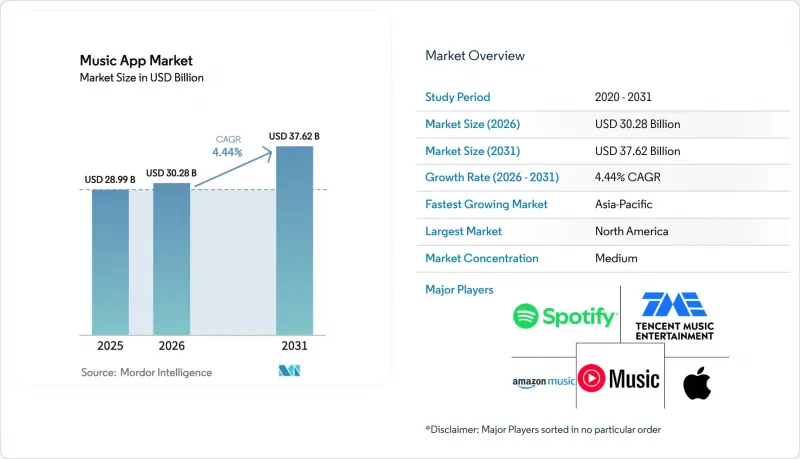
This report is Segmented by Monetization Model (In-App Purchases, Subscriptions, Advertising-Supported, Hybrid and Other Models), Platform (Android, IOS, Web/Desktop, Smart Speakers and Connected Devices), Content Type (Music Streaming, Podcast and Spoken Audio, and More), Age Group (13-24 Years, 25-34 Years, 35-44 Years, 45 Years and Above), and Geography. The Market Forecasts are Provided in Terms of Value (USD).
Global Music App Market Trends and Insights
Rising Adoption of Paid Music-Streaming Subscriptions
Subscription conversion momentum continues to climb as platforms refine value propositions through exclusive content bundles and dynamic pricing. Universal Music Group reported EUR 1.61 billion (USD 1.77 billion) in subscription and streaming revenue for Q1 2025, up 7.2% year over year, reflecting robust paid-user growth. Tencent Music Entertainment added 13.4% more paying users in China, reaching 121 million and lifting monthly ARPPU to RMB 11.1 (USD 1.6), underscoring price elasticity even in cost-sensitive markets. Platforms also leverage diversified content-podcasts, audiobooks, and artist exclusives to reinforce perceived value and justify incremental price steps.
Growing Smartphone Penetration and Mobile-Data Affordability
Low-cost Android devices and competitive data plans have unlocked vast rural and youth cohorts. In India, streaming constituted 88% of recorded-music revenue in 2024, with listeners averaging 26.7 hours per week 30% above the global mean. Carrier-billing rails such as Airtel Mobile Money now plug more than 31.5 million Kenyans directly into app stores, removing credit-card dependence and expanding the music app market.
Escalating Content-Licensing Costs Compressing Margins
Mechanical royalty rates effective January 2025 rose to 12.7 cents per song plus 2.45 cents per minute, lifting cost bases for every major platform. Spotify's rule that tracks must hit 1,000 streams within 12 months before earning royalties reflects attempts to triage payouts and protect gross margin. High fees hit hardest in low-ARPU emerging markets, challenging scalability and potentially driving price tier differentiation.
Other drivers and restraints analyzed in the detailed report include:
- Integration with Smart Speakers and Connected Cars
- Expansion of Global Licensing Agreements and Catalog Depth
- High Churn Amid Intense Platform Competition
For complete list of drivers and restraints, kindly check the Table Of Contents.
Segment Analysis
Subscription services commandeered 66.42% music app market share in 2025, translating into predictable recurring revenue that underpins most platform valuations. Hybrid freemium tiers, however, are projected to grow 13.58% annually as platforms accommodate variable purchasing power. Spotify's USD 11.99 Premium and lower-priced Basic options illustrate layered monetization that widens the funnel while preserving yield. Tencent Music Entertainment diversified revenue to RMB 21.74 billion (USD 3.04 billion) in 2024, combining subscriptions, virtual albums, and live events. Carrier billing proliferation is expected to add tens of millions of first-time payers, broadening the music app market size for lower-priced introductory plans. Advertising-supported models remain essential in markets where average disposable income constrains subscription uptake, but rising ad loads risk dampening user satisfaction and could speed the pivot to micro-payment or creator-tip mechanisms.
The music app market is evolving toward blended income streams that fuse subscriptions, micro-transactions, and contextual advertising. As catalog costs climb, platforms favor higher-margin verticals such as podcast ads and live-event ticketing. Analysts expect subscription ARPU to stabilize as bundles replace single-format offerings, reducing churn and smoothing revenue for rights-holders. Competitive advantage will rest on data-driven segmentation that aligns tier pricing with regional income bands and content preferences, ensuring the music app market size expands without sacrificing profitability.
Android commanded 71.05% of global installations in 2025, anchored by its ubiquity in emerging economies. Despite this dominance, smart speakers and connected devices are surging at an 17.25% CAGR, signaling the next frontier for the music app market. Voice-first usage simplifies discovery, while in-car integration captures captive commuting time. iOS, although smaller in user count, delivers higher per-capita revenue, reinforced by Apple's ecosystem stickiness. Desktop platforms play a complementary role for playlist management and creator tools, especially in professional and prosumer circles.
Connected cars are becoming significant demand drivers; KUKE Music now reaches 100 million Chinese in-vehicle users through partnerships covering 90% of local OEMs. BMW streams classical performances direct to dashboards, illustrating niche-content differentiation strategies. These developments suggest that future music app market share gains will hinge on seamless cross-device continuity rather than mobile-only dominance. Platforms investing early in automotive SDKs and smart-home APIs are poised to secure outsized influence as screenless listening accelerates.
Complete Report Scope:
- By Monetization Model
- In-App Purchases
- Subscriptions
- Advertising-Supported
- Hybrid and Other Models
- By Platform
- Android
- iOS
- Web/Desktop
- Smart Speakers and Connected Devices
- By Content Type
- Music Streaming
- Podcast and Spoken Audio
- Live Audio and Events
- High-Resolution and Lossless Streaming
- By Age Group
- 13-24 Years
- 25-34 Years
- 35-44 Years
- 45 Years and Above
- By Geography
- North America
- United States
- Canada
- South America
- Brazil
- Argentina
- Rest of South America
- Europe
- United Kingdom
- Germany
- France
- Spain
- Italy
- Russia
- Rest of Europe
- Asia Pacific
- China
- India
- Japan
- South Korea
- Australia and New Zealand
- Rest of Asia Pacfic
- Middle East and Africa
- Middle East
- Saudi Arabia
- United Arab Emirates
- Turkey
- Rest of Middle East
- Africa
- South Africa
- Nigeria
- Rest of Africa
- Middle East
- North America
Geography Analysis
North America retained 46.58% music app market share in 2025, driven by high-value subscribers willing to pay USD-level premiums for lossless audio and bundled services. Apple's Services segment generated USD 26.3 billion in Q1 FY25, highlighting the region's monetization depth. However, saturation is slowing net additions, shifting strategic emphasis to ARPU optimization via multi-format bundles and connected-device upsells. Regulatory headwinds around royalty transparency and antitrust scrutiny are intensifying, influencing content-licensing negotiations and platform fee structures.
Asia-Pacific delivered the fastest growth at 24.70% CAGR through 2031, propelled by India's mobile-first adoption and China's scale. Tencent Music Entertainment reported RMB 28.40 billion (USD 3.98 billion) in 2024 revenue, with premium service upselling offsetting a user-base contraction. India's users average 26.7 hours of weekly listening, yet subscription penetration remains low, presenting a sizable conversion opportunity. Carrier billing and localized pricing models are essential for unlocking this latent demand.
Europe posted steady 8.05% growth in 2025 as supportive digital-single-market regulations and affluent audiences sustain healthy paid uptake. Latin America advanced 21.9%, with Mexico entering the global top-10 recorded-music markets, demonstrating Spanish-language catalog power. Middle East and North Africa grew 22.1%, with Anghami emphasizing Arabic content and culturally aligned UX. Sub-Saharan Africa's 24.0% growth potential hinges on continued investment in network infrastructure and micro-payment solutions that align with lower income levels.
- Spotify AB
- Apple Inc.
- Amazon.com, Inc.
- Alphabet Inc. (YouTube Music)
- Tencent Music Entertainment Group
- NetEase, Inc.
- Deezer SA
- SoundCloud Global Limited and Co. KG
- Pandora Media, LLC
- Tidal Music AS
- Wynk Limited
- ByteDance Ltd. (Resso)
- Saavn Media Private Limited (JioSaavn)
- Anghami PLC
- Idagio GmbH
- Napster Group PLC
- KKBOX Inc.
- Yandex LLC (Yandex Music)
- iHeartMedia, Inc. (iHeartRadio)
- Sirius XM Holdings Inc.
- TuneIn, Inc.
- Boomplay Digital Service Limited
- Qobuz Xandrie SA
Additional Benefits:
- The market estimate (ME) sheet in Excel format
- 3 months of analyst support
TABLE OF CONTENTS
1 INTRODUCTION
- 1.1 Study Assumptions and Market Definition
- 1.2 Scope of the Study
2 RESEARCH METHODOLOGY
3 EXECUTIVE SUMMARY
4 MARKET LANDSCAPE
- 4.1 Market Overview
- 4.2 Market Drivers
- 4.2.1 Rising adoption of paid music-streaming subscriptions
- 4.2.2 Growing smartphone penetration and mobile-data affordability
- 4.2.3 Integration with smart speakers and connected cars
- 4.2.4 Expansion of global licensing agreements and catalog depth
- 4.2.5 AI-driven hyper-personalisation boosting retention (under-radar)
- 4.2.6 Carrier-billing uptake in emerging markets enabling paid users (under-radar)
- 4.3 Market Restraints
- 4.3.1 Escalating content-licensing costs compressing margins
- 4.3.2 High churn amid intense platform competition
- 4.3.3 Regulatory scrutiny on royalties and antitrust issues
- 4.3.4 Sustainability concerns over streaming energy use (under-radar)
- 4.4 Value / Supply-Chain Analysis
- 4.5 Regulatory Landscape
- 4.6 Technological Outlook
- 4.7 Porter's Five Forces Analysis
- 4.7.1 Bargaining Power of Suppliers
- 4.7.2 Bargaining Power of Buyers
- 4.7.3 Threat of New Entrants
- 4.7.4 Threat of Substitutes
- 4.7.5 Competitive Rivalry
5 MARKET SIZE AND GROWTH FORECASTS (VALUE)
- 5.1 By Monetization Model
- 5.1.1 In-App Purchases
- 5.1.2 Subscriptions
- 5.1.3 Advertising-Supported
- 5.1.4 Hybrid and Other Models
- 5.2 By Platform
- 5.2.1 Android
- 5.2.2 iOS
- 5.2.3 Web/Desktop
- 5.2.4 Smart Speakers and Connected Devices
- 5.3 By Content Type
- 5.3.1 Music Streaming
- 5.3.2 Podcast and Spoken Audio
- 5.3.3 Live Audio and Events
- 5.3.4 High-Resolution and Lossless Streaming
- 5.4 By Age Group
- 5.4.1 13-24 Years
- 5.4.2 25-34 Years
- 5.4.3 35-44 Years
- 5.4.4 45 Years and Above
- 5.5 By Geography
- 5.5.1 North America
- 5.5.1.1 United States
- 5.5.1.2 Canada
- 5.5.2 South America
- 5.5.2.1 Brazil
- 5.5.2.2 Argentina
- 5.5.2.3 Rest of South America
- 5.5.3 Europe
- 5.5.3.1 United Kingdom
- 5.5.3.2 Germany
- 5.5.3.3 France
- 5.5.3.4 Spain
- 5.5.3.5 Italy
- 5.5.3.6 Russia
- 5.5.3.7 Rest of Europe
- 5.5.4 Asia Pacific
- 5.5.4.1 China
- 5.5.4.2 India
- 5.5.4.3 Japan
- 5.5.4.4 South Korea
- 5.5.4.5 Australia and New Zealand
- 5.5.4.6 Rest of Asia Pacfic
- 5.5.5 Middle East and Africa
- 5.5.5.1 Middle East
- 5.5.5.1.1 Saudi Arabia
- 5.5.5.1.2 United Arab Emirates
- 5.5.5.1.3 Turkey
- 5.5.5.1.4 Rest of Middle East
- 5.5.5.2 Africa
- 5.5.5.2.1 South Africa
- 5.5.5.2.2 Nigeria
- 5.5.5.2.3 Rest of Africa
- 5.5.5.1 Middle East
- 5.5.1 North America
6 COMPETITIVE LANDSCAPE
- 6.1 Market Concentration
- 6.2 Strategic Moves
- 6.3 Market Share Analysis
- 6.4 Company Profiles (includes Global level Overview, Market level overview, Core Segments, Financials as available, Strategic Information, Market Rank/Share for key companies, Products and Services, and Recent Developments)
- 6.4.1 Spotify AB
- 6.4.2 Apple Inc.
- 6.4.3 Amazon.com, Inc.
- 6.4.4 Alphabet Inc. (YouTube Music)
- 6.4.5 Tencent Music Entertainment Group
- 6.4.6 NetEase, Inc.
- 6.4.7 Deezer SA
- 6.4.8 SoundCloud Global Limited and Co. KG
- 6.4.9 Pandora Media, LLC
- 6.4.10 Tidal Music AS
- 6.4.11 Wynk Limited
- 6.4.12 ByteDance Ltd. (Resso)
- 6.4.13 Saavn Media Private Limited (JioSaavn)
- 6.4.14 Anghami PLC
- 6.4.15 Idagio GmbH
- 6.4.16 Napster Group PLC
- 6.4.17 KKBOX Inc.
- 6.4.18 Yandex LLC (Yandex Music)
- 6.4.19 iHeartMedia, Inc. (iHeartRadio)
- 6.4.20 Sirius XM Holdings Inc.
- 6.4.21 TuneIn, Inc.
- 6.4.22 Boomplay Digital Service Limited
- 6.4.23 Qobuz Xandrie SA
7 MARKET OPPORTUNITIES AND FUTURE OUTLOOK
- 7.1 White-space and Unmet-Need Assessment

