PUBLISHER: Mordor Intelligence | PRODUCT CODE: 2120531

PUBLISHER: Mordor Intelligence | PRODUCT CODE: 2120531
Cloud Music Services - Market Share Analysis, Industry Trends & Statistics, Growth Forecasts (2026 - 2031)
According to Mordor Intelligence, the cloud music services market size is expected to grow from USD 16.42 billion in 2025 to USD 18.18 billion in 2026 and is forecast to reach USD 30.24 billion by 2031 at 10.71% CAGR over 2026-2031.
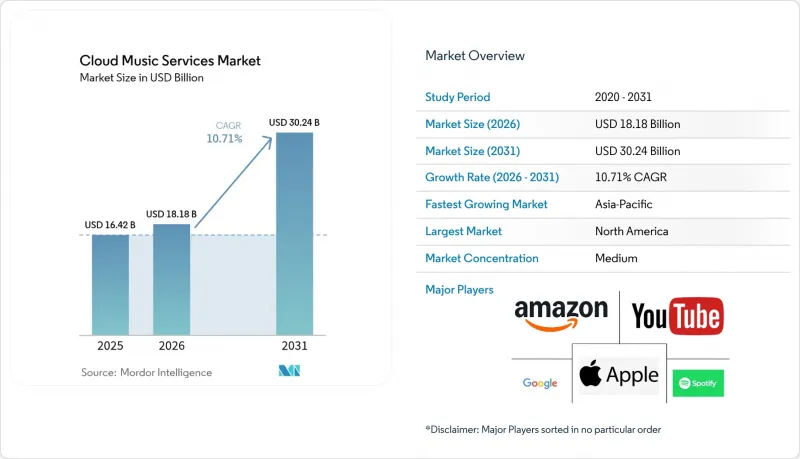
This report is Segmented by Service Type (On-Demand Streaming, and More), Revenue Model (Subscription, Ad-Supported, and More), Platform (Smartphones, and More), End User (Individual Consumers, and Commercial and Enterprise), Content Type (Audio-Only Music, and More), and Geography (North America, South America, Europe, Asia Pacific, and More). The Market Forecasts are Provided in Terms of Value (USD).
Global Cloud Music Services Market Trends and Insights
Rising Smartphone Penetration and Affordable Data
India added approximately 50 million smartphone users in 2024, and sub-Saharan Africa recorded double-digit growth in mobile broadband lines. Meanwhile, data tariffs fell by 15% to 20% in India, Indonesia, and Nigeria. Ubiquitous connectivity has shifted millions from radio or sideloaded files to cloud catalogs, accelerating the adoption of the cloud music services market. Telcos, from Reliance Jio to Claro, embed streaming into prepaid bundles and reduce acquisition costs for platforms. Lower data pricing creates a virtuous circle where streaming usage justifies further network upgrades, which in turn support richer audio and video formats. Platforms that secure carrier partnerships win shelf space on devices, simplify billing, and unlock the next billion listeners.
Paid Streaming Price Increases Boosting ARPU
Spotify increased its US individual plan from USD 9.99 to USD 10.99 in 2024, and Apple Music followed a similar move across Europe. A one-dollar rise across Spotify's 226 million premium base equates to roughly USD 2.7 billion in extra annual revenue. Early churn only ticked up one to two points because playlists, social features, and device integration create switching costs. Nonetheless, consumer surveys flag resistance at monthly prices above USD 15, so platforms are layering premium "superfan" tiers rather than pushing the headline rate too quickly. The price-led ARPU lift shores margins in the cloud music services market, even as royalty costs climb.
Royalty Cost Pressure on Platform Profitability
Music licenses absorb 65% to 75% of streaming revenue. Spotify's 2024 filings showed royalties accounting for nearly 70% of revenue, resulting in single-digit operating margins. Mid-tier players such as Deezer remain loss-making despite surpassing 10 million subscribers. Since labels can withdraw catalogs, platforms have little leverage to lower rates, pushing them to diversify into owned podcasts or direct artist deals. High payout ratios limit capital for product innovation and slow profitability improvement in the cloud music services market.
Other drivers and restraints analyzed in the detailed report include:
- Emergence of Superfan Monetization Tiers
- AI-Driven Personalization Enhancing Engagement
- Intense Competition and Subscription Churn
For complete list of drivers and restraints, kindly check the Table Of Contents.
Segment Analysis
On-demand streaming accounted for 83.01% of revenue in 2025, underscoring its dominance in the cloud music services market. Live music streaming is forecast to grow at a 12.96% CAGR as concert broadcasts, backstage Q&As, and virtual festivals become staples on major platforms. Amazon Music Live taps prime-time audiences during Thursday Night Football, while Apple Music streams intimate shows that spark social buzz.
Live content introduces scarcity and appointment viewing, deepening fan loyalty and driving incremental monetization such as virtual tickets. Locker-style cloud storage remains relevant in bandwidth-constrained areas and among audiophiles storing lossless files, but falling storage costs and the advent of 5G are reducing its mass appeal. The segment mix reflects a broader shift in the cloud music services market, where experiential features complement catalog access to sustain engagement and raise switching costs.
Subscription plans accounted for 78.05% of 2025 revenue, solidifying their role as the economic engine of the cloud music services market. Freemium tiers are projected to expand at a rate of 12.21% as platforms fine-tune ad loads, skip limits, and trial offers to transition free listeners into paid tiers. Spotify's free base of 348 million monthly users feeds a steady upgrade pipeline.
Ad-supported users deliver USD 5 to USD 7 per year, compared with about USD 120 for premium subscribers, yet they lower acquisition costs and widen global reach. Conversion efficiency relies on predictive analytics that identify high-propensity cohorts for discounted trials. Pure ad-only models struggle as on-demand access becomes a table-stakes requirement. Blended revenue streams, therefore, remain central to sustaining growth in the cloud music services market.
Complete Report Scope:
- By Service Type
- On-Demand Streaming
- Cloud Music Storage And Locker
- Live Music Streaming
- By Revenue Model
- Subscription
- Ad-Supported
- Hybrid / Freemium
- By Platform
- Smartphones
- Smart Speakers And Wearables
- Pcs And Laptops
- Automotive Infotainment
- By End User
- Individual Consumers
- Commercial And Enterprise (Retail, Hospitality, Fitness)
- By Content Type
- Audio-Only Music
- Podcasts And Audio Shows
- Video Music Content
- By Geography
- North America
- United States
- Canada
- Mexico
- South America
- Brazil
- Argentina
- Rest of South America
- Europe
- United Kingdom
- Germany
- France
- Italy
- Spain
- Russia
- Rest of Europe
- Asia Pacific
- China
- Japan
- India
- South Korea
- Australia
- Rest of Asia Pacific
- Middle East
- Saudi Arabia
- United Arab Emirates
- Turkey
- Rest of Middle East
- Africa
- South Africa
- Nigeria
- Egypt
- Rest of Africa
- North America
Geography Analysis
North America controlled 41.92% of 2025 revenue, reflecting high ARPU and near-saturation subscription levels in the cloud music services market. Growth now hinges on selective price increases, account sharing crackdowns, and the uptake of superfan tiers. The region also serves as a test bed for new features, including AI DJs and high-resolution audio, before they are rolled out globally. State privacy laws and pending federal algorithm transparency proposals increase compliance costs that smaller challengers struggle to absorb, thereby reinforcing the incumbent's advantage.
Asia Pacific is projected to grow at 11.52% through 2031, driven by subscriber gains in China, India, and Southeast Asia. Tencent Music reached 119.8 million paying users in Q3 2024 and generated revenue of CNY 7.02 billion (USD 0.99 billion). NetEase Cloud Music achieved 49 million payers and CNY 2.5 billion (USD 0.35 billion) revenue in the same period. Local ecosystem integration and telco bundles underpin rapid expansion. In India, JioSaavn leverages Reliance Jio distribution to exceed 100 million users, demonstrating the power of bundled data plans.
Europe, South America, the Middle East, and Africa collectively account for approximately 45.98% of global revenue. Europe exhibits high penetration, but faces heavier regulation under the Digital Services Act and Copyright Directive, resulting in increased operating overheads. South America benefits from falling handset costs yet faces currency volatility that complicates pricing. The Middle East and Africa showcase regional platforms like Anghami and Boomplay, which thrive through localized catalogs and handset pre-installation. Diverse regional dynamics make localization and flexible payment options decisive for success in the cloud music services market.
- Spotify Ab
- Apple Inc.
- Amazon.com Inc.
- Google Llc
- Youtube Llc
- Tencent Music Entertainment Group
- Netease Cloud Music Co. Ltd.
- Deezer Sa
- Pandora Media Llc
- Sirius Xm Holdings Inc.
- Sound Cloud Global Limited & Co. Kg
- Tidal Music As
- Anghami Plc
- Gaana Entertainment Pvt. Ltd.
- Jiosaavn Media Pvt. Ltd.
- Kkbox Inc.
- Boomplay Digital Services Ltd.
- Qobuz Usa Llc
- Iheartradio Inc.
- Soundmachine Llc
- Soundtrack Your Brand Sweden Ab
- Yandex Llc
- Di.fm Llc
- Mixcloud Ltd.
- Resso Music Technology Pte. Ltd.
Additional Benefits:
- The market estimate (ME) sheet in Excel format
- 3 months of analyst support
TABLE OF CONTENTS
1 INTRODUCTION
- 1.1 Study Assumptions And Market Definition
- 1.2 Scope Of The Study
2 RESEARCH METHODOLOGY
3 EXECUTIVE SUMMARY
4 MARKET LANDSCAPE
- 4.1 Market Overview
- 4.2 Market Drivers
- 4.2.1 Rising Smartphone Penetration And Affordable Data
- 4.2.2 Paid Streaming Price Increases Boosting Arpu
- 4.2.3 Emergence Of Superfan Monetisation Tiers
- 4.2.4 Ai-Driven Personalisation Enhancing Engagement
- 4.2.5 Cloud-Native Creator Tools Expanding Long-Tail Supply
- 4.2.6 Regional Telco-Bundle Partnerships Accelerating Adoption
- 4.3 Market Restraints
- 4.3.1 Royalty Cost Pressure On Platform Profitability
- 4.3.2 Intense Competition And Subscription Churn
- 4.3.3 Piracy And Stream-Ripping Services
- 4.3.4 Streaming Fraud And Fake-Stream Manipulation
- 4.4 Industry Value Chain Analysis
- 4.5 Regulatory Landscape
- 4.6 Technological Outlook
- 4.7 Impact Of Macroeconomic Factors On The Market
- 4.8 Porter's Five Forces Analysis
- 4.8.1 Bargaining Power Of Buyers
- 4.8.2 Bargaining Power Of Suppliers
- 4.8.3 Threat Of New Entrants
- 4.8.4 Threat Of Substitute Products
- 4.8.5 Intensity Of Competitive Rivalry
5 MARKET SIZE And Growth Forecasts
- 5.1 By Service Type
- 5.1.1 On-Demand Streaming
- 5.1.2 Cloud Music Storage And Locker
- 5.1.3 Live Music Streaming
- 5.2 By Revenue Model
- 5.2.1 Subscription
- 5.2.2 Ad-Supported
- 5.2.3 Hybrid / Freemium
- 5.3 By Platform
- 5.3.1 Smartphones
- 5.3.2 Smart Speakers And Wearables
- 5.3.3 Pcs And Laptops
- 5.3.4 Automotive Infotainment
- 5.4 By End User
- 5.4.1 Individual Consumers
- 5.4.2 Commercial And Enterprise (Retail, Hospitality, Fitness)
- 5.5 By Content Type
- 5.5.1 Audio-Only Music
- 5.5.2 Podcasts And Audio Shows
- 5.5.3 Video Music Content
- 5.6 By Geography
- 5.6.1 North America
- 5.6.1.1 United States
- 5.6.1.2 Canada
- 5.6.1.3 Mexico
- 5.6.2 South America
- 5.6.2.1 Brazil
- 5.6.2.2 Argentina
- 5.6.2.3 Rest of South America
- 5.6.3 Europe
- 5.6.3.1 United Kingdom
- 5.6.3.2 Germany
- 5.6.3.3 France
- 5.6.3.4 Italy
- 5.6.3.5 Spain
- 5.6.3.6 Russia
- 5.6.3.7 Rest of Europe
- 5.6.4 Asia Pacific
- 5.6.4.1 China
- 5.6.4.2 Japan
- 5.6.4.3 India
- 5.6.4.4 South Korea
- 5.6.4.5 Australia
- 5.6.4.6 Rest of Asia Pacific
- 5.6.5 Middle East
- 5.6.5.1 Saudi Arabia
- 5.6.5.2 United Arab Emirates
- 5.6.5.3 Turkey
- 5.6.5.4 Rest of Middle East
- 5.6.6 Africa
- 5.6.6.1 South Africa
- 5.6.6.2 Nigeria
- 5.6.6.3 Egypt
- 5.6.6.4 Rest of Africa
- 5.6.1 North America
6 COMPETITIVE LANDSCAPE
- 6.1 Market Concentration
- 6.2 Strategic Moves
- 6.3 Market Share Analysis
- 6.4 Company Profiles {(Includes Global Level Overview, Market Level Overview, Core Segments, Financials As Available, Strategic Information, Market Rank/Share For Key Companies, Products And Services, And Recent Developments)}
- 6.4.1 Spotify Ab
- 6.4.2 Apple Inc.
- 6.4.3 Amazon.com Inc.
- 6.4.4 Google Llc
- 6.4.5 Youtube Llc
- 6.4.6 Tencent Music Entertainment Group
- 6.4.7 Netease Cloud Music Co. Ltd.
- 6.4.8 Deezer Sa
- 6.4.9 Pandora Media Llc
- 6.4.10 Sirius Xm Holdings Inc.
- 6.4.11 Sound Cloud Global Limited & Co. Kg
- 6.4.12 Tidal Music As
- 6.4.13 Anghami Plc
- 6.4.14 Gaana Entertainment Pvt. Ltd.
- 6.4.15 Jiosaavn Media Pvt. Ltd.
- 6.4.16 Kkbox Inc.
- 6.4.17 Boomplay Digital Services Ltd.
- 6.4.18 Qobuz Usa Llc
- 6.4.19 Iheartradio Inc.
- 6.4.20 Soundmachine Llc
- 6.4.21 Soundtrack Your Brand Sweden Ab
- 6.4.22 Yandex Llc
- 6.4.23 Di.fm Llc
- 6.4.24 Mixcloud Ltd.
- 6.4.25 Resso Music Technology Pte. Ltd.
7 MARKET Opportunities And Future Outlook
- 7.1 White-Space And Unmet-Need Assessment

