PUBLISHER: Mordor Intelligence | PRODUCT CODE: 2117279

PUBLISHER: Mordor Intelligence | PRODUCT CODE: 2117279
Middle-East And Africa Carbon Black - Market Share Analysis, Industry Trends & Statistics, Growth Forecasts (2026 - 2031)
According to Mordor Intelligence, the middle-East and Africa Carbon Black Market size is expected to grow from USD 403.72 million in 2025 to USD 417.93 million in 2026 and is forecast to reach USD 496.62 million by 2031 at 3.52% CAGR over 2026-2031.
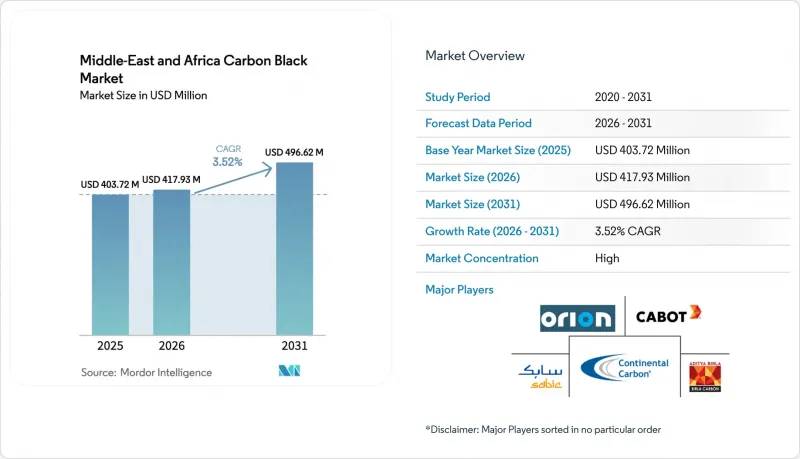
This report is Segmented by Process Type (Furnace Black, Gas Black, Lamp Black, and More), Application (Tires and Industrial Rubber Products, Plastics, Toners and Printing Inks, Paints and Coatings, and More), and Geography (Saudi Arabia, United Arab Emirates, Qatar, Kuwait, Turkey, South Africa, Egypt, Nigeria, and More). The Market Forecasts are Provided in Terms of Value (USD).
Middle-East And Africa Carbon Black Market Trends and Insights
Growing Application in Fiber and Textile Industries
Advanced fiber-modification techniques now embed carbon black pigments that deliver antimicrobial protection against Staphylococcus aureus and Escherichia coli, helping regional mills supply healthcare and hygiene fabrics. Turkey benefits by aligning these technologies with its Twelfth Development Plan green mandates, while Egypt's petrochemical complex secures upstream feedstock. The integration of carbon black in nylon, polyester, and acrylic fibers spreads demand beyond commodity apparel into higher-value technical textiles. As brands pursue traceable and sustainable inputs, specialty black grades gain pricing power and longer contracts.
Expansion of Automotive and Tire Sector
Saudi Arabia's USD 550 million Pirelli plant in King Abdullah Economic City will roll out 3.5 million passenger tires annually from 2026, locking in furnace-grade volumes for two decades. Localization extends into electric-vehicle housings, battery components, and sealing systems, all of which employ tailored carbon black dispersions. Turkey leverages EU proximity to supply emission-compliant tire lines, while the United Arab Emirates channels petrochemical intermediates into synthetic rubber. Construction and mining projects across the Gulf and Africa further enlarge off-highway tire demand, reinforcing steady shipments of abrasion-resistant reinforcement blacks. Collectively, these dynamics anchor long-term baseline consumption even as vehicle electrification reshapes materials mixes.
Accelerating Switch to Silica-Based "Green" Tires
OEM mandates for lower rolling resistance drive the replacement of carbon black with precipitated silica and silane coupling agents that cut fuel consumption by as much as 7%. While silica improves wet grip, it complicates tire recycling and raises compounding costs, forcing Turkish plants to retrofit mixers and sourcing logistics. The transition threatens baseline demand for furnace blacks used in passenger car treads across the GCC. Producers respond by co-developing hybrid filler systems and expanding into specialty blacks for sidewalls and inner liners that retain reinforcement roles.
Other drivers and restraints analyzed in the detailed report include:
- Surge in Conductive Carbon Black for Li-ion Battery Gigafactories
- Recovered Carbon Black Uptake in Circular-Economy Road Projects
- Volatile Feedstock Pricing and Supply Risk
For complete list of drivers and restraints, kindly check the Table Of Contents.
Segment Analysis
Furnace Black contributed 71.62% of regional revenue in 2025 and is projected to expand at 4.31% CAGR through 2031, supported by retrofits that recover waste heat and lower SOx emissions. Producers in Saudi Arabia and the United Arab Emirates leverage captive feedstock from steam crackers to maintain continuous operations and tight particle-size control. Gas Black retains niche status for high-jetness inks and Li-ion electrodes, yet supply remains constrained by reactor complexity. Lamp Black grows steadily in inks and coatings for metal packaging, benefiting from e-commerce-driven canning volumes. Thermal Black and Acetylene Black provide specialty conductivity in wire and cable insulation. The process landscape favors integrated refiners able to monetize by-product streams while meeting tightening emission caps.
Complete Report Scope:
- By Process Type
- Furnace Black
- Gas Black
- Lamp Black
- Thermal Black
- Hexamine
- By Application
- Tires and Industrial Rubber Products
- Plastics
- Films and Sheets
- Pressure Pipes
- Molded Parts
- Toners and Printing Inks
- Paints and Coatings
- Textile Fibres
- Nylon
- Polyester
- Acrylic
- Other Applications (Energy Storage Materials, etc.)
- By Geography
- Saudi Arabia
- United Arab Emirates
- Qatar
- Kuwait
- Turkey
- South Africa
- Egypt
- Nigeria
- Morocco
- Rest of Middle-East and Africa
- Saudi Arabia
List of Companies Covered in this Report:
- ADNOC (Abu Dhabi National Oil Co.)
- Balkrishna Industries Ltd.
- Birla Carbon
- Cabot Corporation
- Continental Carbon Company
- Datwyler Holding Inc.
- Epsilon Carbon Private Limited.
- Himadri Speciality Chemicals Limited
- Imerys
- Omsk Carbon Group
- Orion S.A
- PCBL Chemical Limited
- SABIC
Additional Benefits:
- The market estimate (ME) sheet in Excel format
- 3 months of analyst support
TABLE OF CONTENTS
1 Introduction
- 1.1 Study Assumptions and Market Definition
- 1.2 Scope of the Study
2 Research Methodology
3 Executive Summary
4 Market Landscape
- 4.1 Market Overview
- 4.2 Market Drivers
- 4.2.1 Growing Application in Fiber and Textile Industries
- 4.2.2 Expansion of Automotive and Tire Sector
- 4.2.3 Surge in Conductive Carbon Black for Li-ion Battery Gigafactories
- 4.2.4 Recovered Carbon Black Uptake in Circular-Economy Road Projects
- 4.2.5 Increasing Market Penetration of Specialty Black
- 4.3 Market Restraints
- 4.3.1 Accelerating Switch to Silica-Based "Green" Tires
- 4.3.2 Volatile Feedstock Pricing and Supply Risk
- 4.3.3 Competition from Low-Cost Asian Imports
- 4.4 Value Chain Analysis
- 4.5 Porter's Five Forces
- 4.5.1 Bargaining Power of Suppliers
- 4.5.2 Bargaining Power of Buyers
- 4.5.3 Threat of New Entrants
- 4.5.4 Threat of Substitutes
- 4.5.5 Degree of Competition
5 Market Size and Growth Forecasts (Value)
- 5.1 By Process Type
- 5.1.1 Furnace Black
- 5.1.2 Gas Black
- 5.1.3 Lamp Black
- 5.1.4 Thermal Black
- 5.1.5 Hexamine
- 5.2 By Application
- 5.2.1 Tires and Industrial Rubber Products
- 5.2.2 Plastics
- 5.2.2.1 Films and Sheets
- 5.2.2.2 Pressure Pipes
- 5.2.2.3 Molded Parts
- 5.2.3 Toners and Printing Inks
- 5.2.4 Paints and Coatings
- 5.2.5 Textile Fibres
- 5.2.5.1 Nylon
- 5.2.5.2 Polyester
- 5.2.5.3 Acrylic
- 5.2.6 Other Applications (Energy Storage Materials, etc.)
- 5.3 By Geography
- 5.3.1 Saudi Arabia
- 5.3.1.1 United Arab Emirates
- 5.3.1.2 Qatar
- 5.3.1.3 Kuwait
- 5.3.1.4 Turkey
- 5.3.1.5 South Africa
- 5.3.1.6 Egypt
- 5.3.1.7 Nigeria
- 5.3.1.8 Morocco
- 5.3.1.9 Rest of Middle-East and Africa
- 5.3.1 Saudi Arabia
6 Competitive Landscape
- 6.1 Market Concentration
- 6.2 Strategic Moves
- 6.3 Market Share(%)/Ranking Analysis
- 6.4 Company Profiles (includes Global level Overview, Market level overview, Core Segments, Financials as available, Strategic Information, Market Rank/Share, Products and Services, Recent Developments)
- 6.4.1 ADNOC (Abu Dhabi National Oil Co.)
- 6.4.2 Balkrishna Industries Ltd.
- 6.4.3 Birla Carbon
- 6.4.4 Cabot Corporation
- 6.4.5 Continental Carbon Company
- 6.4.6 Datwyler Holding Inc.
- 6.4.7 Epsilon Carbon Private Limited.
- 6.4.8 Himadri Speciality Chemicals Limited
- 6.4.9 Imerys
- 6.4.10 Omsk Carbon Group
- 6.4.11 Orion S.A
- 6.4.12 PCBL Chemical Limited
- 6.4.13 SABIC
7 Market Opportunities and Future Outlook
- 7.1 White-space and Unmet-Need Assessment
- 7.2 Growth in the Adoption of Electric Cars and Self-driving Cars

