PUBLISHER: Mordor Intelligence | PRODUCT CODE: 2119644

PUBLISHER: Mordor Intelligence | PRODUCT CODE: 2119644
India Carbon Black - Market Share Analysis, Industry Trends & Statistics, Growth Forecasts (2026 - 2031)
According to Mordor Intelligence, India carbon black market size in 2026 is estimated at USD 2.11 billion, growing from 2025 value of USD 1.98 billion with 2031 projections showing USD 2.94 billion, growing at 6.79% CAGR over 2026-2031.
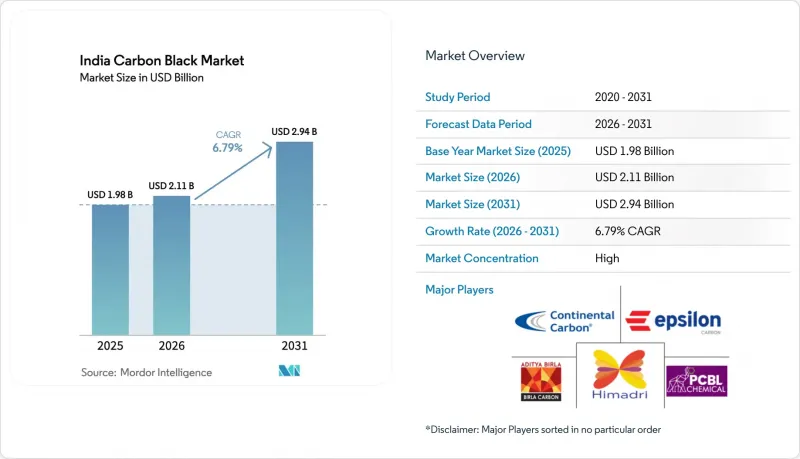
This report is Segmented by Process Type (Furnace Black, Gas Black, Lamp Black, and Thermal Black), and Application (Tire and Industrial Rubber Product, Plastic, Toner and Printing Ink, Coating, Textile Fiber, and Others). The Market Forecasts are Provided in Terms of Value (USD).
India Carbon Black Market Trends and Insights
Surging Radial-Tire Production for Passenger and Commercial Vehicles
Vehicle makers continue to convert truck and bus platforms from bias-ply to radial construction, which requires more reinforcing filler per unit. Replacement cycles remain steady because freight utilization is rising, and highways under Bharatmala have shortened delivery times. Tire plants in Tamil Nadu and Gujarat run high-utilization shifts, sustaining offtake commitments with domestic carbon black suppliers. Higher belt-reinforcement needs raise average carbon black loading by up to 20% over legacy designs. As a result, carbon black demand grows faster than tire unit output, providing volume visibility irrespective of new-vehicle sales variation.
Growing Penetration of Specialty and Conductive Carbon Blacks
Premium conductive and UV-stable grades command two-to-three-times the price of commodity furnace blacks. Birla Carbon's Continua material and PCBL's surface-modified lines illustrate the technical shift toward low-ash, narrow-distribution products for battery electrodes and high-gloss polymers. Indian producers investing in research and development and application labs secure long-term supply contracts because downstream users require formulation support. These grades raise margins and buffer earnings against feedstock swings. The trend encourages capacity earmarked specifically for batteries, cables, and high-performance plastics, diversifying revenue beyond tires.
Volatile Petroleum-Coke and Coal-Tar Pitch Prices
Feedstock accounts for roughly two-thirds of cash cost, so refinery shutdowns and freight spikes compress margins quickly. Oriental Carbon & Chemicals operated near 70% utilization in FY 2024 because price pass-through lagged cost inflation. Hedging is limited, pushing producers to seek long-term supply agreements with refiners such as ONGC. Integrated waste-heat recovery partly cushions energy swings, yet smaller plants lacking scale remain vulnerable.
Other drivers and restraints analyzed in the detailed report include:
- Rapid Ramp-up of Lithium-ion Battery Cell Manufacturing
- Domestic Infrastructure Boom Boosting Pipe and Cable Applications
- Stringent Regulatory Norms for Carbon-Black Furnaces
For complete list of drivers and restraints, kindly check the Table Of Contents.
Segment Analysis
Furnace black held 80.78% of the India carbon black market share in 2025 because it offers the lowest unit cost for large-run production. While niche, gas black posts the fastest 8.12% CAGR because of superior conductivity sought in battery electrodes and antistatic polymers. The India carbon black market size contribution from furnace lines is set to expand in absolute terms as PCBL and Epsilon Carbon commission additional reactors in Gujarat and Karnataka. Environmental investments make new furnace capacity capital-intensive, yet scale economies maintain competitiveness over lamp or thermal processes.
Gas black's growth is rooted in specialty demand rather than volume leadership. Producers target modest capacities co-located with downstream compounders to offset higher conversion costs. Thermal black remains a micro-segment for ultra-pure applications, while lamp black serves legacy ink markets. As OEMs tighten conductivity and purity specs, suppliers upgrading process control capture premium pricing, lifting average realization per ton across the India carbon black market.
Complete Report Scope:
- By Process Type
- Furnace Black
- Gas Black
- Lamp Black
- Thermal Black
- By Application
- Tire and Industrial Rubber Product
- Plastic
- Toner and Printing Ink
- Coating
- Textile Fiber
- Others
List of Companies Covered in this Report:
- Birla Carbon (Aditya Birla Group)
- BKT Carbon
- Cabot Corporation (Cabot India Ltd)
- Continental Carbon India Ltd (Continental Carbon Asia)
- Epsilon Carbon Pvt Ltd
- Himadri Speciality Chemical Ltd
- Jiangxi Black Cat Carbon Black Co. Ltd
- OCI Company Ltd
- Orion Engineered Carbons S.A.
- PCBL Limited
- Tokai Carbon Co. Ltd
Additional Benefits:
- The market estimate (ME) sheet in Excel format
- 3 months of analyst support
TABLE OF CONTENTS
1 Introduction
- 1.1 Study Assumptions and Market Definition
- 1.2 Scope of the Study
2 Research Methodology
3 Executive Summary
4 Market Landscape
- 4.1 Market Overview
- 4.2 Market Drivers
- 4.2.1 Surging radial-tire production for the passenger and commercial vehicle segments
- 4.2.2 Growing penetration of specialty and conductive carbon blacks
- 4.2.3 Rapid ramp-up of lithium-ion battery cell manufacturing in India
- 4.2.4 Domestic infrastructure boom boosting pipe and cable applications
- 4.2.5 OEM pushes for darker, UV-stable plastics for high-end applications
- 4.3 Market Restraints
- 4.3.1 Volatile petroleum-coke and coal-tar pitch prices
- 4.3.2 Stringent regulatory norms for carbon-black furnaces
- 4.3.3 Rising traction of silica-based green tyres among premium OEMs
- 4.4 Value Chain Analysis
- 4.5 Porter's Five Forces
- 4.5.1 Bargaining Power of Suppliers
- 4.5.2 Bargaining Power of Buyers
- 4.5.3 Threat of New Entrants
- 4.5.4 Threat of Substitutes
- 4.5.5 Degree of Competition
5 Market Size and Growth Forecasts (Value)
- 5.1 By Process Type
- 5.1.1 Furnace Black
- 5.1.2 Gas Black
- 5.1.3 Lamp Black
- 5.1.4 Thermal Black
- 5.2 By Application
- 5.2.1 Tire and Industrial Rubber Product
- 5.2.2 Plastic
- 5.2.3 Toner and Printing Ink
- 5.2.4 Coating
- 5.2.5 Textile Fiber
- 5.2.6 Others
6 Competitive Landscape
- 6.1 Market Concentration
- 6.2 Strategic Moves
- 6.3 Market Share(%)/Ranking Analysis
- 6.4 Company Profiles (includes Global level Overview, Market level overview, Core Segments, Financials as available, Strategic Information, Market Rank/Share for key companies, Products and Services, and Recent Developments)
- 6.4.1 Birla Carbon (Aditya Birla Group)
- 6.4.2 BKT Carbon
- 6.4.3 Cabot Corporation (Cabot India Ltd)
- 6.4.4 Continental Carbon India Ltd (Continental Carbon Asia)
- 6.4.5 Epsilon Carbon Pvt Ltd
- 6.4.6 Himadri Speciality Chemical Ltd
- 6.4.7 Jiangxi Black Cat Carbon Black Co. Ltd
- 6.4.8 OCI Company Ltd
- 6.4.9 Orion Engineered Carbons S.A.
- 6.4.10 PCBL Limited
- 6.4.11 Tokai Carbon Co. Ltd
7 Market Opportunities and Future Outlook
- 7.1 White-space and unmet-need assessment

